Let's be honest here - with the state and speed of shipbuilding, by the time the man himself leaves office, this ship will still be nothing more than a render - for better or for worse. I think I'm less worried about the carriers. I'm more worried about DDG(X). The USNI article on this seems to indicate DDG(X) getting the axe in place of this:


The implications of that can (and should) be in it's own thread so I won't go into that

I still don't think F/A-XX is going anywhere. Yes - I could be wrong - but I think there really isn't another option that sensibly replaces the capability F/A-XX brings for naval aviation. It makes little sense why this administration would beat around the bush for F/A-XX when they have not at all been shy or hesitant about killing or starting new programs. For an administration who really isn't known for being subtle, if they really wanted to axe F/A-XX, they would have come out and done that - and then patted themselves on the back for "cutting dead weight"

I've said this before, but I still get the sense that the navy hasn't sold congress or the powers that be on the use case and cause for any of their programs, especially compared to the air force. Before anyone thinks I mean different - I'm not trying to say F/A-XX's intentions weren't clear in the normal sense - F/A-XX was from the start a strike fighter replacement for the hornet. What I AM trying to say is packaging this as a strike fighter replacement for the hornet really isn't enough of a sell for politicians.

The USAF has not only been clear, but also very demanding in both the equipment they need for the future as well as how they will be operated. From the NGAD concept to CCAs and distributed operations - they've been vocal, clear and focused on that all the way back in the mid 2010's (and possibly earlier). They didn't just run about with the PCA part and dabble in CCAs. They framed their use case, their operational concept and defined in sensible terms which pieces of equipment would enable that operational concept. Even with Kendall's review, the focus and the core operating concept still has not changed, even as the USAF has rolled back a large number of organizational changes. At the very least, the past 10 years of this messaging has yielded real fruits - LSRB was awarded and built, two incr1 CCAs prototypes are in testing, the F-47 contract awarded, and recently another 9 vendors for incr2 chosen for prototyping. In contrast, the navy seems hesitant and 10 years late to commit to a number of things the USAF have gone balls deep into - NGAP engines, CCAs, distributed sensing etc. It's plan for shipbuilding and ship procurement is and has always been a mess. MASC/MUSV/LUSV seems to have major program changes every year or two. Now S-M-L USV programs all got collapsed down to the MUSV/MASC program. DDG(X) remains a power point render (and now completely gone apparenlty). The only thing off the top of my head that the navy seems to have done successfully in the past 10 years was work on CPS and that was done in tandem with the Army. Otherwise, the navy seems to have trouble deciding what to do, what can be done, and how to go about it.

I've been digging through the past threads on NGAD and F/A-XX and it's extremely fascinating to see how much the focus has been on NGAD and not on F/A-XX. NGAD's unmanned and PCA elements have been screamed about for at least 10 years now. During these last 15 years, the MSM, the government and all the way down to us forum nerds have talked and talked NGAD and NGAD's PCA / unmanned elements to death and back. We've gone through relevant technologies, we've dug out patents and most importantly, from these technologies, we've been able to piece together the ways in which NGAD, CCAs, distributed sensing and EW and F-47 PCA will work together, but F/A-XX has almost always been the after thought. We're on page 45 of this discussion and at least half of this thread has just been us reiterating and chewing on past info. Even as we say the words "strike fighter", what does that entail in terms of capabilities, weapons carried, required technologies and operational use? Is it a pure strike fighter like the A-12? Is it strike + a good enough air to air complement like the F-18's were in their heyday? Will it be carrying out the EW role too? When officials say it complements the F-35's role, what does that really entail? Which roles is it performing that an F-35 can't? How does that fit into the navy's plan to fight a high end war? What does the navy's plan for fighting the high end war even look like? Does the navy even have a coherent plan?

We have good guesses. We have authoritative forum members who have given us valuable information, but what we don't have is the kind of clear, consistent and bold messaging. Indeed, much of what the navy desparately needs can't really be packaged neatly into a shiny new operational concept like USAF's agile combat employment could (even though I'm 100% certain I've seen the navy put out their own version of this, just named differently). But even so - a more active and coherent job could be done here I think. You can say what you say about Allvin and Kendall, but they did a terrific job selling what they wanted.

I can feel two glowing laser eyes staring holes into my back so I'll say it before he says it - yes, I could play the FOI game with the government quellish, but ultimately, the slightly more informed people like us forum nerds aren't the ones making decisions. The good-for-nothing politicians, and by extension the general chock-full'o-idiots public, who may or may not know what the F-18 hornet actually does, or ever thought about how an operational concept might fair in an opening clash with the enemy - those are the ones making the decisions. If the nerds here aren't willing to do FOI, those guys certainly aren't going to take the time to think through these ideas. The navy doesn't owe us clear answers about anything, but then people are free to think whatever they want about your demands. Then when the next administration enters office and appoints people that were not in the know before, it isn't surprising that they've formed their own, no so friendly opinion of you. So if the navy fails to make it clear to them why F/A-XX is important and frame it's importance as dire enough (and that might be hard to do given the nature of the program), then delay after delay is the logical conclusion when times are tough. And in decisions concerning the department of the navy, times have never been tougher.
To say it's a strike fighter or Super Hornet replacement is not enough. Why not just continue buying F-35C or a NASCAR F-35? What are the requirements and operational concept for a near peer war in the Pacific, especially Taiwan scenario? For the AF, air superiority is an easy sell. The vulnerability of land bases are a concern. But the reality is that if you cannot operate from air bases in the First Island Chain you cannot defeat a Chinese invasion of Taiwan.

This is compounded by the incompetence of Navy leadership. Has the AF every purchased a useless full buy of combat aircraft like the Navy did with LCS?

Regarding the F/A-XX award Vago Muradian thinks it will be NG. A few weeks ago Steven Trimble thought it was Boeing but this seemed more to be a hunch while Muradian seems to have had inside information. Trimble also said he thought it would be awarded this year. If it is not then the competition would have to be restarted.
 
Extremely potent? As in ... TWO JDAMs max?
Yes the F-22 has an extremely potent air-to-ground capability. The lowest radar cross section and the highest supercruise speed of any aircraft in the world.

You have yet to provide a single *unequivocal* example of a conversion from a pure land based air superiority fighter converted to a naval multi role strike fighter or a naval dtrike fighter converted into a dedicated air superiority fighter. Not a single one.
The original quote never mentioned fighter or multi role. It said there had never been a land based aircraft converted to a naval aircraft. I proved this is not the case.

The Mig-29 and Su-27 werw designed purely as an air superiority fighters. They both entered service without a single air to ground weapon. Look at the first paragraph of the Wikipedia pages


The Naval Mig-29K and Su-33 Naval variants are both listed as multi-role and carry a range of anti-ship and air-to-surface missiles weapons just like the Hornet. Both are perfect examples of a pure land based aircraft superiority fighters being converted to naval multi role strike fighters.
Fuel does not equal speed unless you are on a rocket. Speed comes from a function of drag, thrust and tangentially weight, with fuel calculated to reach the desired thrust for the desired endurance.
Ask any fighter pilot and they will disagree with you. Every mission is about managing fuel. Flying supersonic consumes considerably more fuel per mile than at subsonic speeds. If an aircraft with 1,000mile range is flying a 500 mile mission then it can do the mission with enough spare fuel to go fast.

The f22 carries 2 2klb munitions MAX at the cost of two AMRAAMs. F-47 carrying two SiAW (1k lb each) is about the most one can ask for. Two 1klb A2G munitions MAX is a pretty bad load out even for a multirole strike fighter. Conversely, in what world would you need the space required to pack 2 LRASM or 4 SiAW into an air superiority platform again when you likely cant even recover half of that same volume for fuel?
The F-22 was designed to carry four unclipped AMRAAM missiles. That's enough depth for both SiAW and LRASM.

Make the F-22 weapon bay 5% longer and remove the middle divider making it one large bay. It can now fit 4 SiAW or 3 LRASM. That is enough to satisfy the F/A-XX requirement.

Lengthen the F-22 sidewinder bays by 20% and they can now fit an AMRAAM on each side for the F/A-XX self defense while the main bay is filled with strike weapons.

For the USAF NGAD mission the same large central bay can get a fuel tank that permanently mounts on the top half of the weapon bay. This makes maximum use of the extra depth. The fuel tank then has 6-8 conformal AMRAAM sized missiles. The missiles obviously stay inside the weapon bay when the doors are shut. When the USAF wants a strike version of the F-47 they can purchase aircraft without the extra fuel tank and gain the same weapon volume as the Navy variant.

Also regarding the rafale, repeat after me:

Because they have same missions profiles...

Because they have same missions profiles...

Because they have same missions profiles...
All reports show the NGAD and F/A-XX having similar mission profiles. ~1,000 mile combat radius, supersonic capability, high agility.

If you want to claim the mission profiles are vastly different then provide evidence. If you think the USAF F-47 will have a 1,500 mile combat radius and the F/A-XX will only have 750 miles then don't be shy.

The USAF is on record saying 1,000nm

The US Navy has said 25% more than existing which means anywhere from 800-1000 miles. This means the designs are closer in range. Similar mission profiles. The USAF range seams to be slightly greater. That weapon bay fuel tank described above and a 5% lighter empty weight due to lighter landing gear would provide that extra range.

Even NATF and ATF designs were far enough apart that they weren't simply just derivatives - and those were going for the same mission profiles, just land and sea variants, let alone two different mission profiles.
There has been 40 years of aerodynamic improvements since then. The lower landing speed for carrier landings can now be achieved without massive compromises or changes. The Rafale has proven that a supercruise capable aircraft can land on a carrier thanks to canards. The F-47 having canards in the rendering is another obvious clue. Delta canard is the best layout if you want a supercruise capable aircraft to land on a carrier. I also expect bleed air blowing to be used on the carrier variant. It it then not surprising the USAF variant then needs to have canards to maintain commonality.
 
The Mig-29 and Su-27 werw designed purely as an air superiority fighters. They both entered service without a single air to ground weapon. Look at the first paragraph of the Wikipedia pages
Unguided missiles were originally part of the armament
 

Attachments

  • maxresdefault.jpg
    maxresdefault.jpg
    164.7 KB · Views: 94
Yes the F-22 has an extremely potent air-to-ground capability. The lowest radar cross section and the highest supercruise speed of any aircraft in the world.
yeah because.... RCS is what makes or breaks an attack fighter.
The original quote never mentioned fighter or multi role. It said there had never been a land based aircraft converted to a naval aircraft. I proved this is not the case.
Both were designed for similar missions...

Dont know why this is so hard to understand.
The Mig-29 and Su-27 werw designed purely as an air superiority fighters. They both entered service without a single air to ground weapon. Look at the first paragraph of the Wikipedia pages
The Naval Mig-29K and Su-33 Naval variants are both listed as multi-role and carry a range of anti-ship and air-to-surface missiles weapons just like the Hornet. Both are perfect examples of a pure land based aircraft superiority fighters being converted to naval multi role strike fighters.
In the very article of the Su-33,what does it say?

Carrier-based air superiority fighter with multirole capabilities. Not multirole fighter.

Ok sure. Mig 29K I was wrong about but not really either. Mig 29K was a derivative not directly of the Mig29 air superiority fighter, but of the Mig29M. Mig 29Ks modifications were extensive enough to be non trivial, much less share the same air frame with just expanded hardpoints.

That still doesnt invalidate all the problems I listed, especially since the example you gave doesnt have to worry about at least half of those problems like internal bay arrangements, clearances, stealthy heat and rcs signature management and what not. Also - you are looking to convert a naval fighter (and a multierole strike naval fighter no less) to a land based air superiority fighter. So strictly speaking, it still doesnt work for your example

Your weapon dimensions are wrong. You arent fitting LRASM into an F22. You treat these things as if you are playing with Legos. You add and expand things and theres also bloat and tolerances that change too.
All reports show the NGAD and F/A-XX having similar mission profiles. ~1,000 mile combat radius, supersonic capability, high agility.
Clown.
If you want to claim the mission profiles are vastly different then provide evidence. If you think the USAF F-47 will have a 1,500 mile combat radius and the F/A-XX will only have 750 miles then don't be shy.
No. Plenty of people have provided evidence for this. You on the other hand never provide any unequivocal evidence. You almost always cherry pick what fits your narrative and refusw to reconcile opposing evidence. You still have not shown how you can trivially rip out stuff from a navalized multirole strike aircraft (if its even multi role at all) and turn it into an air superiority fighter without paying the necessary penalties. You also havent shown why the USAF would be willing to pay said penalties either. The default argument was that they are different as thats what officials, program requirements have said and implied. If you want to argue otherwise the burden is on you. Not me.

Also you keep rattling on about fuel, but fuel really isnt the only indicator of mission profile. An attack fighter does not share the same mission profile as an air superiority fighter. While air superiority fighters can do air to ground work, thats not something they are going to be good at. Conversely, good luck trying to rip things out of a multi role airframe to make it an air superiority fighter.
There has been 40 years of aerodynamic improvements since then.
And physics are still physics. Every land based fighter modified for naval use still had to retain the same modifications.
The lower landing speed for carrier landings can now be achieved without massive compromises or changes.
J-35, the katest navalized fighter, begs to differ.
The Rafale has proven that a supercruise capable aircraft can land on a carrier thanks to canards.
The F-47 having canards in the rendering is another obvious clue. Delta canard is the best layout if you want a supercruise capable aircraft to land on a carrier.
Pnce again cherry picking to fit your narrative. By your logic is should expect to see J20s flying off a carrier too because canards equals supersonic carrier fighter.

But no. Theres plenty of reasons to have canards besides carrier takeoff - some of which youve listed already. Canards does not necessarily imply carrier fighter.

We dont even know how the depicted canards on the F-47 even works. We arent even sure if they are canards or strakes.
It it then not surprising the USAF variant then needs to have canards to maintain commonality.
What an absolutely stupid reason to keep a canard on an air superiority fighter.

You are the living embodiment of this meme
1766599424084.jpeg
Meanwhile you just draw conclusions where you want to, ignore all evidence against this, refuse to reconcile any of that evidence, then turn correlation into causation to try and justify your bs.

For posterity, I want to reiterate - its not that this isnt possible engineering wise. It is possible. But what tradeoffs do you have to make and why? If it indeed turns out this way, then there must be very good reasons to make said tradeoffs, otherwise this is just bafoonery
 
Last edited:
It seems increasingly likely that the program is canceled by the U.S. administration to fund its other priorities.
 
It seems increasingly likely that the program is canceled by the U.S. administration to fund its other priorities.
Has there been some other news?

Just two weeks ago they said they were still committed to an eventual program award. I still dont know why they would stall for this long if they were cancelling it.
 
Has there been some other news?

Just two weeks ago they said they were still committed to an eventual program award. I still dont know why they would stall for this long if they were cancelling it.

Personal guess. If they are going to fund their golden shower programs, they need to funnel money out of existing programs they do not like. Definding Ford is probably outside any reasonable fudging of budgets, but canccelling a program that has barely started that would equip Fords is likely within his power. It’s not like Congress or the DoJ would stop him, at least not until 2027.
 
@Josh_TN maybe im wrong but this program to me is seems like its more important than the E7 program, as even if they say industrial capacity is a concern, they cant cancel something without a replacement. FFG(X) has a (shitty) replacement. DDG(X) seems related to the BBGs revealed recently. E7 is said to be replaced by space based AMTI satellites but what does F/A-XX have? CPS? tomahawks? Drones? More F-35s?

Im not sure if it would be worth discussing but what else would they replace F/A-XX with?

With the BBG concept, maybe missiles? But they have no loitering capacity.

The navy seems intent on finally integrating CCAs, but industry still seems hell bent on modestly LO subsonic UCAVs.

I still see a some kind of fighter replacement happening. It may or may not be called F/A-XX though. And who knows - maybe insidersource's fever dream comes true and they adapt an F-47 for naval use.
 
Last edited:
Yes the F-22 has an extremely potent air-to-ground capability. The lowest radar cross section and the highest supercruise speed of any aircraft in the world.
2x 1000lb weapons.

It's a bit better if you're packing it with SDBs, but still not ideal. (edit) 4 8x SDBs plus 2x AMRAAMs and 2x Sidewinders.
Edit: oops, 2x SDBs per AMRAAM slot.


The F-22 was designed to carry four unclipped AMRAAM missiles. That's enough depth for both SiAW and LRASM.
LOL, no.

AIM-120A wingspan is 21", which means only 15" depth. SiAW and LRASM have an 18-20" depth. Nevermind the length.


Make the F-22 weapon bay 5% longer and remove the middle divider making it one large bay. It can now fit 4 SiAW or 3 LRASM. That is enough to satisfy the F/A-XX requirement.

Lengthen the F-22 sidewinder bays by 20% and they can now fit an AMRAAM on each side for the F/A-XX self defense while the main bay is filled with strike weapons.
The F-22 bay is not long enough to hold AGM-158s. SDBs are only 6ft long, AMRAAMs are 12ft long. AGM-158s or SiAW are over 14ft.


All reports show the NGAD and F/A-XX having similar mission profiles. ~1,000 mile combat radius, supersonic capability, high agility.

If you want to claim the mission profiles are vastly different then provide evidence. If you think the USAF F-47 will have a 1,500 mile combat radius and the F/A-XX will only have 750 miles then don't be shy.

The USAF is on record saying 1,000nm

The US Navy has said 25% more than existing which means anywhere from 800-1000 miles. This means the designs are closer in range. Similar mission profiles. The USAF range seams to be slightly greater. That weapon bay fuel tank described above and a 5% lighter empty weight due to lighter landing gear would provide that extra range.
JFC, NO. +25% over a Super Hornet is only about 650nmi. +25% over an F-35C barely gets you to 800nmi. And @quellish keeps saying that it's the Super Bug that was the range reference, but I haven't been able to find his source in this monster thread.
 
Last edited:
@Josh_TN maybe im wrong but this program to me is seems like its more important than the E7 program, as even if they say industrial capacity is a concern, they cant cancel something without a replacement. FFG(X) has a (shitty) replacement. DDG(X) seems related to the BBGs revealed recently. E7 is said to be replaced by space based AMTI satellites but what does F/A-XX have? CPS? tomahawks? Drones? More F-35s?
I'd favour more F-35s and extracting as much from the SH fleet as possible which might mean another SLEP.

The navy seems intent on finally integrating CCAs, but industry still seems hell bent on modestly LO subsonic UCAVs.
The US CCA Increment 1 made that call via requirements. While we wait to see what Increment 2 will require it feels to me like the same or lower cost and capability point. It is interesting that we have NG, LM, Boeing, ShieldAI etc offering platforms that are likely higher capability (payload/range) than the CCA Increment 1 so for me Industry actually wants to go more capable but at the moment the CCA program is focused lower.
I still see a some kind of fighter replacement happening. It may or may not be called F/A-XX though. And who knows - maybe insidersource's fever dream comes true and they adapt an F-47 for naval use.
Likely it gets pushed back three+ years. That probably reduces some risk by semi following F-47 and using some of the technologies that may have matured for that program. I don't see that timescale solving the USN budget crunch though, a new trainer is due at a similar time, major uplift in shipbuilding as well as a greater availability requirement from the current force. There are no easy answers here.

If you were NG you'd be pretty upset, a delay probably favours Boeing given F-47 EMD.
 
Likely it gets pushed back three+ years. That probably reduces some risk by semi following F-47 and using some of the technologies that may have matured for that program. I don't see that timescale solving the USN budget crunch though, a new trainer is due at a similar time, major uplift in shipbuilding as well as a greater availability requirement from the current force. There are no easy answers here.

If you were NG you'd be pretty upset, a delay probably favours Boeing given F-47 EMD.

Wasn’t the original idea behind NGAD and F/A-XX to emphasize modular, open architecture specifically to enable faster development cycles and more competition? I wonder how that vision is going to play out in reality.
 
I'd favour more F-35s and extracting as much from the SH fleet as possible which might mean another SLEP.
I think it could be barely marginally workable only if the navy decides to rely on long range ship based fires, aerial assets for ISR, and the USMC for stand in fires, but that replacement's gotta come eventually.
Likely it gets pushed back three+ years. That probably reduces some risk by semi following F-47 and using some of the technologies that may have matured for that program. I don't see that timescale solving the USN budget crunch though, a new trainer is due at a similar time, major uplift in shipbuilding as well as a greater availability requirement from the current force. There are no easy answers here.
Agreed. this program should still be happening, just at a delayed timestep. Regardless of which prime gets the contract, I think both are reasonably invested in existing big programs to warrant a time delay. The technologies being implemented should be shared by both 6th gen fighters. I'm not sure if there's anything internally

Of all the things to cut for the budget, F/A-XX feels like the last thing that should be cut especially given the recent developments with DDG(X) and FFG(X). You have to have some kind of meaningful distributed strike and ISR to enable a stand off surface fleet or else the Navy will effectively sit back and watch the game from Pearl Harbor.
 
Last edited:
Is there a just straight up news thread for the FA-XX that we can look at for updates rather than wondering if we missed them in the last twenty pages of discussion about it and other things?
 
Wasn’t the original idea behind NGAD and F/A-XX to emphasize modular, open architecture specifically to enable faster development cycles and more competition? I wonder how that vision is going to play out in reality.

Yes that is still happening , and at least with USAF it is service-wide. Nearly every program is now doing this
 
Is there a just straight up news thread for the FA-XX that we can look at for updates rather than wondering if we missed them in the last twenty pages of discussion about it and other things?

This actually makes an interesting point.

Most of the “news” especially about this program is very poor quality. Much of it is speculation or misinterpretation. Maybe instead of “news” threads a “primary sources” thread would be more useful.

Case in point, the range numbers reports by some press outlets and repeated here VS the numbers from the Navy which are very different.

For some reason people just seem to like to make things up and speculate about this and other programs.
 
AIM-120A wingspan is 21", which means only 15" depth. SiAW and LRASM have an 18-20" depth. Nevermind the lelength.
The AGM-88G wingspan is only an inch greater than the AIM-120A. LRASM is only 3inchs greater in depth. Naval Strike Missile is the same depth and length as AMRAAM. JSOW also fits in terms of depth.

The F-22 bay is not long enough to hold AGM-158s. SDBs are only 6ft long, AMRAAMs are 12ft long. AGM-158s or SiAW are over 14ft.
The F-22 weapon bays runs the AMRAAMs staggered in the length direction. The 12ft weapon length then requires a 13+ft bay.

I said a 5% length increase over the F-22 which brings the length up to 14ft to fit the SiAW. The JSOW can now fit length wise.

The F-22 main bay increased by only 10% can comfortably fit 4 large 2000lb class weapons. This small increase wouldn't suddenly compromise an NGAD design from an aerodynamic perspective. I do not see a problem with a shared weapon bay.

JFC, NO. +25% over a Super Hornet is only about 650nmi. +25% over an F-35C barely gets you to 800nmi.

The F-35 and Super Hornet fly 13.6% and 18.5% further when in air-to-air configuration. The NGAD combat radius figure would definitely be in air-to-air configuration. We must compare apple to apple.

The F/A-XX having a 25% increase over the air-to-air profile of the Super Hornet and F-35C then means 800-900nm radius. The NGAD profile at 1000+nm can be achieved with a fuel tank in the weapon bay and a 5% lower empty weight. A shared design covers both profiles.
 
Some observations concerning what's been written in the last comments, including some wild guesses...

A weapons bay is not an empty box that can magically receive anything that geometry would theoretically permit. You have to keep in mind a ton of parameters. Hardpoints type, placement, weight capacity, cinematic deployment, airflow and acoustic when the bay is open, weapons interactions plus a reasonable amount of safety margins. Plus the various pipes, boxes, actuators and accesses that have to remain, well, accessible, even with the weapons in, room to manipulate the safety pins until the last moment...

The F-22 bay was effectively designed around the clipped fins AMRAAM (Charlie and later variants), not the Alpha and Bravo. I know early documentation stated four legacy AMRAAM or six compact ones, but I still have to find any evidence that any Alpha or Bravo was ever carried or tested... Or even that the hardpoints configuration can be altered from the usual staggered six to four abreast (or used as it, except the central ones).

Staggering is only possible when said fins don't overlap and clearance is sufficient to prevent physical contact but also any aerodynamic or acoustic interference.
Because it could fit doesn't mean it would work.

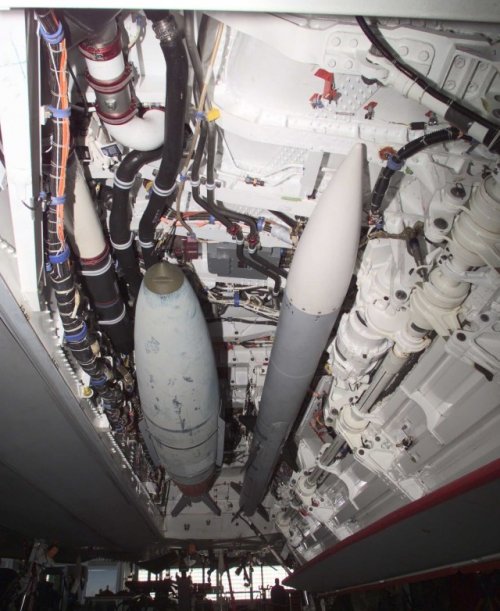
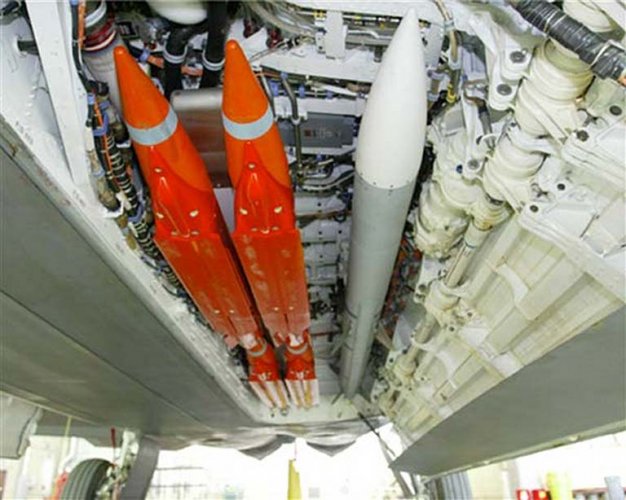
F-22 bays can only receive 1000lbs class JDAM, not 2000lbs. And it still a tight fit.

Check the accompanying picture. Not much room and a cluster of things other than just the fireworks...
 

Attachments

  • F-22A-JDAM-Bay-2S.jpg
    F-22A-JDAM-Bay-2S.jpg
    129.3 KB · Views: 68
  • GBU-39-B-4x-F-22A-1S.jpg
    GBU-39-B-4x-F-22A-1S.jpg
    70.6 KB · Views: 70
Last edited:
The AGM-88G wingspan is only an inch greater than the AIM-120A. LRASM is only 3inchs greater in depth.
Which is too deep to fit into the F-22 weapons bays. The F-22 weapons bay is not deep enough to hold a Mk84 (18").


Naval Strike Missile is the same depth and length as AMRAAM.
JSM is 20" deep.
 
The F-22 bay was effectively designed around the clipped fins AMRAAM (Charlie and later variants), not the Alpha and Bravo. I know early documentation stated four legacy AMRAAM or six compact ones, but I still have to find any evidence that any Alpha or Bravo was ever carried or tested... Or even that the hardpoints configuration can be altered from the usual staggered six to four abreast (or used as it, except the central ones).

4x AIM-120A carriage mentioned may be a leftover from the YF-22, which had weapon bays for 4 AIM-120A afaik. (Not sure if both center bays were available in the YF-22.)
 
Some observations concerning what's been written in the last comments, including some wild guesses...

A weapons bay is not an empty box that can magically receive anything that geometry would theoretically permit. You have to keep in mind a ton of parameters. Hardpoints type, placement, weight capacity, cinematic deployment, airflow and acoustic when the bay is open, weapons interactions plus a reasonable amount of safety margins.
We know all of this but that is not what initiated the discussion.

1) Reddington777 said that the F/A-XX weapon bay to fit four 2,000lb class weapons would then compromise the NGAD design in many ways.

2) I pointed out that the F-22 weapon bay only needs to be 5% larger with no middle divider and it could fit four 2,000lb weapons.

3) The F-22 is not a compromised air-to-air design so with a weapon bay only 5% larger does not suddenly make NGAD compromised. This disproves Reddington777s original point.

4) A weapon bay fuel tank that sits at the top of the bay can then have optimised hardpoints for air to air missiles that covers the details you mention. This tank fully optimises the internal volume so there is no compromise.
 
Here is my Christmas F/A-XX Spicy Take...

F/A-XX is delayed by approximately three years. This allows LM to rebid and overcome their previous issues with not satisfying the USN's criteria per Breaking Defense. The end result is LM wins with their 'Ferrari F-35'. The attraction of 80% capability at 50% the cost will be something the USN cannot ignore (and Administration forces down their throat...)
 
We know all of this but that is not what initiated the discussion.

1) Reddington777 said that the F/A-XX weapon bay to fit four 2,000lb class weapons would then compromise the NGAD design in many ways.

2) I pointed out that the F-22 weapon bay only needs to be 5% larger with no middle divider and it could fit four 2,000lb weapons.

3) The F-22 is not a compromised air-to-air design so with a weapon bay only 5% larger does not suddenly make NGAD compromised. This disproves Reddington777s original point.

4) A weapon bay fuel tank that sits at the top of the bay can then have optimised hardpoints for air to air missiles that covers the details you mention. This tank fully optimises the internal volume so there is no compromise.
Yes because everything is just a wave of the wand away. What a joke.

Keep going. The more you talk the more people who think you credible would see just how much baseless assumptions your theories are built off of.
 
Here is my Christmas F/A-XX Spicy Take...

F/A-XX is delayed by approximately three years. This allows LM to rebid and overcome their previous issues with not satisfying the USN's criteria per Breaking Defense. The end result is LM wins with their 'Ferrari F-35'. The attraction of 80% capability at 50% the cost will be something the USN cannot ignore (and Administration forces down their throat...)
No way in hell a new variant of the F-35 is getting produced. You read it here first.
 
No way in hell a new variant of the F-35 is getting produced. You read it here first.
The attraction of 80% capability at 50% the cost
Im open to it if they can slap two engines on it and it can do the strike job well enough. But we all know thats a pipe dream.

NG is the only prime I trust enough to not screw up a stealth fighter project.
 
No way in hell a new variant of the F-35 is getting produced. You read it here first.
It is a Spicy Take... ;)

I do base it somewhat off this though,
Of particular note for the Air Force, he also indicated Lockheed and its advanced projects Skunk Works division plans to invest in “this notion of sixth-generation technology insertion into the F-35 and F-22.“

“How do we take the Skunk Works activities that were designed to go into NGAD and other potential opportunities, some of which are classified, but we developed these sixth-generation capabilities, whether it’s stealth, propulsion, inlet designs, coatings, those kinds of things in … Skunk Works, which we can actually backward integrate into F-35 and F-22, and are doing so,” Taiclet said.

A Lockheed spokesperson declined to say specifically whether Taiclet meant to say that the company is working on its own tricked-out F-35. Instead, they said he was referencing technologies “broadly.”
 
Im open to it if they can slap two engines on it and it can do the strike job well enough. But we all know thats a pipe dream.

NG is the only prime I trust enough to not screw up a stealth fighter project.
Our YF/F-23 was a little too advanced for the time period during ATF DemVal and would fit very nicely right now.
 
It is a Spicy Take... ;)

I do base it somewhat off this though,

If you swapped out the F135 for two upgraded F414s (though how you could do that, with cooling requirements being what they would be is anybody's guess), stretched it, and did everything else they'd want to, would it even be an F-35 anymore? We're talking about more changes than between the F-8 Crusader and XF8U-3 or Hornet -> Super Hornet. And you'd still be playing catch up at that point because you aren't getting an F414 to 30k.
 
If you swapped out the F135 for two upgraded F414s (though how you could do that, with cooling requirements being what they would be is anybody's guess), stretched it, and did everything else they'd want to, would it even be an F-35 anymore? We're talking about more changes than between the F-8 Crusader and XF8U-3 or Hornet -> Super Hornet. And you'd still be playing catch up at that point because you aren't getting an F414 to 30k.
Slow down on the two engines, that is crazy talk... I suspect LM's view of a souped up F-35 includes an XA series engine. Remember F/A-XX is meant to be a strike fighter, which is exactly what the F-35 is, and be a quarterback for unmanned assets. I suspect while it may not meet the Objective requirements the USN wants it will probably meet the Threshold and be what the USN can afford...

Again just a spicy take, I won't revisit this in three years time and scream I told you so... ;)
 
If you swapped out the F135 for two upgraded F414s (though how you could do that, with cooling requirements being what they would be is anybody's guess), stretched it, and did everything else they'd want to, would it even be an F-35 anymore? We're talking about more changes than between the F-8 Crusader and XF8U-3 or Hornet -> Super Hornet. And you'd still be playing catch up at that point because you aren't getting an F414 to 30k.
You could get an F414 up past 25,000. And that means 50k+lbs thrust.
 
Slow down on the two engines, that is crazy talk... I suspect LM's view of a souped up F-35 includes an XA series engine. Remember F/A-XX is meant to be a strike fighter, which is exactly what the F-35 is, and be a quarterback for unmanned assets. I suspect while it may not meet the Objective requirements the USN wants it will probably meet the Threshold and be what the USN can afford...

Again just a spicy take, I won't revisit this in three years time and scream I told you so... ;)
You could. :D
 
If im already hamstrung by commonality with past / parent platform, Id rather it be an navalized F-47 then. At least that'll come in a flexible, two engined platform with more internal volume.

If it ever comes down to that, Lockheed will have to offer something to outcompete a Boeing offer, which seems unlikely given where they are starting from.
 
how much would such a massive thrust upgrade shorten the F414's service life by?
Fuel burn must also be considered. The very low bypass ratio of the F414 will always make it a terrible choice for a strike fighter.

While a pair of F110 might result in an aircraft weighing 4,000lb more it will probably burn 4,000lb less fuel if the mission profile has a long subsonic transit.

If we look at the J-20 wiki page it lists two engines.
Shenyang WS-10C with 32,000–33,000 lb thrust
Shenyang WS-15 with 36,390–40,470 lb thrust

Basically this would be similar to the Boeing proposals. The Navy gets offered off the shelf 32,000lb F110-GE-132 engines. The USAF gets offered 35,000-40,000lb XA102/103 adaptive engines that the USAF is willing to fund. Common engine bay for both engines.

A similar frame can be used for both services.

Out of all the current fighters in service the J-20 has the large fuel capacity, overall size and weight of what I expect from the F-47 and F/A-XX. The J-20 has a 1,100nm combat radius that is in the ball park of what the USAF wants from the NGAD/F-47.

Increase the J-20 empty weight by 10% to cover naval strengthening and trade 4,000lb of internal fuel capacity for a larger bomb bay and we are at the F/A-XX combat radius estimates of 800nm.
 
Don't try to punch out engine performance too much, you'll be into NHRA rebuilds every other flight.
Oh, agreed, but the F414 EPE was apparently not any worse than the standard F414. The new parts were a lot longer-lived at lower power settings. I think they called that version the EDE, Enhanced Durability Engine.
 
A thought - only four USN carriers plus the Kennedy could technically operate F-35C (I think) and therefore absent any other factor, the pace of F-35C adoption is somewhat crudely gated by the long ago planned refit schedule (which i am sure has been discussed ad nauseum in these fora)…. So what will that mean for F/A-XX if it does go forward, assuming a refit is needed to operate a new airframe…?

Because if carrier refits gate the conversion to F-35C (regardless of how TR3 is progressing), then spiking in a new type in the form of a putative F/A-XX just exacerbates this dynamic; if important new aircraft systems (like XX, realize -25 doesn’t fit this bill) require a carrier to be refitted then those long ago planned refit schedules impose a best case cadence of new airframe adoption - all things being equal and static.

But are things in fact static? If anything, new, current and refit program delays “feel” inevitable, as literally almost every F-35 TR3, US ship or aviation update seems to reinforce and so it seems comically foolish to believe Navair will deliver an on-time/on-budget F/A-XX, given its performance on critical new systems like NGJ & MQ-25.
I’m told one is supposed to see the donut, not the hole, but noodling on the timing on the F/A-XX announcement window got me down this line of thinking, and there doesn’t seem to be anything that can replace the Super Hornet except more Super Hornet, UNLESS…

1. LM has cloned Kelly and uploaded, Neo-style, everything he needs to get F-35 on-track. Does this seems impossible to you? It’s more plausible than actually getting him to work with the JPO and the USN, once reanimated, augmented and oriented!
2. AND American corporations somehow shift from extortion-based business models to actually competing hard to deliver value to their customers (!)
3. AND this happens not only across the defense base (!!) but also specifically and especially in shipbuilding & refitting and its critical associated industries like steel production (!!!) AND this happens in like the next calendar year (!!!!)…..
4. AND the US political leadership creates the funding and political environment (by enforcing ya know taxation and making hard but needed budget trades) to create the conditions that would minimally be required to allow the above (!!!!!!!!)

Perhaps someone in the USN should be having very intense conversations with Boeing and critical subs about what it would take to keep the Hornet line hot for another decade, as insane as that sounds.
 

Similar threads

Back
Top Bottom