
You are using an out of date browser. It may not display this or other websites correctly.
You should upgrade or use an alternative browser.
You should upgrade or use an alternative browser.
US Navy’s UCLASS / CBARS / MQ-XX / MQ-25 Stingray Program
- Thread starter fightingirish
- Start date
 .
.
wtna7
ACCESS: Confidential
- Joined
- 18 September 2025
- Messages
- 138
- Reaction score
- 388
Regarding the U.S. Navy's MQ-25 program:
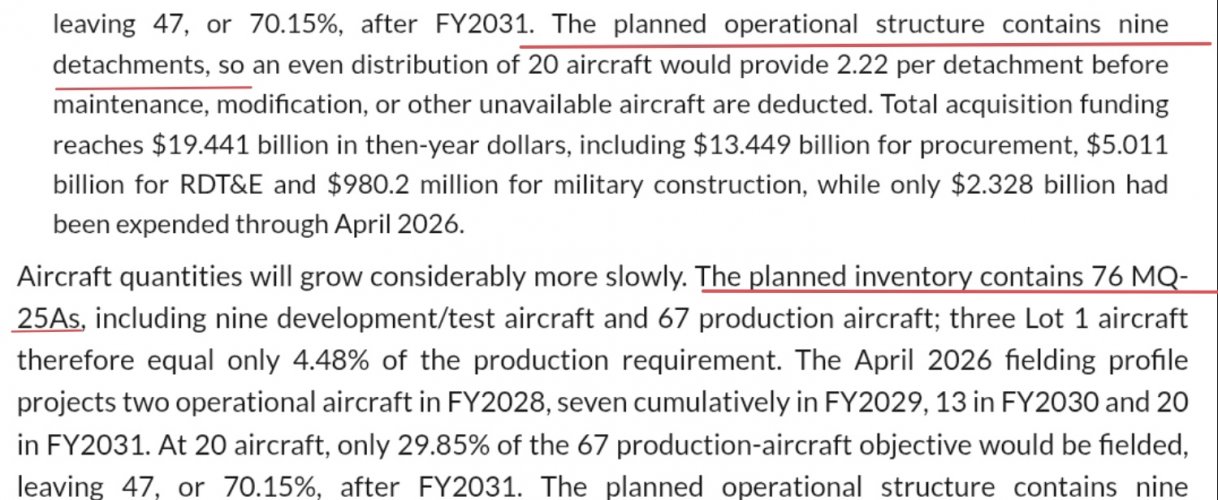
Contracts for 76 MQ-25 aircraft have been signed. Deliveries for "Lot 1"—totaling three aircraft—are expected to begin in 2029, with two additional aircraft entering service in Fiscal Year 2028.
——
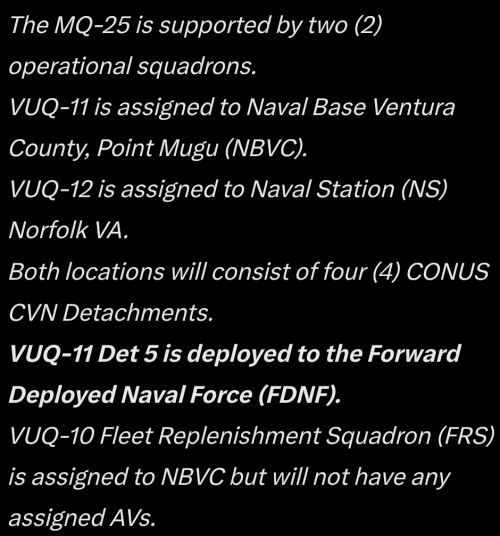
Regarding Squadrons VUQ-11 and VUQ-12: Each detachment is planned to be equipped with five MQ-25 aircraft.
VUQ-11 Detachment 5 is assigned to a forward-deployed naval unit. VUQ-10 is a training squadron and is not counted among the operational detachments.
Contracts for 76 MQ-25 aircraft have been signed. Deliveries for "Lot 1"—totaling three aircraft—are expected to begin in 2029, with two additional aircraft entering service in Fiscal Year 2028.
——
Regarding Squadrons VUQ-11 and VUQ-12: Each detachment is planned to be equipped with five MQ-25 aircraft.
VUQ-11 Detachment 5 is assigned to a forward-deployed naval unit. VUQ-10 is a training squadron and is not counted among the operational detachments.
Attachments

Had the opportunity to talk to someone working on this program, a true Gentleman.
Could ask him stupid questions, cause I know nothin' . This is basically a resume, what I remember :
Me - "Why that air intake style, I thought Naca air intakes were considered quite ineffective for feeding an engine ?"
Him - "Well the guys who designed that one found out it works quite well for what the plane has to do. Plus we can be sure no one is going to walk in front of it, that's a big plus on a carrier."
Me - "If this is going to be mainly a refueller, why the external pod for carrying the hose/drogue system ? Why not integrating the thing in the airframe ?"
Him - "Cause lot of the airframe volume is already filled with fuel, and integrating the refuelling system would have taken too much place, diminishing the capacity a lot. Basically, all the yellow panels you see on the plane are covering fuel tanks."
Me - "So it's basically a flying service station ?"
Him - "That's exactly what it is ."
View: https://www.youtube.com/watch?v=2oWVGd9nfCw
Could ask him stupid questions, cause I know nothin' . This is basically a resume, what I remember :
Me - "Why that air intake style, I thought Naca air intakes were considered quite ineffective for feeding an engine ?"
Him - "Well the guys who designed that one found out it works quite well for what the plane has to do. Plus we can be sure no one is going to walk in front of it, that's a big plus on a carrier."
Me - "If this is going to be mainly a refueller, why the external pod for carrying the hose/drogue system ? Why not integrating the thing in the airframe ?"
Him - "Cause lot of the airframe volume is already filled with fuel, and integrating the refuelling system would have taken too much place, diminishing the capacity a lot. Basically, all the yellow panels you see on the plane are covering fuel tanks."
Me - "So it's basically a flying service station ?"
Him - "That's exactly what it is ."
Last edited:
With regards to the external drogue - IIRC that was a USN program stipulation, to reduce risk. I thought the reasoning was more “we already have a piece of equipment for this that works” more than volume constraints, but I was not working on the project so I will assume he knows what he’s talking about.
(It also means that when you inevitably repurpose the "refueling drone" you did receive funding for into the multi-mission platform you didn't, you don't have to keep lugging that refueling equipment everywhere.)
Lol, actually before I talked to the Gentleman from Boeing, I was watching the vid I posted with a friend and saying "mmmh... with that refuelling system hanged under the wing on an obviously kinda stealthy airframe, I don't think this thing is going to be used only as a refueller..."(It also means that when you inevitably repurpose the "refueling drone" you did receive funding for into the multi-mission platform you didn't, you don't have to keep lugging that refueling equipment everywhere.)
Last edited:

EmoBirb
ACCESS: Top Secret
- Joined
- 18 January 2025
- Messages
- 2,793
- Reaction score
- 7,129
It's almost as if it was envisioned from the start to be multirole (MQ, multirole-unmanned) and also emphasize persistent ISR as a secondary mission profile to aerial refueling as it's priority...
https://www.govinfo.gov/content/pkg/CHRG-114hhrg99630/pdf/CHRG-114hhrg99630.pdf
https://www.congress.gov/114/meeting/house/104961/documents/CRPT-114hrpt537.pdf
https://www.govinfo.gov/content/pkg/CHRG-114hhrg99630/pdf/CHRG-114hhrg99630.pdf
CBARS (MQ–25A) is a restructure of the UCLASS program. The MQ–25A program is envisioned to be an integral part of the future Carrier Air Wing, providing organic refueling and a tactical sea-based long-endurance Intelligence, Surveillance and Reconnaissance capability
https://www.congress.gov/114/meeting/house/104961/documents/CRPT-114hrpt537.pdf
The committee is encouraged that the Department of Defense has completed its review of the Unmanned Carrier Launched Surveillance and Strike (UCLASS) program and has decided to move forward with a slight variation that will include airborne tanking as an additional requirement. While this new capability was not identified as a requirement in the UCLASS Initial Capabilities Document (ICD) or the draft Capabilities Development Document (CDD) that had been previously validated by the Chief of Naval Operations, the committee recognizes the need for the enhanced capability and the positive impact it could have on the overall Carrier Air Wing (CVW). A requirement that was included in both the UCLASS ICD and CDD was the need for persistent, carrier-based intelligence, surveillance, reconnaissance (ISR) and precision-strike. Furthermore, as stated in the Carrier Based Aerial Refueling System (CBARS) budget documents, "The CBARS requirements are aligned with the UCLASS which highlights the need for a persistent, carrier-based ISR, and precision strike asset.’’ The budget documents go on to note in the Air Segment Product Development description that the unmanned vehicle will be ‘‘capable of aerial refueling (give) and persistent Intelligence Surveillance and Reconnaissance (ISR) operations with future precision strike.’’
Last edited:
Realistically though unless the USN drastically changes the program and increases the number of airframes MQ-25 will not be doing ISR. With 5 airframes planned for a carrier airwing you can expect four available at any one time. That gives you two refuelling a strike package, one around the carrier and one reserve.Lol, actually before I talked to the Gentleman from Boeing, I was watching the vid I posted with a friend and saying "mmmh... with that refuelling system hanged under the wing on an obviously kinda stealthy airframe, I don't think this thing is going to be used only as a refueller..."
The alternative is you still use SH for some refuelling sorties but that defeats the purpose of the MQ-25 and its primary role. There is also likely to be cheaper airframes available for ISR before sufficient MQ-25 are available given how long the program is taking to reach IOC, especially if the USN recent CCA RFI gets some reasonable responses.
EmoBirb
ACCESS: Top Secret
- Joined
- 18 January 2025
- Messages
- 2,793
- Reaction score
- 7,129
For the foreseeable future the MQ-25 will remain the only organic ISR asset endemic to the carrier air wing. Unless they're planning on throwing MQ-9B SeaGuardian off the deck anytime soon. Because I wouldn't bet on seeing any USN CCA flying within this decade.There is also likely to be cheaper airframes available for ISR before sufficient MQ-25 are available given how long the program is taking to reach IOC, especially if the USN recent CCA RFI gets some reasonable responses.
You pretty much won't be seeing the MQ-25 flying of the boat this decade either. IOC is still forecast for 2029, 3 airframes available, but given how glacial the flight test program is going and suitable carriers available in 2027 to conduct the first at sea testing that IOC isn't certain by an means.For the foreseeable future the MQ-25 will remain the only organic ISR asset endemic to the carrier air wing. Unless they're planning on throwing MQ-9B SeaGuardian off the deck anytime soon. Because I wouldn't bet on seeing any USN CCA flying within this decade.
- Joined
- 28 January 2008
- Messages
- 1,720
- Reaction score
- 4,396
If the USN turns the MQ-25 into an ISR platform, here we go again, drifting away from the tanker role by adding ISR mission equipment and ruining the aircraft, just like the Comanche helo.
When i said it was a flying sevice station and he agreed, he went along and saying something like it could be positioned as refueling points, adding to the carrier refuelling capacity rather than completely replacing it, anyway that how i understood.Realistically though unless the USN drastically changes the program and increases the number of airframes MQ-25 will not be doing ISR. With 5 airframes planned for a carrier airwing you can expect four available at any one time. That gives you two refuelling a strike package, one around the carrier and one reserve.
The alternative is you still use SH for some refuelling sorties but that defeats the purpose of the MQ-25 and its primary role. There is also likely to be cheaper airframes available for ISR before sufficient MQ-25 are available given how long the program is taking to reach IOC, especially if the USN recent CCA RFI gets some reasonable responses.
The intent is always been to replace SH taking missions. From the MSARWhen i said it was a flying sevice station and he agreed, he went along and saying something like it could be positioned as refueling points, adding to the carrier refuelling capacity rather than completely replacing it, anyway that how i understood.
The MQ-25 Stingray (MQ-25) Program rapidly develops and delivers integrated unmanned air systems to the nuclear-powered aircraft carriers as part of the Carrier Air Wing (CVW) to conduct aerial refueling as a primary mission and provide Intelligence, Surveillance, Reconnaissance (ISR) capability as a secondary mission. MQ-25 extends CVW mission effectiveness range, partially mitigates the current Carrier Strike Group (CSG) organic ISR shortfall and fills the future CVW tanker gap, relieving F/A-18 E/F Strike Fighters of the tanking mission and preserving their remaining life to perform the strike-fighter mission they were designed for.
I think expectations have changed as the program has languished and I expect in the early 2030s other unmanned capabilities will pass it by quite rapidly. One of the CCAs the USN is seeking with a 10k lbs payload would likely have no problem hosting a fuel tank or two and the ARS.
Scott Kenny
ACCESS: USAP
- Joined
- 15 May 2023
- Messages
- 19,890
- Reaction score
- 28,553
The point is that the MQ-25s will be flying in carrier air wings a decade before those CCAs will be.I think expectations have changed as the program has languished and I expect in the early 2030s other unmanned capabilities will pass it by quite rapidly. One of the CCAs the USN is seeking with a 10k lbs payload would likely have no problem hosting a fuel tank or two and the ARS.
The other bit is that I think the MQ-25 will have a much smaller spot factor than those flying-wing CCAs.
EmoBirb
ACCESS: Top Secret
- Joined
- 18 January 2025
- Messages
- 2,793
- Reaction score
- 7,129
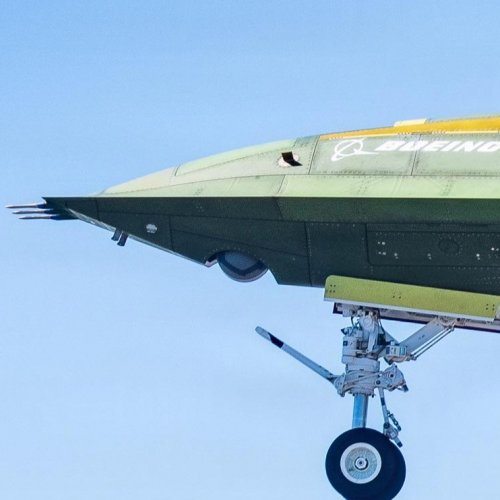
There's no "turning into". It was developed with this in mind.If the USN turns the MQ-25 into an ISR platform, here we go again, drifting away from the tanker role by adding ISR mission equipment and ruining the aircraft, just like the Comanche helo.
Which is why it has a huge sensor turret for electro-optical sensors:
Attachments
Similar threads
-
 Lockheed Martin - Multi purpose long endurance (MPLE) UAV
- Started by fightingirish
- Replies: 3
-

-
 AFRL Low-Cost Attritable Aircraft Technology (LCAAT) Program
- Started by Triton
- Replies: 179
-

-
