The minimum requirement for FF(X) should be FF4923 but I would argue need both FF(X), FFG(X), and a LCS based FF(X) design. The barebones NSC frigates can be handed to the CG after more suitable ones are built.

You are using an out of date browser. It may not display this or other websites correctly.
You should upgrade or use an alternative browser.
You should upgrade or use an alternative browser.
US FF(X) Program
- Thread starter Forest Green
- Start date
The only way I can see the NSC derived FFX (which will likely be the first 4-5 ships at minimum) being useful is to use them as ASW and radar pickets for sea skimmers operating on the flanks of convoys with other ships providing AAW + aircrew/naval crew recovery ships. As they won't have the AAW or radars to operate independently or contribute to battlegroups aside from ASW.The whole point of that laundry list was options. NSC has two hulls on order. Its not a done deal that what comes out in the first two will reflect any others. At this point you are destructing the list. So fair points if you think they cannot fit. Propose options and form a constructive debate.
Legend class is an offshoot of a thirty year old Gibbs & Cox design. NSC was one of the less capable designs. Also realize there has been a fair number of the same family of design loaded down heavier than my proposals. Things like deck strengthening to land Chinooks for supplies is not to be confused with operating them from the ship.
However the hull self noise will likely be an issue, so there should be characterization of NSC and see what amount of silencing can be done on the first batch and just hope that this is enough. Then you remove the boat well, add CAPTAS, ASROC on Thypon or similar launchers on the old boat well, and the 12 ESSM behind the gun which is about there's space for on this hull. Maybe you can fit some UUV handling equipment along side the CAPTAS towed array in the old boat well, but I wouldn't count on it.
UUV likely won't be great for blue ocean/deep water ASW unless you seed the whole route with them due to its range. However it would work quite well in straits and choke points in SEA.
I don't think the NSC related ships with heavier loadings like FF4923 were ever fleshed out beyond concepts. They also have a much reduced ranged 8000nm at 10kn. So much less at ~20kn convoy escort speeds.
It's a shame they could never get the ASW modules working on LCS, otherwise they would be usable in the ASW role.The minimum requirement for FF(X) should be FF4923 but I would argue need both FF(X), FFG(X), and a LCS based FF(X) design. The barebones NSC frigates can be handed to the CG after more suitable ones are built.
Separately there is a large need for a way to get an elevated radar platform for convoys and ships operating alone.
Last edited:
Scott Kenny
ACCESS: USAP
- Joined
- 15 May 2023
- Messages
- 16,975
- Reaction score
- 24,080
And the difference between an FF and an FFG is the presence of full sized Standards, area defense missiles.Whether FF(X) can defend itself is relevant. Its a light frigate, but some form of VLS is pretty much minimum requirement for any "FF". Maybe in future it will mean line of sight defences like big lasers vs an "FFG" having any missiles at all. For now everything needs some air defence missiles.
The old FFs still had Sea Sparrows for a while, later replaced by Phalanx CIWS.
Modules worked just fine on shore. LCS were just too noisy to be usable in ASW. Someone forgot to specify hull silencing measures.It's a shame they could never get the ASW modules working on LCS, otherwise they would be usable in the ASW role.
That's likely addressable by the DARPA TERN VTOL UAVSeparately there is a large need for a way to get an elevated radar platform for convoys and ships operating alone.
In all fairness on the LCS, it really wasn't worse than sonar from two or three decades ago. It is just that the current standards have increased with the threats, Having a bow-mounted sonar in littoral waters seems like a necessity. Let's remember, what we call a sonar is actually a whole suite. Even if its not good enough to track Virginia class subs at 100 miles, its perfectly fine for avoiding obstacles in the shallows and for using Gertrude.
I guess any attempt at doing ASW with the FFX will run into the same issues.Modules worked just fine on shore. LCS were just too noisy to be usable in ASW. Someone forgot to specify hull silencing measures.
That's likely addressable by the DARPA TERN VTOL UAV
The Tern UAV is a bit over a decade old, with not much else to show, it doesn't seem like it'll be continued. However something like that should work with a 600 lb payload. The question is what the endurance is.
Regardless it still means it's incapable in the modern day against threats that are generally louder than the Virginia class. So I would bet it would have a pretty hard time of tracking a Virginia. Also I wouldn't use this in the littoral as it's even more venerable than other ships due to a higher ASM and air threat.In all fairness on the LCS, it really wasn't worse than sonar from two or three decades ago. It is just that the current standards have increased with the threats, Having a bow-mounted sonar in littoral waters seems like a necessity. Let's remember, what we call a sonar is actually a whole suite. Even if its not good enough to track Virginia class subs at 100 miles, its perfectly fine for avoiding obstacles in the shallows and for using Gertrude.

Kat Tsun
eeeeeeeeeeeeeee
- Joined
- 16 June 2013
- Messages
- 1,813
- Reaction score
- 2,525
Okay, fellas. Let's start nailing down specific baselines for an FFG(X). I propose:
Main Gun Weapon System (GWS) - Bofors 57 mm (2.24") Mark 110 Mod 4 Naval Automatic Gun System (AGS) mounted in a low-RCS stealth cupola atop the fore-deck. 120 rounds ready in the mount; additional rounds can be loaded from below-deck magazines. Mark 110 is operated by remote control from the Gun Console (GC) within the Control Officers Console (COC) of the Mark 160 Gun Computer System (Mark 160 GCS), but can be controlled locally in the gun mount. Mark 160 GCS is capable of direct firing attacks against surface radar and optically tracked targets, as well as indirect firing during Naval Gun Fire Support (NGFS). Alternate: Oto Melara 76 mm/62-cal Super Rapid Compact Naval Gun (aka OTO 76/62 SR) is a high-performance naval gun, offering rapid fire, multi-role capabilities, and advanced ammunition options. Total destructive effect favors the 76mm for larger near-misses, but guided and smart 57mm rounds narrow the gap.
Gun Fire Control - Mark 160 Gun Computer System (Mark 160 GCS), AN/SPQ-9B Multi-Purpose Surface Search and Fire Control radar (aka "Spook 9"), and Mark 20 Mod 1 Electro Optic Sensor System (Mark 20 EOSS). Mark 160 GCS is located in the ship's Combat Information Center (CIC) and serves as both the central fire control brain and primary interface between the Mark 110 GWS, the ship's Command and Decision (C&D) system, and an array of mixed sensors. Within the Combat Information Center (CIC), the Gun Console (GC)—often part of the Control Officer's Console (COC)—acts as the main operator interface for the Mk 160. Mark 160 GCS translates target information into gun aiming orders via the Signal Data Converter/Gun Mount Processor (SDC/GMP) and the precision enables an effective Anti-Ship Missile Defense (ASMD). There are two Mark 20 EOSS aboard, and together these serve three primary functions: EOSS/GWS integration, automatic target detection and tracking, and day/night video surveillance. AN/SPQ-9B is controlled at the COC; the high-fidelity X-Band, pulse-doppler radar provides defense against low altitude (below 2000 ft) surface and air targets such as sea skimming missiles, for either gun fire engagement or navigation. Track While Scan (TWS) mode provides high resolutions in two dimensions for the detection and tracking of more than one thousand objects at or near the surface of the water. The Control Officer operates the AN/SPQ-9B and displays target video on the Plan Position Indicator (PPI), assigns targets to the TWS channels, initiates the desired operating mode, selects the Gun Fire Control Console (GFCC), assigns targets and respective gun mounts to a respective Weapons Control Console (WCC), enables WCC firing circuits, then disables the WCC after engagement. Mark 20 EOSS supports operations including anti-surface and anti-air warfare, spotting and damage assessment, target detection and identification, naval gun fire support, safety check-sight, location/track of man overboard and channel position and navigation. The MT 51 Velocimeter (located on the main gun mount) measures the initial velocity of the round leaving the barrel via a doppler signal.
CIWS - One fore-mounted Phalanx Close-In Weapon System (CIWS) with the 20 mm M61A2 Vulcan 6-barreled Gatling cannon, or 11-cell SeaRAM for forward and abeam shots. One 21-cell RIM-116C Block 2B Rolling Airframe Missile (RAM) in RAM Mark 31 Guided Missile Weapon System (GMWS) located high astern for rearward and abeam shots. Both Phalanx CIWS and SeaRAM are autonomous systems which do not need any external information to engage threats. Due to the common mounting, SeaRAM inherits the relatively easy installation characteristics of its gun-based sibling.
Close Range MG - Typhon-mount (Mark 38 Mod 3) Machine Gun System (MGS) located abeam each side, with a TOPLITE gimbal stabilized 25 mm/1" Bushmaster II. The MGS features multi-functional displays in a remote control console, independent electro-optical/infrared (EO/IR) sensors, a laser rangefinder, target autotracking, and two ammunition types. Each Mod 3 also features a backup 7.62mm Mark 52 co-axial gun. MGS focuses on robust close-in self defense. Direct-fire defense against small surface craft and as part of a layered protection against missile and drone threats. Distributed to each quadrant, either the 12.7 mm (.50") M2HB Browning Heavy Machine Guns (HMG; with 100 round or 200 round ammo can holder) or MK19 40 mm Grenade belt-fed Automatic Grenade Launcher (AGL; with 32 or 48 round ammo cans) on MK93 Mod 4 free-swinging pintle mounts. With adapters the M60/MK43 7.62 mm General Purpose Machine Gun (GPMG; with 250 round ammo can), M240 7.62 mm GPMG (with 300 round ammo can), or M249 5.56 mm Squad Automatic Weapon (SAW; 250 round ammo box) can be installed on the MK93 mount as alternative options.
Angle-container Missiles - 8 RGM-184 Naval Strike Missiles (NSM Q) for surface and land strikes, 12 AMRAAM-ER or AIM-9X in six-pack LCHR-derived multi-missile launch containers from NASAMS 3 for air-defense, 8 Precision Strike Missile (PrSM) or 16 Ground Launched StormBreaker (GLSDB2) containers for precision fires land strike, or 24 AGM-114 Hellfire missiles for counter-drone roles; or any combination thereof. Located on the upper weapons deck.
VLS Missiles - Mounted in combination of medial and/or exterior (perimeter) deck spaces. 12/24 RIM-162E Block 2 Evolved Sea Sparrow Missile (ESSM) in one or two medially located 6-cell dual-packed Mark 56 Guided Missile Vertical Launching System (GMVLS). Provisional space for an additional two Stanflex modular mission payloads, laterally located on the lower weapons deck perimeter.
Directed Energy Weapons - 60 kW High-Energy Laser with Integrated Optical-dazzler and Surveillance (HELIOS) for light speed counter drone (UAS/UUV) capability. LRADs (long-range acoustic devices) to repel pirate attacks by sending warnings and by producing intolerable levels of sound.
Torpedo and Anti-Submarine Warfare (ASW) - Mark 32 surface vessel torpedo triple tubes for the 12.75-inch (324 mm) Mark 54 ASW torpedo. Copperhead-100M reusable unmanned underwater vehicles (UUVs) delivered by Anduril's Ghost Shark AI-powered extra-large autonomous underwater vehicle (XL-AUV) designed for long-range, persistent, and stealthy surveillance, reconnaissance, and strike missions.
Other Ship Defenses - Two Nulka decoy launchers. Nulka hovers in the air and emits radiofrequency energy to lure the seekers of anti-ship missiles. AN/SLQ-32 Mod 5 electronic warfare suite. Mark 36 Super Rapid Bloom Offboard Countermeasures Chaff and Decoy Launching System (SRBOC aka "Super-R-Boc") short-range Decoy Launching System (DLS) that launches radar or infrared decoys from naval vessels to foil incoming anti-ship missiles. SLQ-32 (with the exception of the (V)4 variant) can automatically fire decoys from the Mark 36 SRBOCs when it detects an anti-ship missile attack. Towed and offboard decoys for submarine torpedo threats.
Communications - Multi-Functional Information Distribution System Joint Tactical Radio System (MIDS JTRS). Link-11 and Link-16 tactical data links, enhanced command and control (C2) capabilities to facilitate real-time, secure, and jam-resistant data (voice, data, imagery, and video) sharing with Navy, Joint, and coalition forces. MIDS JTRS enables simultaneous operation of Link 16 and up to three additional advanced networking waveforms, including Tactical Targeting Networking Technology (TTNT) and Flexible Access Secure Transfer (FAST). MIDS JTRS uses software-defined radio technology to update and adapt to future security and networking requirements.
Active Electronically Scanned Array (AESA) Multifunctional Radar - AN/SPS-75 (Giraffe 4A) is a multi-role medium-range AESA surveillance radar system in three dimensions for naval applications. It provides medium range, simultaneous air and surface surveillance and can be employed in a weapon designation role. AN/SPS-75 uses Agile Multi-Beam (AMB), which includes an integrated Command, control and communication (C3) system. This enables AN/SPS-75 to act as the command and control center in an air defense system. AN/SPS-73(V)18 Next Generation Surface Search Radar (NGSSR) enhances safety and situational awareness while it simultaneously performs navigation, surface search, and periscope detection (PDD). While primarily for navigation, it offers, advanced, limited, low-altitude, short-range, situational awareness against surface and aerial threats. NGSSR is a software-configurable, Agile Multi-Beam (AMD) in the X-band, maritime radar designed to replace legacy systems on U.S. Navy surface combatants.
Forecastle Main Mast - The primary Mark 20 EOSS is located above the bridge. AN/SLQ-32C(V)6 Surface Electronic Warfare Improvement Program (SEWIP) Block II; see below for details. AN/UPX-29(V) Interrogator System for electronic Identification Friend or Foe (IFF) air traffic control. AN/URN-32 Combined Tactical Air Navigation (TACAN) Antenna and Beacon Transponder to provide azimuth (bearing) and range (distance) information to aircraft. Rapid Deployment Elevation System (RDES) derived telescopic mast that can extend to a point 200 feet above sea level (ASL) with up to 1200 pounds, and has a structural rating for survival in 80 mph winds.
RDES Mounted Sensors - A secondary Mark 20 EOSS is RDES-mounted. Maximum extension allows for direct Line-of-Sight (LOS) of 18.6 miles; this location enhances naval or land-based situational awareness by significantly increasing the sensor's vertical field of regard and horizon LOS. This combination allows for faster, higher-angle target detection, improved horizon scanning, and enhanced identification capabilities. Elevated sensors offer a better view of congested waterways, shorelines, or urban environments. RDES allows the system to be raised or lowered in minutes, enhancing flexibility in fast-paced operational environments.
Electromagnetic Warfare (EW) Suite - AN/SLQ-32C(V)6 SEWIP aka "SEWIP Lite". EW consists of three major subdivisions: electronic attack (EA), electronic protection (EP), and electronic warfare support (ES). Activities used in EW include electro-optical, infrared and radio frequency countermeasures; Electromagnetic (EM) compatibility and deception; radio jamming, radar jamming and deception and electronic counter-countermeasures (ECCM aka anti-jamming); electronic masking, probing, reconnaissance, and intelligence; electronic security; EW reprogramming; emission control; spectrum management; and wartime reserve modes.
Signature Reduction - Low visibility paints to reduce visual, ultraviolet, and infrared identification. Over 13 dB Radar Cross Section Reduction (RCSR) and similar audible emissions reduction. A 13 dB radar cross-section (RCS) reduction corresponds to more than a ten-fold (95%) decrease in the reflected power of a target, effectively reducing its radar signature by over one order of magnitude. In practical terms, this means a target becomes much harder to detect, as a 13 dB reduction shrinks the detection range significantly to about 5% compared to an untreated object.
Bow-mounted Sonar - AN/SQQ-89(V)15 integrated Undersea Warfare (USW) Combat System Suite. Computer-controlled, bow-mounted AN/SQS-53C ("Kingfisher") high frequency active and passive sonar with the capabilities to search, detect, classify, localize and track undersea contacts, and to engage and evade submarines, mine-like small objects and torpedo threats. The AN/SQS-53C is most effective for shallow water navigation, object avoidance, and mine warfare. AN/SQR-19 Tactical Towed Array Sonar (TACTAS) which is a component of the AN/SQQ-89 sonar suite, is a series of hydrophones towed from a cable several thousand feet behind the ship, that is able to passively detect adversary submarines at a very long range. AN/SQR-19 combines active and passive hydrophone arrays for Anti-Submarine Warfare (ASW) detect and track capability. Additional towed arrays on deployed Unmanned Underwater Vehicles (UUV) and/or from a Seahawk helicopter. AN/UQN-4 Sonar Sounding Set (also known as EDO Model 9057) is a digital depth sounder/fathometer for measuring the depth of water from the ship’s keel to the ocean floor for safe operational navigation. Fathometers are operated from all classes of United States (U.S.) Navy surface ships and are considered Mid-Frequency Active (MFA) sonars. AN/WQC-2 (commonly known as "Gertrude" or "The Underwater Telephone") is a hull-mounted transducers or towed-line array utilized as an Underwater Voice Communication (UVC) system used for secure, short-range, two-way, voice, and Morse code communication between submarines, surface vessels, divers, and other underwater vehicles. AN/SQR-19 slated to be eventually replaced by AN/SQR-20 Multi-Function Towed Array (MFTA) and its more advanced TB-37U sensors. AN/SQR-20 and TB-37U offers better performance against quiet diesel-electric Submarine Killers (SSKs) in littoral environments, increased reliability, and reduced obsolescence.
Aviation Support - Chinook and Sea Stallion deck load capacity for efficient Vertical Replenishment (VERTREP). Hangar storage for one Seahawk helicopter and distributed deck moorings to secure up to three helicopters on available deck space. AN/URN-32 Combined Tactical Air Navigation (TACAN) Antenna and Beacon Transponder to provide azimuth (bearing) and range (distance) information to aircraft. AN/UPX-29(V) Interrogator System for electronic Identification Friend or Foe (IFF) air traffic control.
Propulsion and Primary Power Generation - Combined diesel–electric and gas (CODLAG) system using one reversible controllable-pitch propeller. A single 7,400 kW (9,900 hp) Fairbanks Morse Defense (formerly Rolls-Royce) 20-cylinder MTU 20V 1163 TB93 diesel engine provides the best power efficiency to provide propulsion and an onboard power supply. An additional two Fairbanks Morse Defense (formerly Rolls-Royce) 20-cylinder nForcer FM 175D engines 3,750 kW (5,000 hp at 1,800 rpm) may be called upon to combined for an additional 14.875 MW of power. Main cruise solely requires diesel–electric power; the mechanical drive train is disengaged with clutches. Eliminating the mechanical connection between engines and propellers has several advantages including increased freedom in placement of the engines, acoustical decoupling of the engines from the hull, which makes the ship less noisy, and a reduction in weight and volume. Reserve diesel–electric and alternative power sources can boost speeds temporarily with minimal acoustic increase using two additional reversible controllable-pitch propellers. For higher speeds, the reserve 22 MW (30,000 hp) General Electric LM2500 gas turbine engine - with clutches engaged - powers the main shaft via a cross-connecting gearbox. The LM2500 gas turbine is available to quickly respond to increases in dynamic power demands and it can spool up to full power in under 5 minutes. In an emergency the gas turbine can effective propel the ship on its power alone. Reserve diesel engines may take between 20-30 minutes to bring the them up to an efficient rotational speed, and all three diesel–electrics are necessary for an 18 knot cruise speed. The 7,280 kW (9,760 hp at 1,000 rpm) Fairbanks Morse 16V28/33D STC diesel engine may substitute for the MTU 20V 1163 TB93, but maximum cruise speed will drop a up to half a knot.
Auxiliary Power Generation - Integrated electric propulsion (IEP). Two reserve diesel–electric engine and a gas turbine provide for auxiliary electrical generation to meet dynamic energy demands. Some soft storage capacity for transitioning. Distributed hull-mounted bifacial solar cell (BSC) panels, connected to limited battery storage, boosts the daily electrical generation during fair weather. BSCs may provide between 20-30% of energy demands for daytime travel at cruise speeds. The trash incinerator, or Waste-to-Energy (WtE) system, provides minor electrical generation at a rate of about 500 to 600 kWh of electricity per ton of waste incinerated. Retractable bow thrusters for dock maneuvers.
Operational Speed - 28 knots (52 km/h; 32 mph) maximum speed. Hull design for cruise speed of 18 knots.
Endurance - Expected range of 12,000 nautical miles (22,000 km; 14,000 mi) at a 16 knot cruise under diesel–electric engine power alone. Provisional storage for 60-75 duty cycles of an expected minimum 150 day deployment. This includes up to 30,000 gallons (125 tons) of drinkable and potable fresh water, volume equivalent to 17 "twenty-foot equivalent unit" (abbreviated TEU; approximately 20,000 cubic feet) of provisional dry storage concealed in weather-tight containers stored under the deck cover space, and an addition 2 TEU (of approximately 2,500 cubic feet) of mixed storage facilities distributed across internal compartments.
Replenishment - Underway replenishment (UNREP - for Solid, Liquid, Ammunition) and VERTREP (for Solid, Ammunition) capable. Supplies may also be delivered through the LARS, telescoping and swiveling davit locations, and mooring access points at the ship fantails.
Child Vessels - Ability to launch and recover a mixture of manned and/or unmanned child vessels (RHIBs, tenders, Ghost Shark UUV, or minisubmarines). An internal boat bay with weather-tight external doors for dry stack storage of up to four 10 meter child vessels (RHIBs/UUVs). One high-sea-state stern launching ramp (LARS aka "float-in garage") for up to one 25 meter boat; designed to launch and recover smaller craft while in motion or in high seas. This LARS is specifically designed to handle one Combatant Craft Medium, Mark1 (CCM). The stern ramp allows for the launch and recovery of boats without the mother vessel having to come to a complete halt. The garage keeps child vessels secured and protected from the elements, as opposed to being stored on an open deck. Mooring for CCM located on ship fantails located near trailing edges along each side of hull. Two boat cradles located above-deck on the stern with capacity for up to 10 meter child vessels facilitates transfers from dry stack storage to the sea surface.
Utility Cranes - One aft-mounted telescoping and swiveling davit (12-ton capacity hydraulic crane), and one 11-ton capacity telescoping and swiveling davit (electrical crane) located inside each side of internal boat bay. Cranes are for launch/recovery of a Rigid Hull Inflatable Boat (RHIB), UUV, or Combatant Craft Assault (CCA); replenishment; or deployment of sea mines. Weather-tight gangway (narrow passage used to board or disembark ships) connects the LARS well to the center of the ship. Two internal winches on a fixed gantry atop shaft spaces for moving palletized supplies through internal spaces; one of which can be used to transfer up to a 10 meter child vessel from the LARS well to internal boat bay space.
Poke it to pieces.
NSC with an 8-round VLS aft the 57mm for 32x ESSMs guided by the SPS-75 and a Typhon box pair above the boat deck for 8 TLAMs.
Maybe a keel sonar if we can find some SQS-56s in a warehouse somewhere.
Scott Kenny
ACCESS: USAP
- Joined
- 15 May 2023
- Messages
- 16,975
- Reaction score
- 24,080
Why are we sticking TLAMs on a frigate?NSC with an 8-round VLS aft the 57mm for 32x ESSMs guided by the SPS-75 and a Typhon box pair above the boat deck for 8 TLAMs.
Crud, just raid the submarine stocks for the wide aperture arrays off the Virginia-class.Maybe a keel sonar if we can find some SQS-56s in a warehouse somewhere.
Kat Tsun
eeeeeeeeeeeeeee
- Joined
- 16 June 2013
- Messages
- 1,813
- Reaction score
- 2,525
Why are we sticking TLAMs on a frigate?
TLAMs are the most important part of an American warship. They're the colonial peacekeeper.
Crud, just raid the submarine stocks for the wide aperture arrays off the Virginia-class.
It doesn't have to be good. It has to avoid underwater rocks and maybe find a diesel or something before it shoots.
FF(X) will never see a day in a major combat zone like the South China Sea at least until the U.S. Navy has run out of supercarriers and Burkes, at which point the U.S. Navy has been defeated, so it will never see a day in major combat because the United States would be forced into a surrender long before that. It might fight the Iranian or Venezuelan Navies, who are not particularly fearsome, but would require a bit more mettle than was demonstrated in Praying Mantis. Not that much more but still.
The CONOPS that defined FFG-7 basically died with the USSR and the birth of real-time surface ship observation in the 1990s though. You can no longer thwart an air raid by simply shooting down a VID maritime patroller like a Fw 200 or a Tu-142.
The air raid will simply not launch until they have VID'ed your surface units and battlegroup positions via satellite these days, which can be purchased commercially easily from companies like ICEYE, making even countries like Saddam's Iraq a potential naval threat (they had Saccades [or Silkworms] and H-6s) against major SAGs. The most important aspect of defending a hypothetical convoy is that it now requires Aegis, and preferably AMDR, with supercarrier support because the same threats that will be used against a CVBG will be used against a convoy to enforce a blockade. Which is why convoys won't be used.
Merchant ships are fast enough to evade attack by submarine outside of chokepoints now and bunching them together makes a convoy an obvious target when you see like four warships moving together with six ULCCs, RO/ROs and CONEX freighters.
So the merchants just get told to follow trade lanes, fly false flags or act as a ghost fleet, and link with escorts into the grey zone for a blockade run. They're fast but they're not that fast and escort will be necessary in the actual combat zone. I guess you can argue it's not a convoy in the sense of just like a quarantine isn't a blockade. There's a matter of distance involved.
Basically everyone assumes there will be these big trans-Pacific operations to interdict supplies when the reality is it's going to be people sending their shipping to Australia and Japan and avoiding Taiwan because it's a combat zone. It'll look more like Ukraine's air travel situation in 2014 than anything else because the war between the US and PRC won't immediately go super hot. It may not even devolve into a world war since the US is unlikely to get Europe to go along with it.
Anyway AIUI the Constellations were a kludged attempt to get something comparable to Burke for half the price. It failed. You can't make "basically a Burke" without paying for "basically a Burke" in price and displacement. By the time the Connies would've stabilized in design they would've been $2 billion a piece or very close to it. So like 80% of a Burke's price for 80% of a Burke's capability. Shocker.
The DON is now trying the opposite approach: make something barely suitable for the Red Sea or anti-ISIS operations/OEF-P/Horn of Africa, and replace the Burkes in AFRICOM, SOUTHCOM, NORTHCOM, EUCOM and CENTCOM with them when the war comes, so INDOPACCOM can have all the resources it needs to prosecute a major regional war without draining our ability to bomb the Middle East with cruise missiles.
People need to stop thinking in terms of FFG-7 and start thinking in terms of the Gowind 3100 or the MEKO 360. That's the best analogy here. The main difference between FF(X) and Gowind or MEKO is that FF(X) will have an actual strike capability in the form of TLAM. FF(X) is just the kind of warship Europeans have been building for years for their far-flung colonial patrols and major exports except America needs actual muscle in that patrol.
FF(X) might not be able to conduct a Shayrat, at least without SSN support, but it can contribute to that mission with 8-16 TLAMs per hull.
tl;dr It's a cheap hull for a navy that now has to choose between losing WW3 or bombing Iran next week in terms of maint skeds.
The USN is very close to the bare minimum to prosecute a major regional war without retreating from entire global areas, it may have already passed this point (we won't know until the missiles start flying), and it needs something to bulk itself up in terms of escorts: two dozen Burkes that could be in INDOPACCOM but are stuck in AFRICOM, EUCOM or SOUTHCOM to sling cruise missiles is a massive loss for PacFleet's air defense, and one that could be better done by cheap little ships with cruise missiles instead.
I also don't like the idea that we need something like a FFG-7 or whatever because it's obvious to me that the war in the Pacific won't look like the North Atlantic or even the WW2 Pacific. Not clear why a rear line convoy escort designed to handle at most one or two intercepts during an engagement is useful when the DDG-51 seems to be the bare minimum to just survive in the theater. Considering Burke is just about the only warship the US can make in quantity, getting a second ship to be built in similar quantity so it can push more Burkes to a theater is a good thing, because it means you're getting more Burke per Burke.
Last edited:
Scott Kenny
ACCESS: USAP
- Joined
- 15 May 2023
- Messages
- 16,975
- Reaction score
- 24,080
Certainly the most used part of an American warship.TLAMs are the most important part of an American warship. They're the colonial peacekeeper.
Those are simply currently in production. If we need to go cheap we only install one blister per side instead of all 3.It doesn't have to be good. It has to avoid underwater rocks and maybe find a diesel or something before it shoots.
johnpjones1775
ACCESS: Top Secret
- Joined
- 27 May 2023
- Messages
- 1,217
- Reaction score
- 654
Gonna need some actual citations for those claims.TLAMs are the most important part of an American warship. They're the colonial peacekeeper.
It doesn't have to be good. It has to avoid underwater rocks and maybe find a diesel or something before it shoots.
FF(X) will never see a day in a major combat zone like the South China Sea at least until the U.S. Navy has run out of supercarriers and Burkes, at which point the U.S. Navy has been defeated, so it will never see a day in major combat because the United States would be forced into a surrender long before that. It might fight the Iranian or Venezuelan Navies, who are not particularly fearsome, but would require a bit more mettle than was demonstrated in Praying Mantis. Not that much more but still.
The CONOPS that defined FFG-7 basically died with the USSR and the birth of real-time surface ship observation in the 1990s though. You can no longer thwart an air raid by simply shooting down a VID maritime patroller like a Fw 200 or a Tu-142.
The air raid will simply not launch until they have VID'ed your surface units and battlegroup positions via satellite these days, which can be purchased commercially easily from companies like ICEYE, making even countries like Saddam's Iraq a potential naval threat (they had Saccades [or Silkworms] and H-6s) against major SAGs. The most important aspect of defending a hypothetical convoy is that it now requires Aegis, and preferably AMDR, with supercarrier support because the same threats that will be used against a CVBG will be used against a convoy to enforce a blockade. Which is why convoys won't be used.
Merchant ships are fast enough to evade attack by submarine outside of chokepoints now and bunching them together makes a convoy an obvious target when you see like four warships moving together with six ULCCs, RO/ROs and CONEX freighters.
So the merchants just get told to follow trade lanes, fly false flags or act as a ghost fleet, and link with escorts into the grey zone for a blockade run. They're fast but they're not that fast and escort will be necessary in the actual combat zone. I guess you can argue it's not a convoy in the sense of just like a quarantine isn't a blockade. There's a matter of distance involved.
Basically everyone assumes there will be these big trans-Pacific operations to interdict supplies when the reality is it's going to be people sending their shipping to Australia and Japan and avoiding Taiwan because it's a combat zone. It'll look more like Ukraine's air travel situation in 2014 than anything else because the war between the US and PRC won't immediately go super hot. It may not even devolve into a world war since the US is unlikely to get Europe to go along with it.
Anyway AIUI the Constellations were a kludged attempt to get something comparable to Burke for half the price. It failed. You can't make "basically a Burke" without paying for "basically a Burke" in price and displacement. By the time the Connies would've stabilized in design they would've been $2 billion a piece or very close to it. So like 80% of a Burke's price for 80% of a Burke's capability. Shocker.
The DON is now trying the opposite approach: make something barely suitable for the Red Sea or anti-ISIS operations/OEF-P/Horn of Africa, and replace the Burkes in AFRICOM, SOUTHCOM, NORTHCOM, EUCOM and CENTCOM with them when the war comes, so INDOPACCOM can have all the resources it needs to prosecute a major regional war without draining our ability to bomb the Middle East with cruise missiles.
People need to stop thinking in terms of FFG-7 and start thinking in terms of the Gowind 3100 or the MEKO 360. That's the best analogy here. The main difference between FF(X) and Gowind or MEKO is that FF(X) will have an actual strike capability in the form of TLAM. FF(X) is just the kind of warship Europeans have been building for years for their far-flung colonial patrols and major exports except America needs actual muscle in that patrol.
FF(X) might not be able to conduct a Shayrat, at least without SSN support, but it can contribute to that mission with 8-16 TLAMs per hull.
tl;dr It's a cheap hull for a navy that now has to choose between losing WW3 or bombing Iran next week in terms of maint skeds.
The USN is very close to the bare minimum to prosecute a major regional war without retreating from entire global areas, it may have already passed this point (we won't know until the missiles start flying), and it needs something to bulk itself up in terms of escorts: two dozen Burkes that could be in INDOPACCOM but are stuck in AFRICOM, EUCOM or SOUTHCOM to sling cruise missiles is a massive loss for PacFleet's air defense, and one that could be better done by cheap little ships with cruise missiles instead.
I also don't like the idea that we need something like a FFG-7 or whatever because it's obvious to me that the war in the Pacific won't look like the North Atlantic or even the WW2 Pacific. Not clear why a rear line convoy escort designed to handle at most one or two intercepts during an engagement is useful when the DDG-51 seems to be the bare minimum to just survive in the theater. Considering Burke is just about the only warship the US can make in quantity, getting a second ship to be built in similar quantity so it can push more Burkes to a theater is a good thing, because it means you're getting more Burke per Burke.
Tomahawk is a major investment to add whereas RGM-184 Naval Strike Missiles (NSM Q) was intended to be the stick for FF(X). It's much shorter (1/3) range and half the warhead, but designed to be more survivable. Precision Strike Missile (PrSM) Increment 1 is 1/5th the warhead but flies substantially faster in its ballistic trajectory. Precision Strike Missile (PrSM) Increment 2 doubles the range, is equipped with the multi-mode seeker, and will have the ability to engage moving targets including warships. I think both increments are worthy of exploring. But NSM is definitely respectable for an FF(X) ship.
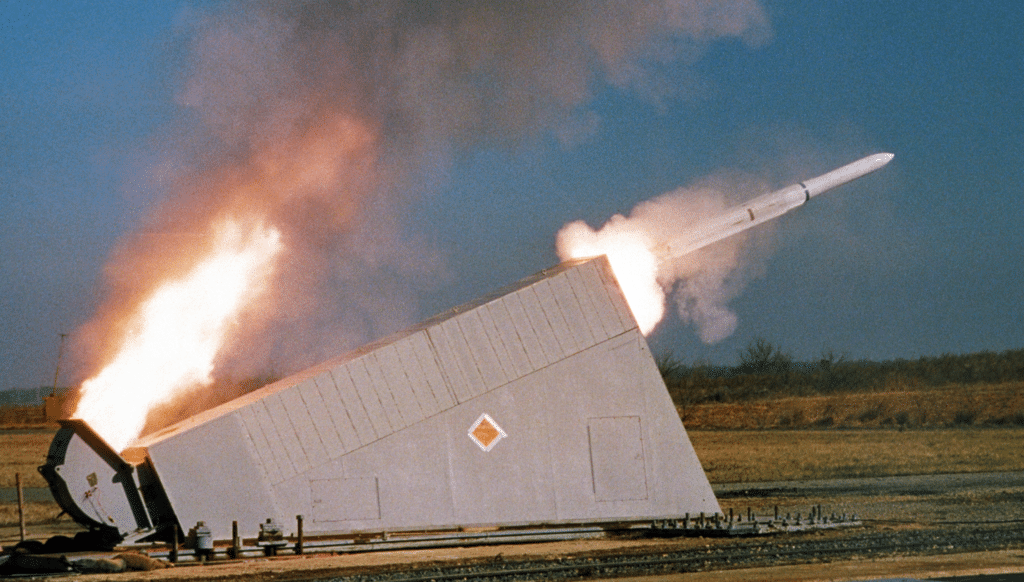
Mark 41 Vertical Launching System (VLS) requires Strike-length cells to accommodate the Tomahawk cruise missile. That is not an FF(X) once you add such deep cells. If you could fit it in the MK 70 Mod 1 Payload Delivery System (PDS) designed to launch the Standard SM-6 from the LCS, then sure. It's another angled launcher. The system has four strike-length MK.41 VLS cells housed in a 12 meter (40 foot) container. Downside is its 4 missiles aimed all to same side in the space of 8 with 4 aimed each side. Being able to handle Chinooks landing on the deck would be handy for MK 70.
Mark 41 Vertical Launching System (VLS) requires Strike-length cells to accommodate the Tomahawk cruise missile. That is not an FF(X) once you add such deep cells. If you could fit it in the MK 70 Mod 1 Payload Delivery System (PDS) designed to launch the Standard SM-6 from the LCS, then sure. It's another angled launcher. The system has four strike-length MK.41 VLS cells housed in a 12 meter (40 foot) container. Downside is its 4 missiles aimed all to same side in the space of 8 with 4 aimed each side. Being able to handle Chinooks landing on the deck would be handy for MK 70.
Last edited:
Kat Tsun
eeeeeeeeeeeeeee
- Joined
- 16 June 2013
- Messages
- 1,813
- Reaction score
- 2,525
Tomahawk is a major investment to add
It's literally a console connected by a big cable to some Mk 70s lol. It's about as intrusive as Phalanx at this point.
whereas RGM-184 Naval Strike Missiles
Are basically a boutique item that's hardly in production and barely worth purchasing except to maintain what few have been bought for the LCS fleet. They might get Mk 141s with Harpoons but it's not an exceptionally pressing demand. FF(X) isn't really supposed to fight ships.
It's a hull being made to replace a Burke's TLAMs and defend it against small threats like Mason/Hanit's random Saccade jumpscares.
Being able to handle Chinooks landing on the deck would be handy for MK 70.
Might be the most British thing ever typed on this forum honestly. It's getting Seahawks and it's gonna like it.
It just may never see those Seahawks because they will be fed to PLANAF and PLAAF missile inventories.
RGM-184 is going into USS Constellation (FFG-62) and Congress (FFG-63). It's already in USS Fitzgerald (DDG 62). This is only the third year of the current procurement agreement and the bulk of new orders in FY26 is going to the USMC's (NMESIS) mobile launchers. They committed to a minimum of five years with Kongsberg through FY28. They wouldn't have built a factory in Virginia for a done program. The USAF also has orders through FY28 for the Joint Strike Missile. I don't think the relationship with Kongsberg is ending soon. If anything, since JSM is the Americanized version of NSM, the future NSM orders should become offshoots of the JSM. The JSM is a leaner animal, has better endurance, fits in tighter spaces, and uses as much American kit as possible. If they can find the funding then Harpoon will be replaced by it through maintenance cycle upgrades and attrition.
Nothing much more to say about the other two parts of your post but to say it is an unusual if not unique perspective.
Nothing much more to say about the other two parts of your post but to say it is an unusual if not unique perspective.
Would USCG want them?The minimum requirement for FF(X) should be FF4923 but I would argue need both FF(X), FFG(X), and a LCS based FF(X) design. The barebones NSC frigates can be handed to the CG after more suitable ones are built.
Definitely more vulnerable than the venerable AB...Also I wouldn't use this in the littoral as it's even more venerable than other ships due to a higher ASM and air threat.
Those Tomahawk boxes would have to come off whenever something more useful has to be fitted. A keel or bow sonar would seem to add value, but quietening needs to happen first. Bonus, if some form of electric propulsion is possible, theres a chance to install lasers to improve survivability.NSC with an 8-round VLS aft the 57mm for 32x ESSMs guided by the SPS-75 and a Typhon box pair above the boat deck for 8 TLAMs.
Maybe a keel sonar if we can find some SQS-56s in a warehouse somewhere.
avoiding rocks (or mines) is useful, but the SSK might be a very quiet modern one, the enemy gets to choose which SSK to put up against you.It doesn't have to be good. It has to avoid underwater rocks and maybe find a diesel or something before it shoots.
But USN might want to add useful capabilities (like a drone mothership) that could be part of a combat group. So FF(X) needs a bit more self defence than was on LCS, and useful defence against modern manoeuvring threats.FF(X) will never see a day in a major combat zone like the South China Sea
Still quite a distance to escort. Convoys unlikely to be attacked by ballistic missiles, but if they think its valuable enough the new hypersonics might be on the cards. What convoying looks like is a guess until you know it works or not, but every escort probably needs a self defence upgrade, Phalanx not useful in this case and theres also low/slow threats. USN should have a layered defence against both types of threats.So the merchants just get told to follow trade lanes, fly false flags or act as a ghost fleet, and link with escorts into the grey zone for a blockade run. They're fast but they're not that fast and escort will be necessary in the actual combat zone.
They had missiles and air defence, but a mission bay and ASW capability better than any Burke. Quite complementary.Anyway AIUI the Constellations were a kludged attempt to get something comparable to Burke for half the price. It failed.
Hence this discussion.The DON is now trying the opposite approach: make something barely suitable...
With a hull stretch?FF(X) might not be able to conduct a Shayrat, at least without SSN support, but it can contribute to that mission with 8-16 TLAMs per hull.
Kat Tsun
eeeeeeeeeeeeeee
- Joined
- 16 June 2013
- Messages
- 1,813
- Reaction score
- 2,525
Gonna need some actual citations for those claims.
There are dozens of CSIS wargames and GAO documents online. There's no single unclass PR document that says "this is what FF(X) does and why" obviously.
It's something you just pick up reading about PLA capabilities and the necessary air defense requirements of the theater (mainly the expected quantity and speed of weapons plus reaction time), the obvious inability of FF(X) to meet this (even the Connies would've been low to medium threat range), and the combat experience of the USN over the past decade battling ISIS and the Houthis in particular.
FF(X) is geared towards long duration patrol in compliant environments similar to the Gulf of Mexico or Horn of Africa because it's an NSC. Give it a couple dozen ESSM and it can stand in at low threat areas like the Red Sea or Levant. Give it Tomahawks and it can effect strikes similar to what the USN has been doing for going on 30 years there.
DDG-51 Flight I/IIA is the closest thing to a modern day Perry. They can protect the UNREPs and random LNG tankers from incidental or single ASBM shots. The Flight IIs with SEWIP and Flight IIIs are the frontline battle force escorts that need to handle multiple supersonic weapon threats and ballistic missile waves while skirting the edges of the A2AD zones and opening corridors to Taiwan. The Zumwalts and SSNs will be able to live in the A2AD zone and make life annoying for the PLANAF airbases.
FF(X) will ease the virtual attrition of the USN needing to commit something like 2/3rds or so of its surface fleet to the major regional conflict that will be Taiwan initially. By the time it escalates to a larger global war, perhaps after someone throws nukes, the USN probably won't exist in the same form it did before. Neither will the PLAN.
The Houthis have already shown that future escort operations will be distributed and rely on islands of protection by zone defenses at least, perhaps that will be the operating model for Taiwan, since it kept Houthi ASBMs from hitting CONEX ships. In any case actual convoys are likely unnecessary due to merchant speeds, and if they were necessary, the minimum escort is an Aegis ship with SPY-1D anyway. We don't have enough of those to spare for random cruise missile flings, while fighting China, but maybe we can get enough available to fight China and still bomb an al-Baghdadi or Saddam Hussein if we buy a much less capable ship.
Kat Tsun
eeeeeeeeeeeeeee
- Joined
- 16 June 2013
- Messages
- 1,813
- Reaction score
- 2,525
Those Tomahawk boxes would have to come off
The Typhon line.
They're Typhon boxes adapted for a big girder box frame that's going over the boat deck on the WMSLs.
They're from the Army lol.
whenever something more useful has to be fitted. A keel or bow sonar would seem to add value, but quietening needs to happen first. Bonus, if some form of electric propulsion is possible, theres a chance to install lasers to improve survivability.
Yeah that's why it almost certainly won't get an underwater combat suite. The helicopter is enough.
avoiding rocks (or mines) is useful, but the SSK might be a very quiet modern one, the enemy gets to choose which SSK to put up against you.
The Iranians don't get any choice at all with Russia tied down in eternal war and PRC not exporting subs. The threats FFX is facing underwater won't have materially changed from threats 30 years ago, outside of a handful of things better dealt with by an EU or UK battlegroup, and some air threats that it will never plan on stopping anyway.
But USN might want to add useful capabilities (like a drone mothership) that could be part of a combat group. So FF(X) needs a bit more self defence than was on LCS, and useful defence against modern manoeuvring threats.
FFX has no battlegroup capacity. That's intentional. Costs too much. Connie fiasco really showed NAVSEA how dumb they are (for trusting FMM) but it's an open question if they've learned anything.
Still quite a distance to escort. Convoys unlikely to be attacked by ballistic missiles
Thanks for the laugh.
18 FEB 24.
Europe better get on that BMD Aster 30!
Phalanx not useful in this case and theres also low/slow threats. USN should have a layered defence against both types of threats.
16 JUL 06.
09 OCT 16.
12 OCT 16.
They had missiles and air defence, but a mission bay and ASW capability better than any Burke. Quite complementary.
They were a rather stupid attempt to apply LCS economics to a Burke to get a Fridtjof Nansen i.e. 66-80% of a DDG-51 for 50-66% of the cost of DDG-51. Regrettable for the MBAs at FMM, capability drives cost and there's no getting around this.
Perhaps they could have delivered the Connies without radars or VLS to save money, deferring that to a midlife upgrade (quarter life?) but that kind of European fiscal foresight is beyond DON and FMM.
Hence this discussion.
It's weakly informed because everyone seems to want to calque the FFG-7 onto FFX because it has frigate in the name. No, it's almost the complete opposite. It genuinely will never get ESSM if it costs too much to program in down the line.
With a hull stretch?
The first FFX will carry between 8 and 16 TLAMs on a baseline and otherwise unmodified NSC hull. It's not some huge secret.
Last edited:
Fixed angle launchers seem more practical tho.The Typhon line.
They're Typhon boxes adapted for a big girder box frame that's going over the boat deck on the WMSLs.
Presumably it has to use a drone to pickup the first contact, classify it, and figure out where to send the helo.They're from the Army lol.
Yeah that's why it almost certainly won't get an underwater combat suite. The helicopter is enough.
Everything can change. I cant predict where an admiral might send this ship whether or not its up to the job. And PRC is exporting subs to Thailand, although unlikely to export many elsewhere.The Iranians don't get any choice at all with Russia tied down in eternal war and PRC not exporting subs.
But if its going to be a drone mothership, it might get pressed into unintended roles.FFX has no battlegroup capacity. That's intentional. Costs too much. Connie fiasco really showed NAVSEA how dumb they are (for trusting FMM) but it's an open question if they've learned anything.
Point taken. But you realise you have just proven that you now need BMD just to sail past the Houthis.Thanks for the laugh.
18 FEB 24.
Europe better get on that BMD Aster 30!
16 JUL 06.
09 OCT 16.
12 OCT 16.
You know it wasnt that simple. Too many competing priorities. But as i said, Constellation complements some of Burke's weaknesses.They were a rather stupid attempt to apply LCS economics to a Burke to get a Fridtjof Nansen i.e. 66-80% of a DDG-51 for 50-66% of the cost of DDG-51. Regrettable for the MBAs at FMM, capability drives cost and there's no getting around this.
Better to deliver with just a smaller radar. Adding half the VLS later wouldnt save that much but whatever you need to do.Perhaps they could have delivered the Connies without radars or VLS to save money, deferring that to a midlife upgrade (quarter life?) but that kind of European fiscal foresight is beyond DON and FMM.
You are pushing your FFG7 idea onto the conversation, but thats a different ship for a different time. You are right, it had a different role, but it was supposed to be armed appropriately for for that role. Most people here seem keen on finding a way to make this combat ready for something at least useful. USN already has enough ships not setup for asia pacific scenarios.It's weakly informed because everyone seems to want to calque the FFG-7 onto FFX because it has frigate in the name. No, it's almost the complete opposite. It genuinely will never get ESSM if it costs too much to program in down the line.
I suspect you wont get more than 8 there on the stern, assuming theres never any attempt to squeeze in a towed array as well.The first FFX will carry between 8 and 16 TLAMs on a baseline and otherwise unmodified NSC hull. It's not some huge secret.
Kat Tsun
eeeeeeeeeeeeeee
- Joined
- 16 June 2013
- Messages
- 1,813
- Reaction score
- 2,525
Fixed angle launchers seem more practical tho.
They don't exist. Typhon does. That's all that matters. If FFX needs a punch for anti-ship it might get Mk 141s or it might get NSMs. Who knows.
Presumably it has to use a drone to pickup the first contact, classify it, and figure out where to send the helo.
What on Earth lol. It'll just use a helicopter or eat a torpedo. It's a disposable little thing.
Everything can change.
If an FFX is in Westpac then the United States has lost the war, and the PLAN has secured a substantial victory as the new global hegemon or whatever is closest to it, because we've clearly run out of Burkes to throw at them.
I cant predict where an admiral might send this ship whether or not its up to the job. And PRC is exporting subs to Thailand, although unlikely to export many elsewhere.
Thailand is a US ally so who cares.
But if its going to be a drone mothership, it might get pressed into unintended roles.
FFX won't be a drone mothership unless you consider the FFG7s to be drone ships because they replaced the Mk 13 with Fire Scout data links.
They're just trying to figure out how to use the RHIB rack AFAICT.
Point taken. But you realise you have just proven that you now need BMD just to sail past the Houthis.
Mason didn't. BMD is a problem for merchants, convoys and insurance to settle, not their escorts to defend against. You send out a LNTM about raining reentry vehicles and hope for the best.
That's just how convoy operations in the 21st century work when you have fewer than 100 escorts in the largest battle fleet in the world. China can afford to do actual convoy operations, likely will, and that will be a good time for American submariners perhaps. America cannot afford to do it at all but it also doesn't need to. The Red Sea showed that zone air defense by patrolling a racetrack is almost as effective as individual escort al a Praying Mantis.
You know it wasnt that simple. Too many competing priorities. But as i said, Constellation complements some of Burke's weaknesses.
It's literally a cheaper Burke. Turns out Burke is as cheap as it gets!
Better to deliver with just a smaller radar.
80% cost radar for 50% capability!
Connie had a smaller radar anyway. In every way conceivable (except VLS count) it was 2/3rd's a Burke for about 4/5th's the cost. FF(X) might be a fifth a Burke for half the cost but cost is the primary issue the USN faces. It has plenty of high end escorts, but it will never have enough high end escorts to both fight China and keep its empire. So it decided it can afford to buy three or four puny ships, to support a couple Burkes in every COCOM besides INDOPACCOM, instead of needing two full DESRONs in every COCOM.
You are pushing your FFG7 idea onto the conversation, but thats a different ship for a different time. You are right, it had a different role, but it was supposed to be armed appropriately for for that role. Most people here seem keen on finding a way to make this combat ready for something at least useful. USN already has enough ships not setup for asia pacific scenarios.
The USN has tons of ships setup for Westpac. In fact it has nothing but those ships! It needs ships that aren't Westpac rated to free up Burkes for Westpac.
The Connie was an attempt to make a ship that could have its cake and eat it too. Unfortunately it cost too much in weight and money. Oops! Time to make like every other Navy in the world and use a Gowind style patrol frigate.
What kind of mental blockade keeps people from understanding that the USN has a severe deficit of escorts because it's wasting its escorts' potential air defense capacity making a Horizon so the job of a Gowind 3100? It's frustrating to repeat this point especially.
If you think FFX won't have a useful mission by sailing to places that aren't Westpac exclusively, then you might as well say the US needs no more than 6 super carriers, 30-40 Burkes, and two dozen submarines to defend each coast. It's a completely silly argument that ignores the reality which is that the US will be needing to juggle fighting China and the GWOT smolders, while deterring Russia and Iran in Europe and the Levant, all simultaneously.
It has a navy adequately equipped for maybe one Pacific War if it can drag Japan into it (this won't be hard tbf) if nothing changes and nothing else. It'll just be ceding the rest of its global empire to Europe, a neutral at best power, afterwards. FFX might let it keep part of its empire and check China's ambitions in Taiwan for 10-20 years. It might be adversarial to Europe in Africa and maybe the Middle East afterwards. Who knows.
Either way, the navy's issues are that it's using a hydrogen bomb as a hand grenade, with Burkes wasting time doing dumb stuff. It needs a cheap ship to fob off Burkes from lesser theaters to bulk up the 76 or so heavy escorts (out of 90-ish Burkes) for Westpac. The easiest way is to get a couple dozen FFX to always have that Burke quiver in hand.
I think the actual shortfall is like 10 or 12 but the more the merrier although given FFX will cost the same as Connies were supposed to I wouldn't hold my breath for more than a dozen.
I suspect you wont get more than 8 there on the stern, assuming theres never any attempt to squeeze in a towed array as well.
Probably yeah. It's fine.
Last edited:
Gowind 3100 is $1 billion dollars built to the wrong standards for US Navy use. Uses the wrong missiles. Needs substantial addons to interoperate. And it has shorter legs than Freedom class. Doesn't make much sense to me. Maybe you can articulate how it makes sense?
johnpjones1775
ACCESS: Top Secret
- Joined
- 27 May 2023
- Messages
- 1,217
- Reaction score
- 654
How are there dozens of documents and wargames including a ship class that was just announced a month ago, and hasn’t even had its final design released?There are dozens of CSIS wargames and GAO documents online. There's no single unclass PR document that says "this is what FF(X) does and why" obviously.
It's something you just pick up reading about PLA capabilities and the necessary air defense requirements of the theater (mainly the expected quantity and speed of weapons plus reaction time), the obvious inability of FF(X) to meet this (even the Connies would've been low to medium threat range), and the combat experience of the USN over the past decade battling ISIS and the Houthis in particular.
FF(X) is geared towards long duration patrol in compliant environments similar to the Gulf of Mexico or Horn of Africa because it's an NSC. Give it a couple dozen ESSM and it can stand in at low threat areas like the Red Sea or Levant. Give it Tomahawks and it can effect strikes similar to what the USN has been doing for going on 30 years there.
DDG-51 Flight I/IIA is the closest thing to a modern day Perry. They can protect the UNREPs and random LNG tankers from incidental or single ASBM shots. The Flight IIs with SEWIP and Flight IIIs are the frontline battle force escorts that need to handle multiple supersonic weapon threats and ballistic missile waves while skirting the edges of the A2AD zones and opening corridors to Taiwan. The Zumwalts and SSNs will be able to live in the A2AD zone and make life annoying for the PLANAF airbases.
FF(X) will ease the virtual attrition of the USN needing to commit something like 2/3rds or so of its surface fleet to the major regional conflict that will be Taiwan initially. By the time it escalates to a larger global war, perhaps after someone throws nukes, the USN probably won't exist in the same form it did before. Neither will the PLAN.
The Houthis have already shown that future escort operations will be distributed and rely on islands of protection by zone defenses at least, perhaps that will be the operating model for Taiwan, since it kept Houthi ASBMs from hitting CONEX ships. In any case actual convoys are likely unnecessary due to merchant speeds, and if they were necessary, the minimum escort is an Aegis ship with SPY-1D anyway. We don't have enough of those to spare for random cruise missile flings, while fighting China, but maybe we can get enough available to fight China and still bomb an al-Baghdadi or Saddam Hussein if we buy a much less capable ship.
johnpjones1775
ACCESS: Top Secret
- Joined
- 27 May 2023
- Messages
- 1,217
- Reaction score
- 654
Fixed angle launchers do exist and have for many years.They don't exist. Typhon does. That's all that matters. If FFX needs a punch for anti-ship it might get Mk 141s or it might get NSMs. Who knows.
What on Earth lol. It'll just use a helicopter or eat a torpedo. It's a disposable little thing.
If an FFX is in Westpac then the United States has lost the war, and the PLAN has secured a substantial victory as the new global hegemon or whatever is closest to it, because we've clearly run out of Burkes to throw at them.
Thailand is a US ally so who cares.
FFX won't be a drone mothership unless you consider the FFG7s to be drone ships because they replaced the Mk 13 with Fire Scout data links.
They're just trying to figure out how to use the RHIB rack AFAICT.
Mason didn't. BMD is a problem for merchants, convoys and insurance to settle, not their escorts to defend against. You send out a LNTM about raining reentry vehicles and hope for the best.
That's just how convoy operations in the 21st century work when you have fewer than 100 escorts in the largest battle fleet in the world. China can afford to do actual convoy operations, likely will, and that will be a good time for American submariners perhaps. America cannot afford to do it at all but it also doesn't need to. The Red Sea showed that zone air defense by patrolling a racetrack is almost as effective as individual escort al a Praying Mantis.
It's literally a cheaper Burke. Turns out Burke is as cheap as it gets!
80% cost radar for 50% capability!
Connie had a smaller radar anyway. In every way conceivable (except VLS count) it was 2/3rd's a Burke for about 4/5th's the cost. FF(X) might be a fifth a Burke for half the cost but cost is the primary issue the USN faces. It has plenty of high end escorts, but it will never have enough high end escorts to both fight China and keep its empire. So it decided it can afford to buy three or four puny ships, to support a couple Burkes in every COCOM besides INDOPACCOM, instead of needing two full DESRONs in every COCOM.
The USN has tons of ships setup for Westpac. In fact it has nothing but those ships! It needs ships that aren't Westpac rated to free up Burkes for Westpac.
The Connie was an attempt to make a ship that could have its cake and eat it too. Unfortunately it cost too much in weight and money. Oops! Time to make like every other Navy in the world and use a Gowind style patrol frigate.
What kind of mental blockade keeps people from understanding that the USN has a severe deficit of escorts because it's wasting its escorts' potential air defense capacity making a Horizon so the job of a Gowind 3100? It's frustrating to repeat this point especially.
If you think FFX won't have a useful mission by sailing to places that aren't Westpac exclusively, then you might as well say the US needs no more than 6 super carriers, 30-40 Burkes, and two dozen submarines to defend each coast. It's a completely silly argument that ignores the reality which is that the US will be needing to juggle fighting China and the GWOT smolders, while deterring Russia and Iran in Europe and the Levant, all simultaneously.
It has a navy adequately equipped for maybe one Pacific War if it can drag Japan into it (this won't be hard tbf) if nothing changes and nothing else. It'll just be ceding the rest of its global empire to Europe, a neutral at best power, afterwards. FFX might let it keep part of its empire and check China's ambitions in Taiwan for 10-20 years. It might be adversarial to Europe in Africa and maybe the Middle East afterwards. Who knows.
Either way, the navy's issues are that it's using a hydrogen bomb as a hand grenade, with Burkes wasting time doing dumb stuff. It needs a cheap ship to fob off Burkes from lesser theaters to bulk up the 76 or so heavy escorts (out of 90-ish Burkes) for Westpac. The easiest way is to get a couple dozen FFX to always have that Burke quiver in hand.
I think the actual shortfall is like 10 or 12 but the more the merrier although given FFX will cost the same as Connies were supposed to I wouldn't hold my breath for more than a dozen.
Probably yeah. It's fine.
BAE Systems awarded Next Generation Launcher design contract - Naval News
BAE Systems was awarded a contract to design the Next Generation Evolved SeaSparrow Missile Launch System (NGELS).
 www.navalnews.com
Last edited:
Gowind would make an excellent starting point for a light frigate, as it's already integrated with many USN systems including NSM, RAM, 57mm gun, Seahawk helicopter and the same MTU diesels used by LCS-2 and NSC. Installing 1-2 MK-41 VLS modules for 32-64x ESSM would no harder than on FF(X). Most importantly it is ASW capable out of the box with a high quality VDS towed sonar.Gowind 3100 is $1 billion dollars built to the wrong standards for US Navy use. Uses the wrong missiles. Needs substantial addons to interoperate. And it has shorter legs than Freedom class. Doesn't make much sense to me. Maybe you can articulate how it makes sense?
Range is better than LCS (5,000nm @ 15kts) and can be extended with long range fuel tanks which the French Navy wants for their future light frigates operating in the Pacific and Indian ocean. Electric propulsion is available on the smaller Gowind 2500 so could likely easily be added.
Gowind's best party trick is the drop-in mast module which includes the CIC and combat system. That's the only element that needs to be redesigned for the USN, and the modular design would greatly simplify the task of installing COMBATSS-21, comms, ESM and whatever rotating AESA radar they want. You could literally sub-contract to Lockheed to design and build this module then ship it to multiple yards across the country who could compete for production contracts.

This would allow for a rapid modular build which would be much more preferable than the current plan which will divert HII's resources when they're already busy building large surface combatants. Greece was offered Gowinds for $400-$450M per hull, so we know they’re cheap to build.
Last edited:
yeetmahboi
ACCESS: Top Secret
- Joined
- 6 April 2022
- Messages
- 957
- Reaction score
- 1,332
Those are the tiny angled launchers for ESSM not Tomahawk which was the subject of discussion.Fixed angle launchers do exist and have for many years.
BAE Systems awarded Next Generation Launcher design contract - Naval News
BAE Systems was awarded a contract to design the Next Generation Evolved SeaSparrow Missile Launch System (NGELS).
View: https://youtu.be/YWZ6xZHsQMo

- Joined
- 16 April 2008
- Messages
- 10,318
- Reaction score
- 17,229
Those are the tiny angled launchers for ESSM not Tomahawk which was the subject of discussion.
The Adaptable Deck Launcher is offered in a strike length version that can handle any missile in a Mk 41-compatible canister.
Attachments

- Joined
- 11 February 2007
- Messages
- 3,823
- Reaction score
- 8,088
The BAE Systems ADL has only been around as a funded programme for a couple of years. Every other angled launcher that comes to mind is ASuW.Fixed angle launchers do exist and have for many years.
BAE Systems awarded Next Generation Launcher design contract - Naval News
BAE Systems was awarded a contract to design the Next Generation Evolved SeaSparrow Missile Launch System (NGELS).
View: https://youtu.be/YWZ6xZHsQMo
It's dead, Jim! (Sorry, couldn't resist). TERN transitioned from DARPA to ONR in 2018 without any intention to ever fly it.That's likely addressable by the DARPA TERN VTOL UAV
- Joined
- 16 April 2008
- Messages
- 10,318
- Reaction score
- 17,229
The BAE Systems ADL has only been around as a funded programme for a couple of years.
It's the same exact concept as Cocoon, which dates to the 1990s.
- Joined
- 11 February 2007
- Messages
- 3,823
- Reaction score
- 8,088
Which is presumably why Kongsberg ordered hundreds of NSM engines last July. Remember the USMC is buying it for NMESIS as well as LCS and all the orders from other Western navies. It's also been seen on at least one Burke, being fired from the Fitzgerald in 2024.Are basically a boutique item that's hardly in production
- Joined
- 11 February 2007
- Messages
- 3,823
- Reaction score
- 8,088
Fair point, and 1991 at that. OTOH there doesn't seem to have been a lot of interest until it turned up on USV Ranger in 2021.It's the same exact concept as Cocoon, which dates to the 1990s.
Considering how little love the CG gets, Im sure they would love more ships they didn't have to pay for. Especially since they only got 10 of the 12 NSCs they wanted.Would USCG want them?
Kat Tsun
eeeeeeeeeeeeeee
- Joined
- 16 June 2013
- Messages
- 1,813
- Reaction score
- 2,525
Which is presumably why Kongsberg ordered hundreds of NSM engines last July. Remember the USMC is buying it for NMESIS as well as LCS and all the orders from other Western navies. It's also been seen on at least one Burke, being fired from the Fitzgerald in 2024.
This is true but IIRC there's still no plans to procure them in huge amounts.
I suspect the first few FF(X)s will have Mk 141s, or nothing, as far as anti-ship missiles go. Perhaps it will be done by removing the Mk 141s from the Burkes and putting them on FF(X)s while the production backlog chews through the DDGs' needs first? That's assuming the Navy about-faced on its plans to put them on destroyers and isn't just testing it on a handful of ships like it is prone to do.
Considering how little love the CG gets, Im sure they would love more ships they didn't have to pay for. Especially since they only got 10 of the 12 NSCs they wanted.
They didn't want 12. They wanted 8 with an option for 10. They were foisted with 11 to keep a Gulf Coast shipyard open through COVID. Now that the Navy has selected NSC, the Coast Guard can wash its hands of it and just skim off that parts supply chain, and DHS can use the USCG money to do something else.
How are there dozens of documents and wargames including a ship class
As I said, there's no document that's PR unclass that says "this is what FF(X) is supposed to do", obviously.
There are dozens of things saying the USN doesn't have enough escorts for Westpac given the threat environment of China is increasingly dangerous to shipping and unlikely to be survivable for ships less well equipped than a Burke. The Navy needs about 75 Burkes to be available and it has 76. That really means it's something like 60 Burkes at any one time if you really press the matter. Usually it's closer to 50.
End goal at the moment is something like 100 Burkes or so. That will likely increase if there are more delays (there will be more delays) as the Flight Is run out of SLEP time.
When you're sending 10% of your surface escort fleet to show the flag in the Mediterranean so Saudi Arabia and UAE don't snuggle up to Brussels or Paris who are increasingly adversarial to the United States (hooray, the early 1990's and all their geopolitical tensions came back), much less deepen their existing relationship with the PRC and Pakistan, that's 10% fewer escorts for fighting an ongoing WW3. The demands of the U.S. Navy to show the flag in other parts of the world isn't going to disappear just because there's a minor and potentially nuclear naval war in the most populated part of the planet.
If you want to be able to fight China and also prevent Europe (or China) from eating the U.S. network of global bases and alliances, you need something like what Europe makes: a tiny frigate not intended for high intensity combat but merely to show the flag.
Connies were always a bad idea made worse by the yard selection because they were supposed to address the shortfall of the Burke fleet directly by making a cheaper Burke. Turns out that's stupid. It's cheaper to just keep making Burkes and produce a tiny little boat of insignificant armament, outside of a colonial war al a Inherent Resolve or Infinite Reach, which is exactly what Europe does. They have big ships and small ships, fast ships and slow ships, but they also know the best ship of all is friendship.
Unfortunately, America is a bit too silly to get ahead of the Burke shortfall by asking Japan or Korea to make destroyers for it circa 10 years ago (there were USNI articles from 2016-2018 about it and the Jones Act at the time), but MHI and HHI will get fat contracts for battle damage repairs when the Second Pacific War (which may or may not end up being WW3) actually kicks off.
If it doesn't happen, great, because it means the house of cards that is the USN surface escort fleet won't have its nakedness exposed. This is something every mid level is talking about but all the flag guys have their heads in the sand about it. They know, of course (they're not stupid), but they literally cannot say it because it means they would be committing career suicide. We can only hope that the big shots turn out to be more competent in general than their opposites (I wouldn't count on it, considering the PLAN isn't stupid either, it's just inexperienced) because that's about the only way you can beat an industrially superior opponent in an industrial war.
China holds all the cards in a potential showdown with the US and if it comes to blows they have an even, or slightly better than even, chance of defeating the United States right now. It will flow in their favor for the next 20 years or so until the USN can patch over its declining hull strength in the surface escort fleet (this has already hit), the carriers (this will hit in 2028-2030), and the submarine hulls (this will hit 2036-2042).
Past that nobody really knows but the general hope is that the investments made today in ships like FF(X) and the 774 production boost (if you've been getting targeted ads in your email about WELDING SUBMARINES...) skedded for 2028-2030 will be a lot better than the Trump I era stuff like the Connies and other hot garbage. There's stuff moving with the LHAs and CVNs to try to clear the backlogs caused by COVID that made Fallujah 8 years late and JFK just now getting her sea trials. Open question whether those pan out, honestly.
The real problem is that we won't see dividends on all that before about 2050 so that gives China plenty of time to just keep steady pace and surpass the U.S. in global strength within a decade or so. All you can really do about that is spite the sky and hope they fumble it somehow for now. Given they've been breaking every industrial moat we've built that's not terribly likely. The second best thing to do is to make kicking America out of Asia an extremely onerous goal.
The good news is we might be able to manage that one it just might cost pretty much the entire U.S. Navy if it goes off sooner rather than later.
Maybe you can articulate how it makes sense?
Do you understand what an "analogy" is?
Europe has tiny patrol frigates like the MEKO 200/300 and the Gowind 3100.
The USN needs that because it has nothing but high end surface escorts that it can't afford enough of.
Gowind would make an excellent starting point for a light frigate
We're never buying another European frigate again. NSC is better because it's production ready for American shipyards.
Last edited:
johnpjones1775
ACCESS: Top Secret
- Joined
- 27 May 2023
- Messages
- 1,217
- Reaction score
- 654
Maybe you should have read the fact sheet I postedThose are the tiny angled launchers for ESSM not Tomahawk which was the subject of discussion.
That literally says
“This identical approach also applies to other missiles and missions including Surface Strike, Air Defense, and Anti-submarine warfare. The ADL answers the call for Distributed Lethality and Distributed Maritime Operations for platforms big and small. Direct applications include LCS, FFG(X) as well as big deck amphibious ships and carriers.”
johnpjones1775
ACCESS: Top Secret
- Joined
- 27 May 2023
- Messages
- 1,217
- Reaction score
- 654
Doesn’t matter how long it’s been around as a government funded project. They’ve existed since 2018The BAE Systems ADL has only been around as a funded programme for a couple of years. Every other angled launcher that comes to mind is ASuW.
It's dead, Jim! (Sorry, couldn't resist). TERN transitioned from DARPA to ONR in 2018 without any intention to ever fly it.
- Joined
- 11 February 2007
- Messages
- 3,823
- Reaction score
- 8,088
BAE have been trying to sell the concept since then (well, before then according to your link), that doesn't mean there was actual hardware in 2018.They’ve existed since 2018
Kat Tsun
eeeeeeeeeeeeeee
- Joined
- 16 June 2013
- Messages
- 1,813
- Reaction score
- 2,525
Doesn’t matter how long it’s been around as a government funded project. They’ve existed since 2018
They're trying to get a boat in the water in the next 24-30 months my guy. That means an unmodified NSC for the first few hulls. HII is going to be running those poor dockhands ragged in the heat already.
Nobody knows what the next hulls will look like but there are lots of ideas. Expect the least effort, and lowest cost, to prevail. Which means favoritism for existing weapons, ordnance and their mounts, like the 57mms and the Harpoon. It depends on what will be funded but FF(X) could end up being anywhere from 12 to 50+ ships right now.
Last edited:
johnpjones1775
ACCESS: Top Secret
- Joined
- 27 May 2023
- Messages
- 1,217
- Reaction score
- 654
So you’re pulling shit out of your ass, got it.This is true but IIRC there's still no plans to procure them in huge amounts.
I suspect the first few FF(X)s will have Mk 141s, or nothing, as far as anti-ship missiles go. Perhaps it will be done by removing the Mk 141s from the Burkes and putting them on FF(X)s while the production backlog chews through the DDGs' needs first? That's assuming the Navy about-faced on its plans to put them on destroyers and isn't just testing it on a handful of ships like it is prone to do.
They didn't want 12. They wanted 8 with an option for 10. They were foisted with 11 to keep a Gulf Coast shipyard open through COVID. Now that the Navy has selected NSC, the Coast Guard can wash its hands of it and just skim off that parts supply chain, and DHS can use the USCG money to do something else.
As I said, there's no document that's PR unclass that says "this is what FF(X) is supposed to do", obviously.
There are dozens of things saying the USN doesn't have enough escorts for Westpac given the threat environment of China is increasingly dangerous to shipping and unlikely to be survivable for ships less well equipped than a Burke. The Navy needs about 75 Burkes to be available and it has 76. That really means it's something like 60 Burkes at any one time if you really press the matter. Usually it's closer to 50.
End goal at the moment is something like 100 Burkes or so. That will likely increase if there are more delays (there will be more delays) as the Flight Is run out of SLEP time.
When you're sending 10% of your surface escort fleet to show the flag in the Mediterranean so Saudi Arabia and UAE don't snuggle up to Brussels or Paris who are increasingly adversarial to the United States (hooray, the early 1990's and all their geopolitical tensions came back), much less deepen their existing relationship with the PRC and Pakistan, that's 10% fewer escorts for fighting an ongoing WW3. The demands of the U.S. Navy to show the flag in other parts of the world isn't going to disappear just because there's a minor and potentially nuclear naval war in the most populated part of the planet.
If you want to be able to fight China and also prevent Europe (or China) from eating the U.S. network of global bases and alliances, you need something like what Europe makes: a tiny frigate not intended for high intensity combat but merely to show the flag.
Connies were always a bad idea made worse by the yard selection because they were supposed to address the shortfall of the Burke fleet directly by making a cheaper Burke. Turns out that's stupid. It's cheaper to just keep making Burkes and produce a tiny little boat of insignificant armament, outside of a colonial war al a Inherent Resolve or Infinite Reach, which is exactly what Europe does. They have big ships and small ships, fast ships and slow ships, but they also know the best ship of all is friendship.
Unfortunately, America is a bit too silly to get ahead of the Burke shortfall by asking Japan or Korea to make destroyers for it circa 10 years ago (there were USNI articles from 2016-2018 about it and the Jones Act at the time), but MHI and HHI will get fat contracts for battle damage repairs when the Second Pacific War (which may or may not end up being WW3) actually kicks off.
If it doesn't happen, great, because it means the house of cards that is the USN surface escort fleet won't have its nakedness exposed. This is something every mid level is talking about but all the flag guys have their heads in the sand about it. They know, of course (they're not stupid), but they literally cannot say it because it means they would be committing career suicide. We can only hope that the big shots turn out to be more competent in general than their opposites (I wouldn't count on it, considering the PLAN isn't stupid either, it's just inexperienced) because that's about the only way you can beat an industrially superior opponent in an industrial war.
China holds all the cards in a potential showdown with the US and if it comes to blows they have an even, or slightly better than even, chance of defeating the United States right now. It will flow in their favor for the next 20 years or so until the USN can patch over its declining hull strength in the surface escort fleet (this has already hit), the carriers (this will hit in 2028-2030), and the submarine hulls (this will hit 2036-2042).
Past that nobody really knows but the general hope is that the investments made today in ships like FF(X) and the 774 production boost (if you've been getting targeted ads in your email about WELDING SUBMARINES...) skedded for 2028-2030 will be a lot better than the Trump I era stuff like the Connies and other hot garbage. There's stuff moving with the LHAs and CVNs to try to clear the backlogs caused by COVID that made Fallujah 8 years late and JFK just now getting her sea trials. Open question whether those pan out, honestly.
The real problem is that we won't see dividends on all that before about 2050 so that gives China plenty of time to just keep steady pace and surpass the U.S. in global strength within a decade or so. All you can really do about that is spite the sky and hope they fumble it somehow for now. Given they've been breaking every industrial moat we've built that's not terribly likely. The second best thing to do is to make kicking America out of Asia an extremely onerous goal.
The good news is we might be able to manage that one it just might cost pretty much the entire U.S. Navy if it goes off sooner rather than later.
Do you understand what an "analogy" is?
Europe has tiny patrol frigates like the MEKO 200/300 and the Gowind 3100.
The USN needs that because it has nothing but high end surface escorts that it can't afford enough of.
We're never buying another European frigate again. NSC is better because it's production ready for American shipyards.
johnpjones1775
ACCESS: Top Secret
- Joined
- 27 May 2023
- Messages
- 1,217
- Reaction score
- 654
I mean it will be modified. Very lightly, but they will be modified.They're trying to get a boat in the water in the next 24-30 months my guy. That means an unmodified NSC for the first few hulls. HII is going to be running those poor dockhands ragged in the heat already.
Nobody knows what the next hulls will look like but there are lots of ideas. Expect the least effort, and lowest cost, to prevail. Which means favoritism for existing weapons, ordnance and their mounts, like the 57mms and the Harpoon. It depends on what will be funded but FF(X) could end up being anywhere from 12 to 50+ ships right now.
Why would they magically decide to put harpoons on these exactly when every other SSC gets NSM?
The ADL utilizes munitions that already exist…mk110 no shit, it’s the only actual option.
If the US Navy wanted a Blohm+Voss MEKO 200 or 300 (doesn't exist beyond paper but 360 does), or Gowind 3100, seems like they could have done it with a Legend frame. There is nothing remarkable about them. If we want lightweight but high endurance boats we can just build Heritage class cutters for the USN. I guess your point escapes me. Kind of like saying newer FF(X) might get Harpoons so that older DDGs can get NSM. During a service cycle, sure, but not just to pass the Harpoons down. That would mean taking a ship out of service to give it an upgrade of a redundant system for surface warfare just to saddle a new ship with hand me downs. I have every faith American shipyards can build what we need. What our shipyards need are less bureaucrats and more doers. Every layer of bureaucracy is a cost.
I wish more people practiced Laconic Philosophy, it would save us circular conversations that seem to expand on no concrete point.
I wish more people practiced Laconic Philosophy, it would save us circular conversations that seem to expand on no concrete point.
Kat Tsun
eeeeeeeeeeeeeee
- Joined
- 16 June 2013
- Messages
- 1,813
- Reaction score
- 2,525
So you’re pulling shit out of your ass, got it.
Lol.
It's been implied PR that the purpose is to allow COCOMs to shift Burkes to INDOPACCOM in wartime. That's the actual purpose of FF(X). FFG(X) was an attempt to make a minimum viable INDOPACCOM ship, under the mistaken belief that DDG-51 was gold plated, which it isn't.
That's as simple as I can put it. I would suggest you peruse any number of articles linked in the news threads on this very forum about it.
If the US Navy wanted a Blohm+Voss MEKO 200 or 300 (doesn't exist beyond paper but 360 does), or Gowind 3100, seems like they could have done it with a Legend frame.
Not in 24-30 months, and it took realizing that DDG-51 is the actual baseline for an INDOPACCOM escort to fathom the idea, at least bureaucratically.
I guess your point escapes me.
Unfortunate. I literally cannot simplify it further for you.
Kind of like saying newer FF(X) might get Harpoons so that older DDGs can get NSM. During a service cycle, sure, but not just to pass the Harpoons down.
That's likely exactly what will happen until NSM proliferates to the point that it can be spared for FF(X).
That'll take a while given they make about 50 a year right now for the US (to be fair that's just JSM IIRC but JSM is an NSM), and might bump that up to 100-200 a year, while LRASM is hitting 1,000. Much like how every DDG-51 in service is slightly different in sensors and ESM, every FF(X) will likely end up with a odd menagerie of ordnance, with some having NSMs, some having Harpoons, some having Hellfires and some having nothing at all.
It's not particularly important because FF(X) is more important in that it allows a Burke to be freed up to go die in the South China Sea. Americans just need to get over the idea that ships are some special super shiny thing and realize that they're as expendable as army battalions. It's something the actual people in DON have done but it's unclear why the public at large can't.
That would mean taking a ship out of service to give it an upgrade of a redundant system for surface warfare just to saddle a new ship with hand me downs.
No, it would be done when it's convenient, like if a ship being stripped of Mk 141s for NSMs and is doing this at the same time as an FF(X) in overhaul for weapons and sensor refit, they might put the Mk 141s on the FF(X) so that one will have Mk 141s. The one next to it might have NSMs or Hellfire-R.
Standardization simply doesn't matter much for such small amounts of ships and ordnance, and it's not like they're going to stop making Hellfires, NSMs, or Harpoons. They're even restarting the SLAM-ER production line.
I have every faith American shipyards can build what we need.
DON doesn't. Congress doesn't. DOD as a whole doesn't. They're just stuck in a weird holding pattern until they can start handing out Section 8679 waivers to MHI and HHI when the President decides it's important enough to do so.
This isn't really an issue with their quality of worksmanship or anything. Rather it's an issue with their existing capacities and ability to expand, which is something the Japanese and Koreans don't really need to do, because they have plenty of capacity to begin with.
American shipyards are nearly maxed out. It'll take decades to bring them up to snuff if we tried to do it all at once so we're focusing on the gators, CVNs and SSNs for the time being. That means escorts are gonna hurt if we can't find a way to build smaller escorts in smaller yards. Connies kind of tried to do this but FMM is incompetent so it'll be NSCs on open tender for whatever shipyard says they can deliver.
Naval arms races are ultimately industrial races and America has a lot of atrophied industry while China is the world's factory.
Think LCS but without the stupid unfunded mission modules or the high speed for inter-theater relocation.
What our shipyards need are less bureaucrats and more doers. Every layer of bureaucracy is a cost.
Empty platitudes and MBAisms don't cut through bureaucracy. War does. Hopefully it comes sooner rather than later since every day the USN gets weaker relative to the PLAN.
I wish more people practiced Laconic Philosophy, it would save us circular conversations that seem to expand on no concrete point.
The point is there are serious material and escort shortfalls facing the USN in a INDOPACCOM fight and some unfortunate and regrettable assumptions regarding the technical, industrial and economic characteristics of an optimal INDOPACCOM escort ended up making an ass out of FMM and NAVSEA about half a decade ago.
FF(X) might be a bit of an over correction if it results in empty useless hulls like LCS did but that idea seems to be isolated entirely to FMM.
Last edited:
yeetmahboi
ACCESS: Top Secret
- Joined
- 6 April 2022
- Messages
- 957
- Reaction score
- 1,332
Admittedly, TIL, as I thought their intention was to use ESSM in surface to surface mode, not stretch it another meter.The Adaptable Deck Launcher is offered in a strike length version that can handle any missile in a Mk 41-compatible canister.
Similar threads
-

-
 A 21st Century Tribal Class ? - RN Type 26 refocused to Commonwealth Needs
- Started by Thorvic
- Replies: 26
-

-
-