
- Joined
- 21 April 2009
- Messages
- 14,348
- Reaction score
- 9,429


WASHINGTON — RTX weapons arm Raytheon and defense startup Ursa Major Technologies have completed two successful test flights of a missile propelled by a new solid rocket motor, the companies announced today.
The recent tests mark a step forward in Ursa Major’s path to become a third provider of solid rocket motors for the US weapons industry around 2026, when qualification of the technology is currently scheduled, the companies stated in a news release.
“There is a new player on the scene in the solid rocket motor industry,” Ursa Major CEO Dan Jablonsky told reporters during a roundtable. “This is an Army program that we’ve been working on with Raytheon. In this particular program, we went from concept and design to firing and flight on the range in just under four months, which is lightning fast.”

Raytheon and Ursa Major have had two successful flight-tests of a new rocket-motor:
Raytheon, Ursa Major log successful solid rocket motor flight test

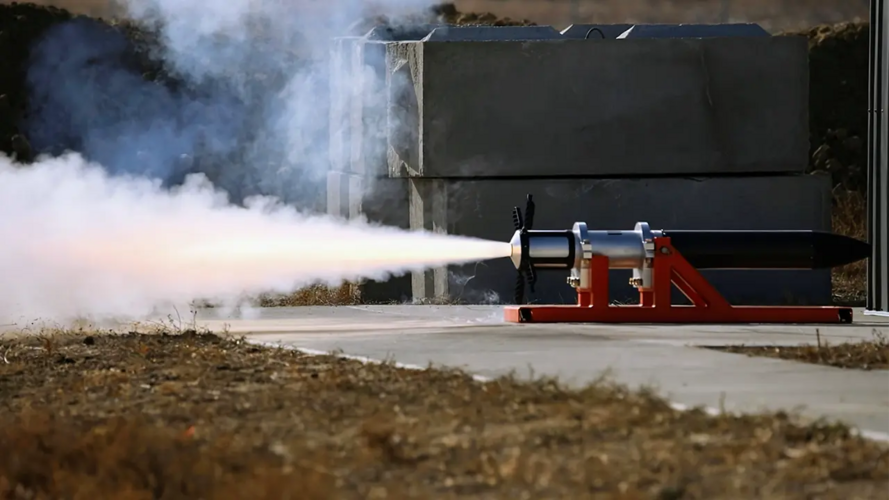

Since the rocket-motor in question was less than 10" in size and for an existing design I was thinking of either an AIM-120, AIM-9 or maybe AIM-7M/P.
TUCSON, Ariz., Dec. 18, 2024 /PRNewswire/ -- Raytheon, an RTX (NYSE: RTX) business, and Ursa Major announced its advanced long-range solid rocket motor completed a successful missile flight test for the U.S. Army. The companies' combined experience and expertise in digital engineering was a critical factor in accelerating the design and development of this transformational capability.
"These long-range solid rocket motors will allow the U.S. Army and allies to strike farther and faster than anything our adversaries have in their arsenals," said Tom Laliberty, president of Land and Air Defense Systems at Raytheon. "This long-range rocket motor technology fills the essential role of providing affordable precision fires, while increasing range, safety, and magazine depth."
Raytheon and Ursa Major's technical approach composes innovative, low-cost component technologies to deliver a new generation of smart munitions for the U.S. Army that are significantly more affordable than currently fielded systems.
"The Ursa Major team has utilized additive manufacturing to complete motor development, manufacturing, and testing in unprecedented timelines, resulting in nearly 300 static test fires this year," said Ursa Major CEO Dan Jablonsky. "The innovative manufacturing techniques we employ are yielding agile solid rocket motor solutions with the design flexibility needed to expand the capabilities of the U.S. military. Ursa Major is poised to scale the production of higher-performing solid rocket motors at the pace and volume the country requires and at a price the country can afford."
Raytheon has selected Ursa Major's advanced propulsion technology as a key enabler to provide affordable solutions for the U.S. Army at extended ranges. During the next phase of the program, Raytheon and Ursa Major will incorporate manufacturing improvements, leading toward additional flight tests in 2025 and qualification in 2026.
In 2023, RTX Ventures invested in Ursa Major to explore new rocket motor technologies and help address this national security requirement. Together, Raytheon and Ursa Major are responding to the U.S. Army's urgent need for affordable precision-guided munitions by rapidly developing a new generation of smart munitions, via investments in rocket motor development and testing to prove design stability and maturity.
Ok, maybe this is relevant:
https://sam.gov/opp/d019864b531048eea0e5558caf82b535/view
"Sources sought" announcement for alternative suppliers of GMLRS rockets from August. The timing fits -- this announcement was about 4 months ago. They could be testing the basic GMLRS rockets (<10 inches) now, with the intention of testing the ER rocket in the near future.
That's just a solicitation for the upcoming production lots for GMLRS. Its not a notice to find a second supplier for either the GMLRS or GMLRS ER magazine.
AvWeek thought otherwise (they certainly could be wrong, though)
https://aviationweek.com/defense/mi...ests-competitive-bids-future-gmlrs-production
Army did go ahead with a multi-year award to LM, though.
Looks like something that they post before negotiating a contract. Raytheon certainly isn't sitting on a FY25 production capacity of 14K GMLRS rounds per year. That would be equivilant to them holding the entire Lockheed GMLRS production footprint idle.
Liquid propulsion for hypersonics provides flight capabilities not seen before
Ursa Major's American-made storable liquid rocket engine technology offers advantages over traditional liquid and solid rocket propulsion.
https://breakingdefense.com/2025/12...provides-flight-capabilities-not-seen-before/
Could also be for a Hellfire/JAGM.A 7" diameter rocket-motor is clearly aimed at as a replacement or supplement for the current AIM-120 rocket-motor.
Could also be for a Hellfire/JAGM.

IIRC, UM is also working with AFRL to fly the liquid fuel draper engine equipped Angry Tortoise in the coming months first at WSMR and then over the Pacific at higher Mach. This appears to be a pitch to continue to evolve the engine and put together some sort of weapon system utilizing it.
https://ursamajor.com/media/press-release/unleashing-havoc-hypersonic-missile-system/
Ursa Major unleashes HAVOC with new hypersonic missile
https://breakingdefense.com/2026/02/ursa-major-unleashes-havoc-with-new-hypersonic-missile/
One can't help but wonder why the US military would go back to using liquid-fueled rockets carrying onboard oxidizer.
Throttleability is my guess and maybe a bottleneck on solid propellants perhaps.One can't help but wonder why the US military would go back to using liquid-fueled rockets carrying onboard oxidizer.

So why not ramjet/scramjet? More range. (Though the rocket might be cheaper, albeit forget the insensitive munitions requirement.)Throttleability is my guess and maybe a bottleneck on solid propellants perhaps.
LFR can go exo-atmospheric and take a trajectory close to an MET giving more range.So why not ramjet/scramjet? More range. (Though the rocket might be cheaper, albeit forget the insensitive munitions requirement.)
https://ursamajor.com/media/press-release/ursa-major-to-go-public/The business combination with Inflection Point-led SPAC expected to provide at least $350 million in committed capital to rapidly scale defense industrial base production


