I'm somewhat surprised that there are still performance gains to be had simply from software changes. Seems like that is low-hanging fruit that would already have been taken advantage of.
This appears to be specific to the AIM-120 D3. If so, then this is something that needed the F3R for the software to unlock some additional capability.
 
Last edited:
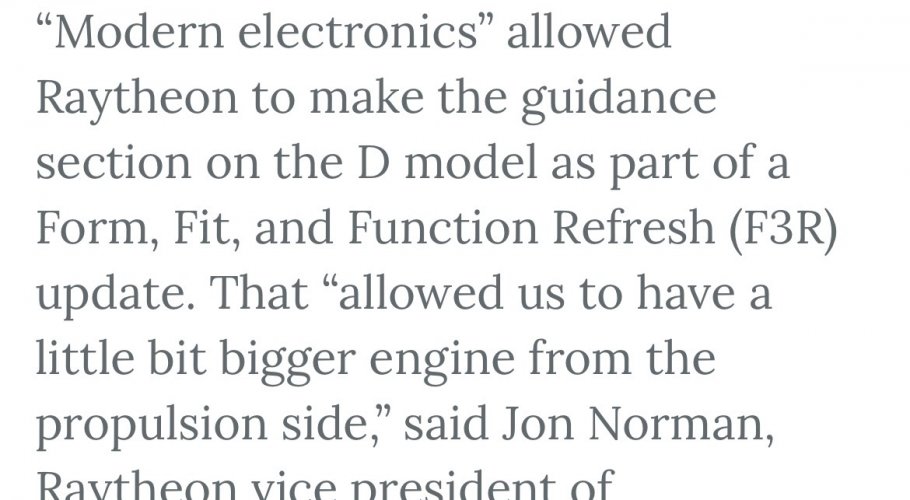
AMRAAM Lot 38 marks the sixth production lot of missiles developed under the Form, Fit, Function Refresh, or F3R, Raytheon said.

F3R is a modification which features improved guidance circuitry and new software, according to the company. It includes a fresh processor to support more advanced algorithms and upgrades to 15 circuit cards in the missile’s guidance section.


more energy efficient operation extends the battery life, which means you can chuck it farther against minimally maneuvering targets?
 
F3R is a modification which features improved guidance circuitry and new software, according to the company. It includes a fresh processor to support more advanced algorithms and upgrades to 15 circuit cards in the missile’s guidance section.

I'd say that the FFFR upgrade happened in two stages with the first stage being the hardware upgrade and then the second stage being the software upgrades to take advantage of the now greatly expanded microprocessor capacity.
 
poor IR target. Small, the main airframe is basically background temperature due to low speed, and the engine is relatively cool compared to jet exhaust.

If you're going to use an IR-guided AAM to intercept such a drone the best intercept geometry is a tail-chase to shoot the drone from behind, that's not a good interception geometry though.
 
With AIM-260A on the verge of becoming operational, the Navy operating the AIM-174, and the AF/Navy likely having other classified A2A efforts, looks like a bit redundant to field a AMRAAM+ESSM motor combo especially given the sheer number of platforms this would have to be qualified on. A more simpler AIM-120D3 upgrade would be a more wiser investment given that Raytheon is expected to produce thousands of D3's and D3++ missiles before it sunsets production probably in the early part of the next decade.
 
I’m wondering, would it be possible to use AARGM-ER in air to air ? I vaguely remember hearing in an interview that HARM could be used defensively but it not very accurate
 
Pushing advanced AMRAAMs into the wings and inventory helps push down lower capability AMRAAMs into other applications like FMS and utilization in point defense.

As a side note, a question just bubbled up: will F-47s IWBs be capable of an equivalent, maximum load of AIM-120s vs all -260s…?

Deleted pointless and yet factually wrong AMRAAM model specific comment
 
Last edited:
Pushing advanced AMRAAMs into the wings and inventory helps push down lower capability AMRAAMs like C8 into other applications like FMS and utilization in point defense.
The US does not operate any AIM-120C8. It is a uniquely FMS and export configuration, pairing the AIM-120C7 with the F3R hardware now the production standard on both the C and D variants.
 
I would be very surprised if they could not, my understanding is that the -260 was spec'ed to have the same fin span as the AIM-120C.

Yes so a -260 can fit where a -120 could from a volumetric perspective but could you achieve more efficient 2D packing by staggering 260s so the fins overlap on the X axis but not on the Y (in a common missile layer deep Z plane), in a way that would be much more difficult if not impractical with AIM-120s?… oh man I’ve read too many threads to remember where but I’m sure this has been discussed…
 
Yes so a -260 can fit where a -120 could from a volumetric perspective but could you achieve more efficient 2D packing by staggering 260s so the fins overlap on the X axis but not on the Y (in a common missile layer deep Z plane), in a way that would be much more difficult if not impractical with AIM-120s?… oh man I’ve read too many threads to remember where but I’m sure this has been discussed…
I don't think so, the Tail fins are still the same size.
 
I kinda wonder if it could be used against something like Mig-31

IMO to intercept a MiG-31 it would have to be a head-on shot and the Foxhound's fire-control radar would have to be in operation continuously until it got close enough to lock on with its' terminal Ka-band active radar-seeker (I wonder if it has a proximity fuse?).
 
Last edited:
I pointed out that it could be used against an AWACS aircraft (They're not what one would call agile).
iirc Lockheed's Mako briefly cites this capacity in some divulgation material as something that can be explored, but since it lost to AARGM-ER continuation project which is a much more orthodox land/surface attack missile I believe no one is exploring this atm
 
just realized the said missile would be very similar to the r-37m, fast, big range but chunky, so primarily focused on AWACS, although there's at least one kill of a f-16 attributed to it
 
just realized the said missile would be very similar to the r-37m, fast, big range but chunky, so primarily focused on AWACS, although there's at least one kill of a f-16 attributed to it
R-37M and AIM-174 probably quite agile at high altitude given their large lifting surface
 
Last edited:
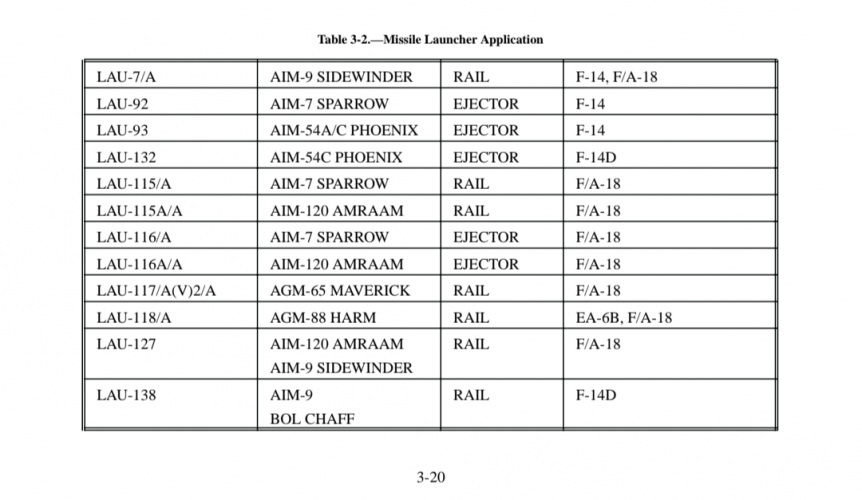
Does anyone know if the LAU-127 launch-rail used to launch the AIM-120 can also launch the AIM-7?
 
iirc Lockheed's Mako briefly cites this capacity in some divulgation material as something that can be explored, but since it lost to AARGM-ER continuation project which is a much more orthodox land/surface attack missile I believe no one is exploring this atm

MBDA's FCASW supersonic missile, Stratus RS (Rapid Strike) will reportedly have air to air capabilities against HVT's like AWACS or AAR. Although a MiG-31 has limited manoeuverability at high altitude, its ability to turn and increase range/angles very quickly would I suspect be enough to evade.
 
MBDA's FCASW supersonic missile, Stratus RS (Rapid Strike) will reportedly have air to air capabilities against HVT's like AWACS or AAR. Although a MiG-31 has limited manoeuverability at high altitude, its ability to turn and increase range/angles very quickly would I suspect be enough to evade.
There's avoiding the missile and there's avoiding the schrapnel. SA-2s probably never hit any air target directly and the Stratus RS's warhead is probably at least as big or bigger. Whether it will have a proxy fuse or not? If A2A is a capability, it probably will.
 
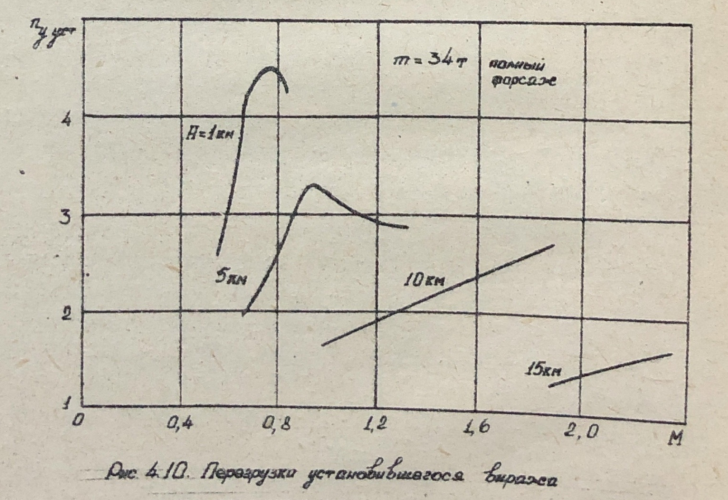
at high altitude, fighters aren't exactly agile, Mig-31 at 15 km altitude can sustain about 1.5G
But they are faster than vehicles and structures on surface what AARGM is designed for.
 
i wonder if the increase in production would cause a more advanced aim120 to be developed. something between a D and 260?
 

Similar threads

Back
Top Bottom