
You are using an out of date browser. It may not display this or other websites correctly.
You should upgrade or use an alternative browser.
You should upgrade or use an alternative browser.
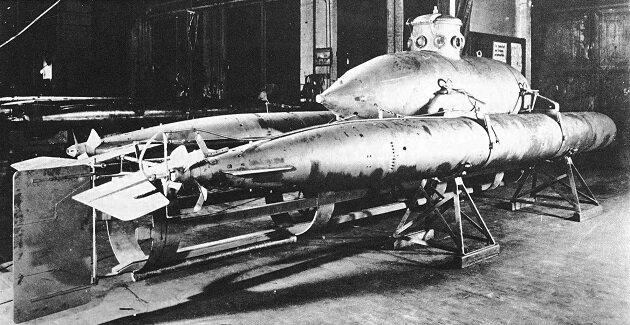
Unknown midget torpedo boat
- Thread starter Raketyr
- Start date

- Joined
- 11 March 2006
- Messages
- 8,491
- Reaction score
- 4,743
Unfortunately, I cannot identify the writing on those signs on the wall, as those would give quite a certain clue about the nationality. Could you give the source, please, as this may ease identification ?
The torpedoes don't look exactly like German types to me, after looking through Rössler's book, though they might be
older, than expected, juding the old fashioned conning-tower.
The torpedoes don't look exactly like German types to me, after looking through Rössler's book, though they might be
older, than expected, juding the old fashioned conning-tower.

Raketyr
ACCESS: Restricted
- Joined
- 7 February 2008
- Messages
- 37
- Reaction score
- 69
Thank you for answer.Unfortunately, I cannot identify the writing on those signs on the wall, as those would give quite a certain clue about the nationality. Could you give the source, please, as this may ease identification ?
The torpedoes don't look exactly like German types to me, after looking through Rössler's book, though they might be
older, than expected, juding the old fashioned conning-tower.
It's been a few years since I saved the picture and unfortunately I can't find the pages anymore. There were more photos of unknown to me prototypes of German and Japanese midget submarines and manned torpedoes.

- Joined
- 11 March 2006
- Messages
- 8,491
- Reaction score
- 4,743
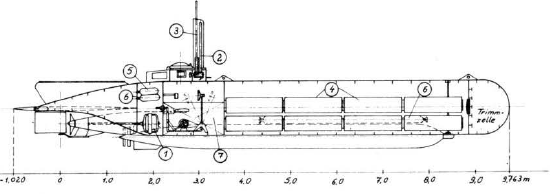
Don't think so, as the Molch had the conning tower at about the rear end of the torpedoes, with rectangular and fewer windows, and judging this schematic drawing from Roessler "Geschichte des deutschen U-Bootbaus", no such integral pressure hull. But the idea of an uncompleted midget sub is worth considering.Seems be uncompleted migdet submarine Molch.
- Joined
- 11 March 2006
- Messages
- 8,491
- Reaction score
- 4,743
A quick search, a new idea taking into account airmans "uncompleted midget sub" idea :
The visible part actually is only the pressure hull, that's why those circular windows are protruding, making the whole thing look like from the late 19th century, but the whole outer shell still is missing. As said by Raketyr, the photo stems from a book about German and Japanese midget subs, so the assumption, that it's German may be correct. Juding that "pressure hull", the bow may have been more pointed, as in other German midget subs.
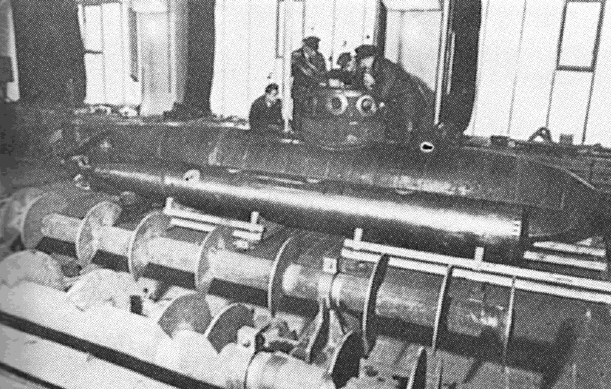
The predecessor to the Biber was a single boat, called "Adam", which was built in 1944, and as stated in Fock's "Marinekleinkampfmittel" (Naval small battle units) got several modifications, before it transmuted into the Biber.

This photo may be shows the faired conning tower and the completed rear section.
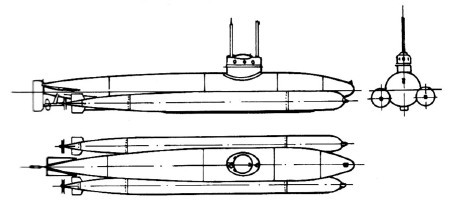
In Gröner's "Die deutschen Kriegsschiffe 1815 - 1945, Bd.8.2", there's a drawing of the Adam:

The diving planes don't match the shape shown in the photo, neither do the torpedoes, but they may have been incomplete, too.
Just an idea ...
The visible part actually is only the pressure hull, that's why those circular windows are protruding, making the whole thing look like from the late 19th century, but the whole outer shell still is missing. As said by Raketyr, the photo stems from a book about German and Japanese midget subs, so the assumption, that it's German may be correct. Juding that "pressure hull", the bow may have been more pointed, as in other German midget subs.
The predecessor to the Biber was a single boat, called "Adam", which was built in 1944, and as stated in Fock's "Marinekleinkampfmittel" (Naval small battle units) got several modifications, before it transmuted into the Biber.
This photo may be shows the faired conning tower and the completed rear section.
In Gröner's "Die deutschen Kriegsschiffe 1815 - 1945, Bd.8.2", there's a drawing of the Adam:
The diving planes don't match the shape shown in the photo, neither do the torpedoes, but they may have been incomplete, too.
Just an idea ...
- Joined
- 11 March 2006
- Messages
- 8,491
- Reaction score
- 4,743
Seem to be full sized torpedoes, fitted with warheads, so maybe not be used as the propulsion system.
If that structure below is actually part of the sub itself, and not just a kind of a jig, it probably would house
drive train with the propellor, I think.
But you're right in so far, as the forward part ("pressure hull") sits too high and probably was nearly the whole length of midget subs like Adam, Biber, Molch and so on.
So, next idea, please ...
If that structure below is actually part of the sub itself, and not just a kind of a jig, it probably would house
drive train with the propellor, I think.
But you're right in so far, as the forward part ("pressure hull") sits too high and probably was nearly the whole length of midget subs like Adam, Biber, Molch and so on.
So, next idea, please ...
The fuselage matches a towed catamaran model, published by Fock, tested in the Hamburg basin. In place of the torpedos one can see floats.Does anyone have more information on this apparently German vessel?View attachment 706593
Silencer1
That now I am the Ruler of the Queen's Navee!
- Joined
- 3 August 2009
- Messages
- 943
- Reaction score
- 696
I noted, that torpedoes doesn't have control surfaces in their tails. So, if this is the actual submarine, these torpedoes hardly could be stabilized after their launch - both by direction or by depth.
Perhaps, they are really used as "off-the-shelf" power units?
Perhaps, they are really used as "off-the-shelf" power units?
Raketyr
ACCESS: Restricted
- Joined
- 7 February 2008
- Messages
- 37
- Reaction score
- 69
May I ask which book by Harald Fock has a photo or drawing of this catamaran?The fuselage matches a towed catamaran model, published by Fock, tested in the Hamburg basin. In place of the torpedos one can see floats.
Raketyr
ACCESS: Restricted
- Joined
- 7 February 2008
- Messages
- 37
- Reaction score
- 69
Looks like it.I noted, that torpedoes doesn't have control surfaces in their tails. So, if this is the actual submarine, these torpedoes hardly could be stabilized after their launch - both by direction or by depth.
Perhaps, they are really used as "off-the-shelf" power units?
"Die Deutschen Schnellboote 1914-1945", published by Koehler. Please see the captured image.May I ask which book by Harald Fock has a photo or drawing of this catamaran?
Attachments
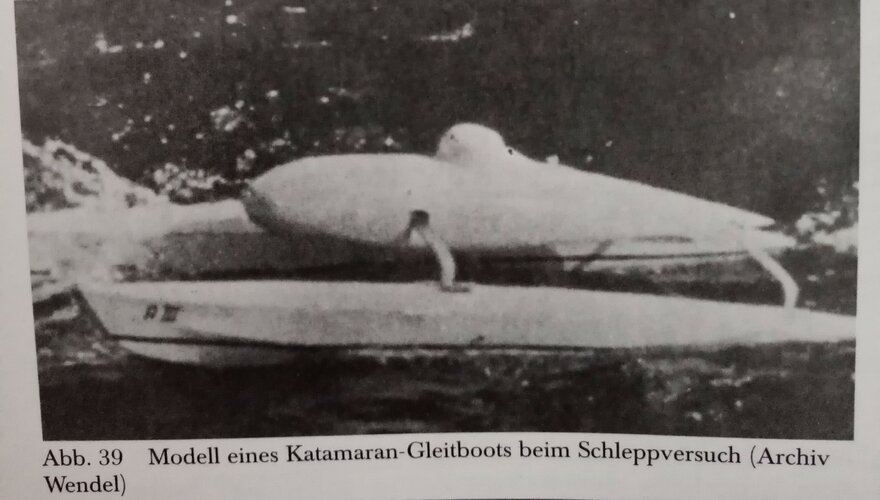
Raketyr
ACCESS: Restricted
- Joined
- 7 February 2008
- Messages
- 37
- Reaction score
- 69
Thank you very much, the catamaran is very interesting. I ordered the book"Die Deutschen Schnellboote 1914-1945", published by Koehler. Please see the captured image.

Does anyone have more information on this apparently German vessel?
T.V.A. Eckernförde "Torpedoreiter"
February 9, 1944
The "Torpedoreiter" consists of a pressure hull supported by struts resting on two torpedoes, which simultaneously propel the vessel forward. Between the two torpedoes, beneath the pressure hull, rests the combat torpedo in a simple rack. The pressure hull has a conning tower and a periscope. The two propulsion torpedoes are set to a specific base speed. Speed can be changed by deactivating one of the torpedoes. The "Torpedoreiter" weighs 5.5 tons. The speed achieved in trials was 3 knots; 6 knots is hoped for. Its operating range is 30 nautical miles. The pressure hull is pressure-resistant to a depth of 40 meters.
Source:
Bundesarchiv
Signatur: RM 7/1258, Page: 58 - 62
Don`t mention! Actually, I have ordered the document through BA/MA`s "Digitisation on Demand".Thanks also go to Wurger for finding document RM 7/1258.
Raketyr
ACCESS: Restricted
- Joined
- 7 February 2008
- Messages
- 37
- Reaction score
- 69
moin1900 and Wurger: Great!
Thank you very much for identifying the previously unknown mini-submarine. It's a shame there aren't more photos, or even a drawing, but maybe they're still waiting to be discovered somewhere (-;
Thank you very much for identifying the previously unknown mini-submarine. It's a shame there aren't more photos, or even a drawing, but maybe they're still waiting to be discovered somewhere (-;
Similar threads
-
-
Unknown Pre-World War Two and World War Two Soviet Midget Submarine Designs
- Started by papacavy
- Replies: 9
-
-

-