I've read 50% more range for AIM-120 from F-22 supercruising M1.6, so it's substantial.

Don't forget that height of release also plays a part....so the likes of F-22 and Typhoon will be firing AIM-120 and Meteor at much higher speeds and altitudes than anything else out there...both are designed for the high end of supercruise and operating at 50,000ft+ where other fighters struggle.
 
Don't forget that height of release also plays a part....so the likes of F-22 and Typhoon will be firing AIM-120 and Meteor at much higher speeds and altitudes than anything else out there...both are designed for the high end of supercruise and operating at 50,000ft+ where other fighters struggle.
My understanding is that meteor gains substantially less from High/High launch than AMRAAM does though.
 
My understanding is that meteor gains substantially less from High/High launch than AMRAAM does though.
Maybe because of lofting? If i remember right AMRAAM mostly flies from that point even higher to gather more energy for flight while Meteor goes relative straight to target but i can be wrong.
 
Maybe because of lofting? If i remember right AMRAAM mostly flies from that point even higher to gather more energy for flight while Meteor goes relative straight to target but i can be wrong.
Meteor's blessing and it's curse is it's ramjet. It's flight inherently is more similar to a plane than to a projectile/glider.

Ramjet has stupid big advantage on isp, but it comes with rather high drag.
As such, it recovers insufficient boost really well, but at the same time - additional boost will also be dragged down into normal cruise phase.

In fact, meteor and it's future descendants alone are probably a strong argument against supersonic investments. It's already kinda stupid - the platform that benefits from meteor the most is arguably Gripen (as it benefits the least from AMRAAM), and the least - for Eurofighter. Interesting weapon adaptation from the MBDA.
 
Last edited:
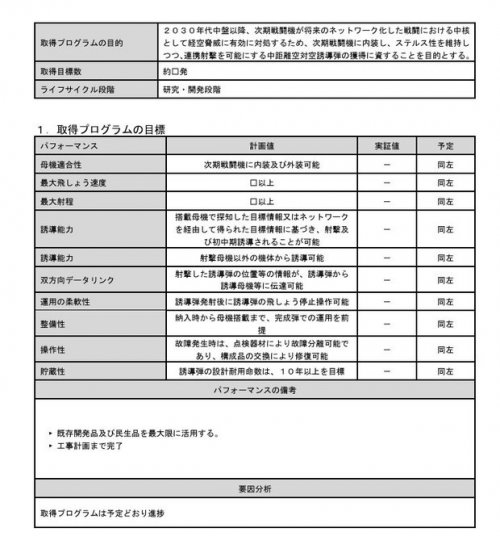
The missile Japan will be using is tentatively designated as 「Next-generation medium-range air-to-air guided missile」.

It is neither AMRAAM nor Meteor.

https://www.mod.go.jp/j/policy/hyouka/seisaku/2023/pdf/jizen_14_honbun.pdf
https://www.mod.go.jp/atla/soubiseisaku/project/gaiyo_r080520.pdf
40 AAM
50 NGF
51 CCA

explanation of the important parts of the AAM.
(Installability) Can be installed/exterior on next-generation fighter jets.
(Networked Firing) Capable of firing and initial/mid-range guidance based on target information from the carrier aircraft or target information via the network.
(Bidirectional DL) Capable of transmitting the missile's position information from the missile to the carrier aircraft, etc.
Speed and range are classified information and therefore not disclosed.
 

Attachments

  • HIwv8Nga4AEeOKX.jpg
    HIwv8Nga4AEeOKX.jpg
    71.6 KB · Views: 22
Last edited:
It can be said that the British government’s explicit statement that it will sign the GCAP international contract “by the end of this month” is one of the few pieces of good news lately.

However, I still honestly have doubts about whether the UK will truly “put its money where its mouth is.”

I’m not British, so I’d like someone familiar with the UK government to explain: Is there any assurance that they will actually allocate a proper budget for GCAP by the end of this month and provide R&D funding on par with their partners? Could they end up reneging on their international commitments?
 
I wrote an article about some possibilities that history says might work.
I think you're rather underestimating the UK's own commitment to design-by-analysis, which dates back to the adoption of Operational Research by the RAF and RN in WWII and was definitely heavily in play for the design of Typhoon.
 
I’m not British, so I’d like someone familiar with the UK government to explain: Is there any assurance that they will actually allocate a proper budget for GCAP by the end of this month and provide R&D funding on par with their partners? Could they end up reneging on their international commitments?
GCAP is a flagship programme, more so than most of the other aspirations in the funding gap (AUKUS probably runs a close second). I don't think there's any doubt it will be funded. I'm slightly less certain it will be all in place by the end of the month, given the new Defence Secretary has been in place less than a week, but I'll be surprised if the delay was more than a few days.
 
I think you're rather underestimating the UK's own commitment to design-by-analysis, which dates back to the adoption of Operational Research by the RAF and RN in WWII and was definitely heavily in play for the design of Typhoon.
OR (from existing aircraft and operations) turning into Operational Analysis (informing new concepts) in the 50s/60s started to influence design at Warton, and dominated it by the 70s. Back in the 1940s Multhopp's work was fairly pioneering. The book shows the missing link was none other than Alan Turing, whose first computer allowed designers at Warton to wrestle with very advanced maths, until then the preserve of prodigies like Multhopp. You are spot on about Typhoon.
 
OR (from existing aircraft and operations) turning into Operational Analysis (informing new concepts) in the 50s/60s started to influence design at Warton, and dominated it by the 70s.
I think you're underestimating the degree of forward planning analysis that was inherent in OR from the start - OR was the minor segment of my degree (Lancaster, '85) and everything was 'this is the situation, what do we change to optimise the result'.

A good example was the adoption of Squid by the RN, replacing both traditional depth charges, and Hedgehog, which while an ahead-thrown weapon and better than depth charges, featured a particularly small warhead and contact fuzing. OR showed that if you could hold the sonar contact, including its depth, and drop a big enough charge around the sub, then your results would be even better. So the last generation of wartime destroyers and escorts got Squid or Double Squid, with the Type 147B Sword depth attachment for their attack sonar.
 
I think you're underestimating the degree of forward planning analysis that was inherent in OR from the start - OR was the minor segment of my degree (Lancaster, '85) and everything was 'this is the situation, what do we change to optimise the result'.

A good example was the adoption of Squid by the RN, replacing both traditional depth charges, and Hedgehog, which while an ahead-thrown weapon and better than depth charges, featured a particularly small warhead and contact fuzing. OR showed that if you could hold the sonar contact, including its depth, and drop a big enough charge around the sub, then your results would be even better. So the last generation of wartime destroyers and escorts got Squid or Double Squid, with the Type 147B Sword depth attachment for their attack sonar.
I hope I am not underestimating it but the book has a very focussed narrative on two design teams. Blackett was in the book briefly as he led a post WW2 committee that recommended a supersonic fighter, and had both a fundamental role in OR in WW2 and naval experience from WW1. Sadly, the need to focus on the core story saw that trimmed.

As you will know Maurice Kirby is good on the wider history. I stick to how it affected Kingston and Warton directly on selected fighter projects.
 
Last edited:
GCAP, AUKUS being high profile international programs with wide ranging consequences beyond the headline system. Cannot be junked or dodged.
Same for Type 26.

While the Army's mess in Ajax has no international partner.
 
SOrry if this has already been posted.

https://www.politico.eu/article/uk-canada-defense-bank-fighter-jet-programs-talks/
Blair also told POLITICO that Canada is giving “very serious consideration and [is] engaged in discussions” with Britain, Japan and Italy about its “potential future participation” in the Global Combat Air Programme (GCAP) — a joint venture aimed at delivering sixth-generation fighter jets by 2035.

"We believe Canada can make a very significant contribution to that initiative,” he said, adding that his country has an aeronautics industry and wider sectors that have the technology, training and testing capability required for the program. In addition, he highlighted Canada’s national resources and secure supply chains for critical minerals as key assets for the scheme.

He noted that Canada has “a great deal of confidence” in Britain, Japan and Italy as “good partners,” and has already “initiated conversations with those countries to see where it might be appropriate for Canada to participate.”

Canada had already been linked to the program as an observer, but Blair's comments represent the first direct intervention by Ottawa, and raise the prospect of more direct involvement.
 
Now that reads as rather more than just GCAP is being discussed and it raises some interesting questions.

But Canada is a good fit for GCAP and it does raise some thoughts on future sales.....
 
"We believe Canada can make a very significant contribution to that initiative,” he said, adding that his country has an aeronautics industry and wider sectors that have the technology, training and testing capability required for the program. In addition, he highlighted Canada’s national resources and secure supply chains for critical minerals as key assets for the scheme.
This doesn't sound like "we'd like to buy the thing" but more like "we also want a piece of this cake". It's to be seen how willing Japan and Italy are to give up some slices of their own for Canada.
 
This doesn't sound like "we'd like to buy the thing" but more like "we also want a piece of this cake". It's to be seen how willing Japan and Italy are to give up some slices of their own for Canada.
At best, I see Canada getting some parts of the planes to build. Vertical stabilizers and rudders, maybe.

In general, Canada would be buying some early production slots, nothing more!
 
At best, I see Canada getting some parts of the planes to build. Vertical stabilizers and rudders ...

That is dead impressive! A former PM and a former BoE governor sit down to chat informally about a proposed Defence, Security, and Resilience Bank and some expensive wingy thing. And, from that, you can extrapolate the exact nature of the industrial scraps that Canada will glean from involvement in the latter?

High Commissioner (and former MND) Bill Blair himself described Canada as a "secure supply chains for critical minerals" for GCAP. In other words, mainly providing a source of rare earths and strategic metals (including untariffed aluminium) for Tempest.
 
That is dead impressive! A former PM and a former BoE governor sit down to chat informally about a proposed Defence, Security, and Resilience Bank and some expensive wingy thing. And, from that, you can extrapolate the exact nature of the industrial scraps that Canada will glean from involvement in the latter?
Considering that UK, Italy, and Japan have already done the industrial split?

Yes, I can guess that someone would be willing to throw Canada a bone and let them have a simple piece or two to make.


High Commissioner (and former MND) Bill Blair himself described Canada as a "secure supply chains for critical minerals" for GCAP. In other words, mainly providing a source of rare earths and strategic metals (including untariffed aluminium) for Tempest.
Which means zero workshare for Tempest proper. As the raw materials aren't really specific/unique to Tempest.
 
...
Which means zero workshare for Tempest proper. As the raw materials aren't really specific/unique to Tempest.

Yeah, you kind of missed my point. Ottawa probably isn't looking for a "bone". The GoC is focused on that Defence, Security, and Resilience Bank. I described GCAP as an "expensive wingy thing" because I very much doubt that Carney, et al, care about it ... but they're well aware that Britain does.

Bill Blair's comments went straight to that "secure supply chains for critical minerals" idea. A firm deal with grown-ups on that supply chain is the brief that Ottawa wants to grow. If the GoC was seriously interested in nailing together random widgets for the Tempest, they wouldn't still be faffing about with 'observer' status of GCAP.
 
I've got to agree the materials and banking issues is the big win here for both Canada and the UK.

GCAP is icing on the cake.

Strategically Canada is perfectly positioned between the UK and Japan.

If things go well Canada may see some offset benefits from the GCAP relationship. But that's likely felt in other areas rather than getting a slice of GCAP work.
 
Thing is, you don't get many economic benefits from digging a little more out of the ground. You're not hiring 1000 aerospace rivet-beaters with their high salaries that pay a lot of people out in town, that pay more people out in town etc.
 
I imagine the observer status is just he start. It gives them a bit of input, lets them ask questions and ultimately they can progress forward from that a little easier.

I think a future Canada can ask, "can we repair and have final assembly" type of question, rather than "Can we build the landing gear or glove box & drinks holder"
 
Thing is, you don't get many economic benefits from digging a little more out of the ground. You're not hiring 1000 aerospace rivet-beaters with their high salaries that pay a lot of people out in town, that pay more people out in town etc.

But this isn't just about digging minerals out of the ground, we are also talking about smelting and processing. Thanks to a couple of illegal wars, Europe now also lacks much of the imported energy needed to process ores. Canada has its own energy resources.

Put another way, direct Canadian involvement in GCAP will likely be more akin to the deal TKMS just announced with Valbruna ASW for the CPSP. If they win the procurement contract, Europeans will still build the submarines ... but they'll be built using specialty steels processed in Welland, Ontario.

For EU country members like Italy, Canada already has the advantage of being a SAFE participant. Broader ideas like the DSRB are intended to 'lube' similar relations with non-EU countries - in the context of GCAP, the UK and Japan.

As for the economic benefits of the aerospace industry, for smaller economies, such investments don't really scale how was once thought. Governments of such nations can subsidise industry until fighter orders dry up ... then rivet-punchers are back on pogey again. Specialist niches are the way to go - so Canadian aerospace is probably better-off building Globals, Dash 8s, and waterbombers.
 
But this isn't just about digging minerals out of the ground
It's every project has four dimensions, height, length, breadth, and politics all over again, but people don't normally consider that the politics can be the primary driver all on their own. Canada is looking to rapidly strengthen geopolitical ties that don't point southwards, and this does that.
 
Last edited:
It's every project has four dimensions, height, length, breadth, and politics all over again, but people don't normally consider that the politics can be the primary driver all on their own. Canada is looking to rapidly strengthen geopolitical ties that don't point southwards, and this does that.
It'll be highly ironic if Canada will get an actual interceptor actually meaningful for the defense of Canada, purely because of that 4th dimension.
 
If things go well Canada may see some offset benefits from the GCAP relationship. But that's likely felt in other areas rather than getting a slice of GCAP work.
There could be Canadian involvement in things like integrating the links to GlobalEye and NORAD, which could have marketing value for future sales.
 
From what I've been told, when we originally bought into the JSF program it wasn't with a clear intent to purchase or do assembly, rather it was to open the way for Canadian firms to act as subcontractors for smaller parts and participate in the supply chain.
 
My understanding is that meteor gains substantially less from High/High launch than AMRAAM does though.
Because meteor uses air-breathing ramjet to extend its range. There is less air at higher altitude so you get less performance out of a ramjet.
 
My understanding was the opposite, its optimised for relatively thin air and at Mach 4 its getting plenty supplied, it struggles close to ground level because of high air resistance in the thicker air. The 100km+ range is when being released at Mach 1 at altitude. When being released at Mach 0.5 while skimming terrain (and assuming the target is itself at altitude) its range drops to about 2/3rds that.
 
My understanding was the opposite, its optimised for relatively thin air and at Mach 4 its getting plenty supplied, it struggles close to ground level because of high air resistance in the thicker air. The 100km+ range is when being released at Mach 1 at altitude. When being released at Mach 0.5 while skimming terrain (and assuming the target is itself at altitude) its range drops to about 2/3rds that.
Probaly both is the case. Too high and the ramjet suffers (and lift?) but too low makes drag your enemy
 
Last edited:
My understanding was the opposite, its optimised for relatively thin air and at Mach 4 its getting plenty supplied, it struggles close to ground level because of high air resistance in the thicker air. The 100km+ range is when being released at Mach 1 at altitude. When being released at Mach 0.5 while skimming terrain (and assuming the target is itself at altitude) its range drops to about 2/3rds that.
Then range would've been much higher; 4M cruise at minimum throttle is plenty fast, especially in a missile which has insane isp (no oxidizer in fuel) and throttle (no oxidizer in fuel).
Like, in this case range should've been underestimated many times.

The best way to explain these inconsistencies, at least as a guy without related background, is that cruise is likely similar to other ramjet cruise missiles(<mach 3), burning at an optimal rate. 4M is instead a v max, which missile can reach in principle, and will ideally try to in the endgame.
 
Meteor has a 3 second oxidised kick burner to get up to supersonic speeds followed by a 30-40 second sustained burn. This is in contrast to other missiles which generally have an initial burn time of about 12 seconds and then are relying purely on kinetic energy.
 

Similar threads

Back
Top Bottom