Turkish engines, power packs and propulsion projects

Interesting development as Baykar is going to develop a 20.000lb thrust engine or the Kizilelma. A gap filled between the TF10000 and TF35000

View: https://x.com/T_Nblty/status/1919458237088252160
I truly hope they won't resort to stealing talent from other key players (as is their usual practice), since the talent base for this in Turkey is finite.

They can't just jump from designing piston engines to 90 kN-class turbofans. I understand this won't happen overnight, and that they're developing a lower-thrust turbofan for Kizilelma as an intermediate step, but they're still taking baby steps. Baykar hasn't yet established the necessary human capital or infrastructure in-house, so they'll have to source these from somewhere.
 
May I hint that Ukraine has still some MIG-29 with probably Klimov RD-33 engines (18,000 to 20,000 lbf).
If you think about the Ukrainian pre-war turbofan jet engine knowledge and the good Baykar -Ukraine relations, I would bet on a different knowledge transfer scenario (at least for the base).
Soo, I'm betting on an engine with 20,000 lbf, a length of ca. 4.20m and a service life of around 4,000 hours. Lets wait and see.

Edit: Thinking a bit more about this Baykar jet engine, it could also be used as a lever to get GE-404 engines for armed Hurjets.
 
Last edited:
May I hint that Ukraine has still some MIG-29 with probably Klimov RD-33 engines (18,000 to 20,000 lbf).
If you think about the Ukrainian pre-war turbofan jet engine knowledge and the good Baykar -Ukraine relations, I would bet on a different knowledge transfer scenario (at least for the base).
Almost all of them immigrated to Central European countries... And Baykar's relations with Motor Sich isn't as good as people think anyway...

In the meanwhile, Baykar has gained notoriety for poaching talent from companies engaged in critical NatSec projects...
 
I truly hope they won't resort to stealing talent from other key players (as is their usual practice), since the talent base for this in Turkey is finite.

They can't just jump from designing piston engines to 90 kN-class turbofans. I understand this won't happen overnight, and that they're developing a lower-thrust turbofan for Kizilelma as an intermediate step, but they're still taking baby steps. Baykar hasn't yet established the necessary human capital or infrastructure in-house, so they'll have to source these from somewhere.

That's silly way of thinking, as long as the talent remains in Turkey I don't see any issues with that!

People need to remind themselves, that GE Aerospace’s 46.2% ownership in TEI can potentially limit or influence TEI’s independent strategic decisions, particularly in sensitive areas like indigenous engine development. So far we haven't seen those strings being pulled, but, it's not to say it won't be in the future.

Baykar with zero foreign stakeholders is the best foot forward for domestic development with minimal external influence, migrating TEIs engineers there would be beneficial, not to the counter!

Anyway, a lot of the material developments which are the most important part of a jet engine, were made by state owned scientific institutes, so not owned by those companies.
 
Last edited:
May I hint that Ukraine has still some MIG-29 with probably Klimov RD-33 engines (18,000 to 20,000 lbf).
If you think about the Ukrainian pre-war turbofan jet engine knowledge and the good Baykar -Ukraine relations, I would bet on a different knowledge transfer scenario (at least for the base).
Soo, I'm betting on an engine with 20,000 lbf, a length of ca. 4.20m and a service life of around 4,000 hours. Lets wait and see.

Edit: Thinking a bit more about this Baykar jet engine, it could also be used as a lever to get GE-404 engines for armed Hurjets.
RD-33 seems far fetched but Baykar ties with Ivchenko-Progress could see a revival of the AI9500. I don't rule out a new design either. The Turks are ambitious and experienced enough to design a military turbofan. Baykar bought themselves a VIM casting machine for turbine blades.

1746655406661.png
 
Last edited:
I wonder why people would be so disingenuous to compare '90s cutting edge turbine technology consisting of SX materials, blisks and TBC to contemporary cutting edge variable cycle technology, blings and CMC HPT blades? The Turks are aiming for the 1st and not the latter.

We are talking about a country which put 4 turbofan engined aircraft in the air within the span of 14 months, 3 of which are (V)LO, 3 of which are supersonic capable and 2 of which are unmanned.

It is the same country who put their first turboshaft engine in the air from scratch, 25% to 33% faster than their modern counterparts while a pandemic was ravaging supplylines globally and locally.

1737445649060.png


They are among the first, if not the first as claimed below to print Ni superalloy turbine blades as well (turbowizardry indeed)

1737446517193.png


They are providing more than 1000 blisk parts every year for some of the most prolific turbofan engines in the world...

1737449878498.png
1737449849378.png


...and are able to indigenously design blisks with advanced shaping. Take note of the forwards swept blade tips. These are the technologies that enable a pressure ratio of 5 for a 3 stage fan. A 3 LPC/6 HPC stage TF36000 could reach an OPR of at least 35 easily, should there be a need.

1737450320658.png


They are developing and casting themselves various alloys for turbine engines from the Incos to the CMSXs...

1737447759017.png


1737448009025.png


...which they are also mining themselves

1737447841221.png


And they are funding two CMC and one MMC project, SİCİM (development of SiC fiber and SiC Matrix Composite), AMETİST (development of laser metal powder melting process for Metal Matrix Composite materials) and ÖTEKTİK (development of high temperature Eutectic Oxide Ceramic Matrix Composites).

1737449373575.png
1737449284199.png
1737449432406.png


There is more (like indigenous turbine engine design software etc.) but this should be enough to show what the Turks are capable enough. I'll try to keep it updated as much as possible.

And there is always some sturdy Soviet legacy Ivchenko-Progress support from the sides to make sure things don't go too much in the "fragile boutique" direction.

TEI showcased some of the R&D it's done on the material tech at Teknofest Istanbul '25.
1759306829704.png
 
Such a pity, they showcased the various parts of TS1400 with descriptions of the alloys used.

I found the live broadcast, didn't know it was saved under 'live' tab on youtube;
View: https://www.youtube.com/live/WszakOForxQ?si=T5mmde28Qdg33Ph8&t=1245


Plaques in the forefront of the display that visible, abiding by Material Standard;

AMS5708 | In development
AMS5629 | In development
AMS5442 | In development
AMS5662 | In serial production
AMS5410 | In serial production
ASTM F1684 | In serial production

They also have a website now;
https://teialloys.com/en/
They've gone from basically a tool shop making bits for engines to casting exotic metals;

1759402559753.png 1759402572061.png
 
Last edited:
Turkey is preparing for new agreements in jet engine exports

Kale Group, following its export of the KTJ-3200 turbojet engine to Brazil, is conducting talks with 10-12 countries.
Deputy Chairman of the Board Osman Okyay said, "This year, we may sign export agreements with one or two more countries."
View: https://x.com/gdhdefence/status/1975843783766864279


The KTJ-3200 turbojet engine powers Turkey's ATMACA ASCM and SOM air launched cruise missile, Brazil selected it for their MANSUP-ER anti-ship missile.

KALE Jet Engines recently upgraded their high-altitude chambers; development of ARAT for Gezgin LACM and BIGA for either an APU or unknown missile development
1759914854866.png
 
Two more jet engines have been confirmed to be under development by Kale Jet Engines, likely for the newly announced high speed loitering munitions family that TAI is developing named 'AYAZ' and or Baykar Tech Loitering munitions. Development of the smaller single use jet engines to be completed in 2026

Max thrust of engines
KTJ-1200 : 1,200N / 270 lbf
KTJ-400 : 400N / 90 lbf

“Our target for 2026 is to complete two of the four engine developments. One of them will be a 1200 N-class engine, while the other will be a 400 N-class engine. One of them will be shown in the first quarter, while the other will be set for the fourth quarter."

Source;
View: https://www.youtube.com/watch?v=DHDn3kUySt4
 
Last edited:
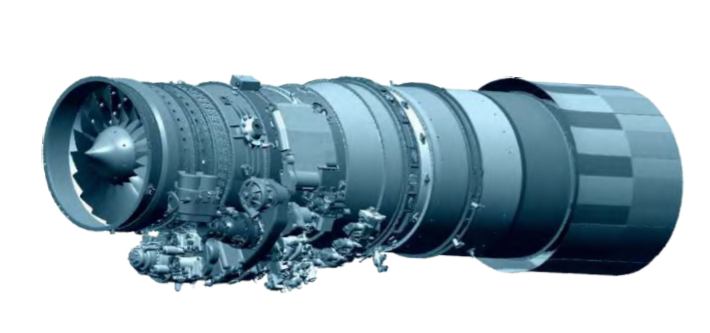
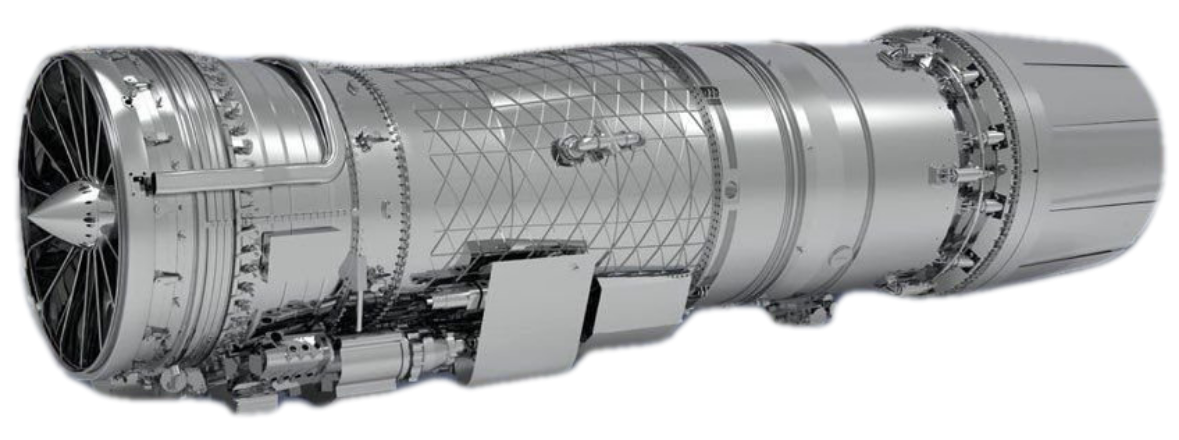
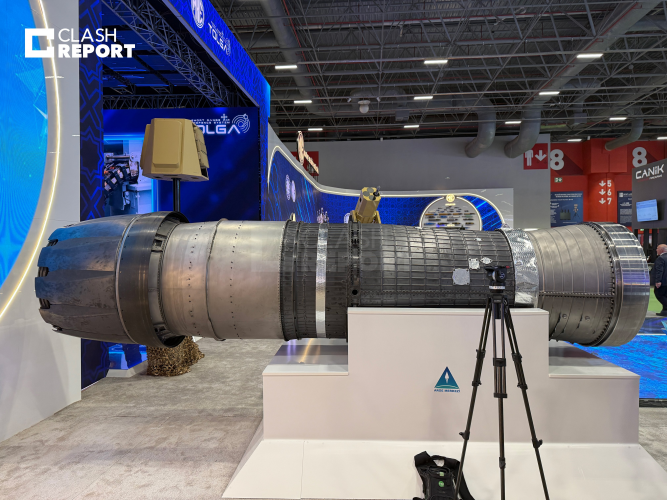
A few observations on the latest render of the TF35000:

1. 14 inlet guide vanes, with an inward swept leading edge toward the nose cone except for a cutback to meet the inlet case. This may point to a bulged outer flow path, similar to the F110, to increase the fan flow behind a smaller intake diameter. Variable trailing edge flaps for the inlet guide vanes

2. An even number of IGVs is usually avoided to prevent harmonic vibration on the 1st stage fan blades, which are usually an even number for fan blade balance. However, this balance consideration is less of an issue with IBR / Blisk construction, and if the Fan rotor shown in Waterballoon's 21 January 2025 post is production representative, I count 21 1st fan blades, which restores the odd / even stator to blade count convention.

3. The fan appears to have a large number of variable 1st stators between the 1st and 2nd fan rotor stage, approximately 4x the number of IGVs. Variable stators behind the 1st stage fan blades is unusual, and has not been used in any production fighter fan that I am aware of. The RB199 and EJ200 have no variable fan geometry at all (no IGVs), while F100, F110, F119, and F135 have variable IGVs only. The only other fan with variable 1st stators I have seen was the GE10 demonstrator engine. It will be interesting if this feature continues with the series production TF35000 after development testing.

4. The isogrid pattern on the fan ducts appears to have changed from earlier renderings. The circumferential ribs completing the triangular rib pattern with the angled ribs has been changed to primarily longitudinal ribs. P&W patented the triangular isogrid rib pattern on chem milled titanium ducts, first used on the F100-229, don't know if the patent has expired or if they are paying royalties to P&W

5. The external components in the middle of the engine appear to be covered with a sheet metal shield. This may be a visual shield to prevent observers from understanding some novel external component arrangement. It doesn't seem likely that there is some engine bay component that is hot enough to require heat shielding of the engine fuel controls when the engine fan ducts are going to be 400F+ at high power.

6. It will be interesting to find out the function of the short tube that exits the fan duct around the 10:00 position, then re-enters the duct a few feet aft. It may be a modulated LPT cooling air supply that can be shut off at lower turbine temperatures to improve cruise SFC. This has been used on at least one Russian engine. P&W tried it on the F119 during EMD development, but the SFC improvement was not sufficient to keep the feature.

7. There appear to be two sets of actuators for the exhaust nozzle. The 6 visible actuators closest the nozzle (probably 10 total) are probably to control the convergent nozzle area. The other 3 visible between every other convergent actuators (a total of 5) are probably for controlling the divergent exit area, independently from the convergent area. They don't appear strong enough for an axi-symmetric vectoring nozzle, but being able to control the divergent area is important for optimizing supersonic thrust under high nozzle pressure ratio conditions.
 
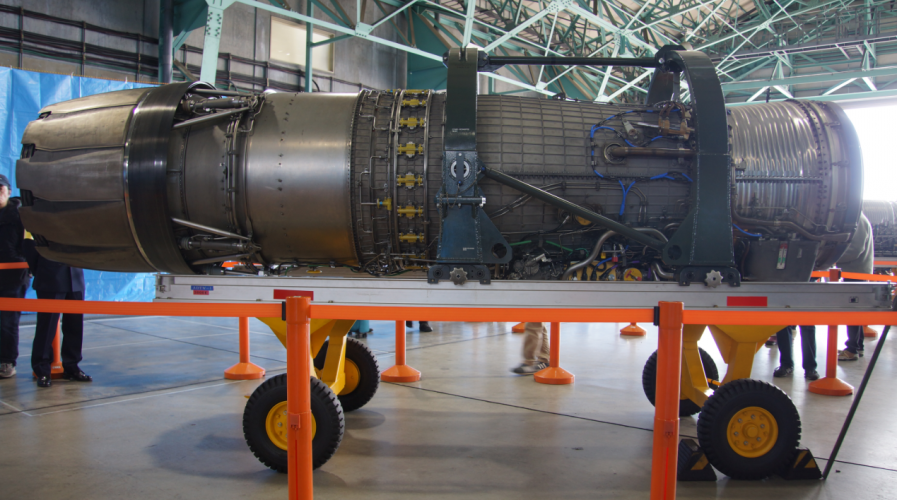
Looks almost like a direct scale up of the F110 (increasing airflow from 270 pps to 330 pps), except for the fan inlet guide vanes having no trailing edge variable flaps.
 
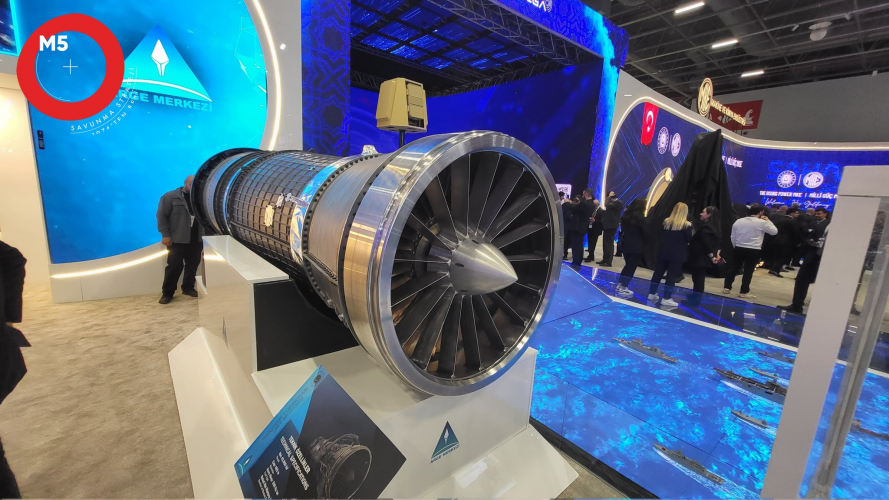
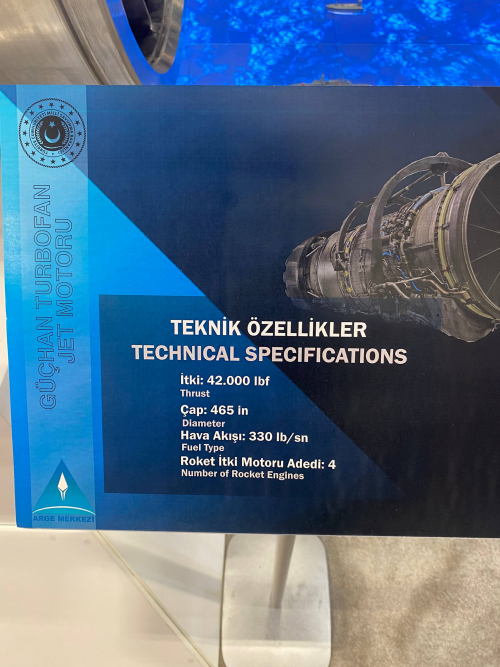
They wrote the specs of that new ICBM on their alleged turbofan engine model's placard lmfaooo :D

___________________________

TR MoD R&D centre be like:

View attachment 811285
The placard vanished
1777991586850.png
1777991763749.png

^ side profile; I honestly think they've just made parts for the F110, incase of embargoes and that's what they are showcasing - making it look like it's a development I guess for legal reasons
Looks almost like a direct scale up of the F110 (increasing airflow from 270 pps to 330 pps), except for the fan inlet guide vanes having no trailing edge variable flaps.
 
^ side profile; I honestly think they've just made parts for the F110, incase of embargoes and that's what they are showcasing - making it look like it's a development I guess for legal reasons
If we were to search for logic:

I think showcasing an indigenous high-thrust turbofan model, which is currently in desperate demand in Turkey, is their way of seeking additional funding (but nobody in their right mind is foolish enough to fall for that)

OTOH, perhaps the MoD R&D center is now being used as a mechanism to take on risky weapons projects (such as a threshold-ICBM) under the defense ministry to bypass embargoes. The missile gets developed by Roketsan but is branded with the MoD R&D logo, so to speak.
 
The TRMOTOR TF35000 Subsystems Signing Ceremony

With the signatures of TRMOTOR, TUSAŞ, İDAK, HARPAX, ANOVA, ALP Aviation, TAAC, and PCS Test and Automation companies, our vision of full independence in the subsystem development processes of our national engine project has been solidified.
Hopefully this is not a “development contract,” as I fear but more of a “delivery contract”; otherwise the engine delivery schedule won’t hold and there will be serious delays in the 2028-32 testing period.

I mean, for an engine that is supposed to begin full assembly and testing in 2028, they have only just recently entered the CDR phase. The TEI CEO (who is a realistic and consistent figure in the industry) says the CDR will take about 1.5 years with preliminary tests running in parallel, but that timeline will still be difficult to meet.
 
It's a modified F110 for sure. Contingency planning in case the US won't supply F110's for Kaan? But the specs don't add up at all.

View: https://youtu.be/dI9QkBY6_1k?t=162
Mate, are you seriously quoting that witless clown Mete Yarar? :D

This whole “high-thrust turbofan by MoD R&D” thing really isn’t worth a second of our time. I mean, their most prominent work so far has been a thermobaric Mk-84 for crying out loud; and they have a habit of making a fool of themselves in front of huge audiences just for attention...
 
It's a modified F110 for sure. Contingency planning in case the US won't supply F110's for Kaan? But the specs don't add up at all.

View: https://youtu.be/dI9QkBY6_1k?t=162

Next to the F110, they also had 1550shp "ONUR" gas turbine engine and compressor assembly - basically T53 gas turbine used on the UH-1 helicopters.
1778000476725.png

---

I still believe it's a show of capability in being able to sustain F110 engine for the F-16s in case of an embargo.
 
Next to the F110, they also had 1550shp "ONUR" gas turbine engine and compressor assembly - basically T53 gas turbine used on the UH-1 helicopters.

---

I still believe it's a show of capability in being able to sustain F110 engine for the F-16s in case of an embargo.
Are y’all forgetting they showcased a ramjet-propelled artillery shell at last year's IDEF and then never brought it up again? And now we’re supposed to believe that at best a few hundred engineers can pull off multiple major projects at once, like an ICBM, a turboshaft engine, a high-thrust turbofan, a ramjet-propelled artillery shell, and so on, while entire nations struggle to deliver even one? Meanwhile, local giants like TEI or Roketsan have already spent close to a decade on each of these individually...

Am I the only sane person left in this thread?!
 
Last edited:
I'm genuinely disgusted and sick to the core right now. How would these people even dare to face the TEI engineers after this facade? What's more, they completely ruined the image of SAHA 2026 and the actual important stuff from the Expo.
 

Similar threads

Back
Top Bottom