The widebody weight premium

exclaimedleech8

ACCESS: Top Secret
Joined
30 September 2024
Messages
830
Reaction score
1,001
You might think that a bigger plane would need less fuel to haul a given number of passengers than a small one given the square cube rule (as a plane gets bigger, the wetted surface per passenger and hence drag, gets smaller). But you would be wrong

The Airbus A380 has a manufacturer empty weight (MEW) of 285,000 kg and is certified to fly a maximum of 853 passengers for an MEW/pp of 334 kg. The final passenger Boeing 747 had an MEW of 220,000 kg and maximum passenger capacity of 605 for an MEW/pp of 360 kg. Boeing's 777-9, despite having a smaller passenger capacity of 495, delivers nearly the same MEW/pp. The Airbus A350 in its larger variant manages 322 kg of MEW/pp. The composite bodied 787-10 does 307 kg.

Moving into narrow bodies, everything changes. The 737 Max 8 has an empty weight of just 45,000 kg and can carry up to 210 passengers, that's only 214 kg per person. The A320neo does 220 kg per person. And even the very long and now defunct 757-300 could achieve 216 kg per person.

It's pretty consistent; a widebody carries 50% more structural weight per passenger than a narrowbody, presumably because as the diameter of the fuselage increases, you wind up with a lot of vertical space in the cabin that isn't really utilized. This explains why widebodies are so uncommon for domestic flights, even where passenger volumes are very high.

Perhaps if new manufacturing and materials advances allowed for fuselages that were less circular, we would see a move to more widebodies.
 
The Airbus A380 has a manufacturer empty weight (MEW) of 285,000 kg and is certified to fly a maximum of 853 passengers for an MEW/pp of 334 kg. The final passenger Boeing 747 had an MEW of 220,000 kg and maximum passenger capacity of 605 for an MEW/pp of 360 kg. Boeing's 777-9, despite having a smaller passenger capacity of 495, delivers nearly the same MEW/pp. The Airbus A350 in its larger variant manages 322 kg of MEW/pp. The composite bodied 787-10 does 307 kg.
You can't compare specs between aircraft without considering range. Even comparing empty weight doesn't work because larger tanks mean larger structure, and then there's hold space to consider. Then there's different structural techniques and the gradual transition from metal to composites, different wing optimisations, different flight controls (neutral stability in pitch means more efficient flight if you have the controls to exploit it, which means less fuel/mile). And so on.

It's not something you can plot on a 2D graph of MEW/pp, it's a real multivariate optimisation, and everyone is looking for a different optimum.
 
You can't compare specs between aircraft without considering range. Even comparing empty weight doesn't work because larger tanks mean larger structure, and then there's hold space to consider. Then there's different structural techniques and the gradual transition from metal to composites, different wing optimisations, different flight controls (neutral stability in pitch means more efficient flight if you have the controls to exploit it, which means less fuel/mile). And so on.

It's not something you can plot on a 2D graph of MEW/pp, it's a real multivariate optimisation, and everyone is looking for a different optimum.
50% more deadweight can't be explained by bigger fuel tanks
 
50% more deadweight can't be explained by bigger fuel tanks
Your own MEW/pp figures range between 307 and 360*, which is a range of only 17%, if you exclude the 1960s structure of the 747, then that drops to 307 to 334, for 8.8%.

You can't compare MEW for aircraft designed for different ranges and passenger numbers, over different generations of structural design, and expect any kind of logical answer. It's comparing apples and orangutans.
 
Last edited:
Your own MEW/pp figures range between 307 and 360*, which is a range of only 17%, if you exclude the 1960s structure of the 747, then that drops to 307 to 334, for 8.8%.

You can't compare MEW for aircraft designed for different ranges and passenger numbers, over different generations of structural design, and expect any kind of logical answer. It's comparing apples and orangutans.
And yet I come up with pretty consistent numbers.
 
1790402025295.png
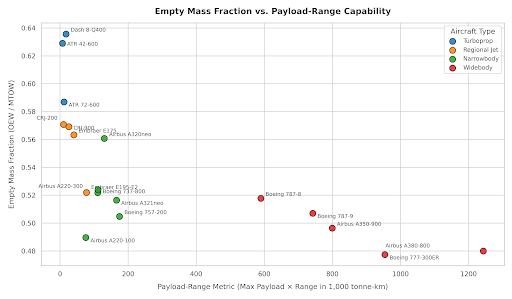
Here is a more informative chart put together with little effort

Further information and explanation can be found in textbooks such as Aircraft Design: A conceptual approach by Dan Raymer
 
Dash Q-400 is perched so high because STOL, I presume ?
Reminds me that a B-52H has a fuel fraction of 0.66.
 
Why then don't the aircraft companies develop widebodies meant for short range routes with smaller fuel tanks and all the weight savings that come with it?
 
To make money the airlines need to operate at high load factors with most of the seats being filled. It is more difficult and less flexible to fill 3-400 seats than 150-200, and so airlines tend to just add more flights/day. For some routes (e.g. Tokyo-Osaka) then JAL and ANA have operated multiple widebody derivatives (e.g. 747SR). Boeing offered the 787-3 short range derivative but this was cancelled due to only having ~50 orders. This short range, high density is currently very niche in the market - so its not cost-effective to even produce major derivative aircraft to meet it, let alone a specific type.
 
Yep wide bodies for flights inside the USA died with 1978 deregulation. 747SP DC-10 Tristar A300...
Japan 747s famously had 500+ pax in the 1980s.
 
Why then don't the aircraft companies develop widebodies meant for short range routes with smaller fuel tanks and all the weight savings that come with it?
Because narrowbodies are more efficient over those passenger numbers and ranges. The only notable widebody use on shorter routes was ANA's 747-100SR for dense, all economy routes in Japan (now superseded by 777s). Most regional airlines can't assemble 550 people for a flight, and need an aircraft that's economical to fly with a load of under 200 pax, in some cases under 100.
 
To make money the airlines need to operate at high load factors with most of the seats being filled. It is more difficult and less flexible to fill 3-400 seats than 150-200, and so airlines tend to just add more flights/day. For some routes (e.g. Tokyo-Osaka) then JAL and ANA have operated multiple widebody derivatives (e.g. 747SR). Boeing offered the 787-3 short range derivative but this was cancelled due to only having ~50 orders. This short range, high density is currently very niche in the market - so its not cost-effective to even produce major derivative aircraft to meet it, let alone a specific type.
I think United could easily fill 3-400 seats on flights between Newark and Chicago.
Yep wide bodies for flights inside the USA died with 1978 deregulation.
They really weren't common before 1978.
 

Similar threads

Back
Top Bottom