exclaimedleech8
ACCESS: Top Secret
- Joined
- 30 September 2024
- Messages
- 829
- Reaction score
- 1,001
You might think that a bigger plane would need less fuel to haul a given number of passengers than a small one given the square cube rule (as a plane gets bigger, the wetted surface per passenger and hence drag, gets smaller). But you would be wrong
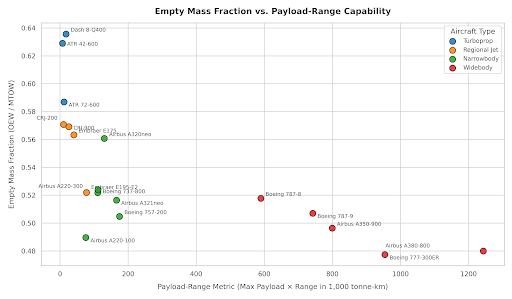
The Airbus A380 has a manufacturer empty weight (MEW) of 285,000 kg and is certified to fly a maximum of 853 passengers for an MEW/pp of 334 kg. The final passenger Boeing 747 had an MEW of 220,000 kg and maximum passenger capacity of 605 for an MEW/pp of 360 kg. Boeing's 777-9, despite having a smaller passenger capacity of 495, delivers nearly the same MEW/pp. The Airbus A350 in its larger variant manages 322 kg of MEW/pp. The composite bodied 787-10 does 307 kg.
Moving into narrow bodies, everything changes. The 737 Max 8 has an empty weight of just 45,000 kg and can carry up to 210 passengers, that's only 214 kg per person. The A320neo does 220 kg per person. And even the very long and now defunct 757-300 could achieve 216 kg per person.
It's pretty consistent; a widebody carries 50% more structural weight per passenger than a narrowbody, presumably because as the diameter of the fuselage increases, you wind up with a lot of vertical space in the cabin that isn't really utilized. This explains why widebodies are so uncommon for domestic flights, even where passenger volumes are very high.
Perhaps if new manufacturing and materials advances allowed for fuselages that were less circular, we would see a move to more widebodies.
The Airbus A380 has a manufacturer empty weight (MEW) of 285,000 kg and is certified to fly a maximum of 853 passengers for an MEW/pp of 334 kg. The final passenger Boeing 747 had an MEW of 220,000 kg and maximum passenger capacity of 605 for an MEW/pp of 360 kg. Boeing's 777-9, despite having a smaller passenger capacity of 495, delivers nearly the same MEW/pp. The Airbus A350 in its larger variant manages 322 kg of MEW/pp. The composite bodied 787-10 does 307 kg.
Moving into narrow bodies, everything changes. The 737 Max 8 has an empty weight of just 45,000 kg and can carry up to 210 passengers, that's only 214 kg per person. The A320neo does 220 kg per person. And even the very long and now defunct 757-300 could achieve 216 kg per person.
It's pretty consistent; a widebody carries 50% more structural weight per passenger than a narrowbody, presumably because as the diameter of the fuselage increases, you wind up with a lot of vertical space in the cabin that isn't really utilized. This explains why widebodies are so uncommon for domestic flights, even where passenger volumes are very high.
Perhaps if new manufacturing and materials advances allowed for fuselages that were less circular, we would see a move to more widebodies.