Stargazer

ACCESS: USAP
Top Contributor
Senior Member
Joined
25 June 2009
Messages
15,517
Reaction score
9,298
Between 1918 and 1930, the U.S.A.A.S., and then the U.S.A.A.C, evaluated a number of aircraft at Wright Field that were usually modified by the Engineering division from existing designs. These were allocated a "P-" number ranging from P-1 (a Curtiss Jenny) to P-599 (a Curtiss A-3B). These were mostly military models, but there is a handful of cases where you get the odd civilian type such as the Driggs Dart (P-443) or the Waco 9 (P-447). This list of projects is pretty well documented (and in fact complete up to P-339). Gaps exist though (P-340/-350, P-401/-406, P-408/-420, and two dozen more in the latter part of the list) but these have not been found by the historians who worked on the subject.

Today I would like to start a topic on something that has never been dealt with anywhere before, at least to the best of my knowledge. In the first half of the 1930s, the U.S.A.A.C. evaluated a number of civilian projects for possible purchase. Instead of using the "P-" list from number 600 up, the Air Corps used a whole different and original system of temporary designations which incorporated the planned mission of each aircraft: (A) for attack, (B ) for bomber, (BT) for basic trainer, (C) for transport, (O) for observation, (P) for pursuit, and (PT) for primary trainer. The list started at number 900 and is known to have extended up to number 950. All type numbers were preceded with an "X", indicating their strict experimental status.

Now these designations were no longer simple airframe numbers as in the old system; here each designation corresponded to a different type (with sub-types in a few cases). Very often the manufacturers themselves would use the designations in their records, while the Air Corps would drop them and replace them with appropriate numbers in each of their respective series if purchased.

This designation system and the list of airplanes that are concerned have all but fallen into oblivion, largely because aviation historians and enthusiasts didn't know what to make of them, assuming wrongly that they were in-house designators from the manufacturers.

I would like to share my list with you, bearing in mind that seven numbers are still missing. Also quite a few of the others are devoid of any details and have only made it to the list thanks to the index of the Sarah Clark archives, which contain documents about them (how I wish I could browse through these!)

LIST REMOVED FROM THIS POST AND REPLACED BY A MORE DETAILED VERSION IN POST #31

For years I've searched high and low to get more info and fill in the blanks, but this is the best I've come to so far. Has anyone found a strange X_-900 designator somewhere that they didn't know what to do with? Here's your chance!
 
Last edited:
Re: The forgotten X_-900 series... and BuAer design numbers

Thanks for this, it filled some gaps in my listing.
Two comments: I have the XO-939 as XP-939 and the XA-944 as XC-944.

With respect to the Wright Field Project numbers, I presume that you have seen my list at http://www.aerofiles.com/wright-field.html. Probably the best there is (but then I am biased :))) With the passing away of KO Eckland earlier this year, I have no idea how long this website (and list) will remain available.

Finally, are you aware of the Bureau of Aeronautics design numbers.
The US Navy’s Bureau of Aeronautics was established on 10 August 1921. Its duties were defined as comprising "all that relates to designing, building, fitting out, and repairing Naval and Marine Corps aircraft".
As such the Bureau issued specifications for a number of aircraft which were built by contractors. In the late 1920s and early 1930 a number of these specifications were identified as BuAer designs. Numbers known to me are listed, along with the designations of the contractors’ aircraft.

BuAer 35 Boeing TB
BuAer 77 NAF T2N, Martin T5M
BuAer 86 Berliner Joyce OJ
BuAer 96 Atlantic FA, Curtiss F9C, Berliner Joyce FJ
BuAer 106 Great Lakes SG, Loening S2L, Sikorsky SS
BuAer 107 Martin FM
BuAer 110 Great Lakes BG, Consolidated B2Y
BuAer 111 Two seat bi-plane fighter (F12C)
BuAer 113 Vought F3U, Douglas FD
BuAer 120 Berliner Joyce F3J, Loening FL, Grumman F2F
BuAer 124 ‘Hook-up’ fighter for airships, to replace F9C (not built)
BuAer 145 Replacement of Douglas TBD (not built)

Jos Heyman
 
Hi Jos, and thanks.

Of course I know your wonderful Aerofiles website. You may recall I once sent you a mail for help with the Bell designations... my name still appears on the page I think... Though it's not devoid of mistakes here and there, your site represents one of the best sources available anywhere and I've often refered to it for help! It would be sad to hear no-one can make it live on... If you need some help of any kind, please let me know.

XP-939 and XC-944 seem correct to me too. I never really believed they could be other than a pursuit and a transport type, but my initial source had them written this way...

As for the BuAer numbers, I had exactly the same list, once copied from this forum, hence from your site... We'll have to keep searching! Thanks again.
 
Just found another element to add to the list of mysteries here: the Northrop XP-938... Appears on the web in a photo archive from the war era that seems pretty accurate:

Northrop-XP938.jpg


This aircraft, of course, is known elsewhere as the Vought XP-948...

Source: http://www.historicaircraft.org/Army-Air-Corps/index_4.html
 
That's a great contribution!

Thanks Stargazer and Jos Heyman
 
Hi,

also the Fairchild T-943 was twin engined amphibain aircraft,I think
it was only a project.
 
Last edited:
hesham said:
Hi,

also the Fairchild T-943 was twin engined amphibain aircraft,I think
it was onlu a project.

Okay, thanks for the details! But as I said earlier on, the Fairchild designations A-941/942 and T-943 are inhouse designations and not actually part of this USAAC list. "A" was for Attack, not Amphibian, and the 941 to 943 slots are already clearly identified.
 
Hi all,

P.377 for Cox-Klemin C.K.2 (CO.1)
P.379 for Cox-Klemin C.K.2 (CO.2)

Servus Maveric
 
A single CO-1 was tested at US Army’s McCook Field with serial P-377, whilst a CO-2, fitted with a Liberty 400 engine, was tested with serial P-379.
Based on the German Heinkel HD17, the aircraft, which have also been referred to as the Cox Heinkel, must not be confused with the Engineering Division’s CO-1 and CO-2 design, ie the Cox Klemin CO's are not military serials.
Both aircaft were returned to Cox Klemin after testing was completed.
 
Maveric said:
Hi all,

P.377 for Cox-Klemin C.K.2 (CO.1)
P.379 for Cox-Klemin C.K.2 (CO.2)

Servus Maveric

Jos Heyman said:
A single CO-1 was tested at US Army’s McCook Field with serial P-377, whilst a CO-2, fitted with a Liberty 400 engine, was tested with serial P-379.
Based on the German Heinkel HD17, the aircraft, which have also been referred to as the Cox Heinkel, must not be confused with the Engineering Division’s CO-1 and CO-2 design, ie the Cox Klemin CO's are not military serials.
Both aircaft were returned to Cox Klemin after testing was completed.

Sorry guys, but you are NOT refering to the special X_-9xx series! This is the P-xxx series which is pretty well documented already... If you don't find a post around here on the subject, I'll get one started so you can contribute there.
 
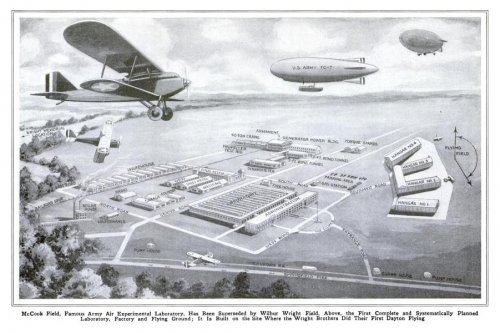
Ever wondered what the U.S. Army Air Corps's Wright Field base looked like?

Here is a wonderful pin-up found in Popular Mechanics dated February 1928.
 

Attachments

  • Wright Field.jpg
    Wright Field.jpg
    315.9 KB · Views: 385
New about the X_-900 series:
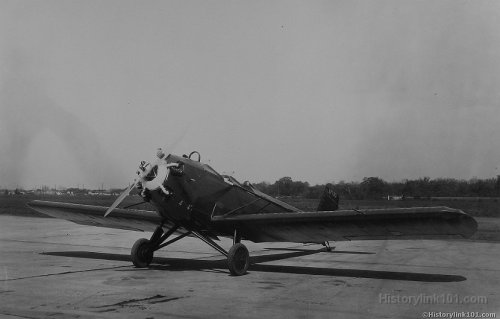
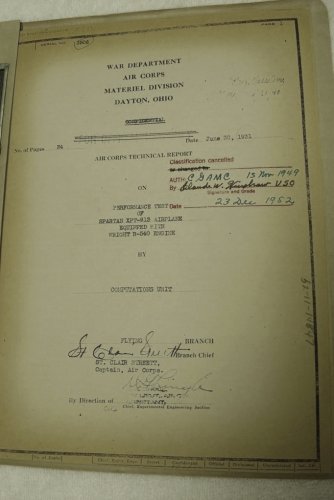
  • Photos of the Spartan XPT-913 have surfaced, and it was a 1931 low-wing monoplane primary trainer prototype with Wright R-540 engine, unlike any of the company's commercial models of the time. I'm enclosing one with also the cover of the Wright Field report.
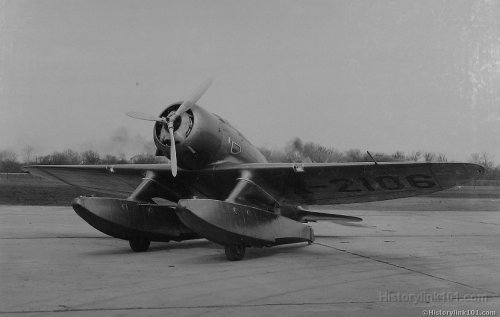
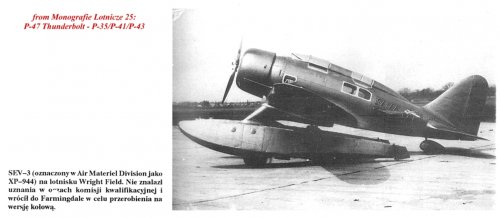
  • A photo of the Seversky SEV-3 on floats appears on a site as the XP-944. Now that's interesting because if confirmed, it's sort of the missing link in the P-35 story, a Seversky aircraft of earlier configuration tested by the Air Corps prior to the XP-35 (but why the float version?) Only trouble is the doubling of the "944" slot, already said to have been used by a Sikorsky transport...
 

Attachments

  • XPT-913.jpg
    XPT-913.jpg
    62.5 KB · Views: 274
  • XPT-913 report cover.jpg
    XPT-913 report cover.jpg
    254.3 KB · Views: 261
  • Seversky XP-944.jpg
    Seversky XP-944.jpg
    66.9 KB · Views: 254
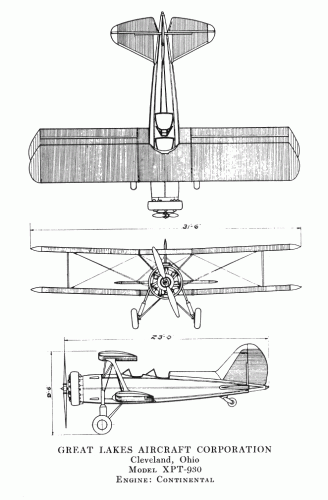
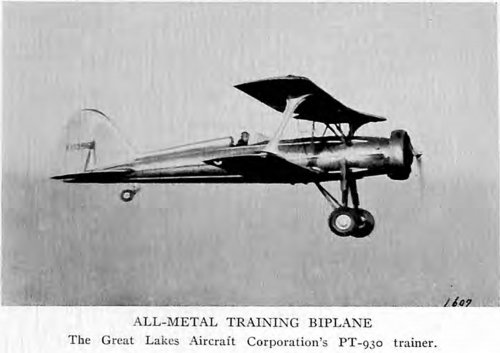
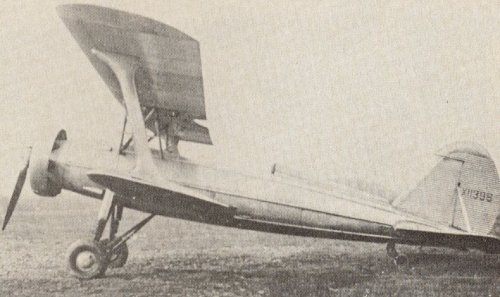
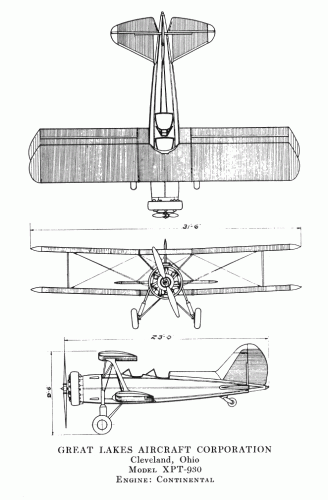
The Great Lakes Model 41 was evaluated as the XPT-930.
Initially, that designation had been reserved for the Inland Model T prototype, but apparently cancelled.
 

Attachments

  • XPT-930 general arrangement small.gif
    XPT-930 general arrangement small.gif
    103.9 KB · Views: 129
Last edited:
This makes the XPT-913 the Spartan C2-60, details of which can be found in Aerofiles.
As far as the Great Lakes XPT-931 is concerned, I have this one also listed as XO-931. A bit confusing.....
As far as the Seversky XP-944 is concerned, I believe we need more evidence that is solidly reliable. Unless such evidence is available we might end up with another designation that has been invented at a later date.
For the time being I stick with the Sikorsky XC-944 Amphibian. If the latter would have been designated as XP-944, we could have interpreted Sikorsky as a 'typo' for 'Seversky', but the P/C difference does not justify that interpretation.
 
Thanks, Jos. At least there is one source I have found to justify the XP-944 designation, and it's the Polish Monografie Lotnicze #25 on the P-47 Thunderbolt.
 

Attachments

  • XP-944 (Monografie Lotnicze 25).jpg
    XP-944 (Monografie Lotnicze 25).jpg
    284.5 KB · Views: 133
As for the duplicated numbers:
  • "938" was used for the Detroit-Lockheed attack prototype that became the Y1A-9 (XA-938) , but may also have been used for the Northrop 3A (XP-938) — unless it is a typo for the Vought XP-948, which was in fact the same aircraft modified.
  • "944" was used for the Seversky SEV-3 floatplane (XP-944) but is also found as a Sikorsky (XC-944). The designation XA-944 was also found.
The Fairchild designations are especially confusing. Why use the "A" for "amphibian" since that letter was clearly used for attacks (which the Model 91 assuredly was not)? Why the use of the "T-" prefix on the second amphibian proposal, which doesn't appear on any other evaluation in the series, and why no "X" attached to it?

Now if the "A- for amphibian" was genuine (which remains to be seen), I guess this would simplify in part the "944" question. Indeed, the book Long Island Aircraft Manufacturers (Arcadia Publishing, 2010) has the following caption for a SEV-3 picture: « The aircraft set numerous speed and distance records for amphibians in 1934 and 1935, which attracted the interest of the U.S. Army Air Corps. » So the quoted "XA-944" may have been genuine and therefore "XP-944" a typo (after all, the SEV-3 doesn't look anywhere near a pursuit!). Questions, questions...
 
Last edited:
More on the U.S. Army Air Corps evaluation of the SEV-3:

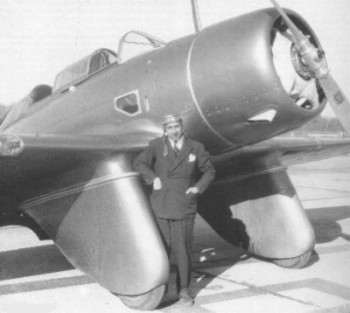
Contrary to what's said above about it's evaluation as an amphibian, here is a photo of the SEV-3 on wheels with spats with the following caption: « The record breaking SEV-3 amphibian as it appeared at Wright Field in the summer of 1934. »

It would seem therefore that along the way, the SEV-3 was changed to standard configuration for Army testing — which is logical since the SEV-3 is said to have served as a basis for BT-8 procurement.

Source: Air Racing History website

4.jpg
 
Jos Heyman said:
This makes the XPT-913 the Spartan C2-60, details of which can be found in Aerofiles.

I'll have to disagree on that. If you compare the two aircraft, you'll notice significant differences, notably the tail's shape, overall size and absence of wiring between the main wheels. This is definitely NOT a C2.
 
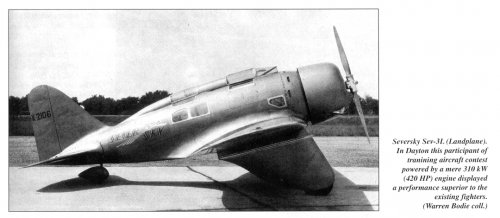
I seem to be doing all the posting on this page, but anyway... another scan, this time from Republic P-47 Thunderbolt (MBI). And although it doesn't state a Wright Field designation, it definitely says that "in Dayton, the SEV-3L participated in a training aircraft contest" and "displayed a performance superior to the existing fighters."

This makes the "XP-" prefix for the "944" very unlikely, therefore. "XBT-" would be logical. But not "XP-"...
 

Attachments

  • SEV-3L (MBI).jpg
    SEV-3L (MBI).jpg
    253.5 KB · Views: 586
Last edited:
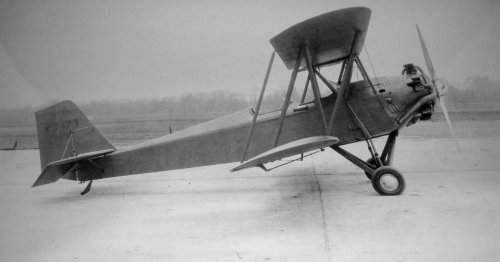
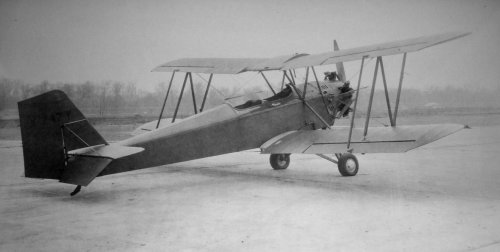
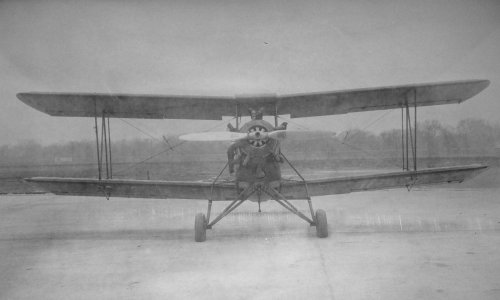
The New Standard D-32 prototype [X747Y, c/n 3000] was evaluated as the XPT-931 but not procured:
 

Attachments

  • XPT-931_01.jpg
    XPT-931_01.jpg
    360.8 KB · Views: 506
  • XPT-931_02.jpg
    XPT-931_02.jpg
    362.8 KB · Views: 447
  • XPT-931_03.jpg
    XPT-931_03.jpg
    403.3 KB · Views: 397
Thanks, that is another one further identified.
If I am right the following X numbers are still to be discovered: 905, 916, 919, 922, 946, 947, 949 and anything above 950.
 
Jos Heyman said:
Thanks, that is another one further identified.
If I am right the following X numbers are still to be discovered: 905, 916, 919, 922, 946, 947, 949 and anything above 950.

Absolutely correct. :) The question of possible duplicates on 908, 912, 930, 934, 938, 939, 942 and 944 also needs to be solved... :(
 
Coming to think of it, there are quite a few mysteries left in the other designations too... A few updates from my research:
  • The Boeing XP-902 and XP-903 pursuits: possible candidates are the P-12F prototype and the Model 100E and 100F.
  • I am pretty certain that the Curtiss XP-904 must have been the XP-23 but I have no document to back it up... yet.
  • Since Keystone became a part of Curtiss, the Curtiss XB-908A was probably a modification of the Keystone XB-908 proposal.
  • The Curtiss XO-911 could be the YO-40 Raven.
  • The Sikorsky XC-920 can only be the Y1C-28, a single S-39C Sport Amphibian and the only Sikorsky transport purchased at the time.
  • The Command-Aire XP-923 pursuit is quite a strange entry. Possibly a pursuit proposal based on the MR-1 "Little Rocket"? Perhaps even the same aircraft modified? Apart from this monoplane type, all known aircraft from that company are biplanes and they're older. Incompatible for a 1932-33 evaluation.
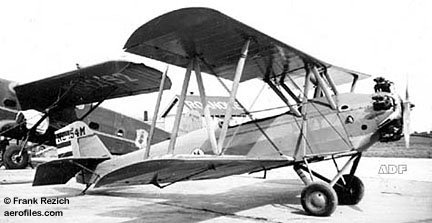
  • The New Standard XP-927 is most likely the one D-29A that was modified as a D-31 after the 100 hp Kinner K-5 was replaced by the 125 hp Kinner B-5. Indeed, that aircraft (registered NC154M) appears on a photo with USAAC markings applied over the civilian registration (see attachment).
  • The Northrop XP-929 pursuit makes me wonder if the USAAC may not have evaluated the Beta 3D. Just a guess here.
  • The Detroit-Lockheed XP-938 is supposed to have been the Y1A-9 attack proposal derived from the YP-24 (itself the XP-900). Many sources however indicate that there never was an A-9. Could they be wrong?
  • The more I consider the '944' slot, the more I'm convinced that "Sikorsky" is just a typo for Seversky. There is still the question of the prefix — XA- for attack? Not much of an attack... For amphibian? Unlikely, the SEV-3 was a floatplane. XP- for pursuit? Not in that configuration. XC- for transport? A little better but not ideal if we consider that the aircraft served as a demonstrator for the BT-8 trainer.
Possible candidates for the unidentified slots:
  • The Atlantic (Fokker) Y1C-16, a commercial F-11A Sky Yacht purchased and registered 32-398.
  • The General Aviation (Atlantic/Fokker) YC-20, a single commercial F-32 transport evaluated but not procured.
  • The single Detroit-Lockheed DL-2A Altair purchased as Y1C-23 and registered 32-232.
  • The quite similar Lockheed 8D Altair purchased as Y1C-25 and registered 32-393.
  • A Martin Model 139 (B-10 conversion) evaluated as the YO-45 but not procured.
  • The Douglas YB-11 became the YO-44 and then the YOA-5.
 

Attachments

  • newstd-d31.jpg
    newstd-d31.jpg
    26.5 KB · Views: 109
Last edited:
Stargazer2006 said:
Jos Heyman said:
This makes the XPT-913 the Spartan C2-60, details of which can be found in Aerofiles.

I'll have to disagree on that. If you compare the two aircraft, you'll notice significant differences, notably the tail's shape, overall size and absence of wiring between the main wheels. This is definitely NOT a C2.

Jos, we were both right AND wrong about this one! The XPT-913 was the sole Model C2-165, a navigational trainer prototype that owed more structurally speaking to the C3 biplane than the C2 (Spartan designations are definitely confusing). See topic here:
http://www.secretprojects.co.uk/forum/index.php/topic,16699.0.html
 
The Seversky SEV-3 was an amphibian, the wheels retracted into the floats.
A for Amphibian would fit if the SEV-3 was the XA-944.
 
Digging out this old thread :)

In "The 1934 Aircraft Year Book" which can be downloaded here (more than 500 pages!) I found a photo of the Great Lakes XPT-930
 

Attachments

  • Great Lakes XPT-930 small, 1934 Aircraft Year Book.jpg
    Great Lakes XPT-930 small, 1934 Aircraft Year Book.jpg
    145.4 KB · Views: 103
Great find Fabulousfour,many thanks.
 
fabulousfour said:
In "The 1934 Aircraft Year Book" (...) I found a photo of the Great Lakes XPT-930

Yeah, the Aircraft Year Books are great. I have downloaded them all and keep discovering stuff in them!
Here's another photo of the Great Lakes XPT-930, by the way, along with a three-view arrangement:
 

Attachments

  • XPT-930.jpg
    XPT-930.jpg
    93.2 KB · Views: 82
  • XPT-930 general arrangement small.gif
    XPT-930 general arrangement small.gif
    103.9 KB · Views: 81
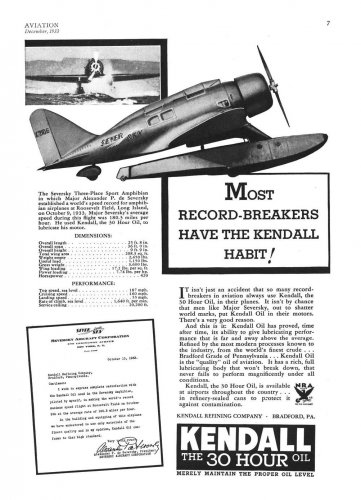
The Seversky SEV-3L (X2106) in its amphibian form can be found in this old Kendall advert from Aviation magazine (December 1933). The ad also gives some specification data.
 

Attachments

  • Seversky_SEV-3L_Three_Seat_Sports_Amphibian_(Aviation_Dec_1933_Kendall)_Advert.jpg
    Seversky_SEV-3L_Three_Seat_Sports_Amphibian_(Aviation_Dec_1933_Kendall)_Advert.jpg
    208.7 KB · Views: 96
The mystery of the missing X_-905 slot is finally solved: it would have been a Fokker pursuit that wasn't built:

1750692073189.png The first mention of the designation X-905 was in a USAAC letter of January 14, 1930, to Fokker Aircraft Corp. of America for the loan of a powerplant for a low-wing monoplane pursuit. Although positive on the request in their response to Mr. Bertrandias of the Fokker sales department, no further information was found on it.

On August 27, 1930, the Material Division allocated Model XP-905 to a Fokker Pursuit with Wright J-6 or Pratt & Whitney Wasp Jr engine to be submitted to the Air Corps for tests. Shortly afterwards drawings and data with detail specification were received of a biplane with all metal fuselage and fabric covered wings on an all-metal structure. The accompanying Fokker drawing SK-271 showed the factory designation H-54 and was adapted from the XFA-1 design for the U.S. Navy. Further data were submitted on October 10, but the Air Corps postponed further study pending results of XA-7 experiments.

One month later, the Air Corps criticized the visibility characteristics and rejected the project on its performance, being less than for the standard pursuit at the time. However, in June 1931, Fokker informed the Material Division again, this time that satisfactory progress was made with the Navy machine after a number of changes such as a gull wing concept to improve the pilot’s visibility. This did not revive the interest of the Air Corps and the project was dropped August 1, 1931.​
Source: AAHS Journal Vol.64 No. 1 (Spring 2019)
 
Last edited:
Although I'm glad that my starting this topic in 2009 was an eye-opener to many, and that some of my findings wound up in Wikipedia and the websites of Joe Baugher, Jos Heyman, and others, I'm equally concerned that some early info may not be totally accurate.
I've gone over the entire list again, ticking what we are sure about, what is reasonable guesswork and what is purely hypothetical.

Part of the potential mistakes resulted from the fact that, originally, it was assumed that all X_-9** designations refered to existing civilian aircraft being evaluated by the Army Air Corps. Well, we know now that it was only partly true — XP-905, XC-942 and others remained paper projects, while XB-908, XO-911 or XO-924 didn't go beyond the full-scale mockup or static airframe stage.

More research has brought to light other initially overlooked facts: the reuse of some designations (like XPT-930 applying to two different aircraft); the very limited time slot during which the system was used (numbers 900 to 937, for instance, were all allocated over a two-year period, from late 1930 to 1932); the fact that most of the aircraft tested remained company-owned and were returned (a few of them being purchased, but not always, even when the type was procured); also, even respectable sources are not exempt from mistakes—not necessarily the collections themselves, but the online indices made from them.

Here is an update of the list which includes warnings with regards to things that have been published previously. The list replaces and supersedes previous versions, which I will therefore edit OUT:
  • XP-900: This one is a no-brainer, it was the Detroit monoplane pursuit derived from the DL-2 Sirius which was acquired as the YP-24 in Sept. 1931 [32-320], but crashed non-fatally on Oct. 19. The disappearance of that Lockheed subsidiary led to the design landing with Consolidated, and its subsequent development as the P-25/P-30/PB-2 series.

  • XB-901: Again, a very well-known allocation, Boeing's Model 215 Death Angel bomber prototype [NX10633] (c/n 1459), which was acquired as the YB-9 [32-301].

  • XP-902 and XP-903: These were allocated to Boeing pursuits, no doubt, but most likely NOT existing types. Given the fact that XP-901 was Model 215, the most likely candidates would be fighter designs from the same period, such as Models 219 and 220, but even those spawned several alternate designs, so even if they proved to be the ones, it's really impossible to say which designs exactly were considered for evaluation.

  • XP-904: At a time when I believed all 900-series aircraft were existing company prototypes, I concluded, somewhat hastily, that the most likely candidate for that Curtiss entry was the Model 63, a.k.a. the XP-23. However, now that we've seen XP-905 being purely a project, it could also have been a totally different, unbuilt design. We just don't know! An Air Corps publication of the time states that the XP-936 and and the XP-23 were both considered by the Army at the time, but XP-23 was the only designation used there!

  • XP-905: This would have been a Fokker pursuit (Model H-54, see previous post) but was cancelled in the early stages. The H- prefix suggests it was another Hall design, like the H-51 (American Fokker Model 11) also was.

  • XB-906: It is customary to associate that designation with the unsuccessful Ford bomber prototype converted from a Model 5-AT; but that was in fact known as the XB-906-1. It is more than likely, therefore, that plain "XB-906" applied to the initial version presented by Ford in full-scale mockup form on Oct. 13, 1930 at Mitchel Field.

  • XB-907/-907A: Martin's Model 123 bomber (c/n 434) did not receive a civilian registration; it was delivered straight to the Army in March 1932 and tested as XB-907 until October, but needed to be reworked; as the enclosed, redesigned XB-907A, it proved satisfactory and was purchased as the XB-10 [33-139]. It had a very short career, being tested in November 1933 and dropped from records at Langley Field in May 1934!

  • XB-908: This Keystone low-wing, all-metal heavy bomber with side-by-side arrangement and retractable wheels was presented in mock-up form only, being inspected by the Army in April 1931. By that time, the Keystone company had been purchased by Curtiss, and therefore the type appears as either a Keystone or a Curtiss. NASM lists it as the "Travel Air Mono", which adds even more to the confusion (Travel Air had become the St. Louis-based Curtiss subsidiary now renamed Curtiss-Wright, so we can assume that the Keystone project landed there). The designation XB-908A also exists for a wind-tunnel model tested in January 1931, suggesting the existence of two alternate configurations (possibly a different seating arrangement?)

  • XC-909: Although it seems well-established now that this applied to a Northrop Alpha 2, it is unclear which one exactly. Depending on sources, it could have been c/n 10 or 12 (the three purchased examples received serials 31-516/518), but there is also a possibility that the demonstrator for the Army was [NX127W] (c/n 2) that was later returned to the company. I haven't been able to clearly determine that. Of course, the lack of markings on photos complicates matter quite a bit!

  • XC-910: This was Boeing's second Monomail prototype, the Model 221 [NC10225] (c/n 1154). It received the designation C-18, although only on lease, and continued its civilian career, becoming a Model 221A.

  • XO-911: Little is known about this obscure Curtiss observation proposal, except that a very crude mock-up was built in 1930 and inspected on 13 Oct. at Mitchel Field. Photos exist but are not available on the web. Obviously it must have proved unsatisfactory.

  • XPT-912 and XBT-915: The Stearman Cloudboy was tested both as a primary and a basic trainer, the difference being mainly in the choice of engine. XPT-912 was a Model 6-A [NC787H] (c/n 6002) while XBT-915 was a Model 6-D [NC786H] (c/n 6001). These evaluations led to purchase of both types as the YPT-9 and the YBT-5.

  • XPT-913: This obscure Spartan low-wing monoplane, the C2-165 [NC993N] (c/n D-1) was evaluated but did not lead to any purchase or procurement.

  • XPT-914: The Verville AT-2 trainer (a version of the commercial Sportsman) was tested and was later purchased as the YPT-10. It has been suggested that the XPT-914 was [479Y] (c/n 15), but [NC457M] (c/n 8) has also been found, so there is a need for more research to determine which of the two it was.

  • 916, 919, 922: Allocations unknown so far.

  • XB-917, XB-921 and XC-928: American Airplane (a subsidiary of Fairchild) had only one aircraft in production, the Model 100 series, also known as the Pilgrim or Pilgrim 100. While XB-921 is said to have been a Model 100-B tested in bomber configuration, no photo of that airplane seems to exist; also how different could XB-917 have been? Possibly based on the Model 100-A instead? Cancelled and replaced by the beefier Model 100-B? Again, this is just guesswork. The rugged Model 100-B didn't satisfy as a bomber, but tested as the Fairchild XC-928 transport (sometimes wrongly transcribed as "928XC" or "C-928"), it led to an order for four Y1C-24 aircraft. Again, there is no certainty here that the example tested was one of the four, as it may simply have been a company demonstrator that was returned.

  • XC-918: Douglas Dolphin 1A [X145W] (c/n 703) was initially known as the Sinbad, and was the company's very first amphibian and ancestor of the entire Dolphin line. It was successfully evaluated and led to an order as Y1C-21. However, that very prototype wasn't purchased by the Army, but by the Coast Guard, where it was named "Procyon", receiving successive serials [CG 27], [227] and [V106].

  • XC-920: The Army tested a single Sikorsky S-39C Sport Amphibion (c/n 919), which was purchased as the Y1C-28 [32-411]. It is tempting to think that XC-920 must have been it, although no document so far has made it possible to clearly establish it.

  • XP-923: The Command-Aire company didn't have many aircraft types on the market, mostly variants of their Models 3C3 and 5C3 biplanes. This might have been a test version of either model, but they seem ill-fitted for the pursuit role. The lack of photos suggests it could also very well have been a project for a different design that was cancelled when the company folded, for example an extrapolation of their Little Rocket low-wing racer.

  • XO-924 and XO-932: Two brand new Thomas-Morse observation types, also designated Y1O-42 and Y1O-41, respectively—pretty weird since the former was only a static test airframe, while the latter was found unsatisfactory and remained the property of the contractor. It seems like wishful thinking on the part of the Army, ordering test batches before a decision had been made over a prototype... Note that the Thomas-Morse company was acquired by Consolidated, whose name sometimes appears next to those designations.

  • XP-925/-925A: The Boeing Model 218 [X66W] (c/n 1260) was a redesigned P-12B with an all-metal monocoque body and a Wasp D engine; evaluated as XP-925 (sometimes wrongly transcribed as plain "P-925"), it became XP-925A when modified with a Wasp E engine. The biplane era was coming to an end and the type was not procured; the prototype was eventually sold to China, where its career is unknown.

  • XO-926: All that we know is that this was a Vought type. Project? Prototype? We know that one V-70 was submitted in 1932 and tested at Wright Field, but as part of an attack tender, so it's impossible it could have received an "O" designator.

  • XP-927: Only certainty is that this was allocated to a New Standard type. I have hypothesized that this may have been a D-29A that was modified as a D-31 after the 100 hp Kinner K-5 was replaced by the 125 hp Kinner B-5, but don't take my word for it... it's only conjecture; it may also have been just a project.

  • XP-929: All we know for sure is that this was a Northrop. Unless it was merely a project, there is a real possibility that this may have been a Beta 3D that was tested by the Army [NX12214] but in the absence of evidence, it is not possible to clearly establish that fact.

  • XPT-930: The infamous duplicated designation, which (unless the duplication is the result of a very early typo) applied to two totally separate prototypes, the Inland Model T [X503Y] (c/n 100) and the Great Lakes 41 [X11396] (c/n 266). Contrary to what was suggested initally, the former didn't become the latter: they had distinct model numbers and distinct construction numbers too.

  • XPT-931: It seems well-established now that this was New Standard D-32 [X747Y] (c/n 3000), which did not result in any purchase or order.

  • XPT-933/-933A and XBT-937: I'll readily admit that I'm still head over heels about that one; XPT-933 is variously given as a Consolidated Model 21-A or 21-C; XPT-933 is supposed to have been the XPT-11 while the XPT-933A was the PT-12, but there is so much confusion over which aircraft was which that I need to dig deeper in order to sort out the mess. The identity of XBT-937 is a little clearer: also a Model 21-C, it was successfully evaluated in August 1931 and was purchased as the XBT-6.

  • XP-934: The Curtiss Swift (later Model 66, c/n 3749) was evaluated in 1932 and subsequently acquired as the XP-31, though it did not lead to any production, with the Boeing P-26 being prefered.

  • XBT-935: If that designation is correct, it is supposed to refer to a Stearman basic trainer. The tricky thing here is that we've already got the Model 6 as the XBT-915, and there was no BT version for the later Model 70/75 Kaydet series. My hypothesis is that the heavier Model 80 Sportster, which was a tandem cockpit job, may have been considered for evaluation as a Basic Trainer at some point... but it's only a theory for now!

  • XP-936: Possibly the best-known of the entire 900 series, the Boeing Model 248 was successfully evaluated in 1932 as the XP-936 (c/n 1678) and became the XP-26 [32-412], prototype of the Peashooter series.
The following designations seem to have occured at a slightly later time, compared to the previous ones.
  • XA-938 and "XP-939": The only "A-for-Attack" known in the series was a sister ship to the XP-900 (YP-24). Assertions vary widely regarding this Detroit-Lockheed product: some say it wasn't built, while others say it was a real company demonstrator; period articles show photos and designate it as XA-9, while later historians refer to it as Y1A-9 (both are possible, since other X aircraft in the series were likewise redesignated as Y1 for budget purposes). At any rate, if it was actually built, the aircraft received no civil registration or military serial number, and like the XP-900, its model number and construction number are unknown. As for "XP-939", given that Detroit-Lockheed had folded, there is little chance that they would have had another pursuit design to submit. So unless it was reserved for a revised, but cancelled version of the XP-900 (which would become the Consolidated P-25), we must assume it's a typo.
  • "XP-938": This duplicate designation may be in error. "If" XP-938 was indeed a Northrop, there is the possibility of a typo, given its resemblance to XP-948. At some point, the possibility that this may have been a Northrop Gamma 2C [NX12291] (c/n 5) that was evaluated in 1933, then purchased as the YA-13 [34-27], was envisaged, but this doesn't hold water for one simple reason: it would have been an XA-, not an XP-. It also seems to me that the 938/939 slots may have been mixed up. Consequently, the 938 slot remains a mystery.

  • XP-940: Boeing's Model 264 pursuit (c/n 1942) of 1934 was a retractable gear alternative to the P-26, later acquired as the XP-29 [34-24]. It was later redesignated as YP-29 and YP-29A through several modifications, but did not lead to a production model (the simpler P-26 being prefered).

  • XC-941: The fabric-covered Kreider-Reisner Model 95 (or Pilgrim 95) was obviously related to the American Pilgrim 100, another product of the Fairchild group. It was the first cargo transport designed specifically for the US military, and was quickly purchased and designated XC-31, but despite its many qualities did not lead to production as all-metal construction was now prefered.

  • XC-942: This was a Bellanca transport proposal building on Y1C-27 experience, with a choice of 650 hp Hornet, 700 hp Cyclone engine or 830 hp Twin Wasp; the model number is unknown, and no aircraft was built.

  • "XA-942": It has been previously suggested that this Fairchild amphibian (also known as the Model 91) had received its odd designation from an Army evaluation... Although you'll readily admit that the association was tempting, given the X_-9** designation, none of the many sources about the Model 91 mentions a military evaluation. Also, if evaluated by the Army, it would have been as a transport; the "A" letter was then in use for Attack, not amphibians or transport types, so if anything, it would have been another "XC-942", not "XA-942"; finally, the fact that Fairchild designated later versions, built and unbuilt, as A-942A, A-942B and T-943 seems to invalidate the theory for good.

  • XPT-943 and XPT-945: There exists quite a bit of confusion in many books over these two distinct evaluations. The Stearman X70 demonstrator [X571Y] (c/n 7001) was the ancestor of the entire Kaydet line. It was evaluated as XPT-943 in early 1934 but resulted in no purchase or order. An improved prototype, the Stearman X75 [NX14407] (c/n 75000) was then evaluated as XPT-945, found satisfactory and impressed as the XPT-13. Although apparently no serial number was assigned (suggesting a lease of the prototype, not a purchase), the type was selected for production in October 1934.

  • XC-944: Mentions exist of a Sikorsky XC-944, without any detail. Given the period, and the fact that the S-39 had already been evaluated, the only other Sikorsky transports that existed at the time were the S-40 (way too big), the S-41 Amphibion (an enlarged development of the S-38) or the brand new S-42. None of those three types seems to really fit the Army's needs at the time, but then again, it could also be a planned, unbuilt proposal, not even necessarily a boat type.

  • "XA-944" or "XP-944": A dubious designation for two reasons: first of all, because of the duplicated number (although it is possible, especially if the other "944" was cancelled); but mostly because this designation was given in relation to the Seversky SEV-3XAR [X2106] (c/n 301). Period articles say that this prototype, which displayed impressive performance, interested the Army; others present it as "the new SEV-3XAR basic training plane for the U.S. Army Air Corps"... So while it is not far-fetched at all to think that it received an X_-9** designation, the use of the "A-for-Attack" makes this one especially dubious. If anything, it should have been an XBT-, not an XA-. The alternate designation "XP-944", also found, wouldn't make a little more sense if we consider it as kind of a prototype for the later P-35.

  • 946, 947, 949: Allocations unknown so far.

  • XP-948: Northrop (soon Douglas El Segundo) Model 3A fighter (c/n 44) was developed from the Navy's XFT-1; it was evaluated as the XP-948 but was lost during a test flight; design rights were then sold in 1936 to the Vought Co. and the rebuilt prototype became the Vought V-141 (and then the V-143). No purchase or procurement resulted from those evaluations. It has been said that the XP-948 designation also applied to the Vought versions, but it makes no sense: the V-141 appeared in 1936, by which time the X_-9** designations were no longer in use. Also it was now a different aircraft, which should have resulted in a new designation (as other examples have shown).

  • XB-950: For the life of me I couldn't possibly remember where I found this allocation, but it has been in my lists for as long as I can remember, going back to a time in the 1980s when my only sources were books and magazines. There is no possibility, therefore, that I would have invented it! According to my notes, it was allocated to the Martin 139A prototype, which became the YB-10. Obviously this one needs a documented confirmation...
There is no evidence that the designation system ever went any further than 950, and very soon it stopped being used.
 
Last edited:
  • "XA-944" or "XP-944": A dubious designation for two reasons: first of all, because of the duplicated number (although it is possible, especially if the other "944" was cancelled); but mostly because this designation was given in relation to the Seversky SEV-3XAR [X2106] (c/n 301). Period articles say that this prototype, which displayed impressive performance, interested the Army; others present it as "the new SEV-3XAR basic training plane for the U.S. Army Air Corps"... So while it is not far-fetched at all to think that it received an X_-9** designation, the use of the "A-for-Attack" makes this one especially dubious. If anything, it should have been an XBT-, not an XA-. The alternate designation "XP-944", also found, wouldn't make a little more sense if we consider it as kind of a prototype for the later P-35.
Given the SEV3XR's complicated developmental history, could the XA/XP confusion actually stretch on to/result from consideration of the SEV2XP or even the 2PA/A8V? A two seater pursuit potentially fudges the XA/XP distinction, cf XP900 being ordered as both the Y1P-24 and Y1A-9.
 
Given the SEV3XR's complicated developmental history, could the XA/XP confusion actually stretch on to/result from consideration of the SEV2XP or even the 2PA/A8V? A two seater pursuit potentially fudges the XA/XP distinction, cf XP900 being ordered as both the Y1P-24 and Y1A-9.
Well, as I said above, the P-24 resulted from the XP-900 evaluation while the A-9 was XA-938, so not the same evaluation.
Design lineage clearly indicates that the BT-8 order resulted from the SEV-3XAR evaluation—and not the SEV-X-BT, despite the fact it came a little after it and was specifically meant as a Basic Trainer.
I suppose that if the X_-9** system had lived on, the SEV-2XP would also have received a similar designation (or perhaps it did, since we don't have the entire run documented).

Another detail I forgot to mention in my previous post is the fact that NOT ALL evaluations at Wright Field received an X_-9** designation, only those that were processed through the Materiel Division. Those were apparently all company demonstrators meant to be returned to the manufacturer, although in some cases the prototypes were actually acquired, or leased for a while.

I find this whole subject fascinating, but it's frustrating that despite tons of books having been written on the subject of USAAC aircraft, no-one seems to have uncovered a complete list or a detailed document pertaining to the whys and hows of that system.
 
Something just struck me... It was not common practice for the Army Air Corps to directly designate a new type as a test aircraft (Y) prefix, and yet the Curtiss Raven prototype, a totally new design, was directly designated as YO-40, and NOT as "XO-40", which would have been totally logical. This usually indicated that the "X" prototype had already been evaluated, either as a company demonstrator returned to the manufacturer, or as a full-scale mockup... Therefore I wonder if the XO-911 (inspected in mockup form in Oct. 1930), may have been that "X" plane, leading the Air Corps to order the real prototype directly as a "Y" (flown in Feb. 32)...
 
I recall reading that when the USAF ordered two B-52 prototypes, the first was designated XB-52, as expected, but the second was designated the YB-52, because it was ordered as a test aircraft, rather than a prototype, which meant the funds came from a different budget. I wonder if the same process was applied in the Curtiss YO-40 case . . .

cheers,
Robin.
 
I recall reading that when the USAF ordered two B-52 prototypes, the first was designated XB-52, as expected, but the second was designated the YB-52, because it was ordered as a test aircraft, rather than a prototype, which meant the funds came from a different budget. I wonder if the same process was applied in the Curtiss YO-40 case . . .
In the early days, "X" meant a totally new or experimental design, while "Y" applied to service test examples, not quite the production version yet but something in-between. For clerical purposes, it did happen at times that the prefix "Y1" was used when funding on the initial budget had been exhausted and procurement had to be done on a different one. Most of the time, the "Y1" aircraft were production-grade aircraft, and simply dropped the prefix when the fiscal year was over.
It almost never happened for an aircraft to begin as a "Y1" (the Thomas-Morse Y1O-41 and Y1O-42, new designs, were never purchased, so I think it was typically one of those budget issues there), and it rarely happened for an aircraft to begin straight as a "Y", if the design was brand new and untested. Aircraft types that derived from an existing model but were considered sufficiently different and needed proper testing got an "X" again, but most of the time they were simple modifications that only got a "Y" (a large part of the "O" numbers were given to derivatives of the Curtiss O-1 Falcon or the Douglas O-2). And of course I'm taking the "O" list as an example, but the pattern was consistent in every other list.
Hence my wondering about the YO-41. Absolutely ALL brand new observation types in those years began as "X" versions: Atlantic XO-27, Douglas XO-31, XO-35 and XO-36, General Aviation XO-47, etc., but NOT the Raven!
 
I've just come across photos of the Curtiss XO-911 proposal which I'd forgotten I had! The XO-911 was INDEED the forerunner of the YO-40, as shown by all its common features (sesquiplane wings, rear gunner position, cockpit enclosure), It's safe to assume therefore, that despite the extreme crudeness of the mockup, the project must have seemed sound enough to the Army for them to consider it as the "XO-40", and to directly order service test examples as the YO-40...

The 1931 wind-tunnel model:


1757029978546.png

The actual YO-40 Raven:

1757030333720.png

The November 1930 full-scale mockup:


1757030057620.png
1757030091243.png
1757030185046.png
 

Similar threads

Back
Top Bottom