The Secret Horsepower Race by Calum Douglas (and piston engine discussion)

My ìdea is, that this throttle is not acting on the air stream but controling the flow of the oil.
But, why??

The Ladedruckregler does control that throttle (Reglerklappe), and only that.

Check the descriptions from the Lehertafel (can be downloaded from here): sheet 9-601-6318 for the Ladedruckregler and sheet 9-601-6314 for the coupling + pumps.
 
But, why??

The Ladedruckregler does control that throttle (Reglerklappe), and only that.

Check the descriptions from the Lehertafel (can be downloaded from here): sheet 9-601-6318 for the Ladedruckregler and sheet 9-601-6314 for the coupling + pumps.
Thanks for the link I'm not pretending I allready understand the whole system yet, but according to the description, the baromatric pressure sensoring system is acting on the hydraulic system and varries the oil flow to the coupling and therefore the compressor speed. There is no mention of a connection to the intake throttle.

I just started to read the second part and here we find the snswer to our questions. To prevent overheating of the hydraulic coupling, the intake throttle is partially closed in the 1th stage in the range were we see it in the diagrams. So it is indeed a kind of quick fix to prevent overheating, like I (and others) suspected before.
 
Last edited:
Hi mmeister,

The manifold pressure control system is really done by the Ladedruckregler (or [typo fixed:]Ladedruckwähler in DB 605D) + Leistungsklappe, not the supercharger variable speed mechanism.

After reading through the invenio documents, it appears the boost pressure limiter/selector (as I'd translate "Ladedruckregler/-wähler) is capable of reacting very quickly, as it's mentioned that it's normally oscillating at the setpoint (at tiny amplitudes) with > 1 Hz frequency.

I suspect that a rapidly rotating supercharger blower to react to changes in setpoint or to exterior conditions (the documents mention ram effect as an example) reacts much more slowly to changes in the oil supply of the fluid coupling, so that even if the fluid coupling would be able to hit the setpoint perfectly, one would still need the normal throttle to ensure quick response times and avoid temporary over- or undershooting of the setpoint values.

It would also seem that a normal throttle valve is desirable for partial-throttle operations, as running the supercharger at slow speed with the associated high slippage percentage would make the heat issue Nicknick pointed out quite serious and probably technologically inacceptable.

Regards,

Henning (HoHun)

 
Hi mmeister,


After reading through the invenio documents, it appears the boost pressure limiter/selector (as I'd translate "Ladedruckregler/-wähler) is capable of reacting very quickly, as it's mentioned that it's normally oscillating at the setpoint (at tiny amplitudes) with > 1 Hz frequency.

I suspect that a rapidly rotating supercharger blower to react to changes in setpoint or to exterior conditions (the documents mention ram effect as an example) reacts much more slowly to changes in the oil supply of the fluid coupling, so that even if the fluid coupling would be able to hit the setpoint perfectly, one would still need the normal throttle to ensure quick response times and avoid temporary over- or undershooting of the setpoint values.

It would also seem that a normal throttle valve is desirable for partial-throttle operations, as running the supercharger at slow speed with the associated high slippage percentage would make the heat issue Nicknick pointed out quite serious and probably technologically inacceptable.

Regards,

Henning (HoHun)
As I wrote, the text confirmed in the second part, that throtteling was done intentionally to prevent overheating of the oil.
 
Hi Nicknick,

As I wrote, the text confirmed in the second part, that throtteling was done intentionally to prevent overheating of the oil.

Apologies for being confusing in my previous post!

What I meant to say: While you talked about partial *throttle* operation in the "1st stage" altitude range, I meant to point out that additionally, the same applies to partial *power* operation at other altitudes, because this is also implemented by closing the throttle and not by slowing down the supercharger wheel.

In addition, that the throttle valves allows quicker response times to power or operational parameter changes applies at all altitudes.

Would you agree with that?

Regards,

Henning (HoHun)
 
As promised a while back, as I get so sick of various professions making their jobs seem very complicated on purpose to gate-keep, I have written a complete guide as to how I research, structure and write history books.

You can do whatever you like, of course, but this is one example of a strategy which is proven to produce
highly sucessful books.

The Secret Horsepower Race now on something like 15th reprint, 15,000 sales in three languages.

More people, especially technical professionals, should write history. Having absolutely zero qualifications
of any sort to qualify me to write, clearly one does not actually need a degree to write proper history
books.


I`m happy to share exactly how I do it, and that its not in any way complicated.

1769371467703.png
 
Tried to look for it (the book not at hand), but anyone know what was the injection rate of the MW liquid with the DB 605AM at the 1800 hp rating (1,7 ata?)?
 
Hi
Hi Nicknick,


Apologies for being confusing in my previous post!

What I meant to say: While you talked about partial *throttle* operation in the "1st stage" altitude range, I meant to point out that additionally, the same applies to partial *power* operation at other altitudes, because this is also implemented by closing the throttle and not by slowing down the supercharger wheel.

In addition, that the throttle valves allows quicker response times to power or operational parameter changes applies at all altitudes.

Would you agree with that?

Regards,

Henning (HoHun)
Hi
sorry for overlooking the answer, the same problem will not automatically return in other altitudes, because it depends on how well the gear ratio fits. A longer 1th gear ratio could have been used to avoid it, but than it would have caused more trouble when switching to the 2nd gear earlier. Also the cooling conditions will propably be better at higher altitude and speed.

So I agree so far, that overheating problems due to a high slip in combination with a high (not maximum) compression ration with unsufficient cooling might also accure in 2nd stages, but there is no evidence that this was the case here.
 
Last edited:
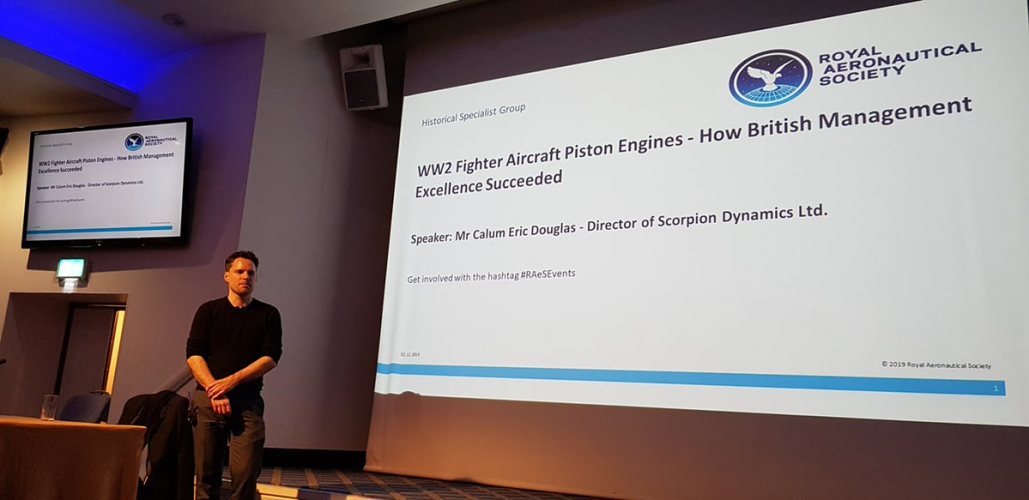
This week, primarily as a result of THE SECRET HORSEPOWER RACE, alongside other heritage engineering aviation activities, I was elected Fellow of the Royal Aeronautical Society for major contributions to the field of aerospace heritage.

View attachment 801985


Congratulations! There might be plenty of exclusive clups in GB, but this one certainly a special honour!
 
Back
Top Bottom