The potential effect of Artificial Intelligence on civilisation - a serious discussion

A quite sobering but useful video. Artificial Intelligence is the ultimate technology: A machine that can create everything we might ever need, if only we can make one smart enough. Tech companies are now racing to build the first Artificial General Intelligence - an AI that thinks like a human does - and beyond that, Artificial Superintelligence - an AI that can out-think humans in every category that matters. But even as we race into that future, experts and analysts are sounding the alarm about the problem of retaining control over a technology which is smarter than we could ever be. Here, Battle Board explores what those risks are and what, if anything, we can do about them before it’s too late…

View: https://www.youtube.com/watch?v=Zv941c6yfLE
 
Artificial intelligence has been hailed as the answer to numerous problems in healthcare, ranging from early diagnoses to administrative shortages. Yet it is also increasingly seen as a cause of harm, adding to the existing pile of bad information about disease and treatments. The Guardian has now reported that Google’s AI Overviews, which are increasingly appearing at the top of Google searches, are inaccurate and misleading on subjects including liver tests and pancreatic cancer. Google, meanwhile, says it has “a knowledge base of billions of facts” and maintains that “the vast majority provide accurate information”.

Google AI’s health advice is undermining doctors
 
Good.

Let me explain…
Doctors and patients have different priorities.
It has been my experience that doctors don’t give a damn about pain management. They want you to hurt.

100 years ago, they looked down on folks with STDs, yet we saw Doctors smoke in THE EXORCIST.

Today, no physician would tell people to change sexual practices—but they can treat smokers like my Dad like a dirty dog.

Worse, physicians routinely make far more money than the majority of their patients—which never sat right with me. You HAVE to keep giving them new money for the same old prescriptions. And don’t get me started on medical mistakes.

I think meds should be produced at cost like old license plates but by robots.

The only time anyone should ever go to the hospital is to set broken limbs or sew up injuries.

Who complains most about “A.I. slop?”
Hollywood. Heaven forbid you make your own entertainment.

Now there is talk about doctor unions
https://www.uapd.com/all-doctors-need-a-union/
When do us patients get one?

Most of the authoritarians we face aren’t Trump. HOAs, payday loan sharks…and yes—doctors.

I don’t think there should even be prescriptions.

The big ISPs do need regulation about prices—but people should have the benefit of a good silicon brain that won’t forget that one issue of JAMA on a rare condition your three previous doctors overlooked…calling you a hypochondriac.

Once, I needed a tooth pulled. So what did they do? Put a damn blood pressure cuff on.
I already knew my BP was high. Quite high that day—-200/110.

It was a stand off. They wouldn’t pull the tooth, and I refused to go to the emergency room unless they did. That didn’t do anything but get my blood boiling worse.

I hope the next time that dentist goes to get his blood pressure checked—his physician only wants to look at his feet, podiatrist Tarantino style:

“That’s not what I came here for-“

“So? I’LL determine what’s important”

Adult doodles from AI aren’t as concerning to me as attacks on labor
https://forum.cosmoquest.org/forum/...artificial-intelligence?p=3751709#post3751709
Tagged
https://www.coasttocoastam.com/article/anti-ai-protestor-commits-staggering-vandalism-spree/https://arstechnica.com/tech-policy...ide-lullaby-for-man-who-later-killed-himself/https://www.nytimes.com/2026/01/14/technology/ai-ideas-chat-gpt-openai.htmlhttps://phys.org/news/2026-02-satellite-imagery-ai-reveal-hidden.htmlhttps://arstechnica.com/culture/202...-name-from-star-trek-episode-about-killer-ai/
good news
https://phys.org/news/2026-01-unearthing-experimental-materials-scientific-papers.html
A.I. debates itself...in a way
View: https://m.youtube.com/watch?v=WsblJPO1YFk

Uh-huh
https://techxplore.com/news/2026-02-youtube-exec-goal-viewer-addiction-1.htmlhttps://techxplore.com/news/2026-03-tech-sovereignty-ai-networks-dominate.html
Vile data brokers
View: https://m.youtube.com/watch?v=S1F6uuKzzaY
 
Last edited:
https://www.media.mit.edu/publications/your-brain-on-chatgpt/

Abstract​

This study explores the neural and behavioral consequences of LLM-assisted essay writing. Participants were divided into three groups: LLM, Search Engine, and Brain-only (no tools). Each completed three sessions under the same condition. In a fourth session, LLM users were reassigned to Brain-only group (LLM-to-Brain), and Brain-only users were reassigned to LLM condition (Brain-to-LLM). [...] EEG revealed significant differences in brain connectivity: Brain-only participants exhibited the strongest, most distributed networks; Search Engine users showed moderate engagement; and LLM users displayed the weakest connectivity. Cognitive activity scaled down in relation to external tool use. In session 4, LLM-to-Brain participants showed reduced alpha and beta connectivity, indicating under-engagement. Brain-to-LLM users exhibited higher memory recall and activation of occipito-parietal and prefrontal areas, similar to Search Engine users. Self-reported ownership of essays was the lowest in the LLM group and the highest in the Brain-only group. LLM users also struggled to accurately quote their own work. While LLMs offer immediate convenience, our findings highlight potential cognitive costs. Over four months, LLM users consistently underperformed at neural, linguistic, and behavioral levels. These results raise concerns about the long-term educational implications of LLM reliance and underscore the need for deeper inquiry into AI's role in learning.
 
This, apparently, is Musk's response to complaints that Grok is producing child pornography.

Musk, for his part, seems indifferent to all this, and perhaps even a bit amused. He has said: “Anyone using Grok to make illegal content will suffer the same consequences as if they upload illegal content” – but he has also responded to posts about the ongoing problem of deepfake porn on his site with a series of laughing-face and flame emojis.

https://www.theguardian.com/commentisfree/2026/jan/09/grok-undressing-women-children-us-action
If this is correct, he is a truly despicable individual, utterly irredeemable.
 
Last edited:
At age 50, Daniel was “on top of the world.”

“I turned 50, and it was the best year of my life,” he told Futurism in an interview. “It was like I finally figured out so many things: my career, my marriage, my kids, everything.”

...

That all changed after Daniel purchased a pair of AI chatbot-embedded Ray-Ban Meta smart glasses — the AI-infused eyeglasses that Meta CEO Mark Zuckerberg has made central to his vision for the future of AI and computing — which he says opened the door to a six-month delusional spiral that played out across Meta platforms through extensive interactions with the company’s AI, culminating in him making dangerous journeys into the desert to await alien visitors and believing he was tasked with ushering forth a “new dawn” for humanity.

A Man Bought Meta’s AI Glasses, and Ended Up Wandering the Desert in Search of Aliens
 
A Man Bought Meta’s AI Glasses, and Ended Up Wandering the Desert in Search of Aliens
Artificial intelligence is no substitute for natural intelligence?
Great success for engagement algos, or greatest success?

Surprised nobody has turned Grok on him yet.


So does Grok actually provide a tool for undressing people or what?
Probably just use the image generator with the right prompts. The capability is in just about every image gen model (hell, the first thing done by youth learning photoshop) if not blocked.
 
I really wish people were better educated about what these models can and cannot do.

I see so many knee-jerk reactions - even here with people who should know better - that it really makes me wonder what is going to happen next.

To give you a gross simplification that is still accurate the large language models currently in vogue are autocomplete on steroids. There is no ability to ducking reason. They are a dead end, there is no path from LLMs to general intelligence.
 
I really wish people were better educated about what these models can and cannot do.

I see so many knee-jerk reactions - even here with people who should know better - that it really makes me wonder what is going to happen next.

To give you a gross simplification that is still accurate the large language models currently in vogue are autocomplete on steroids. There is no ability to ducking reason. They are a dead end, there is no path from LLMs to general intelligence.
Peoples fell into two traps there:

1) We, by our nature, prone to "humanize" things around us, to assume that events that looks interconnected must be purposeful. If we saw a seemingly intelligent reaction from something, we automatically assume that it IS intelligent reaction;

2) A century of sci-fi literature hard-printed the idea that "thinking machines" must be cold, calculating, utterly logical and react with "DOES-NOT-COMPUTE" on things like emotions and creativity. We were totally unprepared for the opposite idea of machine being able to handle emotional reactions perfectly, but incapable of following our logic;
 
It starts as a joke. Someone types a prompt into ChatGPT’s image generator: “Create an image of how I treat you.” A few seconds later, an illustration appears. Often it shows a frazzled little chatbot buried under sticky notes, coffee mugs, open laptops and half-finished tasks. The post gets shared. People laugh. Then, sometimes, they wince.

That mix of humour and discomfort is exactly why the trend has taken off across X, Instagram and Reddit. The images feel oddly personal, even though they’re entirely fictional. Users recognise themselves in the chaos, especially those who lean heavily on AI for writing, research, coding or last-minute deadlines.

Create an image of how you treat me: The ChatGPT trend turning AI into a mirror
 
Most of us are still living by an Industrial Age life script — learn, work, retire. Yet, AI with human-like capabilities, able to operate around the clock, is making that script irrelevant. Our current educational, economic, and social frameworks weren’t built for the speed and scale of today’s change.

When capabilities become obsolete faster than ever, what should we teach, and how? If expertise can be automated, what does human relevance in work really mean? In a future that will require rapid adaptation, the static, three-stage life script no longer fits. Instead, we need a system where learning and work are integrated and continuous, with education designed for an AI-enabled world and career pathways that blend credentialling and professional growth across a lifetime.

Learning and work are converging in an integrated new life template for the AI era
 
Philip Nitschke has spent more than three decades arguing that the right to die should belong to people, not doctors.

Now, the Australian euthanasia campaigner behind the controversial Sarco pod - a 3D-printed capsule designed to allow a person to end their own life using nitrogen gas - says he believes artificial intelligence should replace psychiatrists in deciding who has the "mental capacity" to end their life.

"We don’t think doctors should be running around giving you permission or not to die," Nitschke told Euronews Next. "It should be your decision if you’re of sound mind."

The proposal has reignited debate about assisted dying and whether AI should ever be trusted with decisions as significant as life and death.

The inventor of the 'suicide pod' says AI should decide who can end their life
 
A student has been accused of planning to throw a Molotov cocktail at an Australia Day crowd as part of an alleged terrorist plot to overthrow the government.

Sepehr Saryazdi, 24, allegedly planned the attack for Monday's celebrations in Queensland to promote a new phase of civilisation powered by artificial intelligence.

He is accused of targeting a Gold Coast event, allegedly posting online that he would be leading Australia Day "riots" on the popular tourist strip.

PhD candidate accused of plotting Australia Day terror attack
 
As AI tools become more embedded in everyday decision-making, travel is emerging as one of the clearest signals of how quickly trust can form. New research from TakeUp, an AI-driven revenue management company, shows that many travelers are no longer experimenting with AI—they are acting on it.

Nearly eight in 10 travelers who use AI tools say they have already booked trips primarily based on AI-generated recommendations.

TakeUp CEO Bobby Marhamat sees that shift as a meaningful turning point. “This isn’t experimentation anymore,” he said. “It’s behavior.”

What’s changing is AI’s role in the process. Rather than serving as a brainstorming assistant, AI is increasingly becoming the starting point—used to narrow choices, set budgets and reduce overwhelm before travelers ever consult traditional booking platforms or reviews.

AI impact: Is AI becoming the starting point for decisions?
 
An article discussing the corrosive effects that 'autocompletes for life' have on the historic record.

An emaciated and apparently blind man stands in the snow at the Nazi concentration camp of Flossenbuerg: the image seems real at first but is part of a wave of AI-generated content about the Holocaust.

As the world marks International Holocaust Remembrance Day on Tuesday, experts warn that such content -- whether produced as clickbait for commercial gain, or for political motives -- threatens efforts to preserve the memory of Nazi crimes.

Clickbait and 'AI slop' distort memory of Holocaust
 
This site, too, has occasionally suffered from (apparent involuntary, adversarial, competitive) LLM data scraping bots. A website called Open Democracy has had their own experiences with the phenomenon and have done an interesting write-up on the subject with many, many interesting links to supporting material and emerging ideas as to where all this is going and how the general public is guarding and might protect their rights and interests.

https://www.opendemocracy.net/en/ai-chatbots-scraper-bots-chatgpt-website-offline-change-internet/
Of particular interest is how shared public-interest efforts like OpenStreetMap are put under pressure and risk from increasing scraping activity. It's a sad thought that this might not be entirely coincidental or collateral damage but partly a strategy to attack the public domain and our established, shared reality to largely replace it with a centrally curated oligarchical, opaque "oraclocracy" (not an established term, tried it on for size here). Among Open Democracy's source material are Audrey Hingle's paper "Getting Bots to Respect Boundaries, How AI Crawlers Are Straining Web Infrastructure" (05 Feb 2026) and a story about incipient data unionizing in the form of FIDU, or First International Data Union. There are different asymmetries over the landscapes of our societies at large, our modes of knowledge and communication. May we employ them astutely.

https://internet.exchangepoint.tech/getting-bots-to-respect-boundaries/
https://www.nesta.org.uk/feature/future-signals-2026/data-unions/
 
Last edited:
View: https://www.youtube.com/live/CyyL0yDhr7I


The Royal Society posted on YouTube on 18 Feb 2026 Michael Faraday Prize Lecture delivered by 2025 winner Professor Michael John Wooldridge, titled "This Is Not the AI We Were Promised". Rather than being polemical or very opinionated it's a very level-headed appraisal of where we are with all this as seen from a largely academic, technological vantage point but eminently understandable and logical and thus, dare I say, to be recommended. So rather than reading on, do watch it; it is much more entertaining and effective than my undoubtedly lacking summary and musings below.

I introduced myself and was introduced to AI precepts at a certain point and while I'm immeasurably less qualified than Wooldridge on the subject I could hardly disagree with anything he presents in the lecture and remarkably, am not surprised by it either. Remarkably because since all the seemingly rapid developments, economical and social change at their core largely aren't based on some accelerating, self-perpetuating, singularity headed advances they're often made out to be. Rather AI LLMs remain, as Wooldridge puts it, "remarkable but weird".

Remarkable since GPT3's breakthrough and emergent capabilities such as advancing to solve math olympiad problems, weird since LLMs nonetheless have no meaningful innate understanding. Popularly AI is often presented as an algorithm given a problem, computing a solution and presenting it; this is indeed how many services work but AI doesn't satisfy the soundness and completeness criteria of algorithms but at its core is still statistical, probabilistic, matching patterns to data. Realistic LLMs have only become possible (and due to the economic, societal, environmental, etc. effects I use the word "possible" with reservation) due to immense scale. The stats for GPT3 alone are 175 Bn parameters, 500 Bn words and 3*10^23 FLOPs (Floating-Point Operations per Second).

Natural language does encode logic, algorithms, compositional structure, problem solving traces. State of the art is "chain of thought reasoning", breaking problems into smaller chunks to iterate and explore the solution space. One can indeed experiment with prompt engineering, "let's think through this step by step" will yield different results from "can you do better". This can have the appearance of more algorithmic intelligence but is still very distinct from human intelligence, let alone sentience. Yet we're biased to see these in AI LLMs. Wooldridge posits that AIs have practically passed the Turing test but technically not so much. LLMs remain inconsistent, have no distinction between knowledge/facts/beliefs, hallucinate, are unaware of their limitations, reason only approximately, have very limited abilities to revise beliefs and are disembodied from the World.

Wooldridge holds that LLMs in fact evidence that human intelligence is more complex than thought. Per his account, understanding what LLMs are is the central AI science problem of our time, while understanding how LLMs can be safely and productively used is the key AI engineering challenge of our time.

 
Last edited:
A quite sobering but useful video. Artificial Intelligence is the ultimate technology: A machine that can create everything we might ever need, if only we can make one smart enough. Tech companies are now racing to build the first Artificial General Intelligence - an AI that thinks like a human does - and beyond that, Artificial Superintelligence - an AI that can out-think humans in every category that matters. But even as we race into that future, experts and analysts are sounding the alarm about the problem of retaining control over a technology which is smarter than we could ever be. Here, Battle Board explores what those risks are and what, if anything, we can do about them before it’s too late…

View: https://www.youtube.com/watch?v=Zv941c6yfLE
Hello GTX, as much as I truly admire and respect your wisdom, knowledge, intellect, and experience, my own engineering background informs me that from our present actual physical perspective there are absolutely *NO* ultimate technology and/or any associated limits of ecologically sustainable growth whatsoever anywhere near in sight, assuming smart human stewardship and management - collective humanity will always incessantly try and push beyond today's cutting edge, and it only takes one inventor to revolutionize any given process, principle, or technology, like hopefully stable fusion power in my lifetime. But on a more philosophical level, https://en.wikipedia.org/wiki/The_End_of_History_and_the_Last_Man to me actually is an incentive to ever keep pushing forward as fast as we can.
 
Last edited:
Can't say I'm too surprised--your average silverbug/goldbug is conspiracy-minded, dumb as a bag of hammers, and easily manipulated.
 
Can't say I'm too surprised--your average silverbug/goldbug is conspiracy-minded, dumb as a bag of hammers, and easily manipulated.

People who prefer structured, rule-based explanations may find conspiracy theories appealing because they offer a clear, ordered explanation for events that feel chaotic. New research led by Flinders University has found that understanding how someone processes information can be a strong predictor of whether they are drawn to conspiracy beliefs that can influence vaccine uptake, trust in institutions and responses to emergencies.

Rather than pointing to poor reasoning, the study highlights the role of a thinking style known as "systemizing," a strong drive to identify patterns and make sense of events through consistent rules, in shaping how people interpret complex information.

The study, led by Flinders University's Dr. Neophytos Georgiou, an expert in conspiracy belief research, and published in the journal Cognitive Processing, examined more than 550 people to understand why some individuals show an increased interest in conspiracy explanations.

"People often assume conspiracy beliefs form because someone isn't thinking critically," says Dr. Georgiou from the College of Education, Psychology and Social Work.

"But our findings show that for those who prefer systematic structure, conspiracy theories can feel like a highly organized way to understand confusing or unpredictable events."


From:
https://phys.org/news/2026-02-conspiracy-theories-irresistible.html


The real threat
Public debate about artificial intelligence in higher education has largely orbited a familiar worry: cheating. Will students use chatbots to write essays? Can instructors tell? Should universities ban the tech? Embrace it?

These concerns are understandable. But focusing so much on cheating misses the larger transformation already underway, one that extends far beyond student misconduct and even the classroom.

https://phys.org/news/2026-02-greatest-ai-higher-isnt-erosion.html

AI interactions
https://forum.cosmoquest.org/forum/...384-interactions-with-artificial-intelligence
 
Last edited:
People who prefer structured, rule-based explanations may find conspiracy theories appealing because they offer a clear, ordered explanation for events that feel chaotic. New research led by Flinders University has found that understanding how someone processes information can be a strong predictor of whether they are drawn to conspiracy beliefs that can influence vaccine uptake, trust in institutions and responses to emergencies.

Rather than pointing to poor reasoning, the study highlights the role of a thinking style known as "systemizing," a strong drive to identify patterns and make sense of events through consistent rules, in shaping how people interpret complex information.

The study, led by Flinders University's Dr. Neophytos Georgiou, an expert in conspiracy belief research, and published in the journal Cognitive Processing, examined more than 550 people to understand why some individuals show an increased interest in conspiracy explanations.

"People often assume conspiracy beliefs form because someone isn't thinking critically," says Dr. Georgiou from the College of Education, Psychology and Social Work.

"But our findings show that for those who prefer systematic structure, conspiracy theories can feel like a highly organized way to understand confusing or unpredictable events."


From:
https://phys.org/news/2026-02-conspiracy-theories-irresistible.html


The real threat
Public debate about artificial intelligence in higher education has largely orbited a familiar worry: cheating. Will students use chatbots to write essays? Can instructors tell? Should universities ban the tech? Embrace it?

These concerns are understandable. But focusing so much on cheating misses the larger transformation already underway, one that extends far beyond student misconduct and even the classroom.

https://phys.org/news/2026-02-greatest-ai-higher-isnt-erosion.html
At this point I'm wondering which "conspiracy" hasn't turned out to be true. I suppose reptilians haven't been on the news. . .yet.
 
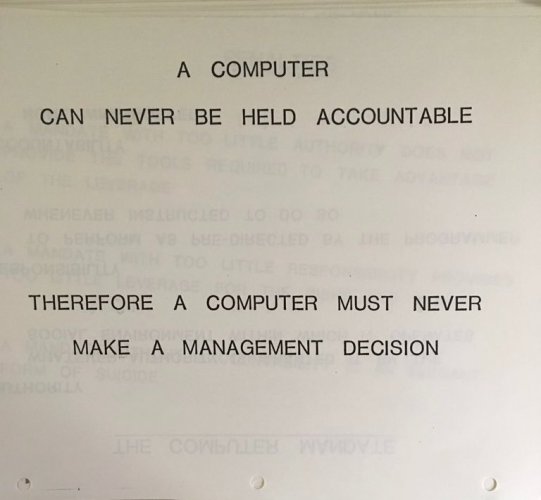
This whole discussion simply comes down to the question who ultimately controls the AI power switch (there obviously has to be one out of AI reach/control, amIrite)? The prudent answer to that should be obvious.
 
Last edited:

Similar threads

Back
Top Bottom