The Messerschmitt P.1100 and P.1099

blackkite

Don't laugh, don't cry, don't even curse, but.....
Joined
31 May 2007
Messages
9,408
Reaction score
9,269
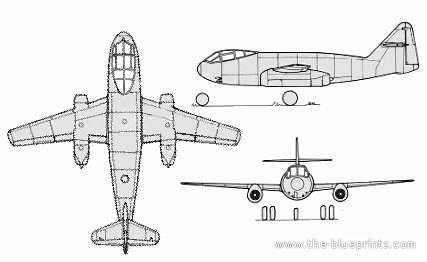
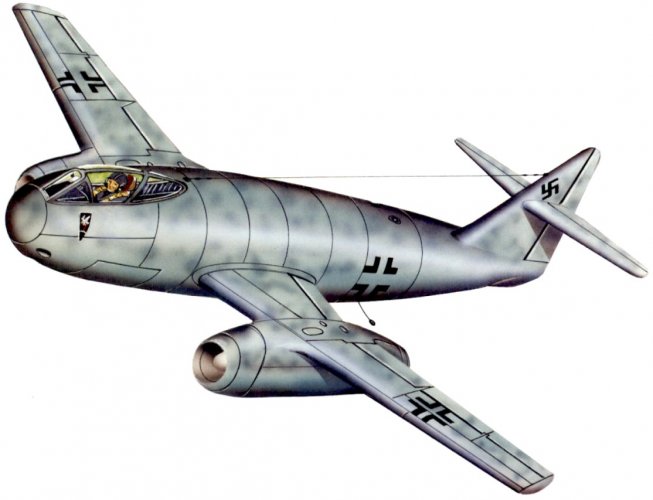
The Messerschmitt P.1099 was a two-seat multirole fighter.
The design of the Me P.1099 began in the summer of 1943 and was intended as an improvement to the Messerschmitt Me 262. The Me P.1099 was planned in a way which could later be developed into high-speed bomber (Schnellbomber), reconnaissance plane, interceptor, night fighter and trainer versions.

Variants
The Messerschmitt P.1099 project had different versions of two-seat fighters which retained the tail and the wing design of the Me 262. All of the projected aircraft variants would be powered by two Junkers Jumo 004 turbojets.

Messerschmitt Me P.1099A​

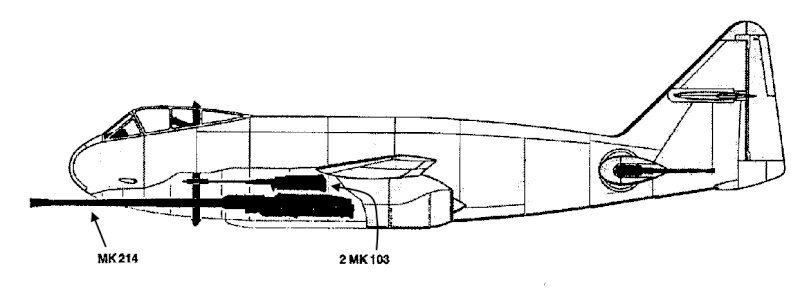
Jet-powered fighter with a crew of two, developed in January 1944. It retained the wings and the tail section of the Me 262A-2a, but with a wider fuselage. There were three planned versions, differing in armament: Version A with four MK 108 30 mm cannon. Version B with two MK 103 30 mm cannon and Version C with two MK 108 and two MK 103 cannon in the nose.

Messerschmitt Me P.1099B​

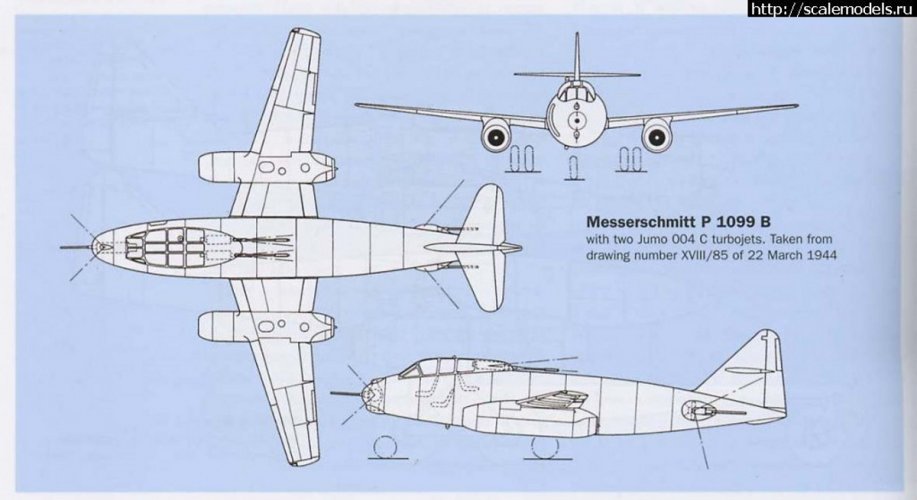
A heavily armed variant, developed from the Me 262, of which two versions were foreseen: Version A would be armed with a MK 108 cannon and a MK 112 55 mm cannon. Version B was armed with a MK 114 50 mm cannon. The radio equipment would be a FuG 16, Peil G6, FuG 101 radio altimeter, FuBl 2 blind landing equipment, as well as the FuG 25a Erstling identification friend or foe transceiver. There was also a night fighter version equipped with two upward-firing MK 108 cannons.
(Wikipedia abstract)
 
Last edited:
Hi! Me P.1099A.
 

Attachments

  • me1099a.jpg
    me1099a.jpg
    20.4 KB · Views: 60
  • 00055225.jpg
    00055225.jpg
    106.5 KB · Views: 37

Attachments

  • P1099B.jpg
    P1099B.jpg
    410 KB · Views: 39
  • 00055221.jpg
    00055221.jpg
    227 KB · Views: 36
  • messerschmitt-me-p1099-heavy-jet-fighter-nazi-germany.jpg
    messerschmitt-me-p1099-heavy-jet-fighter-nazi-germany.jpg
    63.7 KB · Views: 40
Last edited:
"Me P.1099B (1 Cockpit Mock-up built)
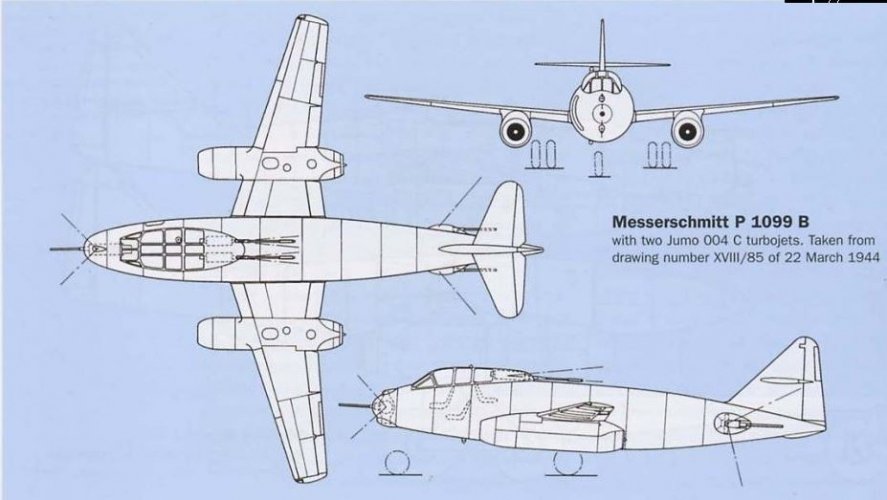
Note: This Messerschmitt design was an advanced development of the basic Me 262 airframe and was proposed in January 1944. The P.1099B utilized the wings and tail of the Me 262 A-2a, but had an entirely new and enlarged fuselage and undercarriage. Two Jumo 004C jet engines were to be fitted and a crew of two or three sat in the redesigned cockpit. The basic armament for this variant was two FPL 151/20 in the rear and one FHL 151/20 barbette remotly controlled in the nose, one MK 103Z was placed behind the cockpit. A large variety of more detailed proposals for the Me P.1099 were issued on March 22, 1944, including various armaments. A night fighter development was also proposed, armed with an additional two MK 108 in an upward firing Schräge Musik configuration.
The main difference between the P.1099A and B series was that the B version had better offensive and defensive armament. "Fighter I or II ~ A - B" were different schematic armament designations and shouldn't be mistaken with the A and B variant designation of the P.1099. The version in the first picture is the B-1 which was the basic variant and has nothing to do with Fighter I and II.
It's very complicated to seperate all these designations. :D
Span: 12.58m
Length: 12m
Height: 4.43m
Wing Area: 22m²
Max. Speed: 825km/h
Engine: 2x Jumo 004C 1015kp each
Climbrate: ---
Ceiling: 9810m
Range: 1340km
Armament Fighter I A: 4x 30mm MK 103
Armament Fighter I B: 2x 30mm MK 103, 1x 55mm MK 214B
Armament Fighter II A: 4x 30mm MK 108 (2x additional as Schräge Musik)
Armament Fighter II B: 4x 30mm MK 108
Turrets Fighter I A: 2x 20mm FPL 151
Turrets Fighter I B: 2x 20mm FPL 151
Turrets Fighter II A: 2x 20mm FPL 151
Turrets Fighter II B: 3x 20mm FPL 151"
 

Attachments

  • me_p-114.jpg
    me_p-114.jpg
    41.4 KB · Views: 52

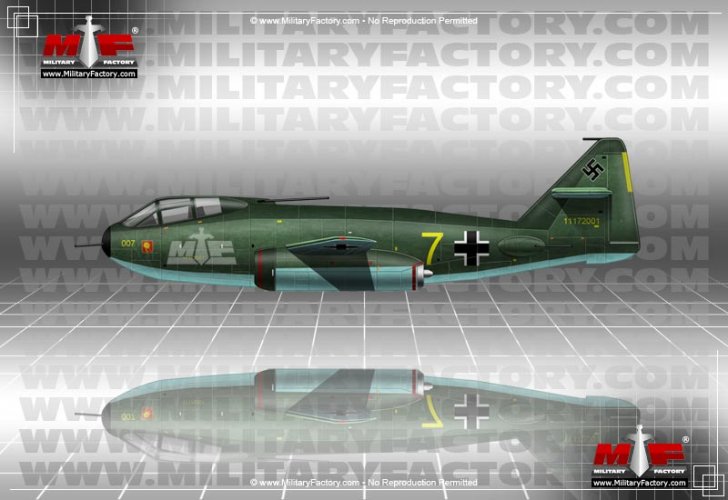
"Secret weapon part 9 - Me P. 1100 “The level bomber”.

Until that Dan Sharp released his next book with new details, I will bring the data I have could find.
Me P.1100 (22 March 1944).
In the beginning of 1944 Messerschmitt began the Heavy fighter Me P. 1099 and the fast bomber Me P.1100 project. The project sharing the same fuselage for both product line, and the drawings are saved under project XVIII.
A version:
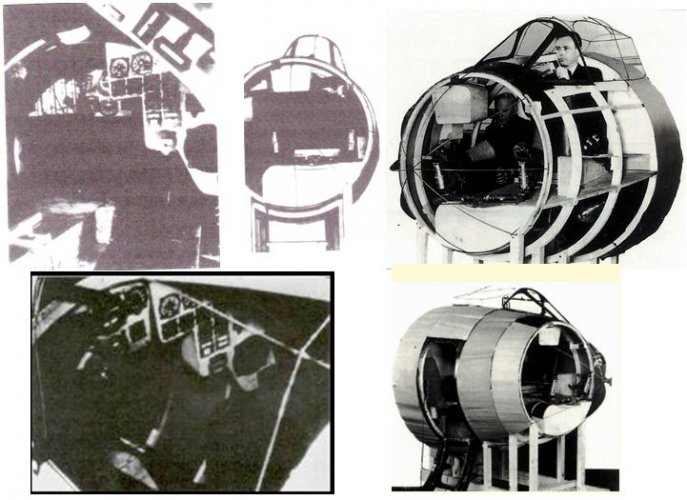
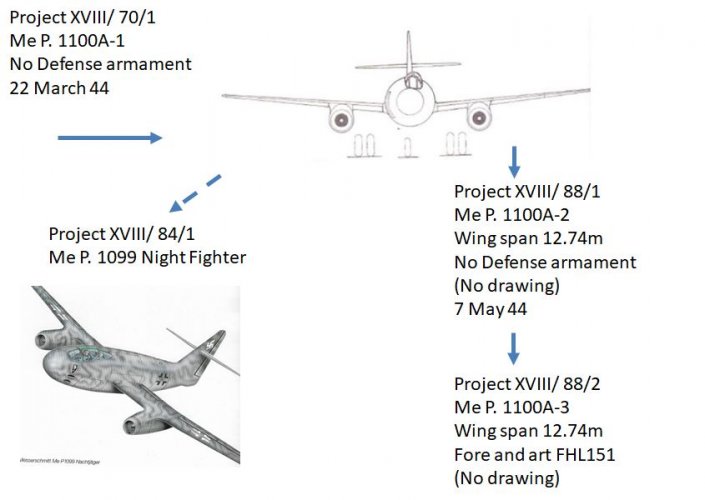
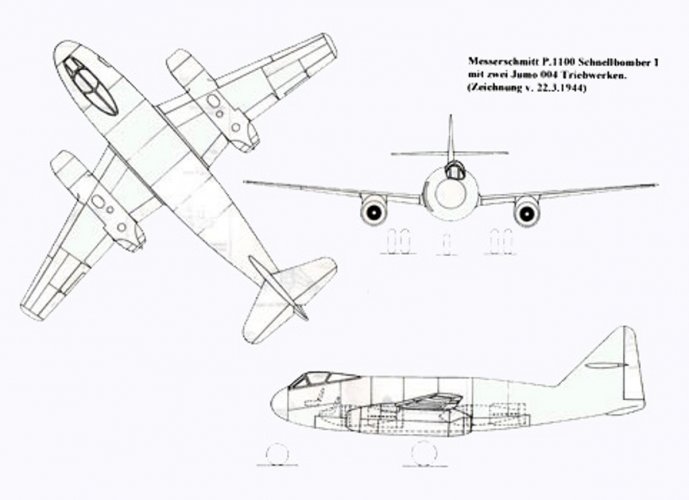
The first project was project XVIII/70/1 is dated the 22 march 1944(see illustration 1 & 2), but the documents is shown another date (13.01-1944). This plane was build as a mock- up of the cockpit design (See illustration 3), had an asymmetric placement of the cockpit.
I have named it as Me P. 1100A-1 and this concept was later developed into the concept XVIII/84/1 (Me P.1099 night fighter). (See the over view for A versions, illustration 4)
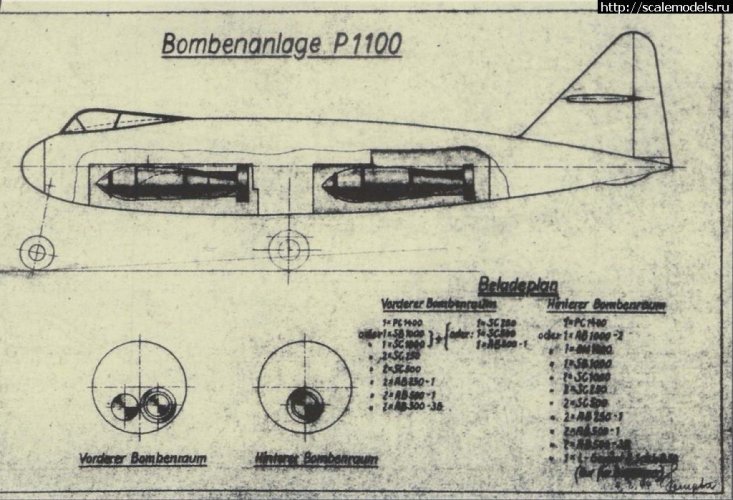
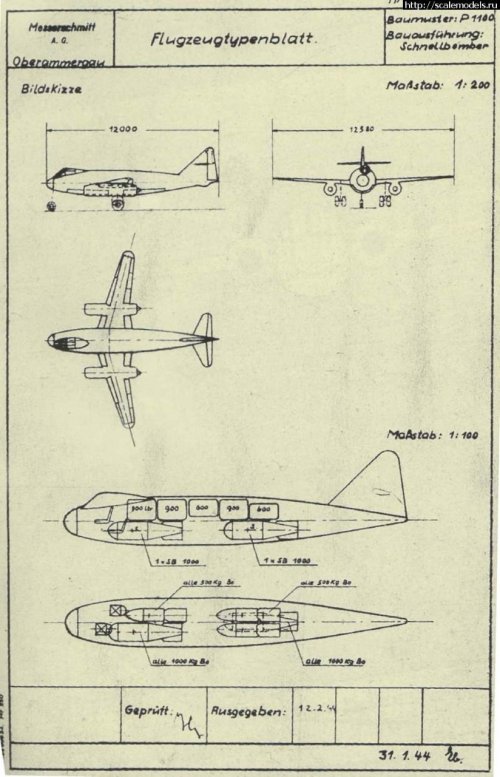
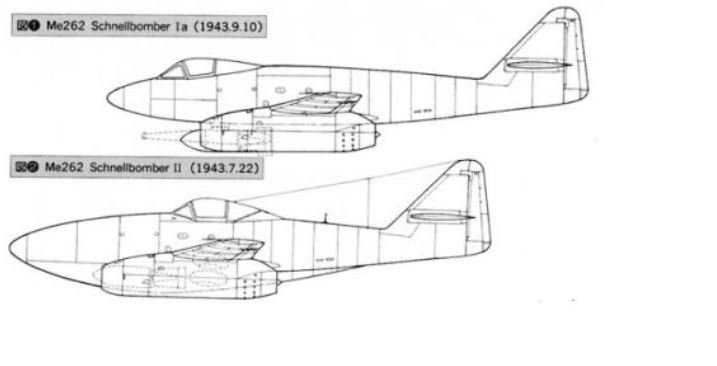
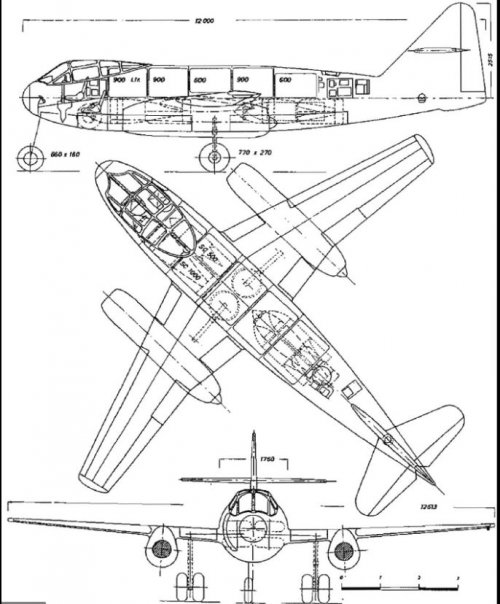
Compared with the earlier bomber version of Me 262 could the Me 262A-2A carried 2x 250kg bombs, the “schnellbomber I” carried 2x 500kg (See illustration 5), and Me P. 1100 could carried 4x 500kg, 2x 1000kg, or in overload condition 2x PC1400 (total 2800kg). The Me P1100 had the bomb bay split up in two rooms, placed in the fuselage separated by the bay for the main landing gear.

The earlier design of bomber version of the Me 262 family, had problems with center of gravity after dropping the bombs. With Me P.1100 design the bombs would be drop synchronized with the same weight from the front and rear bomb bay. So it was possible to drop the half of the load.
The two crew design make this plane to a level bomber (pilot and bombardier).

The Me P.1100A-1 design wasn’t armed with any defense armament, but was rely on speed advantage.
The maximum speed level was calculated to 722 km/h at sea level, and 746km/h at 6.000 meter . It was power by two Jumo 004C jet engine (see illustration 6).

The project XVIII/70/1 was development into project XVIII/88/1 dated the 7 May 1944 (in this context named as Me P.1100A-2) where the wing span is increase to 12.74m from 12.613m.

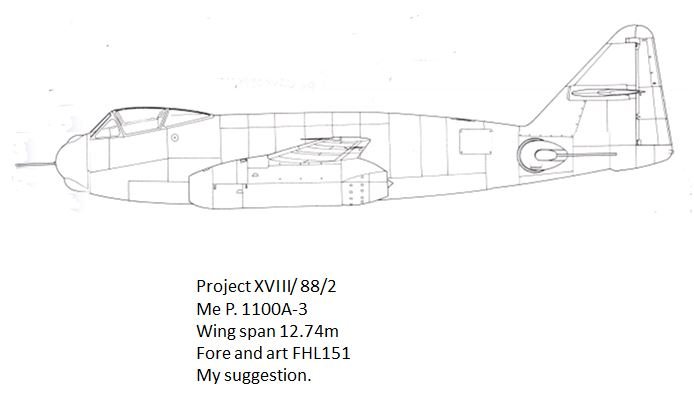
(Me P.1100A-3) Project XVIII/88/2 did also had remote weapon system 15mm MG FHL151 (in A and D stand). I have make a suggestion for the weapon system, and with asymmetric cockpit it will give some problem with aiming the weapons (See illustration 7)

B-version: (see illustration8)
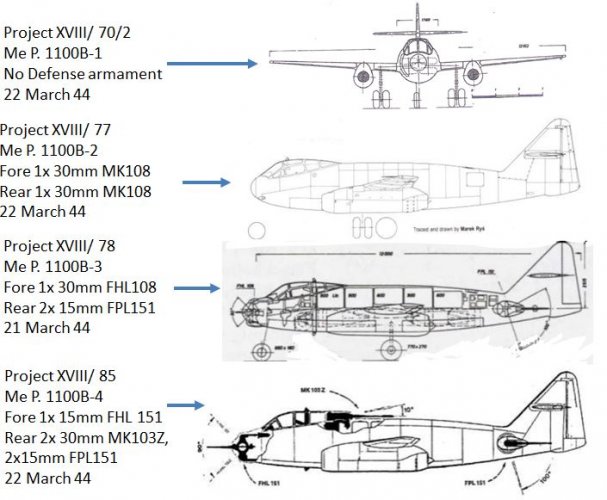
(Me P.1100B-1) Project XVIII/70/2 had a larger cockpit, and didn’t had any defense armament
(Me P.1100B-2) Project XVIII/77 had one 30m MK 108 in port side placed in the front (A-stand) and in the rear (D- stand). The pilot aimed the rear gun by the periscope.
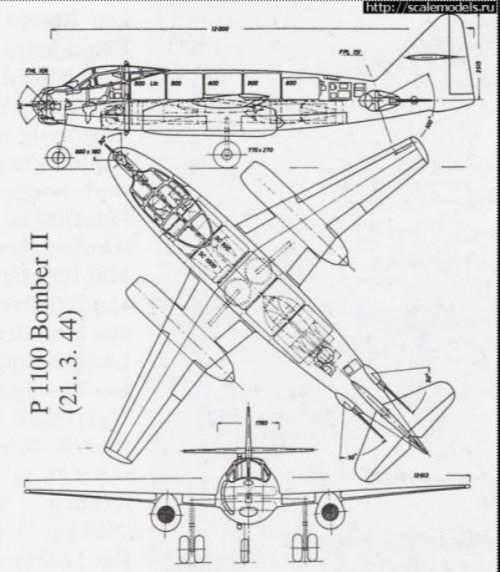
(Me P.1100B-3) Project XVIII/ 78 had moveable gun (30mm FHL108) in the front (A-stand) controlled by the navigator, and he is controlled the Rear gun turret system (15mm FPL151) with periscope (D-stand). (see illustration 9). The rear gun system was also used by Me 410 (but only 13mm MG).

(Me P. 1100B-4) Project XVIII/ 85 were a three crew design. Pilot, (front gunner/bombardier / Periscope gunner) and rear top gunner/ radio operator (see illustration 10). The front gun was now change to a 1x 15mm FHL 151 (A- stand), top rear gun controlled by the 3th crew member 2X 30mm MK108Z (B-stand), and 2 x15mm FPL 151 in D –stand.
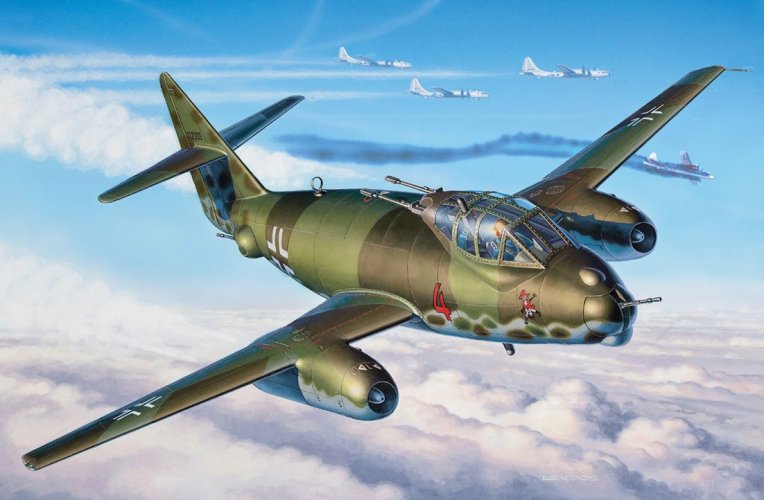
This design was inspiration for Revell model Me P.1099B/1, but this design wasn’t a fighter.

C-Version (see illustration 11):
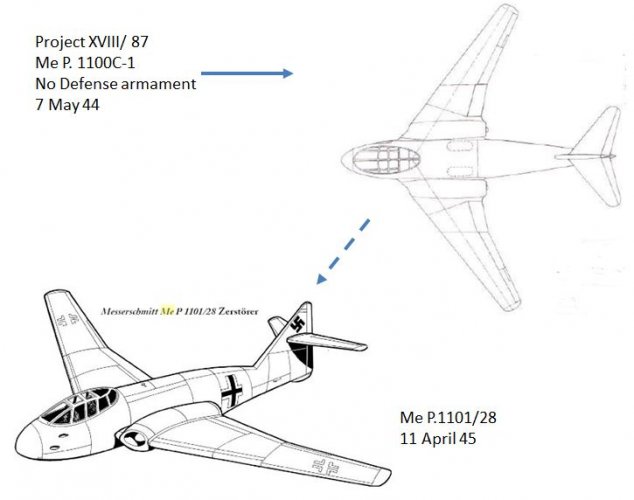
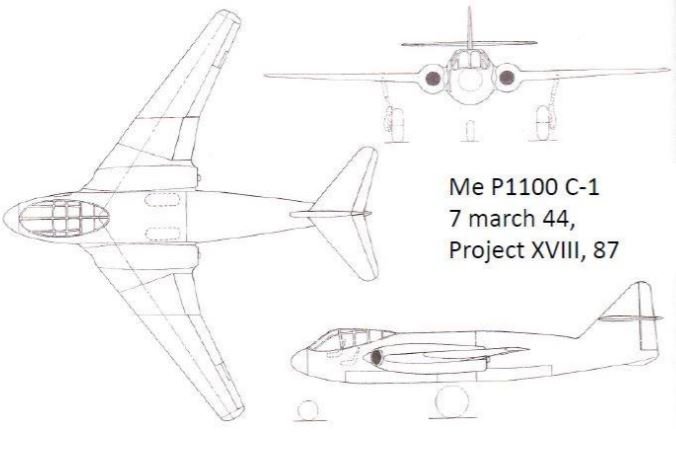
(Me P.1100C-1) Project XVIII/ 87 was powered the more powerful HeS 011A jet engine buried in the wing root and with 35 degree sweep back wing. The speed is unknown, but a later design indicated the speed (see illustration 12)

In the last days of the war, the air manufacture still had to show results of new design, and here come the fighter project Me P.1101/28 (11 April 1945) that is very similar to project XVIII/87. Sources indicate the max speed to 910Km/h, and the dimension is the span 14.30m, Length 13.35m and the height to 4.4m.
The armament is unknown, but the demand for this period was 4x 30mm MK108.

Me P.1100 design after the war many of the German technicians took hire in other countries, and the Me P.1100 was also known inspiration for two projects. These projects were the British Canberra and the French S.O. 4050 Vautour II.

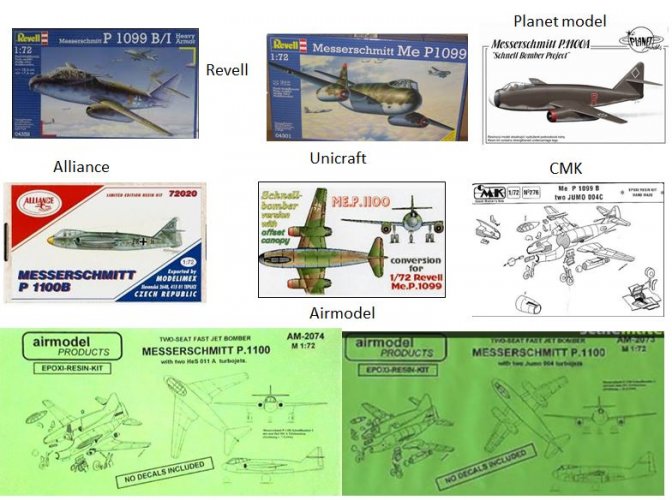
Model kit in scale 1/72 has been made by Revell, Planet model, Alliance the same mold as Airmodel, and CMK.
(See illustration 13)."
 

Attachments

  • illustration 1.jpg
    illustration 1.jpg
    178.6 KB · Views: 32
  • illstration 2.jpg
    illstration 2.jpg
    203.1 KB · Views: 33
  • illustration 3.jpg
    illustration 3.jpg
    66 KB · Views: 33
  • illustration 4.jpg
    illustration 4.jpg
    47.6 KB · Views: 30
  • illustration 5.jpg
    illustration 5.jpg
    21.8 KB · Views: 29
  • illustration 6.jpg
    illustration 6.jpg
    82 KB · Views: 31
  • illustration 7.jpg
    illustration 7.jpg
    20.5 KB · Views: 29
  • illustratin 8.jpg
    illustratin 8.jpg
    66.4 KB · Views: 29
  • illustration 9.jpg
    illustration 9.jpg
    70.1 KB · Views: 30
  • illustration 10.jpg
    illustration 10.jpg
    53.7 KB · Views: 28
  • illustration 11.jpg
    illustration 11.jpg
    34.4 KB · Views: 29
  • illustration 12.jpg
    illustration 12.jpg
    25 KB · Views: 32
  • illustration 13.jpg
    illustration 13.jpg
    82.1 KB · Views: 35
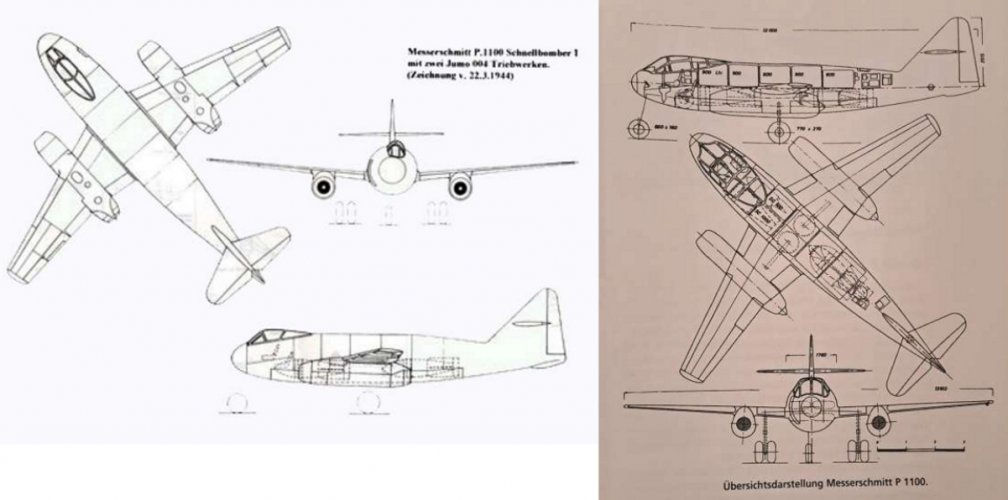
I'm still wondering wether I can turn a revell P1099 kit in a 1100, the perioddrawings in dan sharp book show design relatively identical externally .
 
I'm still wondering wether I can turn a revell P1099 kit in a 1100, the perioddrawings in dan sharp book show design relatively identical externally .
Show me the name of his book.
 
Show me the relation between these two drawings.
Left side is A-1 and right side is B-1?

And P 1099A equal P 1100A?
 

Attachments

  • Me P 1100.jpg
    Me P 1100.jpg
    240.5 KB · Views: 50
Last edited:
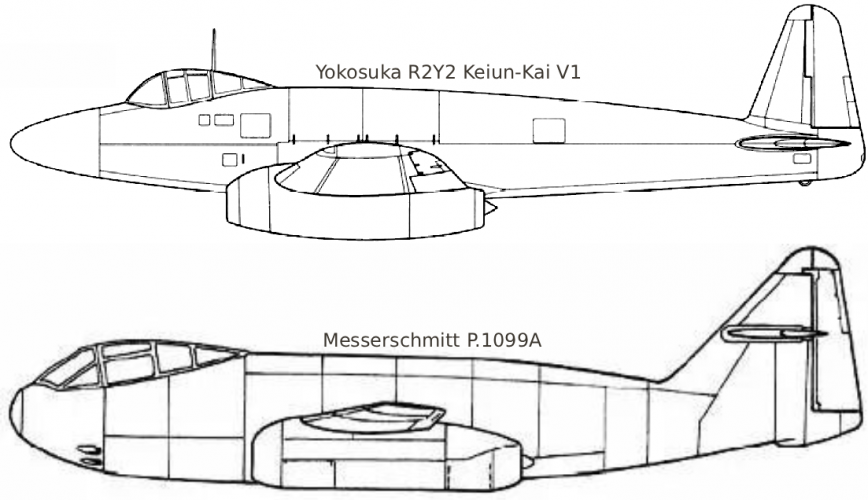
We are going into very hypothetical territory here, but could the Messerschmitt P.1099 have influenced the R2Y2 V1 variant?

We know Messerschmitt was providing technical information to the Japanese, leading to the creation of the Nakajima Kikka (based on the Me 262) and Mitsubishi J8M Shūsui (based on the Me 163). Since the P.1099 project was a 1943 development of the Me 262, there is a good chance the Japanese were informed about it.

The R2Y2 V1 looks exceptionally similar to the P.1099, (in fact it more resembles the P.1099 than its R2Y1 predecessor), has the same role (heavy interceptor/fast bomber), and approximately the same flight performance, compared below.

Data for P.1099 from Heinz Nowarra, Dieter Herwig, and other sources were the former two had no info. Data for R2Y2 from any available source due to scarcity of information surrounding this design.

Messerschmitt P.1099

Length: 12 meters
Wingspan: 12.56 meters

Speed: 820 km/h
Range: 1,340 km
Payload (fast bomber variant): 1,000kg


Yokosuka R2Y2 Keiun-Kai V1

Length: 12.2 meters
Wingspan: 14 meters

Speed: 850 km/h
Range: 1,300 km (V1 variant)
Payload (fast bomber variant): 800kg
 

Attachments

  • R2Y2 and Messerschmitt P.1099A comparison.png
    R2Y2 and Messerschmitt P.1099A comparison.png
    213.4 KB · Views: 21

Similar threads

Back
Top Bottom