The Future of the Royal Navy and the 'Hybrid Navy' Initiative - News, Platforms, Development and Speculation

You mean the sonar 2176 made by Thales?
In this case it's Thales UK, who are entirely British. The Flash dipping sonar is a mixture, CAPTAS-4 is French but our version has been adapted by Thales UK and their hull sonars and the rest of the CAPTAS line are French.

European conglomerates are an absolute mess to try to work out who does what and who has access to what information, but the RN's submarine sonars are one of the easier things to identify as being UK only.
 
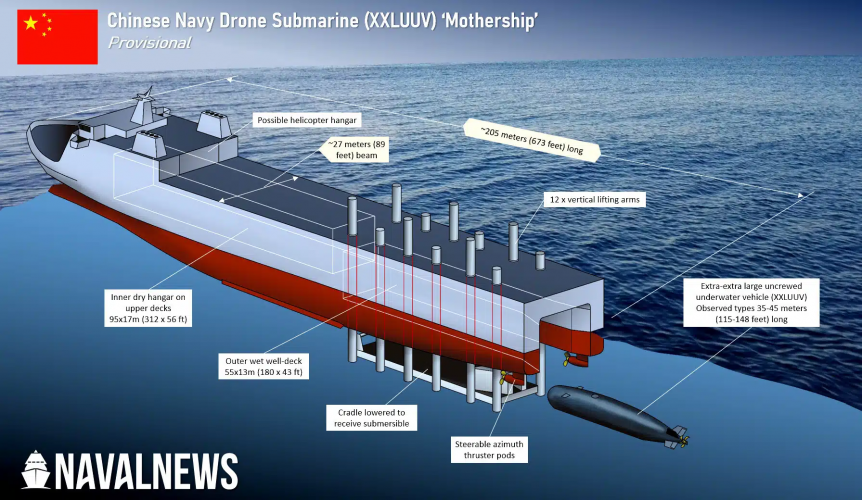
https://www.navalnews.com/naval-news/2026/09/chinas-new-giant-submarine-drone-mothership/
Never seen anything like this before. Like a floating shiplift. Wonder if Atlantic Bastion demands something similar?
View attachment 823861
That's interesting. I do think we'll need new auxiliaries going forward, and I reckon you could use something like this for the same role as RFA Proteus.

That said, the four amphibious transport ships could fit a couple of smaller unmanned submarines instead of their landing craft.

Rather than investing in Norwegian Standard Vessels, as Kongsberg reports the UK as doing, we should be looking at something between those ships and this Chinese vessel.
 
News on RN nuclear submarines:

https://ukdefencejournal.org.uk/steel-to-be-cut-on-first-new-generation-british-attack-sub/

Steel to be cut for the first SSN-AUKUS next year, but a decision on numbers will not be made until 2028.

https://www.navylookout.com/foundat...on-of-the-royal-navy-nuclear-submarine-fleet/

More material here, with a link to the annual update report to parliament. There's stuff on which bits will be coming from where and so on.

https://assets.publishing.service.g...-057_DNE_2026_Annual_Update_to_Parliament.pdf

The 2026 report is the most specific statement of intent yet for SSN-AUKUS, with dates, money and named facilities. The decisions that will determine whether the RN gets the size of fleet it has been promised have been delayed. Sustaining the 18-month drumbeat over the long term will require joined-up planning across SSN-AUKUS, Dreadnought and the eventual Dreadnought successor.

The article outlines how the management of the interrelated Dreadnought and SSN-AUKUS programmes and industrial strategy should avoid the long delays of the Astute programme.

The first AUKUS-SSN will be entering service in the late 30s. The first Astutes will begin retiring years before the first of the new boats are in service, leading to a shrinking fleet, though they promise an increased production rate, with a new boat every 18 months.

The figure of “up to 12” SSNs promised in the Strategic Defence Review (SDR) of June 2025, and reaffirmed in the Defence Investment Plan on 30 June, does not appear in the DNE report. The document refers only to an expanded SSN fleet, with decisions on the total number of submarines expected before D2L2 ends. Ministers restated the 12-boat ambition to the Defence Committee in June, so the omission may reflect drafting rather than policy.

Less time running the reactor at sea means less fuel burned from the PWR2’s Core H, which is designed to last the life of the boat. How long each Astute can serve will depend on both the condition of the hull and the fuel left in the core, and both may be in better shape than the boats’ ages suggest.

<sarc> If none are at sea, then they'll last a lot longer, won't they? </sarc>
 
Very nice, hopefully we can clear this up then. I'm prepared to eat my words :)
Seems I was right
In response to your question, the Minister’s use of the term ‘augment’ referred to the potential procurement of complete Australian radar systems to enhance UK capability. As part of this work MOD will consider how any future procurement could leverage advanced technology already developed in Australia while creating opportunities for UK industry through co-development, co-production, component manufacture, integration and through-life support; providing a significant growth opportunity for the UK.
 
So is there anything to suggest that the companies and their technologies are "siloed"?
That there are individual French and British sites which are descended from different companies, and that nuclear submarine construction is one of the things countries are most secretive about.
Any form of cross dependence would be bad for both parties, and the French in particular are prickly about having an entirely independent deterrent.
 
Just releasing that amount of weight from a small submarine is not a trivial issue.
 
What worries me is that if the AUKUS nuclear submarines use American systems and can't use Spearfish torpedoes, that would be a real pain.
 
That there are individual French and British sites which are descended from different companies, and that nuclear submarine construction is one of the things countries are most secretive about.
Any form of cross dependence would be bad for both parties, and the French in particular are prickly about having an entirely independent deterrent.
So that would be a no then.
https://www.navylookout.com/royal-n...ine-fires-heavyweight-torpedo-in-aukus-trial/
I didn't know Excalibur was going to be used for this sort of thing. Mk48 was used, and must have been carried externally somehow as it's too big for the cubic payload bay.
You can clearly see it in the video attached underneath Excalibur
 
What worries me is that if the AUKUS nuclear submarines use American systems and can't use Spearfish torpedoes, that would be a real pain.
Primarily it's down to the plug interface location in the tube. It's fairly trivial to produce adaptors and extensions.

Nothing beats good design.
 
Primarily it's down to the plug interface location in the tube. It's fairly trivial to produce adaptors and extensions.

Nothing beats good design.
Always good to have both options as well, so that a submarine can be easily rearmed.

We should also be looking at lightweight torpedoes for knocking out drone submarines, or cheaper heavyweight torps for merchant ships.
 
Always good to have both options as well, so that a submarine can be easily rearmed.

We should also be looking at lightweight torpedoes for knocking out drone submarines, or cheaper heavyweight torps for merchant ships.
Might be worth going for a brakestop-esque weapon as you describe, slower and less refined against advanced countermeasures to save money relative to Spearfish. Torpedo room space might be a concern but even in an absolute best case 'happy time' scenario would an SSN fitted with VLS be able to fire 20 torpedoes at difficult targets in a single cruise?

If it's too big a problem might torpedo storage be arranged so that a half-length weapon be possible? Or perhaps in the least dangerous scenarios VLS could be used for extra torpedo stowage.
 
Might be worth going for a brakestop-esque weapon as you describe, slower and less refined against advanced countermeasures to save money relative to Spearfish. Torpedo room space might be a concern but even in an absolute best case 'happy time' scenario would an SSN fitted with VLS be able to fire 20 torpedoes at difficult targets in a single cruise?

If it's too big a problem might torpedo storage be arranged so that a half-length weapon be possible? Or perhaps in the least dangerous scenarios VLS could be used for extra torpedo stowage.
I mean, twenty heavyweights is enough to task two to every active submarine in the Northern Fleet. I'm sure they could drop a few in exchange for something equivalent to the American RaPTor.

I reckon twenty is pretty conservative, as well. Virginias are about 8000t and equipped for 25 tube-launched weapons. SSN-A will likely be >10,000t, so I wouldn't be surprised if 30 or more weapons could be packed.

Northrop Grumman claim their Very Lightweight Torpedo (VLWT) could be packed in numbers of up to 10 per torpedo tube. Those are already integrated into AN/BYG-1 and can also function as a hard-kill countermeasure, which is very cool. I know the Russians have a similar system on their Gorshkovs, but I don't know about Western systems.
 
I reckon twenty is pretty conservative, as well. Virginias are about 8000t and equipped for 25 tube-launched weapons. SSN-A will likely be >10,000t, so I wouldn't be surprised if 30 or more weapons could be packed.
The Seawolf class doesn't displace much more than the Virginias but has 8 tubes with 50 weapons. I don't know if that many would be necessary if the submarine also has VLS for Tomahawks (or some other cruise missile).
 
The Seawolf class doesn't displace much more than the Virginias but has 8 tubes with 50 weapons. I don't know if that many would be necessary if the submarine also has VLS for Tomahawks (or some other cruise missile).
The Astutes can carry 38 weapons with a mix of Tomahawks. It would seem reasonable to drop down only to 30ish with the renewed focus on ASW, plus 28 Tomahawk or equivalent in the VLS. That leaves a reasonable set for North Atlantic ASW missions- I don't know what policy is for the expected number of torpedoes per engagement is but by SSN-AUKUS we ought to be able to surge two in a hot Atlantic war and that's a lot of kills.

I'm sure they could drop a few in exchange for something equivalent to the American RaPTor.
Another interesting American development is Anduril's Copperhead, which are designed to be much cheaper than conventional torpedoes and have a wider range of possible roles. An all-electric propulsion weapon might be interesting as it would be able to stop and loiter for extended periods unlike Spearfish, which is gas turbine powered.
 
Are the torpedoes not themselves buoyancy neutral? So a cradle release wouldn't do anything.
IIRC they're just slightly positively buoyant, actually. At least the Extorps are, and IIRC extorps are absolutely identical in weight and balance to warshots.

At least once the fuel burns off.


The Seawolf class doesn't displace much more than the Virginias but has 8 tubes with 50 weapons. I don't know if that many would be necessary if the submarine also has VLS for Tomahawks (or some other cruise missile).
The Seawolf class was designed when people weren't sure about the VLS.

But then again, 4 tubes and ~24 weapons is the same stows-per-tube as 8 tubes and 50 weapons.

These days, I wouldn't expect more than 6 tubes and ~36 weapons in the torpedo room, plus VLS.
 
The Seawolf class was designed when people weren't sure about the VLS.

But then again, 4 tubes and ~24 weapons is the same stows-per-tube as 8 tubes and 50 weapons.

These days, I wouldn't expect more than 6 tubes and ~36 weapons in the torpedo room, plus VLS.
There's a pretty significant difference between target density in a place like the Norwegian Sea, where the RN SSN-AUKUS might be fighting, and somewhere like the South China Sea, where the Australian SSN-AUKUS would be. Electric swim-out ROV torpedoes like the Anduril Copperhead family would be safer to use (no torpedo tube launch transients) and could provide more options against smaller surface targets, so there's more chance of actually working through the entire magazine before being sunk by Chinese ASW. If you're deep into the SCS, ECS, or TST, missiles would be the last thing you would want to shoot. The Astute has plenty of capacity to play tag with the Northern Fleet, but in the Pacific there are going to be thousands of Chinese ships and boats to sink. That being said, a VLS would be extremely useful in less contested areas or in other wars that the SSN-AUKUS might be involved in.
 
There's a pretty significant difference between target density in a place like the Norwegian Sea, where the RN SSN-AUKUS might be fighting, and somewhere like the South China Sea, where the Australian SSN-AUKUS would be. Electric swim-out ROV torpedoes like the Anduril Copperhead family would be safer to use (no torpedo tube launch transients) and could provide more options against smaller surface targets, so there's more chance of actually working through the entire magazine before being sunk by Chinese ASW. If you're deep into the SCS, ECS, or TST, missiles would be the last thing you would want to shoot. The Astute has plenty of capacity to play tag with the Northern Fleet, but in the Pacific there are going to be thousands of Chinese ships and boats to sink. That being said, a VLS would be extremely useful in less contested areas or in other wars that the SSN-AUKUS might be involved in.
We're still talking 6 weapons per tube. Maybe 7, if you load the tubes first and then fill the torpedo room. Note that filling the tubes for more stows doesn't leave you a lot of room to swap around what's in the tubes.

Because we are still talking about needing to engage a variety of targets.

For example.
  • A missile sub has a dozen ish torpedoes and only torpedoes, the only threat to an SSBN is an SSN (edit) and SSBNs aren't supposed to go hunting. Self defense only.
  • The Cold War loadouts for a Fast Attack were a couple of SUBROCs, ~4 Harpoons, ~4 Tomahawks, and ~10-14 Torpedoes.
  • The VLS boats would gain more torpedoes in exchange for the Tomahawks. The reason for the low number of Tomahawks is because a boat with 4 torpedo tubes can only volley 3 Tomahawks at a time. The last tube is saved for a torpedo as an emergency warshot because you got surprised during the launch.
 
Last edited:
I don't know much about the masts but a lot of the discussion seems to mix systems in the same I-MAST (integrated mast) solutions. Sea Master 100 goes on I-MAST 100 which is for corvettes. Sea Master 400 goes on I-MAST 400, for large OPVs. Sea Fire goes on I-MAST 500, for destroyers and frigates. There is also a tiny I-MAST 50 version. The competing products is SLIM by Saab and PSIM by Naval Group. Japan and India have UNICORN (Unified Complex Radio Antenna)/NORA 50. South Korea has another that I cannot remember the name.. China has something equivalent. But these syatems are extremely long lead times to build and manufacture. I don't see much variation in any orders by country except when it comes to ship class, because maintenance and support is not for the feint of heart.

While ARTISAN is old, it works and they can recoop them from retired ships. It seems odd to criticize them for various models going into MLUs and new builds, as they are not exactly obsolete.
 
Last edited:
https://ukdefencejournal.org.uk/plymouth-built-uncrewed-boat-armed-with-sea-venom-missile/

Big fan of this thing. Surface-launch, so if there's no booster, I reckon 17-20km range
Sea Venom has an integrated booster. It's boost-sustain but the booster isn't discarded, which is what causes the strange banana shape with the sustainer nozzle being underneath the missile body.

If I were at MBDA I'd be trying to build a MK2 with a proper staged booster and a turbojet for a Brimstone->Spear type evolution.
 
From the Financial Times/ft.com:

UK defence


Healey to promise ‘new age of industrialisation’ with £6bn Royal Navy plan

Chancellor will pledge that work on building three new floating docks on the Clyde in Scotland will be carried out by British firms

John Healey sits at a podium in front of a pink background at the UK Labour Party annual conference.
John Healey, the current Labour chancellor, is a former defence secretary © Mary Turner/Bloomberg

George Parker, Chris Smyth and Lucy Fisher in Liverpool
Published13 hours ago


UK chancellor John Healey will claim Britain is about to enter “a new age of industrialisation” as he confirms a £6bn plan to build three new floating docks at the Royal Navy’s submarine base on the Clyde in Scotland.

Healey’s speech to the Labour conference in Liverpool on Monday follows a demand by Louise Haigh, first secretary of state, that more of the UK’s annual £400bn public procurement budget should be spent on British firms.

His address will be closely watched by the markets for any signals he gives ahead of the Budget on October 28. Healey has insisted that he will be cautious and one senior Labour figure said: “It won’t be a blow-the-doors-off Budget.”

But facing a Labour audience, Healey is expected to claim that Andy Burnham’s new government will generate jobs and growth at home.

The former defence secretary will promise that work on the Royal Navy’s Clyde base will be carried out by British firms with a “UK-only” competition for the work known as “Programme Euston”.

“By backing British shipyards, we are not only boosting national security but also securing resilience in the industries that will drive growth today while building the capabilities the country needs for the future,” Healey will say.

“My politics were shaped by the industrial heartlands of South Yorkshire. Today, on the site of the Orgreave pit is Rotherham’s Advanced Manufacturing Park. Our coal mines are not coming back.

“But this is how Britain’s industrial past is being remade now for the modern world. This is the new age of industrialisation.

”The investment in the submarine facility is part of a “multi-decade, multibillion-pound transformation” of the site set out in July by Lord Vernon Coaker, defence minister, who said the work would cost £15bn over the next decade.

The announcement by Healey will end speculation that the UK could be forced to rely on foreign shipyards to help construct the large floating dry docks.

The Royal Navy has been grappling with creaking defence maritime infrastructure, which has contributed to lengthy maintenance backlogs and the availability of its surface and submarine fleets.

Haigh, speaking at the Labour Party conference on Sunday, told defence companies and privatised utilities that they had to buy more from British companies as she set out plans to end outsourcing of government cleaning and catering services.

She also sought to pressure businesses reliant on government contracts to spend more with British companies.

Haigh said that “businesses who want to win government contracts are in no doubt what we expect from them — good jobs, skills and apprenticeships for people here in Britain”, having revealed her plans to overhaul government procurement rules to the FT in August.

Defence contractors will be “told to create British jobs and British opportunities in return for the billions they receive,” Haigh said. “If your business is bidding for government contracts to defend our country, then you will be judged on your commitment to backing high-quality British jobs.”

She sought to argue this was what Burnham meant when he said that national security “can’t come at the expense of social security”, widely interpreted as a reluctance to cut welfare to fund defence.

Promising to hold the government to the same standard, Haigh said she would start bringing outsourced government contracts back in house.

“When existing contracts end in 18 months’ time we will begin bringing more than a thousand outsourced cleaning, catering and security jobs across Whitehall back in house,” she said, promising this was “just the start”.

 

Similar threads

Back
Top Bottom