The Future of the Royal Navy and the 'Hybrid Navy' Initiative - News, Platforms, Development and Speculation

CEAFAR isn't multi band in the way Hyperion is supposed to be. Unless I'm reading all the wrong sources it has separate panels for X, S and L-band. So do Kronos Dual Band and the SPY-3 based DBR, which is what I was trying to reference. Sorry.
The idea of HCDA in Hyperion is that a single panel does everything, and as far as I can find no such radar is in service or projected to be on any currently concepted vessel.
Oh dear... I know. I wasn't comparing it that way. I was saying it's a good bridge to that technology when it matures compared to other contemporary systems, including Kronos DBR. SPY-3 isn't DBR by the way, it's an X band radar.
I struggle to understand what AKERU is
Really? In a day you've gone from struggling to understand to suddenly an expert. But I feel like I'm arguing with AI on this one so let's just leave it there.
These things may happen, but, like all military and aerospace equipment their use is predicated on known serviceability rates, failure analysis and adequate redundancy (which for USVs may be provided by another vessel).
Right... And that equipment has a team of trained technicians that live onboard with those systems to monitor and repair them when necessary.
Where I come from we call that a strawman argument. Everything could go wrong, therefore everything will go wrong. If that was true no aircraft would ever be allowed to fly, no ship to sail, no car to drive.
Well okay. If suggesting that mechanical and technological systems can malfunction is a logical fallacy... Well I'm lost. Nowhere did I suggest that anything couldn't or shouldn't be attempted, but you've now strawmanned me while accusing me of strawmanning. :D:D:D

Edit: spelling
 
Last edited:
Oh dear... I know. I want comparing it that way. I was saying it's a good bridge to that technology when it matures compared to others contemporary systems, including Kronos DBR. SPY-3 isn't DBR by the way, it's an X band radar.
Really? In a day you've gone from struggling to understand to suddenly an expert. But i feel like I'm arguing with AI on this one so let's just leave it there.
What these two comments tell me is that you don't check your own knowledge before replying. The tiniest little Google search would have told you that the two panels of DBR that I was talking about are the X band SPY-3 and the S-band Volume Surveillance Radar.
Where I come from we call that a strawman argument. Everything could go wrong, therefore everything will go wrong. If that was true no aircraft would ever be allowed to fly, no ship to sail, no car to drive.
Isn't that just Sod's Law? :)
 
What these two comments tell me is that you don't check your own knowledge before replying. The tiniest little Google search would have told you that the two panels of DBR that I was talking about are the X band SPY-3 and the S-band Volume Surveillance Radar.
Like when you told me SPY-6 was dual band? And then it was SPY-3 based? The DBR for Zumwalt was meant to be 2 radar systems. The one you're missing (if you had done the tiniest little Google search) is SPY-4 —as fitted to Gerald, but not to Zumwalt. Two separate systems mashed together, but not working as one.

I hope this helps ;)
 
Regarding crew size, would it be a good place to start with a modern civilian ship - google says a VLCC has about 30 crew. Basically Bridge, engineering and food/care for the other 2 groups. I assume everyone is called up for docking etc.

If we are moving combat control ashore, and then of course automation can reduce the need for engineers, but I see the most mundane issues causing a demand either for 2 engineers to be flown in, or the ship comes off line, and meets a manned 'repair ship' or goes to a dock.

This implies you need repair ships, heli's, and engineers, spare parts, tools, either on the ship or again on the heli - this a bigger heli, and so on.

If I was responsible for this, I'd be looking at the current ships, automating what we can, as the control ships, and then building cheap 'disposable' ships with basic sensors, and simple weapons(sealed for life, no guns).

The other idea is to have 4 of Elon's robots on board.
 
Perhaps a better way to approach the CCV mission is with a containerized C2 system (thinking similar to Aegis CIC but more robust and much smaller footprint) so you could directly do all of these DMOs with existing platforms. I'm thinking something like containers placed on the helo deck which control tailored unmanned packages and requiring 2-3 crew. I understand the engineering required would be a challenge.
 
What's the meantime between failure on a marine diesel? What's the meantime between failure on an AESA radar? What's the meantime between failure on a CAMM round in the VLS? (Remember when answering that CAMM has a zero-maintenance encapsulated service life of 20 years....) These things may happen, but, like all military and aerospace equipment their use is predicated on known serviceability rates, failure analysis and adequate redundancy (which for USVs may be provided by another vessel).
I'm pretty sure most of those should be measured in years (~8800hrs).

Though bad seas messing with your engine oil sump levels could greatly shorten that, I'd strongly recommend converting to dry sump systems.
 
If a single tile is effectively a complete AESA and by software and 'timing' multiple tiles 'connected' become a integrated 'single' AESA.....

Then communications between tiles can conceptually handle any distance between each tile as long as software can handle timing of signals output.

Producing one 'single' AESA spread across various vessels. As long as they orient in the same direction. In theory software can compensate for actual divergence of tile orientation. As long as they all orient in roughly the same direction.

Probably quite a slow system, but synthetic apature size is measured in the distance between furthest tiles mounted on different ships. Meaning absurd detection and tracking ranges and resolutions.
That requires nigh-perfect coordination of the signals. Microsecond if not nanosecond level timing tracking.

Plus, part of how AESAs work relies on interference between the beam frequencies, and that requires fractional-wavelength-precise spacing between emitter pieces.

TL;DR: I can see the fleet wide set of arrays being grouped together as the input of dozens of individual radars, but not as a single synthetic aperture radar.
 
That requires nigh-perfect coordination of the signals. Microsecond if not nanosecond level timing tracking.

Plus, part of how AESAs work relies on interference between the beam frequencies, and that requires fractional-wavelength-precise spacing between emitter pieces.

TL;DR: I can see the fleet wide set of arrays being grouped together as the input of dozens of individual radars, but not as a single synthetic aperture radar.
When news on the quantum atomic clocks and their uses for navigation is published I sometimes see quotes on how they may be used for distributed radar with no physical connection between the sites. Combined with the similarly enabled improvements to GPS and INS perhaps it could become possible to use elements on two different ships as a single array?
For example from the University of Birmingham:
The high precision timing of the atomic clocks will also enable the formation of next-generation distributed radar systems, which will transform surveillance with greater coverage and enable the detection of stealth objects. Quantum clock-enabled network distributed radars will be a game changer for wide-area surveillance in both defence and civil applications, with the ability to maintain real-time situational awareness in highly congested and cluttered environments.
https://www.birmingham.ac.uk/resear...quantum-technologies/quantum-clocks-and-radar
 
TL;DR: I can see the fleet wide set of arrays being grouped together as the input of dozens of individual radars, but not as a single synthetic aperture radar.
Agreed. You'd also need a compute horsepower upgrade so that an individual ship could see the entire synthetic aperture and still see its own radar picture. Unless configured so that a flag ship is the only one that gets to see that wide aperture
 
When news on the quantum atomic clocks and their uses for navigation is published I sometimes see quotes on how they may be used for distributed radar with no physical connection between the sites. Combined with the similarly enabled improvements to GPS and INS perhaps it could become possible to use elements on two different ships as a single array?
Maybe?

I mean, with enough data on exact time doing that is theoretically possible.

But actively doing it is a whole different challenge.
 
https://www.adsadvance.co.uk/armor-force-babcock-hybrid-navy/

This is an interview with Sir Nick Hine (Babcock exec) discussing the Common Command Vessel (Babcock's variant, not the following RN Common Combat Vessel, though they are likely connected). Here's some interesting excerpts.

Babcock believes the first common command vessel could be created from an existing Type 31 without rebuilding the frigate.

“You can have a minimum viable product quite quickly, with effectively some computer server additions, some communications upgrades and some software,” Hine explained.

This is broadly good. Though Hine is likely simplifying, if the transition from conventional warship to CCV requires just minor tweaks for a minimum viable capability, the existing T45 destroyers, and upcoming T26 and T31 frigates ought to make the jump without significant issue.

It does also suggest that Hine, if tasked with constructing the RN's Common Combat Vessel, would likely initially offer an essentially unmodified T31.

The proposed Arrowhead 60 would be considerably larger and more capable than the small explosive-laden boats associated with the war in Ukraine.

“When you talk about drones, everybody in their mind sees some little flying quadcopter,” Hine said. “Then, if you go into the maritime space, when you say drone, you see a speedboat. These are 60 metres long. These are big things. You will notice them.”

Arrowhead 60 does not refer to the HII Romulus line of uncrewed escorts. Instead, it will be a Babcock-designed and built solution, though it will be able to share modular payloads with the Romulus line.

HII’s 150ft Romulus 150 and Babcock’s 60-metre Arrowhead 60 are being developed for different national standards but are intended to share autonomy software and common space, weight and power interfaces.

“A capability in a box that is developed in the US will go on a UK platform and vice versa,” Hine said. “You suddenly get the ability to move all of these things around in a much more sophisticated way.”

Both of these numbers are smaller than the previously reported sizes of the Type 91/92 (80m) and the T94 (100m).

ARMOR Force is also central to Babcock’s ambitions beyond the Royal Navy. Hine said the company is presenting the concept in Denmark and New Zealand and expects to offer it to Chile.

Rather than exporting a fixed British product, Babcock wants partner countries to contribute their own containerised capabilities and potentially build elements of the force domestically.

“Think of it a bit like the F-35 programme, but not as complicated and not as expensive,” Hine said. “It allows nations to bring their expertise and capabilities quickly to bear in a containerised form.”

So, this is interesting. This means that Denmark is being presented with two options by Babcock at least: the conventional air defence frigate we've already seen, and the CCV/T9X-equivalent concept being pursued by the RN.

I question the prudence of describing an export deal as 'like the F-35 programme', though. It doesn't call to mind images of a quick, cheap and focused development period.
 
Arrowhead 60 does not refer to the HII Romulus line of uncrewed escorts. Instead, it will be a Babcock-designed and built solution, though it will be able to share modular payloads with the Romulus line.
Yeah the reporter has gotten it wrong. There is no arrowhead 60. It's the HII Romulus Which is 190ft long or 57m
 
Yeah the reporter has gotten it wrong. There is no arrowhead 60. It's the HII Romulus Which is 190ft long or 57m
Hard to tell, but I think that the reporter refers to the Romulus and 'AH60' in the same sentence and distinguishes between them says that it isn't a mix-up. A shame they didn't include the recording.
 
It would be reasonable for the videos use the option that already exists rather than Babcock's clearly very vague intention to produce their own LUSV.
That's because they don't make one. They do have a 50m fast attack craft design they did for Ukraine, but that's about it.
 
https://www.adsadvance.co.uk/armor-force-babcock-hybrid-navy/

This is an interview with Sir Nick Hine (Babcock exec) discussing the Common Command Vessel (Babcock's variant, not the following RN Common Combat Vessel, though they are likely connected). Here's some interesting excerpts.


This is broadly good. Though Hine is likely simplifying, if the transition from conventional warship to CCV requires just minor tweaks for a minimum viable capability, the existing T45 destroyers, and upcoming T26 and T31 frigates ought to make the jump without significant issue.

It does also suggest that Hine, if tasked with constructing the RN's Common Combat Vessel, would likely initially offer an essentially unmodified T31.


Arrowhead 60 does not refer to the HII Romulus line of uncrewed escorts. Instead, it will be a Babcock-designed and built solution, though it will be able to share modular payloads with the Romulus line.


Both of these numbers are smaller than the previously reported sizes of the Type 91/92 (80m) and the T94 (100m).


So, this is interesting. This means that Denmark is being presented with two options by Babcock at least: the conventional air defence frigate we've already seen, and the CCV/T9X-equivalent concept being pursued by the RN.

I question the prudence of describing an export deal as 'like the F-35 programme', though. It doesn't call to mind images of a quick, cheap and focused development period.
If that’s what the CCV is going to be, it sounds roughly on par with the FDI — and it may not even use a British-built radar. That’s pretty disappointing.
 
If that’s what the CCV is going to be, it sounds roughly on par with the FDI — and it may not even use a British-built radar. That’s pretty disappointing.
It'd be less individually capable than the FDI - Seafire is a air defence-focused radar, whilst this future T31 would probably be using a NS-series rotating radar.

Again though, I should clarify; Hine is talking about the Babcock Common Command Vessel (CCV). This is a Babcock concept being offered to Denmark, Chile, New Zealand, and the UK. The Common Combat Vessel (CCV) is a British programme for a future drone control ship. They're not the same thing, and using what Hine is stating to assume the characteristics of the British CCV isn't reliable.

[There's also a third CCV; the Collaborative Combat Vessel made its first appearance as a term at CNE 2026. This was in reference not to a specific ship, but as a label to be applied to any warship integrating with uncrewed escorts. The T45 destroyer was (still is?) intended to be the first Collaborative Combat Vessel, though the T83 destroyer would have been the first to be purpose-built as a CCV.

Now, I don't know which moron signed off on having three different, closely related programmes with identical acronyms, but going forward in my posts, I'll refer to the Common Command Vessel (Babcock's) as 'CCV-B' , the Common Combat Vessel (UK programme) as 'CCV-UK' and though I doubt the Collaborative Combat Vessel will see many mentions from me going forward, it can be 'CCV-CNE'.]

Edit - that's incorrect above in brackets - Collaborative Combat Vessel is formally just another name for Common Combat Vessel, though this was before it became its own class. T45 was still intended at that time to be the first CCV, rather than being replaced by the first CCV.
 
Last edited:
Hine is talking about the Babcock Common Command Vessel (CCV)
Babcock itself now calls it's CCV the Common Combat Vessel in line with the MoD— look at the ARMOR Force page on their website.
The Common Combat Vessel (CCV) is a British programme for a future drone control ship. They're not the same thing, and using what Hine is stating to assume the characteristics of the British CCV isn't reliable.
They are exactly the same thing... Only the MoD is looking to develop it's own USVs as well as the support services that make it work
There's also a third CCV; the Collaborative Combat Vessel made its first appearance as a term at CNE 2026. This was in reference not to a specific ship, but as a label to be applied to any warship integrating with uncrewed escorts.
There's no reference to it anywhere except from someone called "leh" on Navy Lookout. It's likely just a mistake someone has made along the way. I wouldn't read anything into it.
 
Babcock itself now calls it's CCV the Common Combat Vessel in line with the MoD— look at the ARMOR Force page on their website.

They are exactly the same thing... Only the MoD is looking to develop it's own USVs as well as the support services that make it work

There's no reference to it anywhere except from someone called "leh" on Navy Lookout. It's likely just a mistake someone has made along the way. I wouldn't read anything into it.
I hadn't seen the Babcock name swap, that makes things even more complex :(

I'm not sure they're the same thing. Until we get more information (or any information) from the MoD, I'll treat them as different things.

As for this 'leh' person, they sound quite trustworthy to me...and very well-informed...and probably quite handsome too.

That said, I'm definitely wrong on the CNE stuff, given the marketing leaflets I was given use 'Common Combat Vessel'. I think the guy I was talking to was probably misinformed or just mistakenly quoting.
 
https://www.telegraph.co.uk/politic..._tw_post_delays-buying-new-attack-submarines/

This is a classic bit of dodgy Telegraph journalism, but it does raise some interesting points.
  • I believe there was an exchange between Pollard and a Conservative MP a month back in which Pollard said the same thing; the Telegraph has hardly 'discovered' anything new here.
  • The DIP stated that steel-cutting on the SSN-A was due in 2027 - whilst positive, that date did seem early, given delivery was expected in 2038/39.
  • What confuses me here is whether Streeting meant 'we'll clarify whether we intend to actually build more than seven in 2028', or 'we'll clarify whether we intend to build any in 2028'. If it's the former, the DIP-established timeline is still entirely viable (if achingly optimistic). If it's the latter, this is directly contradicting the DIP.
  • Assuming either date is correct (steel-cutting in 2027, or ordering in 2028), being just halfway through the design makes little sense to me, given the Aussies were claiming that more than 70% of the design was complete - several years ago...
So, I am utterly baffled. Congratulations Pollard and Streeting, you have turned what remained of my brain to a liquified neuron slurry.
 
If it's low quality or misleading information then don't bother with it. You'll get nothing new from this
It's not the Telegraph reporting I'm interested in, it's the actual exchange between the ministers. The Telegraph article is the only site I could find covering it, but my questions aren't based on the article.
 
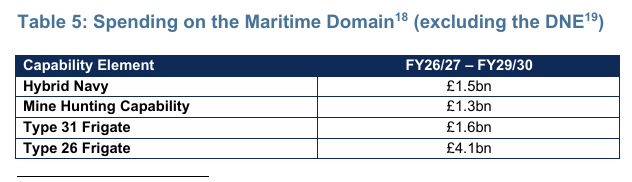
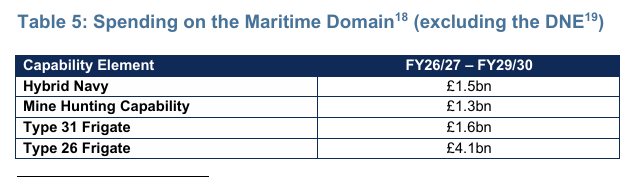
Does the £1.5 billion budget include the CCV?
Yes. £1.5b for the entire 'Hybrid Navy'. One of the reasons many people are not taking it seriously. £1.5b to design five platforms, and field two of them, by 2030. It's just not realistic.
 
Yes. £1.5b for the entire 'Hybrid Navy'. One of the reasons many people are not taking it seriously. £1.5b to design five platforms, and field two of them, by 2030. It's just not realistic.
....

It's £1.5bn per year till 2030. Funding will likely be reassessed at that point.
 
....

It's £1.5bn per year till 2030. Funding will likely be reassessed at that point.
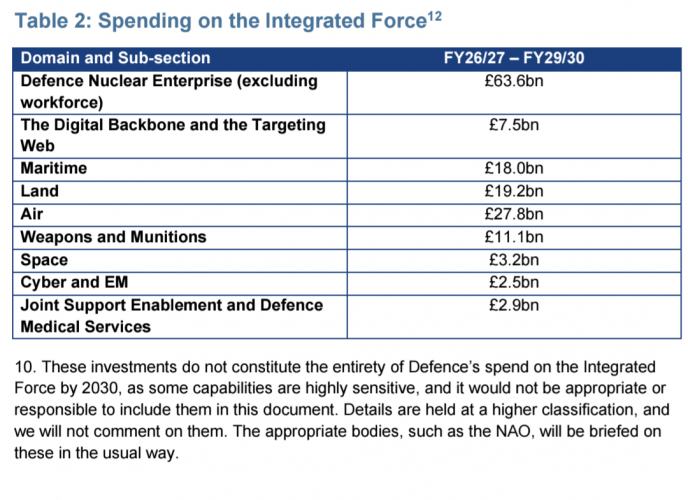
Is it? I'm probably misunderstanding this table, but to me that's £1.5b through till 2030.

Screenshot 2026-09-14 162927.png

If it is though, that's better. I'm no good at understanding these reports.

Edit:

1789400683386.png

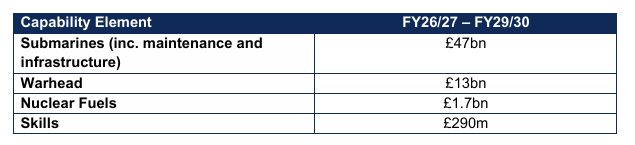
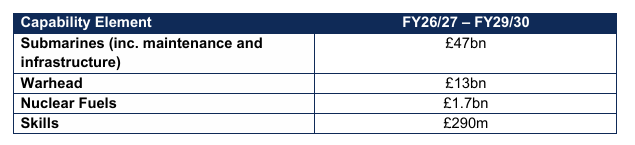
I'm pretty sure it's over four years, otherwise this section would mean the UK would be spending 2/3 of its £297b defence budget (over four years) purely on submarine maintenance, construction and support. Subs are expensive, but not that expensive.
 
Last edited:
Have a look at the spending profile at 1.1
I did, and it still doesn't make sense.

If that checks out, the MoD also plans to spend £47b each year of its submarine fleet and support. That'd be 2/3 of total defence spending through till 2030 (approx £200b out of £300b). Either they changed methodology halfway through the report, or it's not per year.

It just doesn't check out.
 
I did, and it still doesn't make sense.

If that checks out, the MoD also plans to spend £47b each year of its submarine fleet and support. That'd be 2/3 of total defence spending through till 2030 (approx £200b out of £300b). Either they changed methodology halfway through the report, or it's not per year.

It just doesn't check out.
How are you getting that determination?
 
How are you getting that determination?
So, total MoD budget over the next four years is according to the DIP £297.7b (I approximated this as £300b).

If, as you claim, the DIP allocates £1.5b per year, for the next four years, to the Hybrid Navy, as shown in the table on the 'Maritime Section', we should also assume that the DIP allocates £47.7b a year for submarine construction, maintenance and infrastructure, over the next four years.

Here are the two tables:

Screenshot 2026-09-14 162927.png Screenshot 2026-09-14 164432.png

Working through the maths, that would mean that the UK planned to spend £188b on submarines in total, over the next four years. That would represent approximately 60% of the total MoD budget, for the next four years, according to your logic.

That is a very large percentage of spending, and not realistic. It would mean that the UK planned to spend on submarines, annually, just under what the Conservative government had spent in total on defence in its final year (£54b). Obviously, that's just not viable.

Therefore, I think that your proposed idea of reading these tables as annual allocations is extremely unlikely. Instead, I think these tables should be read as total allocation over the four years covered by the DIP, rather than annual allocation.

As such, it would be £1.5b total expenditure for the Hybrid Navy over four years, not £1.5b annual expenditure over the four years.


I may be missing something, but that's my logic.
 
Last edited:
I did, and it still doesn't make sense.

If that checks out, the MoD also plans to spend £47b each year of its submarine fleet and support. That'd be 2/3 of total defence spending through till 2030 (approx £200b out of £300b). Either they changed methodology halfway through the report, or it's not per year.

It just doesn't check out.
No you are right, I seem to have gotten turned around somehow while trying to make sense of the project and the figures. This might make things clearer and less clearer at the same time. Look at point 10 under the table. That's usually what the government says when they're working out specifications and estimates before companies bid on them. So... That £375mn a year is likely study costs and work on the "Web" that links then all together.. or whatever nonsense they call it.
 

Attachments

  • Screenshot_20260915-014319.png
    Screenshot_20260915-014319.png
    278.7 KB · Views: 2
Yes. £1.5b for the entire 'Hybrid Navy'. One of the reasons many people are not taking it seriously. £1.5b to design five platforms, and field two of them, by 2030. It's just not realistic.
If this £1.5 billion were used wisely, I feel it could also be used to design a fairly capable CCV.
 
If this £1.5 billion were used wisely, I feel it could also be used to design a fairly capable CCV.
£1.5 billion buys you a lot of design work. To a very rough approximation, it's the entire NRE for the Type 26 programme, which includes virtually all design work - there's some Stage 2/3 design that winds up being done on a per-ship basis - plus some other bits and pieces like project initiation costs.

It could also buy one or more actual ships, depending on how expensive those ships are.
 
£1.5 billion buys you a lot of design work. To a very rough approximation, it's the entire NRE for the Type 26 programme, which includes virtually all design work - there's some Stage 2/3 design that winds up being done on a per-ship basis - plus some other bits and pieces like project initiation costs.

It could also buy one or more actual ships, depending on how expensive those ships are.

If this £1.5 billion were used wisely, I feel it could also be used to design a fairly capable CCV.

Sure, but that's not the only thing it's being used for. It's £1.5b for the CCV, T91, T92, T93, T94, and then the associated infrastructure, software.
 
Sure, but that's not the only thing it's being used for. It's £1.5b for the CCV, T91, T92, T93, T94, and then the associated infrastructure, software.
Yup - it buys a lot of design work, but Hybrid Navy also needs a lot of design work. There's a conspicuous silence on what the various Type 9xes and the CCV actually entail. I suspect that the MoD hasn't fully decided what it wants.

What will really make or break Hybrid Navy isn't the platforms, but the integration that lets them interact in operationally useful ways.
 
https://www.navylookout.com/thales-miniaturised-sonar-system-tested-at-sea-on-an-uncrewed-submarine/

They've tested the Thales S76Nano (name suggests a miniaturised version of the existing Sonar 2076, the system on the A-boats and Dreadnoughts) onboard an XLUUV, so either BAE's Herne or the XV Excalibur.

Whilst Excalibur could carry about 16 panels, larger uncrewed submarines (Orka-sized) could carry around 48, which would give performance similar to crewed submarines.

Alongside Sonar 2176 (for SSN-AUKUS), British sonar development is looking strong (which means it's the perfect time to pivot to a foreign competitor ;) )
 

Similar threads

Back
Top Bottom