The Future of the Royal Navy and the 'Hybrid Navy' Initiative - News, Platforms, Development and Speculation

Reuben James

ACCESS: Top Secret
Joined
15 September 2024
Messages
546
Reaction score
1,113
https://drive.google.com/file/d/1t9J7SpwCbTa5-xkD_Xmqzor79sV4qsm9/view

Hey everyone, I noticed we didn't have a centralised thread for discussion of the Royal Navy's movement towards its planned Hybrid Navy, and Atlantic Bastion (Net, Shield and Strike). The attached document above, from CNE 2026, gives an introductory overview in decent detail.

I'll summarise, though.

  • The Royal Navy has four primary concerns - homeland defence, maritime strike, global presence and nuclear deterrence. All of the missions undertaken, and equipment purchased, fall into at least one of these four categories.
  • These continue to be the basic four requirements of the Royal Navy. However, as budgets have shrunk, the RN has been left doing more and more, with less and less.
  • The thinking goes, that investing en masse in uncrewed and lean-crewed assets, with very high degrees of networking, can initially compensate for a decline in traditional strength, and then eventually deliver an increase in capability over established platforms. This is what is known as the 'Hybrid Navy'. Note that this is a hybrid, not an autonomous, navy. Manned platforms will remain present.
  • Under this framework, the traditional role of the warship (and eventually the form of the warship) will change. Warships will work in tandem with multiple uncrewed vessels. This offers three principle advantages: an increased operational footprint, an increased operational endurance, and an additional layer of protection for the manned ship. Large unmanned surface vessels (LUSVs) and large unmanned underwater vessels/vehicles (LUUVs) will extend the sensor reach of the manned vessel, for example with onboard sonar or radar, increase the weapons complement of the manned vessel (they might carry additional missiles, for example), whilst being able to operate more aggressively without risking crew lives.
  • The manned warship will be known as the Collaborative Combat Vessel (CCV). The first CCVs will be the Type 45 destroyers, likely beginning testing with large unmanned vehicles in 2027-28. The incoming Type 26 and Type 31 frigates will also fill this role, whilst the Type 83 destroyer will be the first warship designed from the ground up as a CCV.
  • There is also the Hybrid Air Wing initiative, that seeks to undertake a very similar plan of action, but with the F-35B Lightning as the CCV-equivalent. Trials should begin in 2026.

I'll be posting everything Hybrid Navy-relevant here, feel free to drop your own articles, thoughts and opinions below!
 
In terms of coverage say for Atlantic Bastion, numbers will matter.

I'd say numbers matter a lot and overly expensive, large and complex warships threaten to never be affordable or crew-able in sufficient numbers. Without a drastic change in policy from government across parties.
It would need a return of the Navy to the premier position it used to hold in society.
Something I doubt will happen as it threatens other vested interests.
 
I agree. If they can maintain that central core of at least 19 escorts, you could really start to turn each individual warship into its own task group.

Does your CSG need a pair of ASW frigates and a pair of AAW destroyers, if your ASW frigate brings with it a pair of LUSVs with TAS. Do you need your second destroyer, if you can replace it with a pair of VLS-equipped arsenal barges?

If we think back to the Red Sea Crisis, Diamond, if accompanied by a pair of LUSVs, could have remained on station for significantly longer, exhausting her escorts missiles long before her own Asters were used.

Three LUSVs for every escort gives the RN a requirement for 57 LUSVs. Realistically, that could be dragged down to 30 LUSVs.
 
Yes, that'd be my choice to begin the transition. But either way, if we can move from operations requiring multiple crewed warships, to single warships leading squadrons of lean/un-crewed vessels, then the RN suddenly has the capability to operate in 8 locations or so at any one time.
 
I am unclear what evidence supports the claim that building and operating many more ships will reduce costs. We're not talking about small ships to carry the required weapons/sensors over distance in weather.
 
I am unclear what evidence supports the claim that building and operating many more ships will reduce costs. We're not talking about small ships to carry the required weapons/sensors over distance in weather.
There'll still be maintenance costs, but they'll be reduced. There'll be a significant reduction in personnel costs, as you won't need to recruit an increased number of sailors. Build costs will be reduced (smaller, less complex vessels).
 
If one worked on a compliment of 50 as per Batch 2 River class OPV, that's roughly a third of a Type 26 compliment.
Implying 600 personnel is enough for 12 ships

Though Batch 1 had just 30 which might be a bit too lean....

Whereas RFA Bay class uses 70, or roughly just under half a Type 26.
But those be big ships, which impose an increased need for crew.
 
There'll still be maintenance costs, but they'll be reduced. There'll be a significant reduction in personnel costs, as you won't need to recruit an increased number of sailors. Build costs will be reduced (smaller, less complex vessels).
For each individual ship yes, but we will then need/have 3-4 times as many ships. I don't remotely see how the maths adds up.
 
There are two issues that I think need adding to that initial post:
The first that difficulties in recruitment are an issue driving the Hybrid Navy/LUSV proposals. If we solve the recruitment issues, does the hybrid model still apply?

And the second is that we're not doing this alone. Not only is Norway collaborating in Atlantic Bastion via the Lunna House Agreement and the acquisition of Type 26 (and if Germany is flying its P-8s out of Lossiemouth under the Trinity House Agreement, then is that on Atlantic Bastion taskings? It's also explicitly covering North Sea subsurface infrastructure under Trinity House), but there's also the wider Joint Expeditionary Force, headquartered out of Northwood (ie the RN's HQ) involving the UK, Denmark, Estonia, Finland, Iceland, Latvia, Lithuania, the Netherlands, Norway, and Sweden.

https://www.gov.uk/government/news/...ea-threat-through-major-new-defence-agreement
https://www.gov.uk/government/news/...ent-to-strengthen-our-security-and-prosperity
https://jefnations.org/

From JEF's 30th March statement it was agreed :

"2. To further leverage the JEF’s specific geographical focus and collective expertise of operating in the Arctic, High North, North Atlantic and Baltic Sea regions to strengthen NATO’s northern flank​

The JEF nations reaffirmed that the Baltic Sea region, the High North and the North Atlantic form the core, interlinked, geostrategic area of concern and mutual interest for the JEF. In this context, remote participation of the Canadian Prime Minister at the Summit today was welcomed by JEF Leaders.

The JEF nations will increase awareness, understanding and coordination of activities and efforts across the whole JEF region. Special attention is given to the JEF’s significance in the Arctic, North Atlantic, and Baltic Sea regions, including the JEF’s contribution to NATO’s developing posture in the region, its role in the European burden shifting effort, and JEF’s role as a bridge between national and NATO operations as well as its function in the transition from crisis to conflict."
 
Unmanned vessels don't just save on the cost of personnel but also the vast resource they take up. No living accomodation, no water, cooking and storing. No life saving equipment. With the world population increasing every year I wondered why we have manning difficulties but then I read according to WHO projections, the working-age population is expected to shrink from 65% to 58% of the global population by 2050.
 
Not a fan of the snide comment:
Well, it's not as if the SOSUS processing stations ever went to sea, and they were fairly significant for ASW - and that really ties into the second half of the piece and relocatable operations centres that probably will also be land based.

ETA: and I'm not sure Triton is capable of at sea ops, she's been laid up since 2018 when Australian Customs decommissioned her.
 
Last edited:
https://ukdefencejournal.org.uk/bmt-sets-out-how-hybrid-navy-will-transform-command-at-sea/

The paper argues that the shift from platform-centric to effects-centric warfare means that command and effect will no longer always be co-located. As sensing, decision-making, and effect are distributed across crewed and uncrewed assets, the coherence of the battlespace picture at the tactical edge will inevitably reduce.

Future commanders, BMT argues, will have to accept tactical ambiguity and delegate authority further down the chain than current doctrine demands, with mission command by design becoming central to how the hybrid navy operates.
 
Type 91 Contenders start to emerge.

https://ukdefencejournal.org.uk/bmt-sets-out-how-hybrid-navy-will-transform-command-at-sea/

The shift to a hybrid navy will fundamentally change how command is exercised at sea, with commanding officers moving from being the best-informed individual on a ship to managing competing streams of information across a digital network, according to a paper published by defence consultancy BMT at the Combined Naval Event at Farnborough.

(Stuck with the f*cking bold type no matter what cut and paste trick I try, f*ck!)

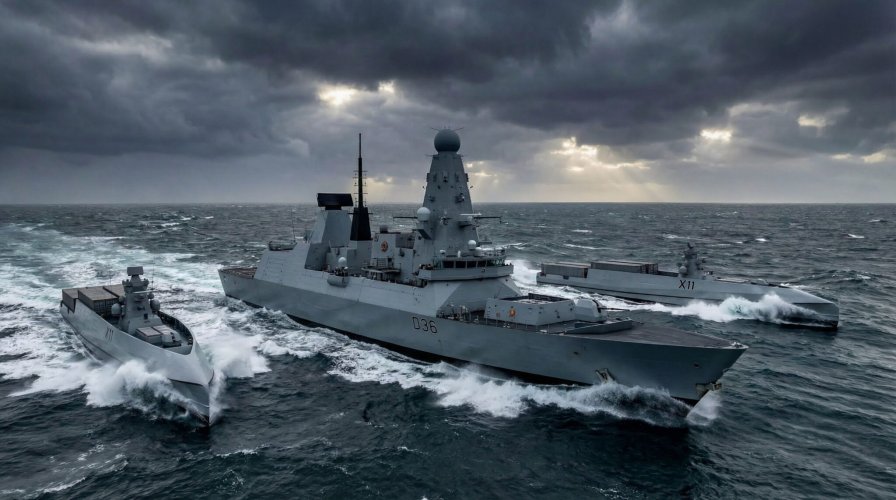
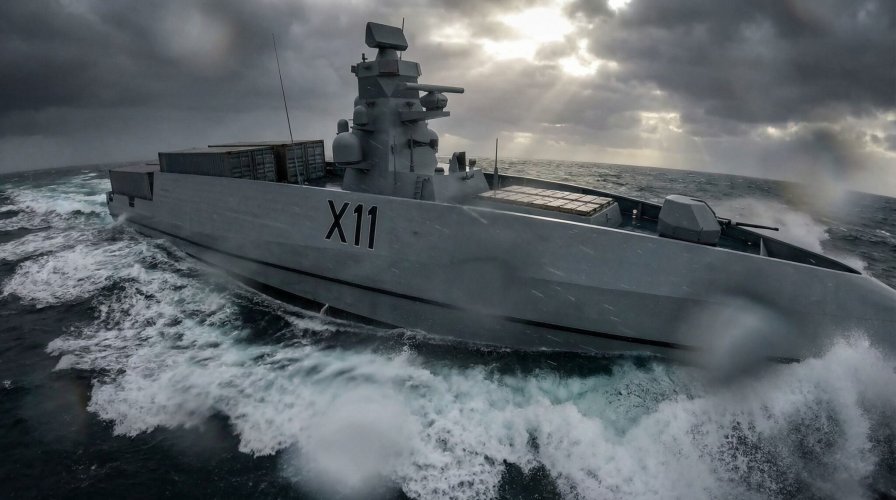
https://ukdefencejournal.org.uk/navantia-uk-unveils-autonomous-warship-concept/

The LASV75, designed in the UK, is intended as an uncrewed escort and support platform built from the keel up without crew accommodation, which the company says provides high levels of availability. The vessel’s modular hull allows it to be configured for different roles, covering sensing, operational, or combined mission profiles. According to Navantia UK, the platform can be constructed at pace and at a cost significantly lower than crewed vessels of comparable size.

https://www.navylookout.com/bae-systems-large-uncrewed-warship-proposal/

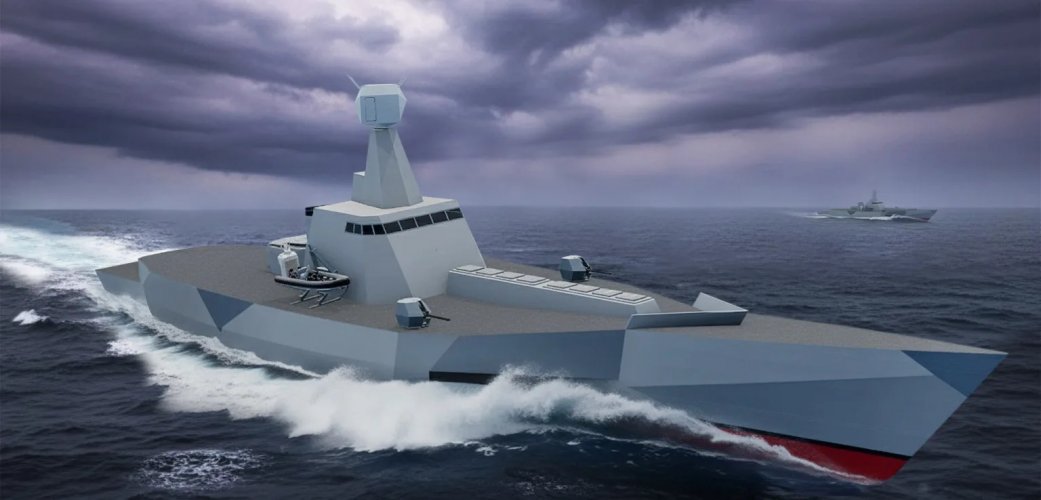
As part of the Royal Navy’s Future Air Dominance System (FADS) concept, BAE Systems has proposed low-cost, rapidly-built uncrewed/ minimally crewed vessels to supplement the Type 83 destroyer. Drawing on the legacy of the Triton trimaran demonstrator built for the RN in 2000, the proposed Sensor-Effector Platforms (SEP), could form a key element of the disaggregated air defence architecture.
 

Attachments

  • From-Triton-to-Type-91-uncrewed-warship-5-1536x738.jpg
    From-Triton-to-Type-91-uncrewed-warship-5-1536x738.jpg
    182 KB · Views: 74
  • IMG-20260416-WA0002.jpg
    IMG-20260416-WA0002.jpg
    143.5 KB · Views: 72
  • Navantia-LASV-3-2048x1143.jpg
    Navantia-LASV-3-2048x1143.jpg
    283.5 KB · Views: 72
  • Navantia-LASV-4-2048x1143.jpg
    Navantia-LASV-4-2048x1143.jpg
    241.7 KB · Views: 77
Navantia concept
32 VLS and what looks like a 57mm up forward.
Not sure what the radar is.

Four ISO 20ft containers in 2 by 2 arrangement.
 
Really still confused out the BAE option's VLS arrangement. Are those four-cell Mk41 blocks?

Navantia's interests me because they suggest they'd build them in all their UK yards. It's also decently large, and nicely specced. The radar looks like a Saab variant of some kind, not sure which though.

BMT need a partner to produce them, right? Babcock and BMT have worked together in the past?
 
Giraffe is being built in the UK, so SAAB has it's foot in the door here.
 
Really still confused out the BAE option's VLS arrangement. Are those four-cell Mk41 blocks?
I'm praying BAE have developed or are developing a UK VLS system. Each silo also appears to only have 1 lid (on the DSEI model too) so it might be a large-diameter VLS with multipacking of smaller missiles, which would be excellent.
Navantia's interests me because they suggest they'd build them in all their UK yards. It's also decently large, and nicely specced. The radar looks like a Saab variant of some kind, not sure which though.
As others have said I think the lack of a helicopter deck is a major drawback, as it would hinder maintenance and if the whole thing shuts down would make recovering the vessel much more difficult. It also tries to do both ASW and AAW, which seems like a waste of the additional mass we could generate with specialised USVs.
However it does look like a decent vessel if we wanted a reconfigurable more general USV.
BMT need a partner to produce them, right? Babcock and BMT have worked together in the past?
BMT always seem to jump onto the bandwagon with a shipbuilding competitor to get their design built. They joined the Arrowhead consortium and then paired up with Navantia to offer FSSS. If they win the design competition the govt might force Navantia to build them but Babcock are currently dependent on an American USV design.
 
https://www.navylookout.com/defence...l-navy-built-primarily-on-uncrewed-platforms/

Encouraging and concerning statements here.

The minister was unequivocal on procurement philosophy, stating that Ukraine had demonstrated beyond doubt that uncrewed systems could destroy a major conventional fleet and that this reality must now drive British acquisition decisions. “If it doesn’t work in Ukraine, I don’t want to buy it,” he said, adding that legacy platforms suited only to museums had no place on the front line.
I assume this is a more nuanced take in reality.
The Minister for Defence Readiness and Industry has set out an ambition for a “1000 ship navy” that would be largely composed of uncrewed vessels, declaring that any equipment unable to prove itself in Ukraine will not be procured for British forces.
 
It's still short, fat and with low forecastle :)


There were rumors that the program since came under heavy review and the ship may be either redesigned or cancelled. What's going on with that?
There have been suggestions that under the Hybrid Navy programme large destroyers are a thing of the past and everything can be distributed across multiple large USVs instead to increase numbers.
It's poppycock because a big radar needs a big ship, and at that point you might as well carry most of the VLS as well.
 
BAE Sensor Effector Platform design for the T91 USV. They based it on the Triton trimaran hull, which was a subscale demonstrator early in what became the T26 programme.
I dig it. T91 is the floating missile barge? T92 the ASW version?


Ah OK then, not too bad. There's also a 150m design which is probably slightly worse, but Burke shaped isn't terrible. I have always liked the long, elegant Japanese escorts however.
A longer L:B reduces power needed for any given speed.


It's poppycock because a big radar needs a big ship, and at that point you might as well carry most of the VLS as well.
I think I'd put most of the big stuff onto the big ship. Say, Tomahawks, CPS, SM3/SM6, or whatever needs the longest tubes that the UK uses. Short missiles get stuffed into the T91s.
 
I dig it. T91 is the floating missile barge? T92 the ASW version?
At risk of going OT, T91 is the USV that will be part of the Future Air Dominance System ( supporting T83). The Navy seems not to have decided whether it should just be a missile barge or carry sensors too, but all of the industry concepts so far show 16-32 fixed VLS, some containerised kit and a small radar like Giraffe 1X. BAE's SEP is at the top end with an Artisan NG.
T92 is the ASW USV for Atlantic Bastion. There haven't been many concepts on this, partly because industry seem to have decided they can do both jobs with one hull and so win the entire USV production order rather than having it split between yards. I think that's stupid because T91 needs to be fast and carry weapons but T92 should just be a sonar tug along the lines of your SURTASS ships (smaller obviously) carrying CAPTAS-4 and perhaps some containerised LRAW when that comes along.
I think I'd put most of the big stuff onto the big ship. Say, Tomahawks, CPS, SM3/SM6, or whatever needs the longest tubes that the UK uses. Short missiles get stuffed into the T91s.
We're standardising on mk41 at the moment, though I wouldn't rule out some bigger silos for Nightfall-derived ballistic missiles or whatever hypersonics come out of AUKUS. I don't think it's worth keeping the smaller missiles on the USVs because they are needed on every ship for self defence anyway and to have a spread out task group longer missiles are needed anyway. In addition CAMM is extremely compact and so T83 is most likely to run out of long range missiles first. Rotating T91s with the larger weapons can allow the T83 to retain enough CAMM for its own self defence on station, though of course it would carry a decent number of Stratus-RS and Aster just in case.
 
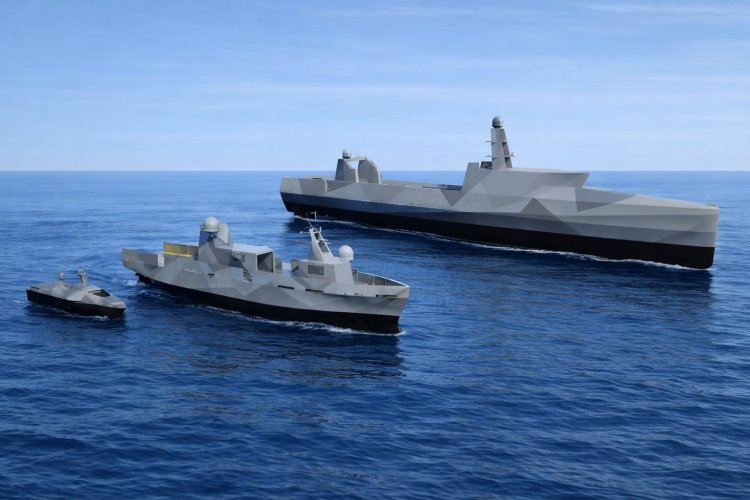
DSEI in September last year.
I would just say that the central warship in that render is a concept from neither BAE nor Babcock, but a placeholder for the RN for various PR and other such events.

I'm suspicious of that image on the whole as well. I can't really find it anywhere else, and I have feeling it might be a Navy Lookout AI-special rather than an official release.
 
I think that's stupid because T91 needs to be fast and carry weapons but T92 should just be a sonar tug along the lines of your SURTASS ships (smaller obviously) carrying CAPTAS-4 and perhaps some containerised LRAW when that comes along.
I think from both industrial perspective and under tight schedules, keeping the split between Type 91 and Type 92 is the only way forward.

We're likely looking at a pair of T92 per T26 and at least 3 T91 asigned to a Type 45 to start with.
Meaning at least 16 T91
And at least 18 T92

Then we have Type 93 UUV of which we may be able to run out to supplement Astutes to the order of 20 such UUV.

It's a relatively substantial increase in building. But only by concurrent effort can Atlantic Bastion schedules be met.
 
Not the British hybrid navy, but the American one. Just shows another use of unmanned systems.

https://www.bbc.co.uk/news/articles/cze9359gglyo

A spokesman for Centcom told the BBC that the crew members were rescued by an uncrewed surface drone that was operated by Task Force 59 - a Bahrain-based unit that launched in 2024 to focusing on "the operational deployment of unmanned systems teamed with manned operators to bolster maritime security across the Middle East region".
 
I agree. If they can maintain that central core of at least 19 escorts, you could really start to turn each individual warship into its own task group.
Generally agree here. I've kinda been running with the idea of each combat vessel in the USN operating 3x ASW 2XL-USVs. So the concept of the ASW FF would go away, replaced by a 2XL-USV with dual towed arrays with about 12x VL-ASROCs and 12x ESSM quads (24x Mk41).

For UK purposes, they'd need about the same long range ASW weapon load, regardless of who makes it (Japan makes a really nice long range one that is Mk41-compatible), but would have a big mushroom farm for CAMM instead of ESSMs.


Does your CSG need a pair of ASW frigates and a pair of AAW destroyers, if your ASW frigate brings with it a pair of LUSVs with TAS. Do you need your second destroyer, if you can replace it with a pair of VLS-equipped arsenal barges?
You still need the second radar for backup, so you do need the second destroyer.

But I think you can get away with only one manned ASW frigate if the USVs each have the dual towed arrays.


Three LUSVs for every escort gives the RN a requirement for 57 LUSVs. Realistically, that could be dragged down to 30 LUSVs.
Disagree, as the USVs will still need maintenance periods and the manned ship will need training time with the USVs before the next deployment. At best I think you could get down to about 45 LUSVs, but I think it'd be better for each ship to always work with the same LUSVs so you need all 60.
 
Speaking of maintenance periods, I feel like there’s an aspect of USVs that doesn’t get discussed enough: under way maintenance.

The USVs we’ve seen in Ukraine have been very successful in their context, but one might almost call them glorified torpedoes. They have enough endurance to cross a good chunk of the Black Sea, but their operational life is pretty short, compared to most blue water naval vessels.

But for those blue water naval vessels, the arguable majority of their crew spends most of their time doing maintenance to preserve their ship against the endless tide of entropy that the sea represents. With no crew, there’s no ongoing maintenance, and there’s definitely no damage control if something does hit the vessel. What happens when the props on one of these USVs gets fouled up with seaweed, or a LIDAR rotational mechanism gets caked up with salt?

I do believe USVs are probably the future, but they may be a little more specialized in design and limited in endurance than some of the current theories seem to assume.
 
Speaking of maintenance periods, I feel like there’s an aspect of USVs that doesn’t get discussed enough: under way maintenance.
If the standard deployment results in a port visit roughly every 3 weeks, I'd expect that the "underway maintenance" would happen then. Either flying some workers out to the port or the manned ships providing bodies.


But for those blue water naval vessels, the arguable majority of their crew spends most of their time doing maintenance to preserve their ship against the endless tide of entropy that the sea represents. With no crew, there’s no ongoing maintenance, and there’s definitely no damage control if something does hit the vessel. What happens when the props on one of these USVs gets fouled up with seaweed, or a LIDAR rotational mechanism gets caked up with salt?
USV reports the fault to the controlling ship, controlling ship sends a helicopter-full of dudes to fix it.
 
If the standard deployment results in a port visit roughly every 3 weeks, I'd expect that the "underway maintenance" would happen then. Either flying some workers out to the port or the manned ships providing bodies.

USV reports the fault to the controlling ship, controlling ship sends a helicopter-full of dudes to fix it.
A theory of operation I’d love to see demonstrated rather than assumed.
 
Fair, I’m afraid I only have pretty surface level knowledge of that program—I don’t know what the testing parameters for it were like, how long it could go between maintenance cycles, or what executing field maintenance was like. But regardless of how successful it was for one USV, I’d have some concern about how it would scale to entire fleets of them, especially if any plan for them didn’t include explicit details about it. It feels like designing WWI-WWII submarines but not spending any thought on things like submarine tenders.
 

Similar threads

Back
Top Bottom