

You are using an out of date browser. It may not display this or other websites correctly.
You should upgrade or use an alternative browser.
You should upgrade or use an alternative browser.
Taurus cruise missile

kqcke for you
PUMA PUMA PUMA
- Joined
- 3 November 2022
- Messages
- 1,867
- Reaction score
- 2,705
That should be quite a slight to see but a welcome one to be sure
https://www.edrmagazine.eu/adex-2025-taurus-advances-kasom-development

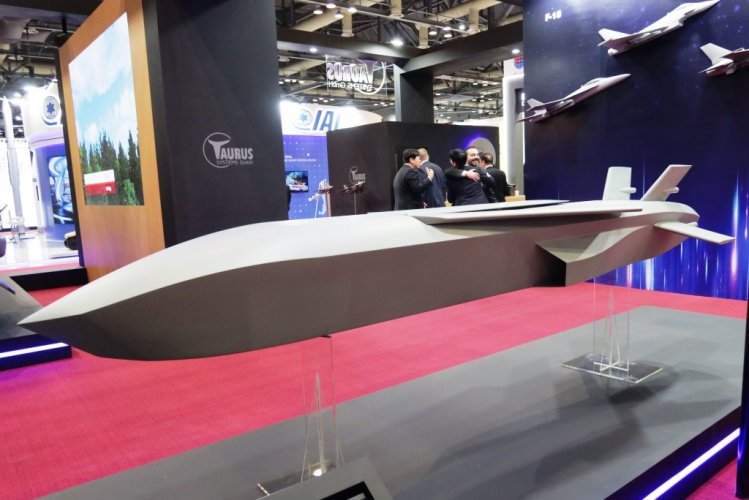
A slide showing a comparison between KEPD-350 and KASOM data was shown at the exhibition. The length is reduced by 1,100 mm, the original Taurus being 5,100 mm long versus the 4,000 mm of the KASOM, this being one of the most critical figures when considering the use in a weapons bay. Width is marginally reduced, from 1,080 to 950 mm, while mass reduction is considerable; the new missile has a mass of 907 kg versus the 1,400 kg of the Taurus, an over 35% reduction. Declared ranges are respectively 500+ and 400+ kilometres, while speed remains identical, ranging from 0.6 to 0.95 Mach. The guidance is also heavily based on the previous missile, both having a GNSS, IBN (Image-Based Navigation), TRN (Terrain-Referenced Navigation) navigation suite. That said, technology is advancing and for example IBN will probably be based on colour images, while the current system used black and white pictures. The flight profile will also be similar to that of the KEPD 350, the missile flying at the lowest possible altitude to avoid being detected by radars, a capacity provided by the IBN/TRN navigation system.
Taurus is trying to keep performances as close as possible to the bigger weapon. As seen, the range decrease is 20%, while lethality should also be only marginally reduced. EDR On-Line understood that a tandem shaped-charge warhead is the main option, however should a customer require a lower cost solution, a single shaped charge might also be developed. The warhead will most probably be developed by the Schrobenhausen-based TDW, this MBDA company already providing the Taurus warhead.

Forest Green
ACCESS: USAP
- Joined
- 11 June 2019
- Messages
- 14,600
- Reaction score
- 31,716
Will 950mm diameter fit in F-35A/C bays?
Forest Green
ACCESS: USAP
- Joined
- 11 June 2019
- Messages
- 14,600
- Reaction score
- 31,716
kqcke for you
PUMA PUMA PUMA
- Joined
- 3 November 2022
- Messages
- 1,867
- Reaction score
- 2,705
Taurus Neo seems to have more interrest out of europe then just germany.
Wobei nicht nur Deutschland den Marschflugkörper beschaffen wird. Vielmehr soll das Projekt, so das BAAINBw, in ein europäisches Beschaffungskonzept überführt werden: „Als zukünftig gemeinsames Beschaffungsprojekt mehrerer verbündeter Partnerländer wird es unter dem Dach der europäischen Rüstungsagentur OCCAR weiterverfolgt.“
Machine translation:
Not only Germany will procure the cruise missile. Rather, according to the BAAINBw, the project is to be converted into a European procurement concept: "As a future joint procurement project of several allied partner countries, it will be pursued under the umbrella of the European Defence Agency OCCAR."
https://defence-network.com/taurus-neo-vertrag-schlagkraft-eurofighter/
https://defence-network.com/taurus-neo-vertrag-schlagkraft-eurofighter/
Wobei nicht nur Deutschland den Marschflugkörper beschaffen wird. Vielmehr soll das Projekt, so das BAAINBw, in ein europäisches Beschaffungskonzept überführt werden: „Als zukünftig gemeinsames Beschaffungsprojekt mehrerer verbündeter Partnerländer wird es unter dem Dach der europäischen Rüstungsagentur OCCAR weiterverfolgt.“
Machine translation:
Not only Germany will procure the cruise missile. Rather, according to the BAAINBw, the project is to be converted into a European procurement concept: "As a future joint procurement project of several allied partner countries, it will be pursued under the umbrella of the European Defence Agency OCCAR."
https://defence-network.com/taurus-neo-vertrag-schlagkraft-eurofighter/
https://defence-network.com/taurus-neo-vertrag-schlagkraft-eurofighter/
Last edited by a moderator:
- Joined
- 23 August 2011
- Messages
- 2,566
- Reaction score
- 8,460
Attachments
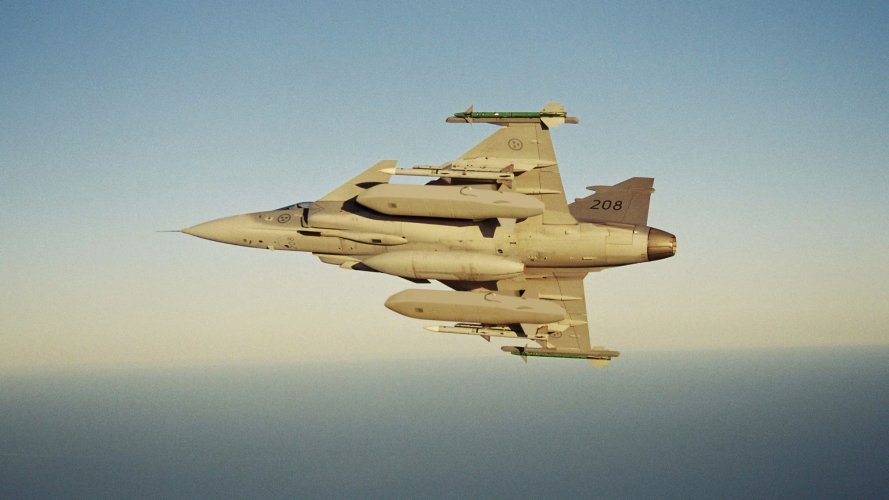
I suspect it has been fitted to earlier Gripens but perhaps never actually launched.First time for a Gripen E/F, not for a C/D right ?
Interestingly, this page from 2001 states "The Saab Bofors / MBDA Taurus KEPD 350 long-range stand-off missile, with a range of 350km, has been successfully flight tested on the Gripen."
Last edited:
kqcke for you
PUMA PUMA PUMA
- Joined
- 3 November 2022
- Messages
- 1,867
- Reaction score
- 2,705
There where some images with gripens let me have a look again
Ainen
I really should change my personal text
- Joined
- 25 August 2011
- Messages
- 2,874
- Reaction score
- 4,984
There were, but they were only suspended, as they were meant to(I guess weird Taurus shape is because of gripen in the first place). No launches until today.There where some images with gripens let me have a look again
Ainen
I really should change my personal text
- Joined
- 25 August 2011
- Messages
- 2,874
- Reaction score
- 4,984
Rbs-15 is fully integrated, yes.So Sweden does not have any air launched cruise missiles ?
What about RBS-15, is that fully integrated ?

Titus K
ACCESS: Top Secret
- Joined
- 6 September 2025
- Messages
- 840
- Reaction score
- 2,856
Similar threads
-
-
 Otto Funk, Peter Funk, & Bücker und Funk Designations
- Started by Apophenia
- Replies: 2
-
Brazil and Argentina ballistic missiles projects
- Started by Aflp
- Replies: 5
-
 US Army's 1990s Armored Systems Modernization (ASM) Program (FIFV, Block III Tank, Crusader)
- Started by RyanC
- Replies: 81