- Joined
- 2 January 2006
- Messages
- 4,147
- Reaction score
- 7,740
This is utterrly BS.
May I ask what's your information about the current status?

This is utterrly BS.

The latest FGA-35 variations from a google search swing from 3m2 at 200kms and 3m2 at 250kms. They did say they made the Su-75 configurable enough to change and replace radars and change the aircraft canopies to whoever the customer is. But still marketing 5m2 at 160kms is not a bright idea.So from 120 km for 5 m2 fighter and 120 km railway bridge in the 1990s, to 148 km for 5 m2 fighter (equivalent of stated 130 km for 3 m2) and 120 km railway bridge in 2000s on paper - to today's 160 km for 5 m2 fighter and 120 km railway bridge. Perhaps that's mature, not paper numbers for 2010s and simply due to the war and change in funding priorities, development of small radars was not worked on further since 2010s and since MiG-35 project proved to be a stillborn project.


 www.computerra.ru
https://tass.ru/ekonomika/23384269Element Group of Companies has announced plans to create the first silicon photonics foundry center in Russia. The project involves the development and production of basic elements of photonic integrated circuits. The total investment is estimated at 560 million rubles, the implementation period is set for 2026-2027.
Photonics is considered as a key end-to-end technology that can bring Russia to a new technological level. It uses silicon processes to handle light signals, providing high bandwidth and energy efficiency. This is important for the development of data centers and telecommunications.
According to the company's plans, by 2030 it is planned to bring at least 17 types of optoelectronics and integrated photonics products to the market. The main production contractor of the project should be Mikron - today it is the only enterprise in Russia that produces chips according to the standards of 90-180 nanometers. The development of "silicon-on-insulator" substrates can be carried out by the Sedakov Research Institute of Measuring Systems, and MIPT and Skoltech are among the potential design centers.
According to the company's estimates, the cost of one wafer with a photonic integrated circuit will be $2500-6000. Currently, there are no commercial foundry services in the field of silicon photonics in Russia. The implementation of this project can contribute to the formation of an appropriate production ecosystem in the country.
MOSCOW, March 13. /TASS/. Moscow Mayor Sergei Sobyanin inspected the Moscow Center for Photonics on the territory of the Technopolis Moscow Special Economic Zone (SEZ) in Zelenograd (Alabushevo site) and said that the production of photonic integrated circuits will begin by the end of 2025.
"Technopolis Moscow is the country's largest special economic zone, which implements a number of key areas of our country's technological independence. In particular, projects such as pharmaceuticals and microelectronics are being implemented here in Zelenograd," Sobyanin said on Thursday.
The area of the Moscow Center for Photonics is 26.7 thousand square meters. The created capacities will allow the production of up to 100 thousand products per year.
"And now we have begun to develop another unique, key area for our country - the development of photonics. On behalf of the President, a project is being implemented to build a plant for the production of photonic integrated circuits. The building has been built, equipment is being supplied, commissioning is underway. I hope that by the end of the year we will receive new products that are unique for our country," the mayor said.
Used in transceivers, FIS can transmit data at speeds in excess of 100 Gbps, reducing power consumption by up to 10 times and reducing device size by up to 20 times.
"The products manufactured here will increase the speed of data transmission by 50-100 times, which is critically important for telecommunications, including the creation of fifth-generation communication networks (5G) based on domestic equipment, space communications, as well as the implementation of projects in the development of artificial intelligence, biomedicine and other high-tech industries," the press service of the mayor's office says.
About the SEZ
The Technopolis Moscow Special Economic Zone (SEZ) is a territory with a special legal status, which has a preferential business regime for investors. The SEZ was created in 2006, but its active development began after the transfer of the project to the Moscow government in 2016. For eight years, the Technopolis Moscow SEZ has become the largest in Russia both in terms of investment and the area of operating enterprises.
Currently, more than 220 high-tech enterprises are localized in the SEZ, of which 120 have resident status. More than 22 thousand jobs have been created.

That is an extremely aggressive price target.The task has been set to offer the buyer a fifth-generation fighter at a price of $ 30 million. To ensure such a price, the option with the least expensive components is offered.
Do you want more expensive? You are welcome!
I suddenly wonder if you could strip down F-35A down to roughly comparable level through cheaper/cots/non aerospace components.That is an extremely aggressive price target.

There's barely any details on electronics of the su-75 and much of what defines 6th gen is in the dark still. To me, block 4 f-35 electronics is the bare minimum to be considered 5.5th gen much less 6th gen:If the Su-75's domestic role is a success I honestly think the only 2 things missing that would make it a 6th gen is the new flat nozzle design they used for the Su-57 if that would even work for a single engine aircraft besides a serrated nozzle and a 3-stream cycle adaptive engine. I dont know what kind of road map the US and China have with their 6th gen aircraft projects to determine if Russia is ahead, with them or behind them but what they have showcased so far with the Su-75's features and patents is very impressive.

And I doubt it's veracity, especially given that the Su-57 moves north of 130 Million, according to what was recently "leaked". I'd expect the Su-75S to move around the 70 Million mark, with the D being more expensive, I wouldn't say the unmanned B variant will be particularly cheap either.That is an extremely aggressive price target.

F-104 - worked fine. J65 ->J79This is the thing that's always bothered me -
Why is that when China and Russia designs a new plane, slapping a random engine onto the air frame works out fine, but in any of the 6th gen speculation threads, this idea is deemed infeasible and too complex?
Would there need to be a whole lot of redesigning in order to go from a prototype on one engine and switch over to another for production? Do you always design with your ideal engine in mind (even if it doesn't exist yet) and then just fit the interim engines in sort of an adhoc way for testing? How long did it take for something like the J-20 to go from WS10 to WS15 when the WS15 became available?
At that point why not just buy an F-16?I suddenly wonder if you could strip down F-35A down to roughly comparable level through cheaper/cots/non aerospace components.
Presumably because they needed the stealth.At that point why not just buy an F-16?
Yep, pretty much. Since "hull" doesn't appear to cost all that much(and another key enabler, software, shouldn't), save as much as possible on COTS equipment using 80/20 rule.Presumably because they needed the stealth.
Though I will point out that the Block 60 and Block 70 Vipers are pretty close to the cost of an F-35A!

Software costs whatever it took to develop, divided by however many aircraft you've set as the target sales needed to earn the investment back. It's entirely possible that ends up costing more than the hardware.Since "hull" doesn't appear to cost all that much(and another key enabler, software, shouldn't)
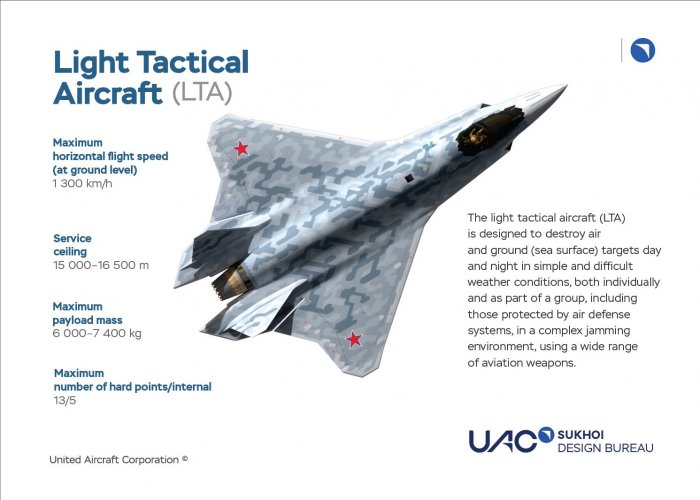
Remember that the Su-57 loses a pylon on the wings due to the "armpit" weapons bays.8 external hardpoints... 4 on each wing sounds ridiculous considering its smaller than the su-57. and the su-57 gets only 6 with 2 on each wing and 1 on each of the intakes

So 3 hard points on each of the wings then for the su-75… though where are the last 2 going?Remember that the Su-57 loses a pylon on the wings due to the "armpit" weapons bays.
3 under the wings and wingtips?So 3 hard points on each of the wings then for the su-75… though where are the last 2 going?

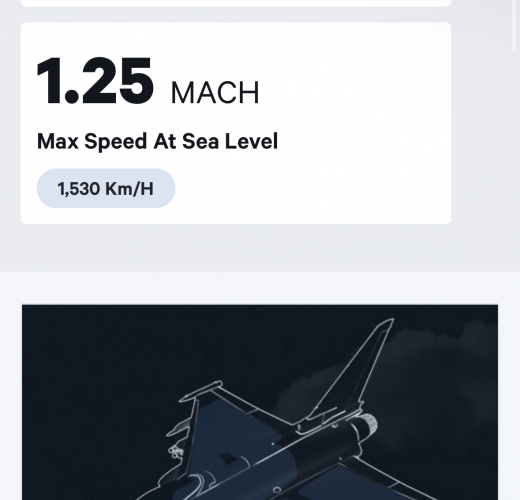
1300 kmh ? is not realy fast
1300 kmh ? is not realy fast

It's SL, most fighters are barely supersonic here as well1300 kmh ? is not realy fast
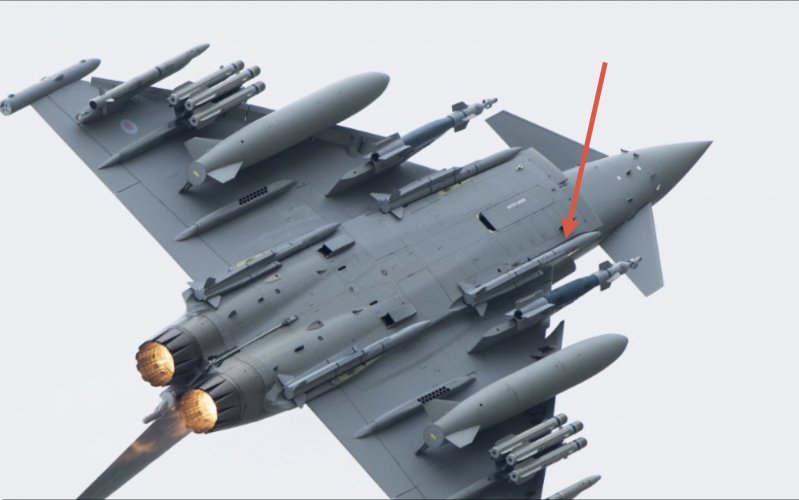
I think forward bays are already more or less that.Left and right edge of intake like on Eurofighter?

It's SL, most fighters are barely supersonic here as well
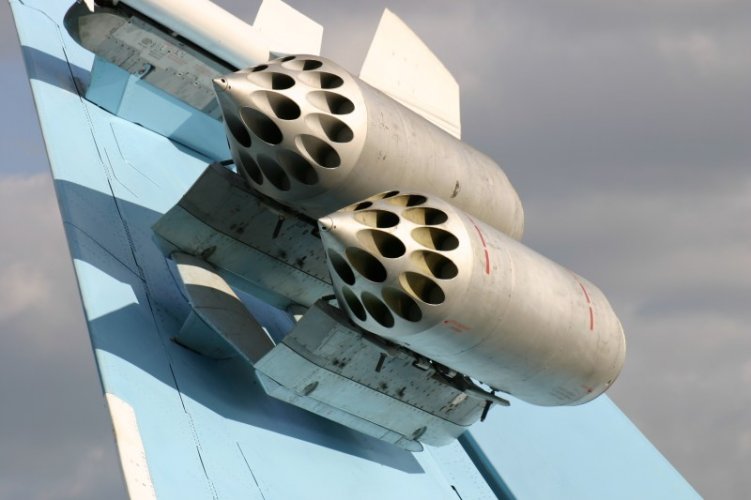
Dual pylons?
Left and right edge of intake like on Eurofighter?
M1.2 / 800 KEAS is pretty much the sea level limit of any fighter, primarily due to massive pressures and temperatures in the engines and the high dynamic pressures on the airframe. Bad things can happen very quickly in that environment and beyond. The F-111 was the only aircraft I know of that didn’t have a formal low level KEAS limit, but it would run into a temperature limit shortly after the 800 KEAS. I’ve heard the MiG-23 could also exceed that speed easily, not sure the limit, although General Bond discovered where the limit was during his fatal flight with the Red Eagles.Because everything melts above those speeds at sea level!
I wouldn’t say the mirage f1 and tornado are fast at sea level, they only go around 1450 kph for tornado and 1400 kph for mirage f12 other notably very fast aircraft at sea level, also at those speeds, were the Mirage F1 and Panavia Tornado.
The Mirage III official tested speed at sea level is 1390 km/h.The fastest aircraft at sea level that I know of is the eurofighter at 1530kph/mach 1.22 ish at sea level
I wouldn’t say the mirage f1 and tornado are fast at sea level, they only go around 1450 kph for tornado and 1400 kph for mirage f1

They pretty much just ctrl+v specs from zhuk-a radar, right from MiG-29m. However, if rumors about export cost around €50-55mil per plane is true, cheapest version of LTA can have such radar, to minimize the cost.The latest FGA-35 variations from a google search swing from 3m2 at 200kms and 3m2 at 250kms. They did say they made the Su-75 configurable enough to change and replace radars and change the aircraft canopies to whoever the customer is. But still marketing 5m2 at 160kms is not a bright idea.
Never seen radar blockers on X-32. Do you have some pictures of it?They use radar blockers for that (similar to the X-32 solution).


 hushkit.substack.com