So from 120 km for 5 m2 fighter and 120 km railway bridge in the 1990s, to 148 km for 5 m2 fighter (equivalent of stated 130 km for 3 m2) and 120 km railway bridge in 2000s on paper - to today's 160 km for 5 m2 fighter and 120 km railway bridge. Perhaps that's mature, not paper numbers for 2010s and simply due to the war and change in funding priorities, development of small radars was not worked on further since 2010s and since MiG-35 project proved to be a stillborn project.
The latest FGA-35 variations from a google search swing from 3m2 at 200kms and 3m2 at 250kms. They did say they made the Su-75 configurable enough to change and replace radars and change the aircraft canopies to whoever the customer is. But still marketing 5m2 at 160kms is not a bright idea.
 
My personal guess is that they're intentionally selling it with a crappy radar - most customers (like India, Turkey, Malaysia etc) would likely want to put in either their domestic array or one from a third-party. In that case, a sophisticated radar is purely unnecessary extra cost.
I wouldn't be surprised if the Su-75 was offered at a price point not previous Russian fighter was able to hit - and customers will be able to negotiate a 'poverty spec' where most of the sensors will be either removed, or replaced with very basic variants - at which point said customers will be able to replace those with their own. I think it makes sense that Russia would limit export of its highest-end electronics to the most trusted customers, and even those would be subject to heavy restrictions on its use and maintenance, similarly how the US sells the F-35. This is partly to protect their technology, partly because the expertise to modify such a complex machine simply doesn't exist outside the country.

The Su-75 could be positioned as a cheap(er) alternative with much more liberal policies as to modification, and potentially accessible and attractive to a wider base.
I wouldn't be surprised if it wanted to compete with the cheapest available planes internationally - the Gripen, the F-16, J-10 and JF-17 comes to mind, that accidentally happens to be stealthy. Russia historically didn't offer a cheap plane to export - the MIG-29 was a somewhat unpopular plane owing to its outdated electronics, low service life and expensive running costs. But I guess they're looking to change that.
 
General idea of what their next gen radars might be like if we are assuming aircraft radars are just generally made up of 1000+ transceivers, then I will just make a road map prediction what expected roles the aircraft has for its future use.
Element Group of Companies has announced plans to create the first silicon photonics foundry center in Russia. The project involves the development and production of basic elements of photonic integrated circuits. The total investment is estimated at 560 million rubles, the implementation period is set for 2026-2027.

Photonics is considered as a key end-to-end technology that can bring Russia to a new technological level. It uses silicon processes to handle light signals, providing high bandwidth and energy efficiency. This is important for the development of data centers and telecommunications.

According to the company's plans, by 2030 it is planned to bring at least 17 types of optoelectronics and integrated photonics products to the market. The main production contractor of the project should be Mikron - today it is the only enterprise in Russia that produces chips according to the standards of 90-180 nanometers. The development of "silicon-on-insulator" substrates can be carried out by the Sedakov Research Institute of Measuring Systems, and MIPT and Skoltech are among the potential design centers.

According to the company's estimates, the cost of one wafer with a photonic integrated circuit will be $2500-6000. Currently, there are no commercial foundry services in the field of silicon photonics in Russia. The implementation of this project can contribute to the formation of an appropriate production ecosystem in the country.
https://tass.ru/ekonomika/23384269
MOSCOW, March 13. /TASS/. Moscow Mayor Sergei Sobyanin inspected the Moscow Center for Photonics on the territory of the Technopolis Moscow Special Economic Zone (SEZ) in Zelenograd (Alabushevo site) and said that the production of photonic integrated circuits will begin by the end of 2025.

"Technopolis Moscow is the country's largest special economic zone, which implements a number of key areas of our country's technological independence. In particular, projects such as pharmaceuticals and microelectronics are being implemented here in Zelenograd," Sobyanin said on Thursday.

The area of the Moscow Center for Photonics is 26.7 thousand square meters. The created capacities will allow the production of up to 100 thousand products per year.

"And now we have begun to develop another unique, key area for our country - the development of photonics. On behalf of the President, a project is being implemented to build a plant for the production of photonic integrated circuits. The building has been built, equipment is being supplied, commissioning is underway. I hope that by the end of the year we will receive new products that are unique for our country," the mayor said.

Used in transceivers, FIS can transmit data at speeds in excess of 100 Gbps, reducing power consumption by up to 10 times and reducing device size by up to 20 times.

"The products manufactured here will increase the speed of data transmission by 50-100 times, which is critically important for telecommunications, including the creation of fifth-generation communication networks (5G) based on domestic equipment, space communications, as well as the implementation of projects in the development of artificial intelligence, biomedicine and other high-tech industries," the press service of the mayor's office says.

About the SEZ​

The Technopolis Moscow Special Economic Zone (SEZ) is a territory with a special legal status, which has a preferential business regime for investors. The SEZ was created in 2006, but its active development began after the transfer of the project to the Moscow government in 2016. For eight years, the Technopolis Moscow SEZ has become the largest in Russia both in terms of investment and the area of operating enterprises.

Currently, more than 220 high-tech enterprises are localized in the SEZ, of which 120 have resident status. More than 22 thousand jobs have been created.

Su-75's export role

If they are selling them then the countries receiving them will only be considered a threat to other countries that just only have 4th generation aircrafts. Multiple countries based on patents have proven any measures of applying stealth reduces an aircraft's size on radar by 10 times or more. Even if Russia is behind the east and west in semiconductors, they are not far behind enough on radars like the fga-35 for adversaries to think that having a small bump in radar range detection/tracking for their own advantage will make any difference in BVR combat because of the RCS significance between a 4th gen and 5th gen aircraft is just that big. However, any country that has any other 5th generation aircraft will not see a country with a Su-75 as a threat.

Su-75's domestic role

The aircraft is built to be easily configurable for cockpit and electronics design role. The aircraft can be considered a threat to other country 5th gen aircrafts if they receive photonic circuits to be used as transceivers for a new radar design. As time goes by, they also have a road map for improving their wafer size and production capability. A set flight date and set production date has yet to be met, there is a high chance ground radars, communication systems, satellites, Su-57s would be given the priority of using PICs as transceivers before the Su-75 and we don't know if the production capacity would be more than enough to also start supplying new Su-75 radars with them. I don't know how many sorties the Su-70 has flown for its single crash, but photonic circuits offer higher data transmission speeds using higher frequencies, higher computer processor speeds with enhanced A.I. problem solving technology, higher electronic warfare resistance and they have their own increased satellite production with satellite projects to control drones. The circuits can also determine how fast the road map would be for unmanned Su-75 to be used which will also have increased stealth and more flight range by removing the cockpit.

If the Su-75's domestic role is a success I honestly think the only 2 things missing that would make it a 6th gen is the new flat nozzle design they used for the Su-57 if that would even work for a single engine aircraft besides a serrated nozzle and a 3-stream cycle adaptive engine. I dont know what kind of road map the US and China have with their 6th gen aircraft projects to determine if Russia is ahead, with them or behind them but what they have showcased so far with the Su-75's features and patents is very impressive.
 
If the Su-75's domestic role is a success I honestly think the only 2 things missing that would make it a 6th gen is the new flat nozzle design they used for the Su-57 if that would even work for a single engine aircraft besides a serrated nozzle and a 3-stream cycle adaptive engine. I dont know what kind of road map the US and China have with their 6th gen aircraft projects to determine if Russia is ahead, with them or behind them but what they have showcased so far with the Su-75's features and patents is very impressive.
There's barely any details on electronics of the su-75 and much of what defines 6th gen is in the dark still. To me, block 4 f-35 electronics is the bare minimum to be considered 5.5th gen much less 6th gen:

12 6 DAS apertures for constant 360 passive detection and tracking with analog like zoom capability, and more impressively, triangulation for passive targeting from overlapping zones between the apertures, especially frontal when combined with the EOTS, with ever expanding spectrum - MWIR, SWIR, visual light spectrum.

Complete virtualization of the CNI where pilots can tell the CNI system to generate different waveforms for different functions (IFF, navigation, landing etc) all simultaneously without dedicated hardware/instrument.

Electronic suit that covers wide range of frequencies to perform electronic attacks on both air and ground radars, not just reactive and for self protection but robust and powerful enough as a force enabler.

Though I'm sure su-75 will have a few unique things up its sleeves, From what I can see, it doesn't have the equivalence of the EODAS system, instead still machanically scanning gimbal ir sensors. Making any claim of constant stare and simultaneously tracking and weapon grade passive targeting in the IR spectrum doubtful.

I could be outdated with my info, but as far as I know, radar's design is still not the more capable flared notched antenna design that the US already achieved for decades and still going down the route of less capable but simpler patch/slotted design.
 
Last edited:
That is an extremely aggressive price target.
And I doubt it's veracity, especially given that the Su-57 moves north of 130 Million, according to what was recently "leaked". I'd expect the Su-75S to move around the 70 Million mark, with the D being more expensive, I wouldn't say the unmanned B variant will be particularly cheap either.

In general, what's cheap and expensive is something very different for a modern multirole jet, the F-35A which can be had for ~80M for the jet itself is an indicator for that and quite "cheap" for what it is and offers. Due to labor cost, sharing of some components and different design choices I could see the Su-75 undercutting the F-35, but not by 50 Million, that's fantasy. Just as it was fantasy when people spouted similarly ridiculous numbers for Su-57E. Even completely dumbed down in the most basic configuration nobody would ever consider even touching it's not possible to get price this low.
 
I'd like to see an F-35 being sold for $80 million. I just quickly checked the Finland purchase - they bought 64 F35A for $9.4B - a per plane cost of $146M. Of course this deal involves more than just buying the planes - training, weapons, depots need to be paid for - and there will be ongoing sustainment costs as well.
But if we look at the financial side as well - it makes sense for a country to overpay for the initial purchase in exchange for lower ongoing costs. Countries have access to cheap lines of credit and have lots of money on hand, while their growth rates are modest. On the other hand, companies need to pay more for loans, but are more likely to grow with investment.

Let's say Finland pays $100m to LM today, and borrows the money for that at 2% interest (paid back in a year to keep things simple) with a delivery date of 1 year from now. That $100m will be invested by LM, and they'll grow 10% a year, so they'll be worth $110m a year from now, but they can only borrow at 4% interest.
So if Finland were to buy the same plane on credit, LM would have to borrow $100, and pay back $104, and also miss out on that growth - so out of their 10%. This means buying from credit for them would cost them $12m more than if Finland paid a lump sum. So it makes sense for countries to frontload the costs.
 
For a long time Lockheed Martin was losing massive money as cost overrun and engineering issues plagued the f-35 program, yet it was able to keep throwing money at it because investors were pumping cash in the back end knowing that there are buying commitments from 3 aviation branch of US military and a dozen countries (much like tesla for a while kept losing money but kept getting cash).

Not to mention, much of the money spent was on developing simpler and cheaper technological alternatives to drive down cost. For example, the RWR system carried less arrays but covered much wider frequency range than the more complex and expensive system on the f-22 and BAE was able to develop methods to do away with elevation arrays entirely to provide even more saving.

Another example come to mind - the EOTS housing is an alloy alternative Beralcast rather than the traditional expensive rare earth metal.

The su-75, without any guaranteed order from Russia, nor the "too big too fail" almost bottomless money commitment for its development, does not have these advantages. Its only way to drive down cost is to literally remove capabilities in comparison to more performance driven older sibling su-57.

This is entirely guess and hope on my end, but its stealth might be more promising than the su-57. The adherence to thorough edge alignment of small gaps and panels might suggest that sukhoi continued to refine its stealth techniques even after the su-57 design has frozen and achieved or projected to achieve breakthroughs in the material science that make these smaller edge alignments worthwhile, naming a more thorough manipulation of electromagnetic surface/traveling waves.
 
Last edited:
This is the thing that's always bothered me -

Why is that when China and Russia designs a new plane, slapping a random engine onto the air frame works out fine, but in any of the 6th gen speculation threads, this idea is deemed infeasible and too complex?

Would there need to be a whole lot of redesigning in order to go from a prototype on one engine and switch over to another for production? Do you always design with your ideal engine in mind (even if it doesn't exist yet) and then just fit the interim engines in sort of an adhoc way for testing? How long did it take for something like the J-20 to go from WS10 to WS15 when the WS15 became available?
F-104 - worked fine. J65 ->J79
F-105 - worked fine. J57 ->J75
A-12 - worked fine. J75 ->J58
F-14 - "we promise, it's just for a little while" (not so fine)
Both the F-15 and F-16 seem to be fine going from the F100 to the F110.

On the other hand, you might not be able to operate all the systems with a place-holder engine. For example, if you require the cooling capacity of a 3-stream engine but you don't have one fitted. . .
 
Presumably because they needed the stealth.

Though I will point out that the Block 60 and Block 70 Vipers are pretty close to the cost of an F-35A!
Yep, pretty much. Since "hull" doesn't appear to cost all that much(and another key enabler, software, shouldn't), save as much as possible on COTS equipment using 80/20 rule.
Zhuk may sound shitty on Sukhoi, but if it saves you money, gets you a customer and still detects things without exposing aircraft - customer is free to chose this option.
Enlarged Phantom strike, for example...
 
Since "hull" doesn't appear to cost all that much(and another key enabler, software, shouldn't)
Software costs whatever it took to develop, divided by however many aircraft you've set as the target sales needed to earn the investment back. It's entirely possible that ends up costing more than the hardware.
 
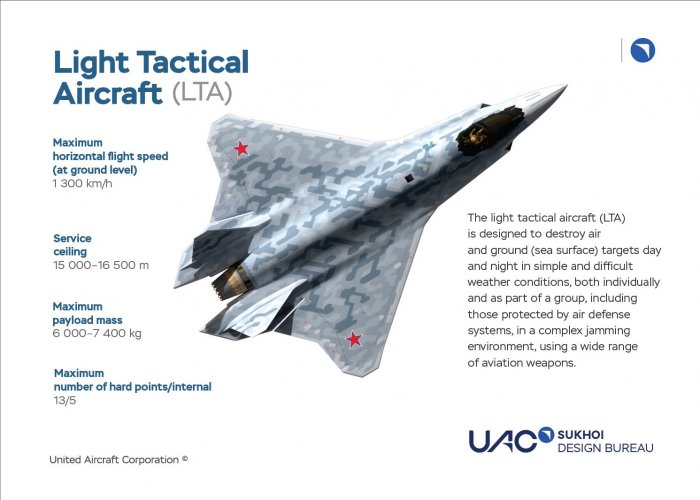
8 external hardpoints... 4 on each wing sounds ridiculous considering its smaller than the su-57. and the su-57 gets only 6 with 2 on each wing and 1 on each of the intakes
 
8 external hardpoints... 4 on each wing sounds ridiculous considering its smaller than the su-57. and the su-57 gets only 6 with 2 on each wing and 1 on each of the intakes
Remember that the Su-57 loses a pylon on the wings due to the "armpit" weapons bays.
 
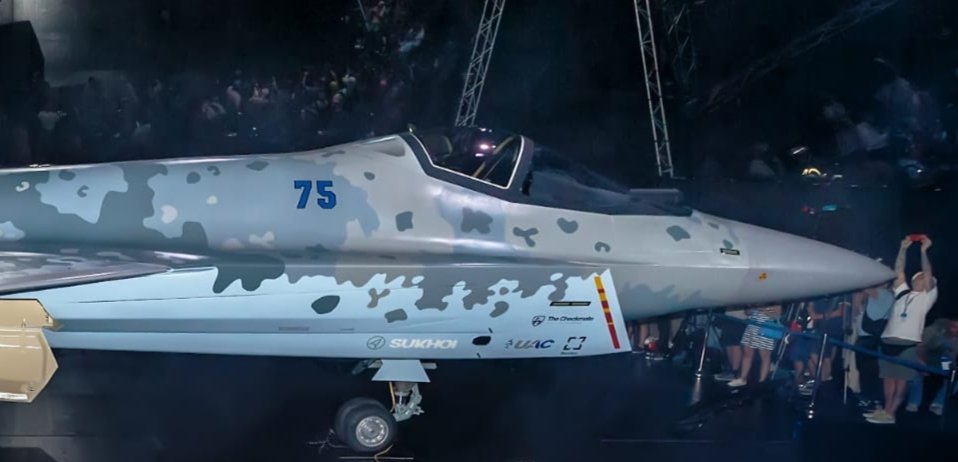
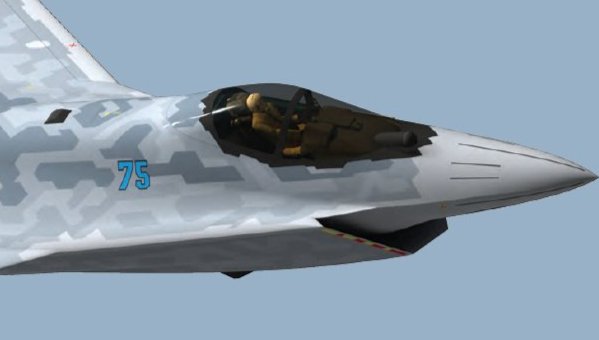
Unlike the original mock-up, later presented designs (2024 and 2025) lack side sensors of the EO system (101KS-U or mod?), but have dorsal ones.
However, their number is limited to 4 and there is no installation for side sensing.
 

Attachments

  • IMG_20251127_092703.jpg
    IMG_20251127_092703.jpg
    171.3 KB · Views: 189
  • IMG_20251127_092235.jpg
    IMG_20251127_092235.jpg
    64.3 KB · Views: 233
So lots of the money saving comes from not having to redesign the nose, cockpit, wings, vertical tails, and internal components. My question is; how will reusing the wing affect the aircraft performance? I was under the impression that fist you design the wings; and you calculate the ideal wing area/weight to achieve performance numbers. So it looks like this design adds area to the inner ailerons, but looses some area by cutting the tail sections. It also looses some area by not having the forward movable lerx. So the aircraft is a delta wing, with tailerons, and full movable vertical tail sections. With this layout it might be better at high alpha than for example a mirage-2000 retaining some yaw control by the full moving tails, but it might loose speed like a delta? Is it going to have 3D TVC??
 
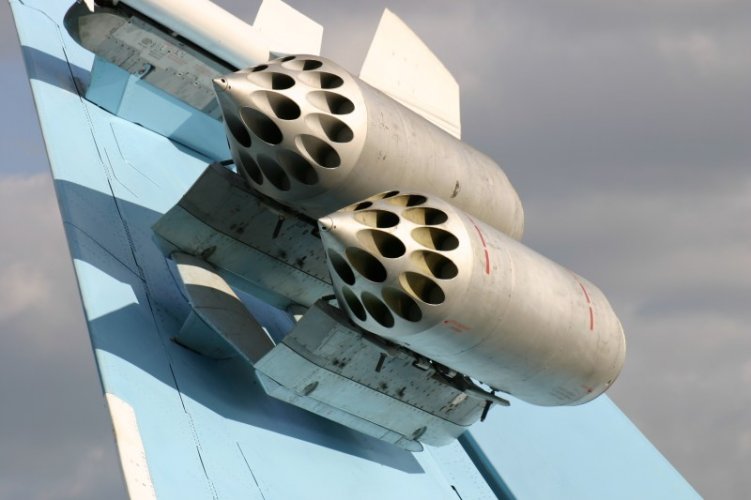
Dual pylons?


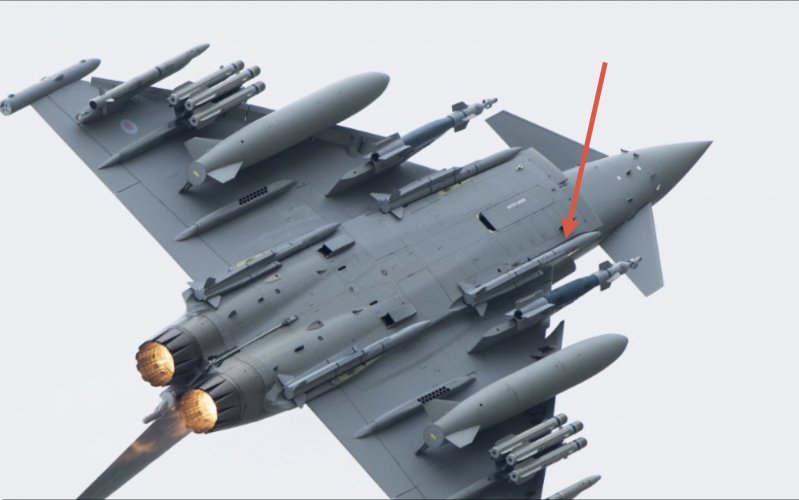
Left and right edge of intake like on Eurofighter?

The wing is long enough to have two pylons (one behind the other), at least for the inner wing. One could certainly do it with bombs. Maybe even having one AAM behind another?

Some Soviet era strike proposals (especially with delta wings) had such an arrangement, and it is common for fuselage hardpoints (Mirage 2000, Eurofighter, F-15 etc.)
 
Because everything melts above those speeds at sea level!
M1.2 / 800 KEAS is pretty much the sea level limit of any fighter, primarily due to massive pressures and temperatures in the engines and the high dynamic pressures on the airframe. Bad things can happen very quickly in that environment and beyond. The F-111 was the only aircraft I know of that didn’t have a formal low level KEAS limit, but it would run into a temperature limit shortly after the 800 KEAS. I’ve heard the MiG-23 could also exceed that speed easily, not sure the limit, although General Bond discovered where the limit was during his fatal flight with the Red Eagles.
 
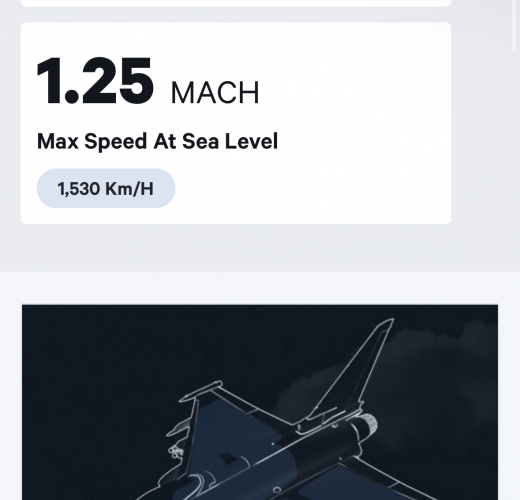
The fastest aircraft at sea level that I know of is the eurofighter at 1530kph/mach 1.22 ish at sea level
2 other notably very fast aircraft at sea level, also at those speeds, were the Mirage F1 and Panavia Tornado.
I wouldn’t say the mirage f1 and tornado are fast at sea level, they only go around 1450 kph for tornado and 1400 kph for mirage f1
 

Attachments

  • 1764798168217.png
    1764798168217.png
    314.5 KB · Views: 144
The fastest aircraft at sea level that I know of is the eurofighter at 1530kph/mach 1.22 ish at sea level

I wouldn’t say the mirage f1 and tornado are fast at sea level, they only go around 1450 kph for tornado and 1400 kph for mirage f1
The Mirage III official tested speed at sea level is 1390 km/h.
The later Mirage F1 is between 1450 and 1470 km/h depending on conditions.
Like I said, the Tornado and F1 are 2 other notably very fast aircraft at sea level.

Much of this is academic anyway, and subservient to conditions, load out, roles..etc.

Anyway, enough derailing.
 
Last edited:
The latest FGA-35 variations from a google search swing from 3m2 at 200kms and 3m2 at 250kms. They did say they made the Su-75 configurable enough to change and replace radars and change the aircraft canopies to whoever the customer is. But still marketing 5m2 at 160kms is not a bright idea.
They pretty much just ctrl+v specs from zhuk-a radar, right from MiG-29m. However, if rumors about export cost around €50-55mil per plane is true, cheapest version of LTA can have such radar, to minimize the cost.
 
Last edited:

Similar threads

Back
Top Bottom