Interesting detail if this was the real situations , here is no vortices with Su-57.

You are using an out of date browser. It may not display this or other websites correctly.
You should upgrade or use an alternative browser.
You should upgrade or use an alternative browser.
Sukhoi Su-57 flight testing and development
- Thread starter overscan (PaulMM)
- Start date
Lold. You can cite Sohu or Toutiao with the same level of credibility.
You can have different nozzles using the same engine, imagine that.
OK but we already know that there is a new gen engine and many sources gave info about that couple a years ago. If we talk about the possibility that maybe Izd 30/AL-51F can get these new nozzle we must keep on mind that Izd 30 has some inovations like it has no classic AB chamber at all.
''В «Изделии 30» форсажной камеры как таковой не будет. Вместо неё появилась кольцевая система, которая будет создавать сгорание топлива без его дополнительной подачи по насосным системам, что будет экономичнее. ''
Transl
''In Product 30 there will be no afterburner chamber as such. Instead, a ring system has appeared that will create fuel combustion without additional supply through pumping systems, which will be more economical.''
Source: https://russian.rt.com/russia/article/926444-su-57-dvigatel-izdelie-30

QuadroFX
Russia, Chelyabinsk
You must stop, please. It is funny, but stop.
Marchukov talked about flat nozzle for gen5 engine for Su-57.
I remember providing transcript from his speech. He directly said that Sukhoi DB, likely on behest of Russian MOD demanded flat nozzle for new engine. And as Sukhoi isn't willing to change plane much, they had to resort to a complex design with 4 independent moving parts.
I remember providing transcript from his speech. He directly said that Sukhoi DB, likely on behest of Russian MOD demanded flat nozzle for new engine. And as Sukhoi isn't willing to change plane much, they had to resort to a complex design with 4 independent moving parts.

- Joined
- 1 April 2006
- Messages
- 12,024
- Reaction score
- 13,950
Darn, this made my day.''In Product 30 there will be no afterburner chamber as such. Instead, a ring system has appeared that will create fuel combustion without additional supply through pumping systems, which will be more economical.''
Source: https://russian.rt.com/russia/article/926444-su-57-dvigatel-izdelie-30

If "four independent moving parts" mean fully variable convergent and divergent areas (stations A8 and A9), then it's not a bad thing from a performance perspective as it enables you to ensure more ideal expansion across various parts of the envelope.Marchukov talked about flat nozzle for gen5 engine for Su-57.
I remember providing transcript from his speech. He directly said that Sukhoi DB, likely on behest of Russian MOD demanded flat nozzle for new engine. And as Sukhoi isn't willing to change plane much, they had to resort to a complex design with 4 independent moving parts.
However, the overall RCS reduction of the aircraft from a rectangular nozzle wouldn't be fully realized if the nacelles still remain cylindrical, but that kind of redesign would require much more structural and flight re-testing, and Sukhoi evidently avoided that as they wanted minimal changes to the air vehicle.
There is one topic here from earlier....
''On May 18, 2021, AEX.RU - A. Lulka Design Bureau - a subsidiary of"ODK-UMPO"is working on the formation of a scientific and technical backbone to create a sixth-generation engine for combat aviation. "This is a three-contour scheme, which the whole world is doing," Evgeny Marchukov, general designer of the Design Bureau, said at the ICAM-2020 conference. This is reported by the press service of the MAKSAir Show.
According to him, two options for implementing this scheme are being developed. The first stand tests of the demonstrator are due to take place in 2021. Using a three-contour scheme will allow to modernize the al-41F-1engine, improving its characteristics while maintaining dimensions.
In addition, as part of the creation of the NTH OCB, I.A. Lulki is engaged in such areas as a combustion chamber with wave detonation, a pulsating resonative detonation engine with a two-stage burning of kerosene-air mixture.''
''On May 18, 2021, AEX.RU - A. Lulka Design Bureau - a subsidiary of"ODK-UMPO"is working on the formation of a scientific and technical backbone to create a sixth-generation engine for combat aviation. "This is a three-contour scheme, which the whole world is doing," Evgeny Marchukov, general designer of the Design Bureau, said at the ICAM-2020 conference. This is reported by the press service of the MAKSAir Show.
According to him, two options for implementing this scheme are being developed. The first stand tests of the demonstrator are due to take place in 2021. Using a three-contour scheme will allow to modernize the al-41F-1engine, improving its characteristics while maintaining dimensions.
In addition, as part of the creation of the NTH OCB, I.A. Lulki is engaged in such areas as a combustion chamber with wave detonation, a pulsating resonative detonation engine with a two-stage burning of kerosene-air mixture.''
QuadroFX
Russia, Chelyabinsk
Slightly better screencaps postprocessed with AI:
Attachments
-
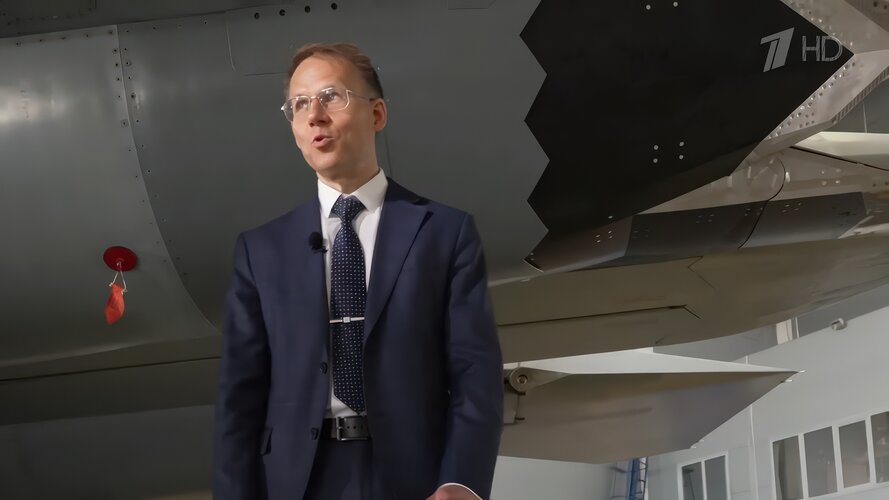 _неба_К_85_летию_ОКБ_Сухого_и_ОКБ_МиГ.mp4_snapshot_00.28.043-gigapixel-standard v2-2x-faceai ...jpeg1 MB · Views: 135
 -
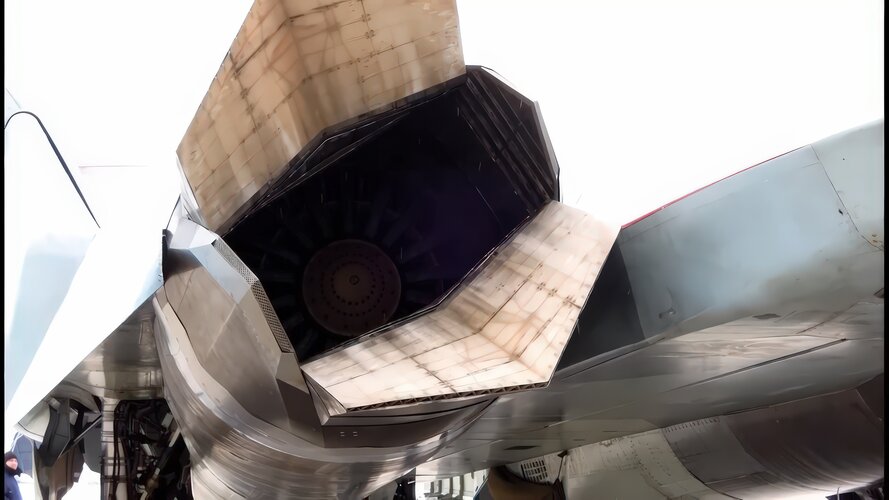 Властелины_неба_К_85_летию_ОКБ_Сухого_и_ОКБ_МиГ.mp4_snapshot_00.29.540-gigapixel-standard v2-2x.jpeg1.1 MB · Views: 131
 -
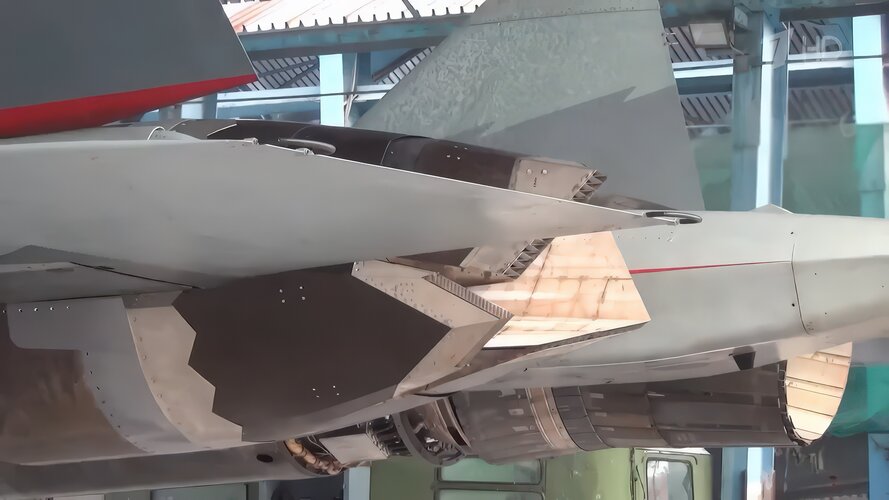 Властелины_неба_К_85_летию_ОКБ_Сухого_и_ОКБ_МиГ.mp4_snapshot_00.29.873-gigapixel-standard v2-2x.jpeg1.3 MB · Views: 131
 -
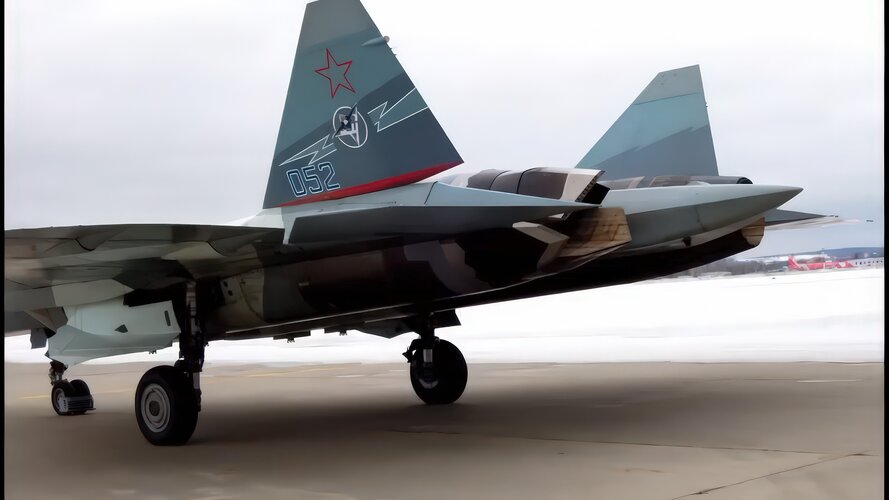 Властелины_неба_К_85_летию_ОКБ_Сухого_и_ОКБ_МиГ.mp4_snapshot_00.31.031-gigapixel-standard v2-2x.jpeg1 MB · Views: 125
QuadroFX
Russia, Chelyabinsk

RadicalDisconnect
Anthony Foulke
- Joined
- 28 April 2014
- Messages
- 228
- Reaction score
- 180
What is this "1164" Al-Li alloy?? The book only mentioned attempting to use 1461 Al-Li alloy for "2nd Stage" structural redesign of the Su-57. It then pointed to issues with impact resistance, plastic deformation properties, and VIAM allegedly cherrypicking samples. The book even said that during the first round of loads testing on T-50-7, the design with 1461 Al-Li alloy failed in an unacceptable manner, and it was thereafter rebuilt using more traditional aluminum alloys like B-95 duralumin when it then passed loads tests. And yes the centroplane reinforcement had to replace the composite panel with aluminum alloy, which is there even on serial production airframes.Now some details about that '1164' .It was written that AL-Li Alloy 1164 was used only for some structural parts/ panels from prototype T-50-6 etc,so for the second stage prototypes with goal to reduce the weight by 100-120kg.This was done in accordance with construction documentation for the second stage prototypes.
After a while as we can read the problems went bigger and bigger and finally they decided to throw out that Alloy.Now I have some questions to ask. If '1164' was used from T-50-6 which Al-Alloy was used earlier ? We know for the problems with that big composite skin panel on the upper side of the centroplane which appeared earlier. Solution was found with that big cross Al Alloy section but which Alloy exactly? One more thing ,in the first part of the reportage 'From T-50 to Su-57' ,author Aleksey Egorov saw some details of the static strength testing of the T-50-7( sequences from 29th min ).Test was successful. It happened maybe during 2018 when reportage was made or even earlier.
Sukhoi then mentioned that 1461 Al-Li alloy was removed from the "2nd Stage" prototype in stages to not interfere with construction schedule, and by the time of serial production airframes, only non-load bearing parts of Su-57 have that alloy.
This is indication that application of the 1461 Al-Li alloy, intended to reduce weight growth from the needed strengthening, was not entirely successful.Решающим фактором в вопросе внедрения нового алюминиево-литиевого сплава 1461, стало испытание статического образца Т-50-7, во время которого произошло веерное разрушение силовых шпангоутов в средней части фюзеляжа, а также отдельных стенок и поясов при достижении половины от расчетного случая нагружения. Результаты статических испытаний были ошеломляющими: конструкция планера разрушилась не в одном месте или нескольких локальных зонах, как это часто происходит, а масштабно, и в первую очередь причиной такого разрушения стало отсутствие зоны пластических деформаций материала перед разрушением. «Конструкция планера повела себя как старый сухой пень», что окончательно убедило главного конструктора М.Ю. Стрельца (с 2013 года) отказаться от использования данного материала в серийных Т-50 и перейти на детали из «классических» сплавов. Отказ от сплава 1461 в конструкции опытных образцов происходил постепенно и пошагово, поскольку опытные образцы Т-50-8, -9, -10 к тому моменту уже были заложены на стапелях). С каждым последующим вы- пущенным опытным образцом Т-50 доля сплава 1461 неуклонно снижалась (в первую очередь в высоконагруженных деталях) и к моменту создания Т-50-11 материал был практически полностью заменен, за исключением нескольких локальных мест в ненагруженных частях каркаса.
Полученные результаты прочностных испытаний восстановленной и доработанной статической машины Т-50-7 (с исключением сплава 1461) оказались положительными: конструкция планера второго этапа стала вести себя иначе по сравнению с конструкцией первого этапа: за счет внедренных изменений распределение нагрузок по планеру стало более равномерным, что позволило получить на статических испытаниях полный зачет по прочности.
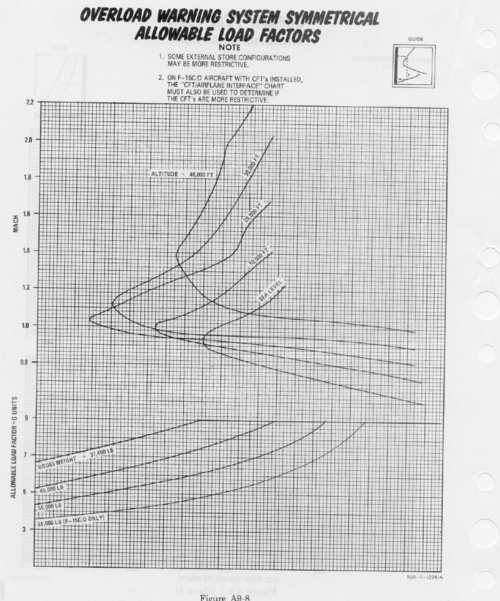
PeregrineFalcon said:Here is the chart for similar type of limitations for the F-15:

And you are clearly cherrypicking your data for the F-15, since this is the limit without OWS. In the same document several pages later, with OWS, F-15 is clearly able to pull 9g, something you conveniently left out.
PeregrineFalcon said:It states, “перегрузка” - load factor for the sustained turns at the weight of 20000 kg (missiles included, 50% of fuel from the normal fuel load etc.)
The full lines represent the G load for the 8G limit, and intersected lines represent the G load when the exploitation 8G limit is exceeded/overridden.
If there was serious danger of destroying the airframe under 9G sustained turn at 20000 kg, there wouldn’t be such option on the EM chart, and the plane would be hard limited to 8G.
And that chart has clear marks at the 8g limit, which clearly indicates those are limits not to be exceeded in normal operational service at risk of damaging airframe.
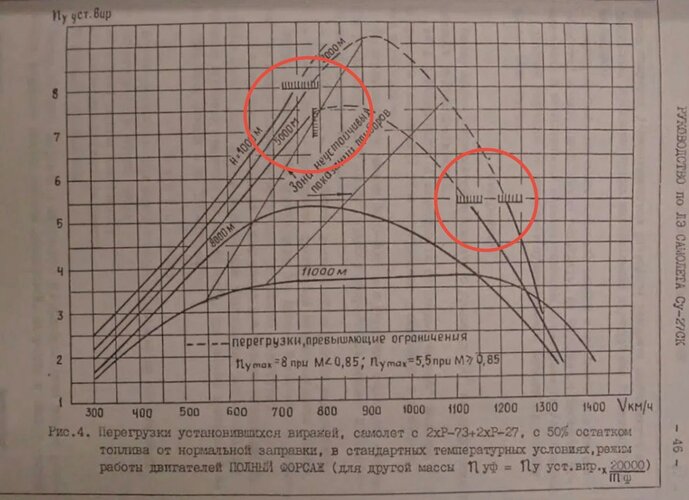
This is similar to F-15 able to pull more than 9g even when not explicitly in manual (which has happened in training and in combat operations), or F-18 Hornet having ability to override 7.5g-limit. The aircraft able to do it aerodynamically but doing so absolutely risk damaging or even losing aircraft, and cannot be done repeatedly.
But for purpose of aerodynamic comparison don't even know why F-15 is being invoked at all as analogue for F-22 when they're made by completely different companies and only look superficially similar at the roughest glance and even then, not that much other than closely spaced engines.
While Su-57 has longer root chord than Su-27, it's not much different from F-22, which is the point of this weight comparison, and the F-22 also has delta wing but has much deeper fuselage structural depth. And while not certain how spanwise lift distribution between the two exactly compares, the fuselage structural depth at the peak loads along the centerline and along the wing chord is much greater on F-22 which significantly increase area moment of inertia and reduce stresses.PeregrineFalcon said:Su-57 is basically using cropped delta wing, and here are the basic structural benefits from using such wing:
“The long root chord of the delta wing and minimal area outboard make it structurally efficient. It can be built stronger, stiffer and at the same time lighter than a swept wing of equivalent aspect ratio and lifting capability.
Its long root chord also allows a deeper structure for a given airfoil section. This both enhances its weight-saving characteristic and provides greater internal volume for fuel and other items, without a significant increase in drag. However, on supersonic designs the opportunity is often taken to use a thinner aerofoil instead, in order to actually reduce drag.”
...
Now, in my opinion the main reason for structural cracks during testing faze is predominantly tied to the materials used (that are not used in Su-35S construction).
Russians wanted to make the Su-57 as light as possible, and the new materials used were simply not adequate. Using different materials, that have somewhat higher specific weight has solved the problem.
This is a structural risk that Su-57 design consciously took in order to have large internal weapons bay between engine nacelles and good aero characteristics but it's not without tradeoffs. Again the weapons bay do not add any structural depth and it spans the entire wing root chord, while this empty "hole" is located mostly in front of the wing root chord on the F-22. And this is why if Su-57 does weigh less empty, it's likely with some kind of compromise, for example a lower weight limit at maximum g.
And you have the correlation between cracks and materials backwards, it was the need for strengthening that caused Sukhoi to try to apply the 1461 Al-Li alloy in the first place. The initial design couldn't pull the required g and needed reinforcement, and a Stage 2 redesign tried to reduce weight growth, but the application of new material wasn't entirely successful.
Where is this coming from? Measured by who and at what airspeeds?PeregrineFalcon said:And when we talk about lift to drag ratio, I have almost no doubt that Su-57 is superior in this regard. F-22 according to measurements has worse L/D ratio than Su-27 (11,6 vs 10,1 if I remember correctly).
Taking into account the amount of fuel F-22 can carry, it has very poor range (not so efficient engines and not so stellar lift to drag ratio will do that).
Su-57 is highly unstable plane (both in pitch and lateral direction) which provides excellent L/D ratio in subsonic/supersonic area, and that was possible to do with the use of LEVCON’s which can actively control the center of lift.
...
For that reason Su-57 doesn’t need the full depth bulkheads in that region, and the bulkhead between the weapons bays is simply additional strengthening measure.
Now, look at the structural depth of the fuselage of the Su-35S:
IMG_6804.jpeg
It is also “thin”, but no one is complaining, Su-35S is a monster of a plane!
...
Throwing around numbers of dubious provenance is not at all convincing, and last I checked the Cl and Cd data for F-22 across flight envelope has never been openly published.
Instability is not unique to Su-57, the F-22 is also quite unstable although only in pitch but there is not the data for you to claim which aircraft has better L/D. And also it's not a simple static number across the flight envelope.
As far as using Su-35 structure as example, we don't have overload values for Su-35, and even using Su-27 as example which does have overload in it's manual, one can clearly see that it has lower overload. On other hand, from the OWS chart above even the more lightly built F-15A variant can pull 9g at over 50,000lb weight which translate to overload of over 450,000lbs or 204,500kg, higher than Su-27's 171,000kg. This lower overload is part of why Su-27 is quite light for it's size.
As far as using airshow videos to prove your point, also extremely dubious considering that the weights flown at airshow is unknown for Su-57. Considering the precedent set by the Su-27 where none of the wing tanks (considered "ferry tanks") are filled for airshows which leaves it with 5,270kg of fuel, very unlikely Su-57 performs with full fuel either and anecdotal Sukhoi pilot reports are airshows performed at 50% internal fuel or less.
By contrast F-22 demo is done at full fuel of 18,000lb or 8,165kg so these airshow comparisons mean nothing considering the vastly different weighs..
What is this supposition based on?PeregrineFalcon said:my guess is that the Russians are aiming at Mach 2 supercruise with AL-51F-1 engines, where this type of intake will come handy.
Last edited:
One detail ...


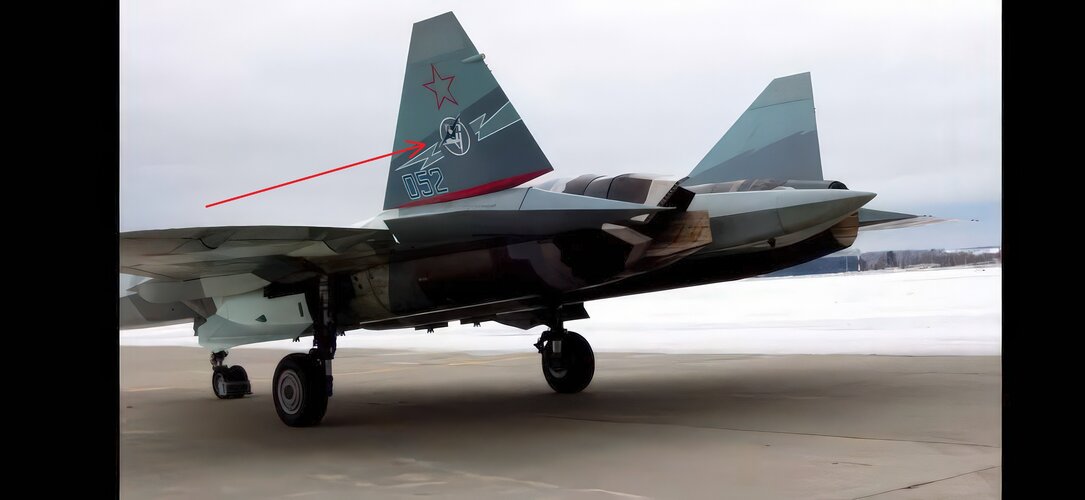
One more ,T-50-2LL with the amblem of Su-57M.

@RadicalDisconnect
Sorry it was number replacement.
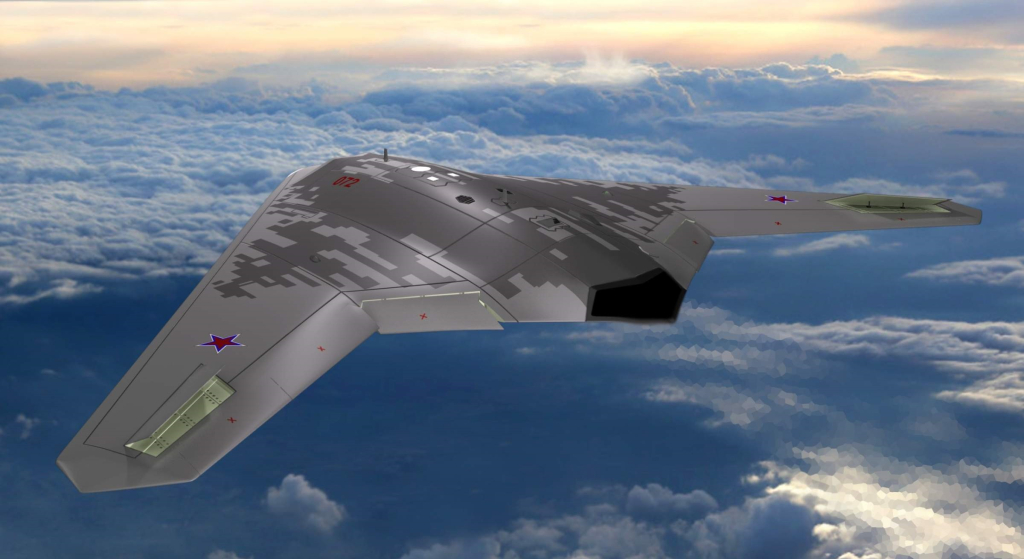

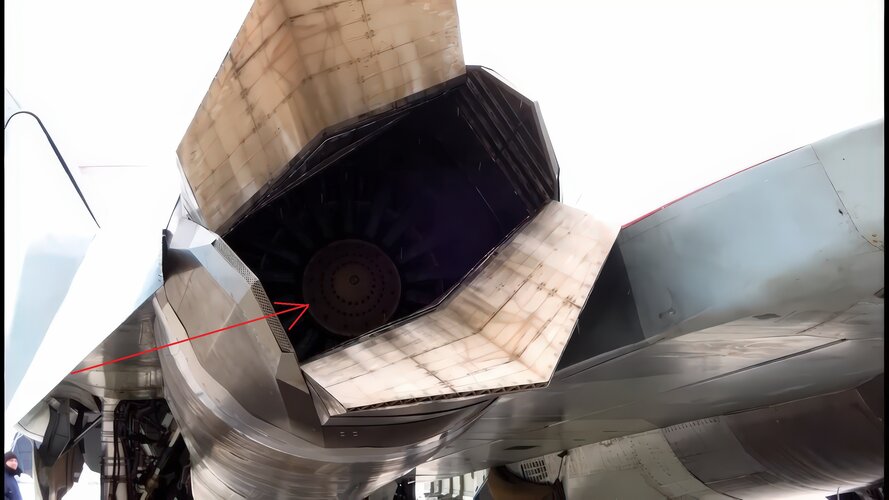
One more ,T-50-2LL with the amblem of Su-57M.
@RadicalDisconnect
Sorry it was number replacement.
Last edited:

Acatomic
ACCESS: Secret
- Joined
- 18 October 2020
- Messages
- 299
- Reaction score
- 845
They didn’t completely solve it. They just reduced it by making it less flat then on F-22.I'm curious if Sukhoi finally solved the loss of thrust issue from changing nozzle geometry

haavarla
ACCESS: Secret
- Joined
- 29 June 2010
- Messages
- 200
- Reaction score
- 255
As always, nice beat down Rad.
After all this time(i been away for years in here), and people, and i mean the SAME people are still hyperbole everything about everything.
If we look at how long the Flanker has been in service and improved upon.
Id say we are far from seeing the mid term edition of Su-57.
I am pretty sure it will be something sweet.
But we don't know if this nozzle is for this jet or that that was simply tested on a "flying lab" for something destined for another aircraft.
Perhaps a larger aircraft..
After all this time(i been away for years in here), and people, and i mean the SAME people are still hyperbole everything about everything.
If we look at how long the Flanker has been in service and improved upon.
Id say we are far from seeing the mid term edition of Su-57.
I am pretty sure it will be something sweet.
But we don't know if this nozzle is for this jet or that that was simply tested on a "flying lab" for something destined for another aircraft.
Perhaps a larger aircraft..
haavarla
ACCESS: Secret
- Joined
- 29 June 2010
- Messages
- 200
- Reaction score
- 255
Over the history, Lots of Patents from Sukhoi which never reached their aircrafts.This nozzle is for this jet. Was shown on a model years ago, number of patents filed years ago.
Lets see how this fan out then.
RadicalDisconnect
Anthony Foulke
- Joined
- 28 April 2014
- Messages
- 228
- Reaction score
- 180
The LOAN nozzle was the original nozzle solution for izd.30 and is applied to the izd.177 since they’re similar dimensions and compatible with same aircraft. In 2023, UEC Saturn in presentation said that the flat nozzle is a belated addition, and Sukhoi didn’t want to change airframe much, so they designed around existing airframe. Also explains the nacelles still being round as members here have mentioned.It's also possible the "LOAN"-style nozzle was always intended for what we now know as the Izd. 177?
Russia’s Fighter Engine Development Is Slow Going | Aviation Week Network
Arkhip Lyulka Design Bureau is also working on a three-stream sixth-generation fighter engine.
 aviationweek.com
Marchukov complained in his June speech that when the engine program for the Su-57 was launched, Sukhoi expressed no interest in a flat nozzle and only ordered it much later, when both the aircraft and engine were already formed. While the flat nozzle should be firmly integrated into the aircraft, Sukhoi “resists changes to the airframe itself,” he added.
“That’s why we came up with a rather complex flat nozzle,” Marchukov said.
Last edited:

- Joined
- 12 July 2006
- Messages
- 975
- Reaction score
- 950
...
But we don't know if this nozzle is for this jet or that that was simply tested on a "flying lab" for something destined for another aircraft.
Perhaps a larger aircraft..
But why does "the larger aircraft" need engines whose thrust nozzles can rotate around the longitudinal axis
? See at 0:32 in the video (please view at 0.25x speed).
- Joined
- 1 April 2006
- Messages
- 12,024
- Reaction score
- 13,950
Strange logic in regards to the case. Patents were filed by ODK, not Sukhoi, and they perfectly fit Su-57 'bionical design' model with 2D nozzles from 80th anniversary documentary, another official desktop model, later presentations from RAS and Saturn, and new footage.Over the history, Lots of Patents from Sukhoi which never reached their aircrafts.
Last edited:
RadicalDisconnect
Anthony Foulke
- Joined
- 28 April 2014
- Messages
- 228
- Reaction score
- 180
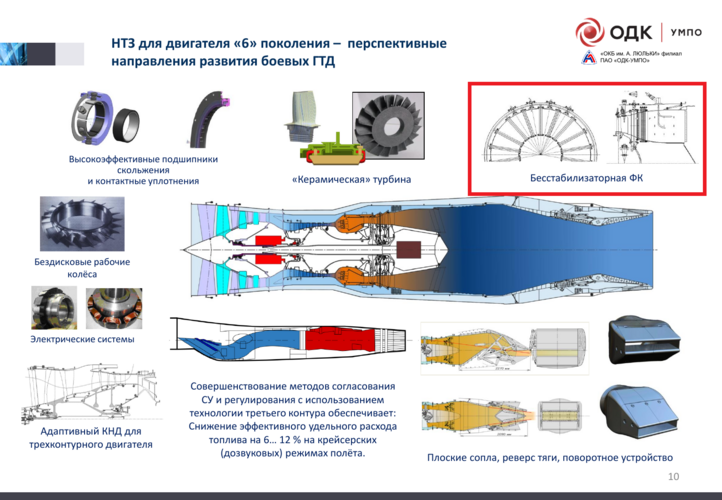
Also, the rear of izd.30 or AL-51F1 seem to have radar blocker and flame holder/spray bar similar to EJ200 or YF119? Although not full coverage like serial production F119.
Last edited:
- Joined
- 1 April 2006
- Messages
- 12,024
- Reaction score
- 13,950
They can't actually. There's no need for that. Animation was made by broadcaster studio design girls.But why does "the larger aircraft" need engines whose thrust nozzles can rotate around the longitudinal axis
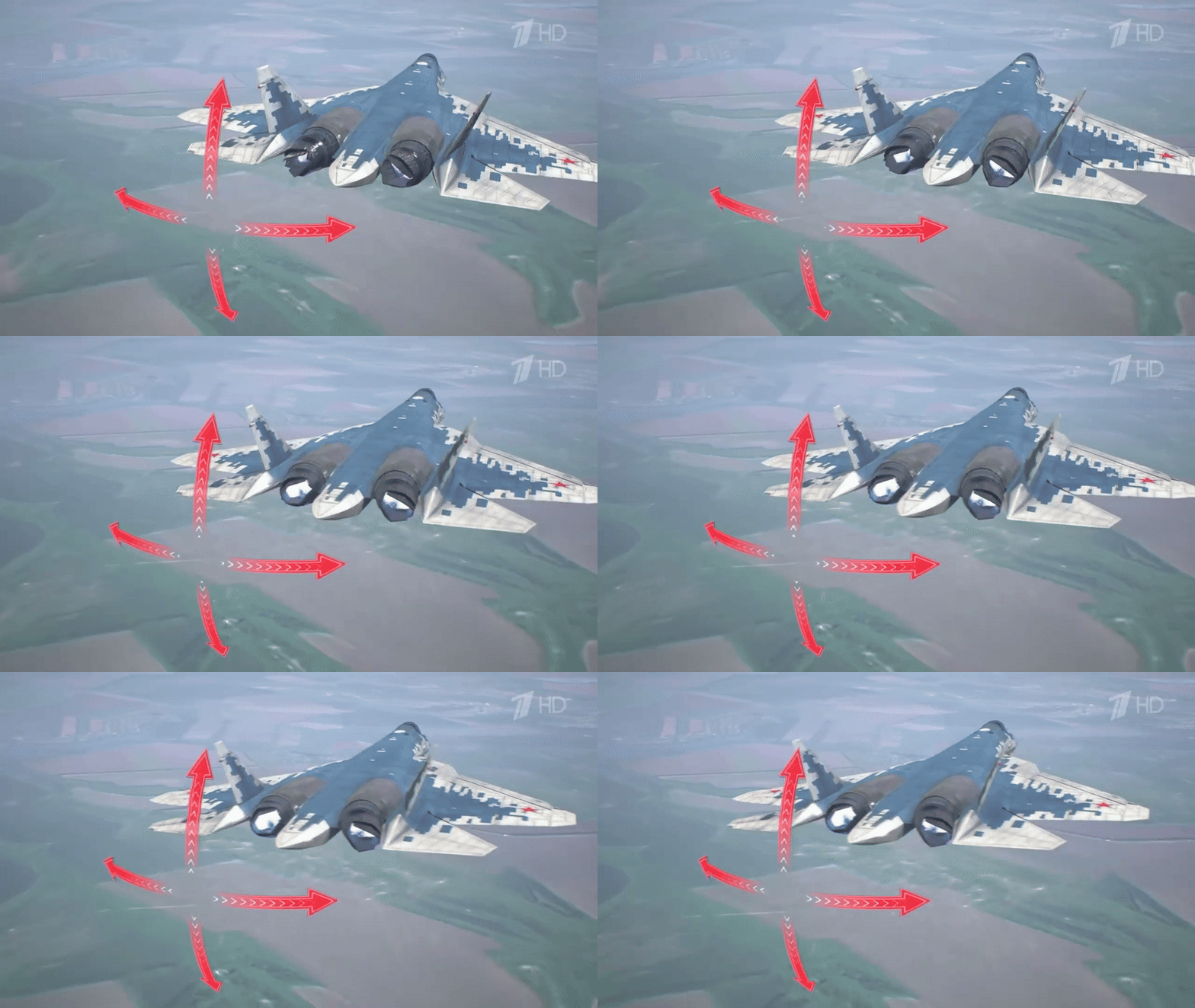
Is this an official animation? I was under the impression that they just went up and down and the canted angle was used for the z axis, like the su-30, su-35 and current su-57does this mean the real thing can change the vector of thrust in a rudder axis in addition to the standard pitch control via petals deflection?
This one definitely just go up and down, the one from GIF maybe for future development.Slightly better screencaps postprocessed with AI:
- Joined
- 1 April 2006
- Messages
- 12,024
- Reaction score
- 13,950
does this mean the real thing can change the vector of thrust in a rudder axis in addition to the standard pitch control via petals deflection?
aonestudio
I really should change my personal text
- Joined
- 11 March 2018
- Messages
- 3,323
- Reaction score
- 8,958

Su-57 Felon’s Two-Dimensional Thrust-Vectoring Engine Nozzle Breaks Cover
The flattened exhaust nozzle installed at an angle is planned to reduce the signature of advanced versions of the Su-57. The novel flattened exhaust nozzle is planned to reduce the radar signature of advanced versions of the Su-57 Felon fighter.
 www.twz.com
The raptor has less swept going for it and the camber on the tips of the wings, so it is not so clear which one could turn faster. I do thin the su-57 has more innovative aerodynamics. Now if only we had the f-23
Also, the rear of izd.30 or AL-51F1 seem to have radar blocker and spray bar similar to EJ200 or YF119? Although not full coverage like serial production F119.
First tnx for 'modified pic',second, maybe it is not the radar blocker but this ,AB chamber w/o stabilizer.
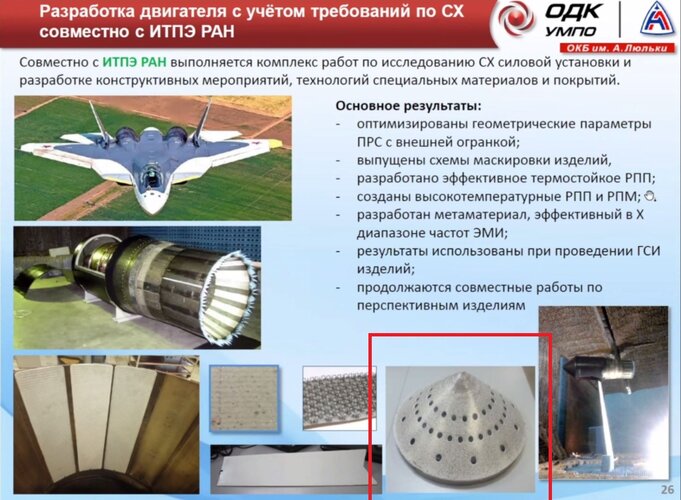
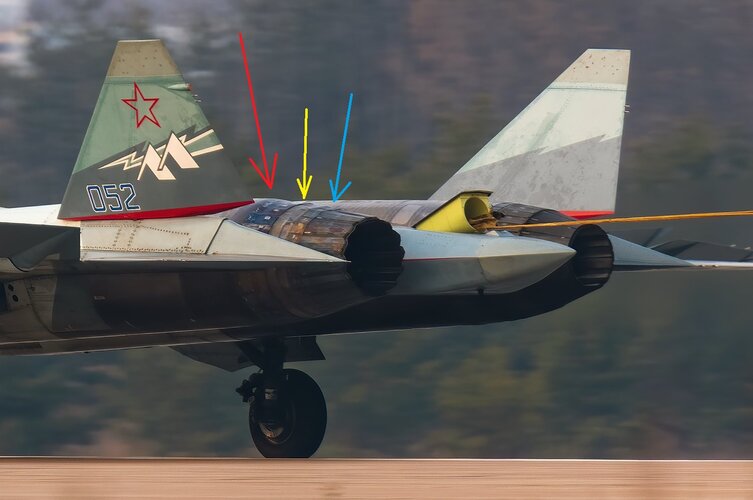
Another details... now let us see how LOAN of Izd. 30/AL-51F is look like.First the video of static test.
What we can see here? Red arrow shows us skin plate of the Izd.30 ,yellow arrow to end of the skin plate and the place where we can see LOAN movements,blue of course shows to us LOAN itself.
Now let us see how the new nozzle is look like. Red arrow shows to us completely new skin panel,yellow arrow shows to us the end of it and grey arrow to the section for nozzle rotating in longitudinal axis.Blue arrow shows to us moveable part of the nozzle.
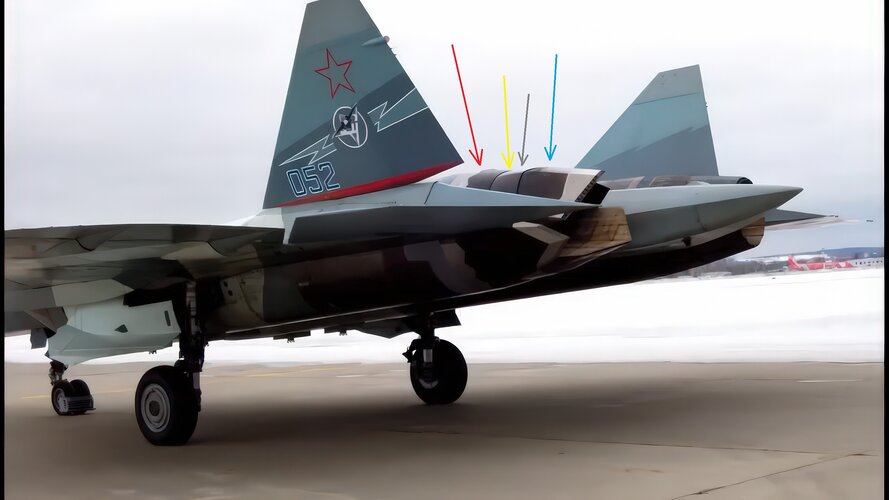
My question is, if this is Izd. 30/AL-51F with the new nozzle, why is there completely new upper skin panel ? Other detail ,if we look better ,lower skin panel of the engine nacelle is also new.If there is really AL-51F ,inside left engine nacelle, why they changed skin panels on it ?
Blue lines shows to us nacelle panels that are the same ,yellow shows us the place where we can see new panels,
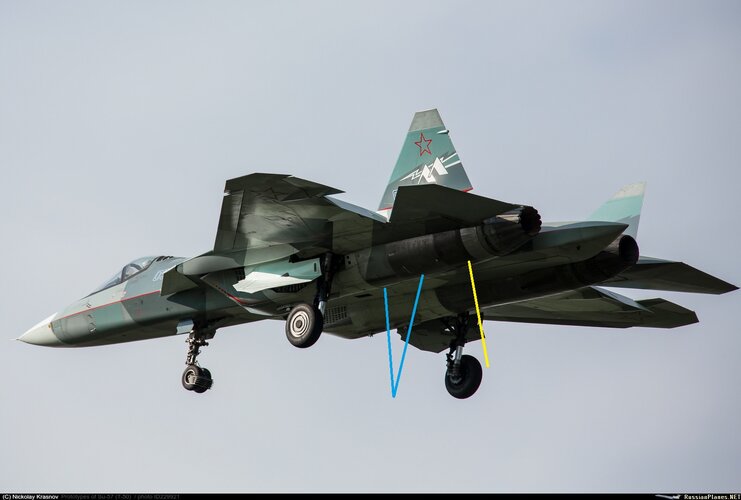
As wrote before ,we can clearly see that Su-57M emblem on the vertical stabilizer so it means that this new engine is for the Su-57M ,not for Su-57. As some official sources said ( personally it was Yuriy Slyusar), AL-51F will be integrated into serial Su-57's from 2025 and all serial Su-57's with AL-41F1 will not get Izdeliye 30. As we know ,static tests for Izd 30 started in 2016 ,flight tests began in 2017 and lasted 7 years ( 2017-2024). Static tests of this completely new ( yes, 6 gen) engine started in 2021 and as we can see ,flight tests started at the end of 2024 and will last for years to come.
First flying prototype of Su-57M had first test flight on Oct. 21 2022 .Pilot was of course Sergey Bogdan. Su-57M is prototype of the Russian 5+/6 gen fighter with many technical inovations.As Sergey said several times,he achieved several test flights so far in which he didn't do anything at all from the takeoff phase ,flight itself and landing phase.He only monitored work of all systems.
On June 2023 it was released info from ODC that new 6th gen engine is testing...
В ОДК показали кадры испытаний двигателя шестого поколения для Су-57
''В Объединенной двигателестроительной корпорации (ОДК) проинформировали об успешном испытании двигателя шестого поколения для многоцелевого истребителя Су-57.Немалую роль в высоких эксплуатационных характеристиках нового двигателя будет играть плоское сопло.''
Ð ÐÐРпоказали кадÑÑ Ð¸ÑпÑÑаний двигаÑÐµÐ»Ñ ÑеÑÑого Ð¿Ð¾ÐºÐ¾Ð»ÐµÐ½Ð¸Ñ Ð´Ð»Ñ Ð¡Ñ-57
Ð ÐбÑединенной двигаÑелеÑÑÑоиÑелÑной коÑпоÑаÑии (ÐÐÐ) пÑоинÑоÑмиÑовали об ÑÑпеÑном иÑпÑÑании двигаÑÐµÐ»Ñ ÑеÑÑого Ð¿Ð¾ÐºÐ¾Ð»ÐµÐ½Ð¸Ñ Ð´Ð»Ñ Ð¼Ð½Ð¾Ð³Ð¾Ñелевого иÑÑÑебиÑÐµÐ»Ñ Ð¡Ñ-57. ÐемалÑÑ ÑÐ¾Ð»Ñ Ð² вÑÑокиÑ...
 topcor.ru
In the article we can see all those illustrations but also pic where we can see ''Su-57'' with new 6th gen engine.Pic was in fact photoshop from paralay. Many sources wrongly wrote that it was the start of the flight tests of that new engine.
Russian source where we can see that it is in fact AL-51F-1 with flat nozzle.There are pics where we can see nozzle with and w/o rotation section.

Су-57 получил двигатель второго этапа АЛ-51Ф1 с плоским соплом » Авиация России
Первый канал российского телевидения представил трейлер фильма «Властелины неба», посвящённого 85-летию Опытно-конструкторского бюро им. Павла Сухого. Сам
 aviation21.ru
P.S. If I am wrong about this ,I will apologize to all members.
Last edited:
New engines are not made so quickly, this is work for another 15 years. The letter that you read as the letter M is not it, it is 2 letters L in Russian transcription Л. That stands for Flying Lab (летающая лаборатория). English is not my native language, sorry for the mistakes.
Last edited by a moderator:
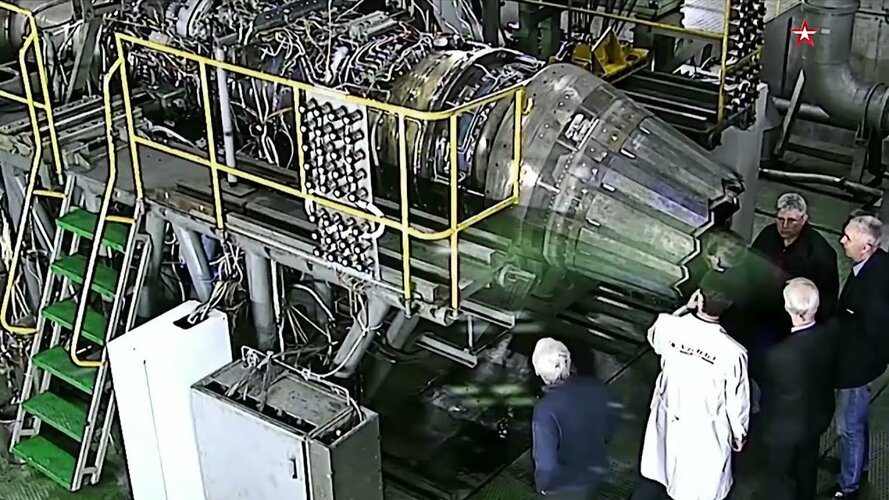
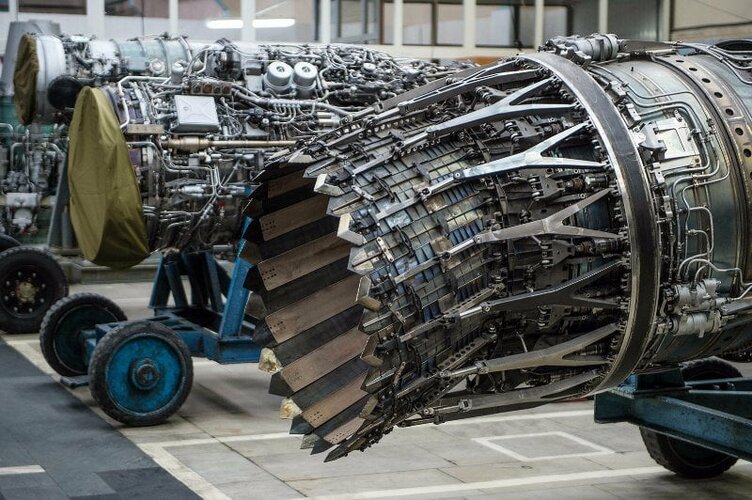
Second part of the analysis after the first one .Here is some pics of Izd. 30

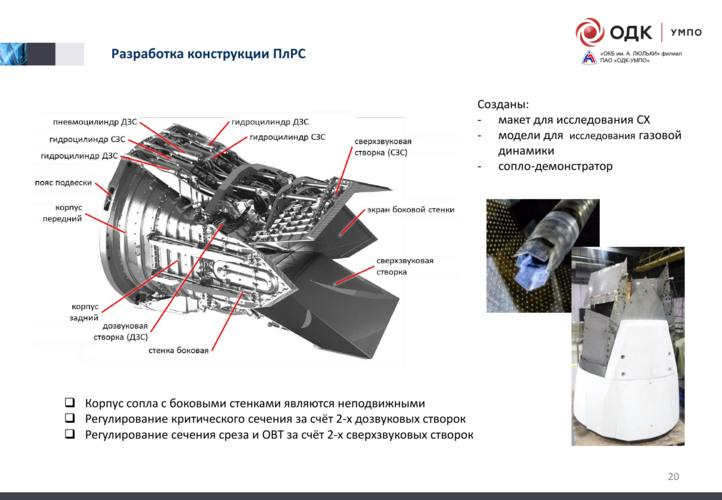
Now the illustration shown before. Nozzle itself is one rotatable block with all of that hydraulic and pneumatic cylinders that
would require significant changes on Izd 30.
Also as one member noticed where is the sense, the logic to spent so much time testing Izd 30 with LOAN and after so many years to start test it with the new nozzle???

I will repeat what Е. Marchukov said about 6 gen. engine in 2019.
''In parallel with the development of the second stage engine for the Su-57, designers are already creating the scientific and technical basis for the sixth generation engines. First of all, research is aimed at improving the specific characteristics of the power plant compared to fifth-generation engines.According to Marchukov, such a project involves adding a third external air stream to the power plant design. Thanks to this, it is possible to achieve low specific fuel consumption at supersonic cruising mode. When flying at subsonic speeds, the third air stream will be open. Thanks to this, the air flow from the fan will pass through the second and third stream and the engine will operate almost like a turbofan power plant with a high bypass ratio. In this mode, the power plant will have slightly greater thrust and significantly lower fuel consumption.During supersonic flight, the third stream will be completely closed, and the second partially, due to which the engine will operate as a power plant with a low bypass ratio.''
Now the illustration shown before. Nozzle itself is one rotatable block with all of that hydraulic and pneumatic cylinders that
would require significant changes on Izd 30.
Also as one member noticed where is the sense, the logic to spent so much time testing Izd 30 with LOAN and after so many years to start test it with the new nozzle???
I will repeat what Е. Marchukov said about 6 gen. engine in 2019.
''In parallel with the development of the second stage engine for the Su-57, designers are already creating the scientific and technical basis for the sixth generation engines. First of all, research is aimed at improving the specific characteristics of the power plant compared to fifth-generation engines.According to Marchukov, such a project involves adding a third external air stream to the power plant design. Thanks to this, it is possible to achieve low specific fuel consumption at supersonic cruising mode. When flying at subsonic speeds, the third air stream will be open. Thanks to this, the air flow from the fan will pass through the second and third stream and the engine will operate almost like a turbofan power plant with a high bypass ratio. In this mode, the power plant will have slightly greater thrust and significantly lower fuel consumption.During supersonic flight, the third stream will be completely closed, and the second partially, due to which the engine will operate as a power plant with a low bypass ratio.''
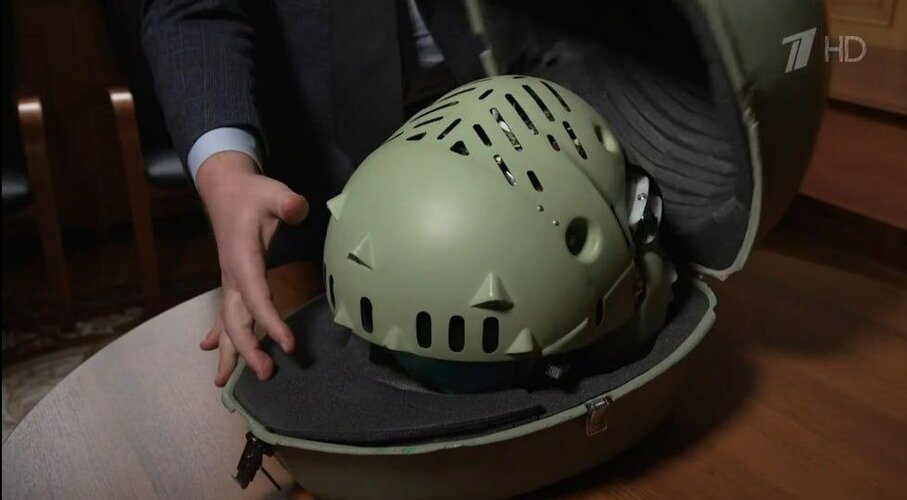
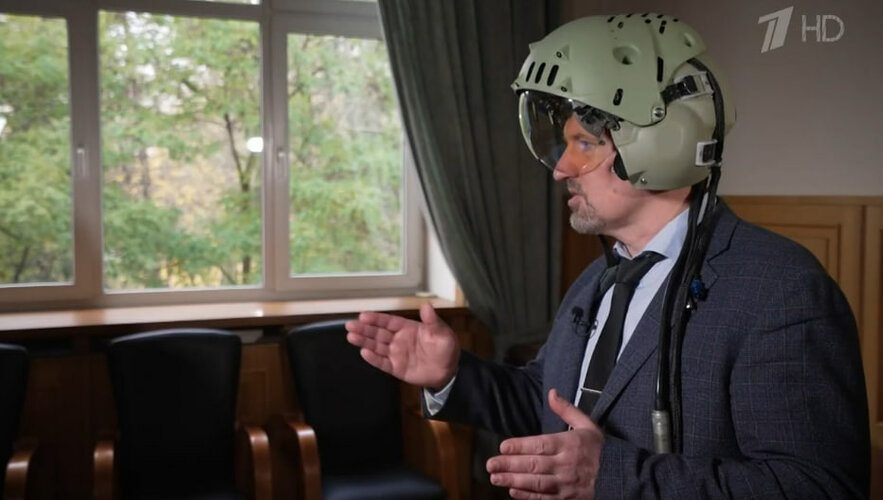
New helmet for the Su-57 pilots was also shown ... The helmet with NSTsI /HMD. It is obvious that pilot will see all parameters that will be presented on the wide-angle HUD ShKAI-5M.
Шлем дополненной реальности для лётчиков истребителей Су-57 (с) Кадр из видео «Первого канала»

Шлем дополненной реальности для лётчиков истребителей Су-57 (с) Кадр из видео «Первого канала»
- Joined
- 1 April 2006
- Messages
- 12,024
- Reaction score
- 13,950
This is not Izd.30. Your analysis with constant 'now we can be sure', 'we clearly see', 'apparently' often based on poor knowledge of things that long known or wrong assumptions. You remind me a guy from KPF who thought that every Russian patent filed in certain IPC class was directly related to PAK FA, presenting his wishful thinking as real things.Second part of the analysis after the first one. Here is some pics of Izd. 30
View attachment 752022
Last edited:
This is not Izd.30. Your analysis with constant 'now we can be sure', 'we clearly see', 'apparently' often based on poor knowledge of things that long known or wrong assumptions. You remind me a guy from KPF who thought that every Russian patent filed in certain IPC class was directly related to PAK FA.
I can see there is some differences between serated petals, tnx . That engine is ?
New engines are not made so quickly, this is work for another 15 years. The letter that you read as the letter M is not it, it is 2 letters L in Russian transcription Л. That stands for Flying Lab (летающая лаборатория). English is not my native language, sorry for the mistakes.
Hm,there is T-50-2LL (Bort number 052 blue ) as that Flying Laboratory and Su-57M ( Bort number 511 blue) as Modernised. I know Russian language/letters.

Dreamflyer
'Senior Something'
- Joined
- 13 July 2008
- Messages
- 553
- Reaction score
- 908
Here you can see how efficient Su-57 is when rolling at high AoA, and at what speed it can point its nose in any direction.
Assuming the (test-)pilot executes such (demo-)manoeuvres regularly, I wonder at what speed he can now point his own nose in any direction. And if his wife is still complaining about his roll rates during 'high AoA' nights.
RadicalDisconnect
Anthony Foulke
- Joined
- 28 April 2014
- Messages
- 228
- Reaction score
- 180
That Salyut nozzle, they proposed AL-31FM3 and a follow on for PAK-FA but Sukhoi chose Saturn. Salyut nozzle clearly vectors differently from AL-41F1 and AL-31FP style nozzle.I can see there is some differences between serated petals, tnx . That engine is ?

TSARb
ACCESS: Confidential
- Joined
- 8 March 2011
- Messages
- 108
- Reaction score
- 294
...is photographed at the Salut's fab.I can see there is some differences between serated petals, tnx . That engine is ?
Similar threads
-
 Sukhoi Su-57 / T-50 / PAK FA first flight - pictures, videos and analysis [2010]
- Started by flateric
- Replies: 872
-
 Sukhoi Su-57 / T-50 / PAK FA - flight testing and development Part I [2010-2012]
- Started by Matej
- Replies: 760
-
-
 Sukhoi PAK FA news and speculation (T-50, I-21) Part I [2006-2008]
- Started by overscan (PaulMM)
- Replies: 455
-