In relation to the discussions in the USN about the move from 700ft to 1300ft (Scorpion to Thresher) the USN and its designers seemed to have not fully appreciated the dangers involved. The Threshers retained significant lengths of unneeded ambient seawater pressure piping within their hulls (heads for example) so as is often the case designs 'fail' at their margins - the hull of USS Thresher collapsed at about 1900 feet, a testament to its over all soundness BUT - some of the details in its design were inherently poor for her designed diving depth.

While I'm sure we would all delight if SSN's had the performance of the ceramic hulled USS Challenger in Joe Buff's novels, in the real world the technology associated with making such deep diving SSN's is probably not there AND equally important there is no overriding tactical reason for submarines to go that deep, never mind the likely horrendous expense of such a deep diving depth.

A poster above mentioned that the jump from 700ft to 1300ft was made relatively quickly and in the spirt of the late 50's - early 60's it was probably assumed that similar jumps to deeper diving depths would come just as quickly and easily.
Depends if you’re talking to Norman Polmar who thinks we should just do whatever the Soviets/Russians were/are doing.
 
AND equally important there is no overriding tactical reason for submarines to go that deep, never mind the likely horrendous expense of such a deep diving depth.
The analogy that might be made is with aerospace. We can put people on the moon, and regularly send people into low orbit. But nobody's proposing fighter aircraft with that kind of performance, and actually Mach 2/50,000 feet (ish) is enough to realise most of the advantages of speed and height.
 
Even knowing the substantial access to titanium Russia has it still boggles my mind that the USSR was able to build titanium hulled attack submarines of that size. Welding titanium is a difficult process and even for the Russians mining and refining it had to cost something significant. Eventually even their high-end attack boats like the Akulas moved back to steel.

I checked where most of the world's titanium is produced these days and not too surprisingly China does about 50% of it, though I'm sure most of the minerals are mined elsewhere. I'm wondering if they'll start building titanium hulled submarines in due time given their blue water ambitions.
 
I'm wondering if [China will] start building titanium hulled submarines in due time given their blue water ambitions.
I doubt it. Even with an economy the size they have, titanium hulled submarines are stupid expensive.

I wouldn't be surprised if the Soviet subs were 10x or even 100x more expensive per hull than the steel hulled equivalents.
 
I don't know much about this specific topic even though I am interested in submarines.
A thing I do know of is this from the US Congress which was posted a couple days ago.

Might anyone want it as a historical reference?

https://www.congress.gov/crs-product/IF11826
Navy Next-Generation Attack Submarine (SSN[X]) Program: Background and Issues for Congress

CRS PRODUCT (LIBRARY OF CONGRESS)Hide Overview
CRS Product Type: In Focus
CRS Product Number: IF11826
Referenced Legislation: H.R. 1968; P.L.119-4
Topics: Defense & Intelligence
Publication Date: 07/09/2025
Author: O'Rourke, Ronald

Download PDF (291KB) | PDF Version History

Introduction

The Navy has been procuring Virginia-class nuclear powered attack submarines (SSNs) since FY1998. The Navy's envisaged successor to the Virginia-class design is the Next-Generation Attack Submarine, or SSN(X). The Navy's FY2025 budget submission deferred the envisaged procurement of the first SSN(X) from FY2035 to FY2040 due, the Navy stated, to limitations on the Navy's total budget. The Navy's proposed FY2026 budget requests $622.8 million in research and development funding for the SSN(X) program.
 
I don't know much about this specific topic even though I am interested in submarines.
A thing I do know of is this from the US Congress which was posted a couple days ago.

Might anyone want it as a historical reference?

https://www.congress.gov/crs-product/IF11826
Ref Ronald O'Rourke CRS report to Congress quotes original submerged displacement of Virginia as 7,800 long tons, Seawolf 9,138 tons and CBO estimating the SSN(X) will be 10,100 tons, which think may be on the low side as the Virginia Block V with the addition of the 84 foot VPM said to be 10,200 tons.
Arbitrary guess the SSN(X) may be around 2,000 tons larger than Virginia Block V so looking at approx. 12,000 tons ? If so the CBO estimate (usually more accurate than the Navy figures) of $8.7 billion per boat will be on the low side as their estimates based on displacement.
 
Ref Ronald O'Rourke CRS report to Congress quotes original submerged displacement of Virginia as 7,800 long tons, Seawolf 9,138 tons and CBO estimating the SSN(X) will be 10,100 tons, which think may be on the low side as the Virginia Block V with the addition of the 84 foot VPM said to be 10,200 tons.
Arbitrary guess the SSN(X) may be around 2,000 tons larger than Virginia Block V so looking at approx. 12,000 tons ? If so the CBO estimate (usually more accurate than the Navy figures) of $8.7 billion per boat will be on the low side as their estimates based on displacement.
If I'm right and the SSN(X) is more or less a Seawolf front end grafted onto a Columbia engineroom, ~10ktons is about right.

The concept art certainly doesn't have any VLS amidships. I do kinda expect that there will be an SSGN(X), or rather a Columbia-class SSGN.
 
If they can modify Virginias with an 84 foot plug couldn’t they design later Columbias with another 2x quad pack?
IIRC the Columbias are theorized to max out the length of various dry docks and such? But it would also introduce delays and cost increases, and the Ohios only have so much hull life. More boats seems like the lowest risk option IMO. 20-24 tube Columbia-derivatives would also be good, though. I don't know if there's the information to say what is the best option
 
One thing I would really hope they do is go to a double hull with SSN(X). Single hull construction was always a bad idea. The dangerously poor reserve buoyancy of US subs is inexcusable from a safety standpoint, particularly when they don't have escape capsules. Vulnerability to underwater explosions is worse and hydrodynamic shaping is severely constrained.
Another reason to listen to Norman Polmar and copy the Russians. (although we used to build double hulled nuclear subs)
 
One thing I would really hope they do is go to a double hull with SSN(X). Single hull construction was always a bad idea. The dangerously poor reserve buoyancy of US subs is inexcusable from a safety standpoint, particularly when they don't have escape capsules. Vulnerability to underwater explosions is worse and hydrodynamic shaping is severely constrained.
Another reason to listen to Norman Polmar and copy the Russians. (although we used to build double hulled nuclear subs)
There are numerous disadvantages:
  • For a given beam, the pressure hull must be smaller, forcing constraints on the propulsion plant silencing in particular.
  • The displacement is necessarily larger, and double-hull submarines typically are more expensive.
  • Maintenance is more difficult, time-consuming, and costly.
  • Special care must be taken to ensure that the light plating and structure of the outer hull does not vibrate at speed.
  • For a submarine with "surface unsinkability" (i.e., the ability to surface with one watertight compartment and its corresponding main ballast tanks flooded) the watertight compartment length must be quite short, which is why this standard was abandoned after the Albacore.
  • The increased wetted area of a double-hull submarine offsets any minor gains by hydrodynamic shaping. Adding a parallel midbody to a streamlined body-of-revolution has only a minor drag penalty.
Certainly it can be done, as the Russians have shown, and NAVSEA has conducted concept design studies of single-hull submarines. But for the reasons above it has never really made sense. In regard to survivability, I generally agree, although it remains to be seen how survivable double-hull submarines are in practice as so few submarines have been sunk in combat since WWII (remember that essentially all of the U.S. submarines sunk during WWII had double hulls).

The U.S. Navy only built one double-hull submarine, the Triton. Of course she was different than any other U.S. Navy nuclear submarine: initially a radar picket, ship-like hull for higher speed on the surface than submerged, two reactors, surface ship-like steam plant, etc. Otherwise, all other U.S. Navy nuclear submarines have had single hulls.

 
For a submarine with "surface unsinkability" (i.e., the ability to surface with one watertight compartment and its corresponding main ballast tanks flooded) the watertight compartment length must be quite short, which is why this standard was abandoned after the Albacore.
FWIW, there's no reason in principle that you couldn't design a single-hull boat for surface unsinkability. Or indeed a double-hulled boat that didn't meet that criterion.

The USN also doesn't build true single-hulled submarines: there's a spectrum from the outer hull limited to the fore and aft ends (as the US does), through a small upper casing (RN practice) to a full outer hull (Russian practice). Bringing the MBTs inside the pressure hull is another thing that you can put on the list of things which are possible, but inadvisable.
 
The USN also doesn't build true single-hulled submarines: there's a spectrum from the outer hull limited to the fore and aft ends (as the US does), through a small upper casing (RN practice) to a full outer hull (Russian practice). Bringing the MBTs inside the pressure hull is another thing that you can put on the list of things which are possible, but inadvisable.
Single-hull submarines in the strictest sense are rare, only having existed in significant numbers around the turn of the 20th Century. Hence the usage of the term "single hull" for submarines which have a significant portion of their pressure hull forming the outer skin of the vessel. It's just a matter of semantics.

As for internal MBTs, it was actually done at least twice in recent memory: the George Washington and Resolution SSBN classes had internal MBTs because of their (on paper) conversion from SSN designs.
 
There are numerous disadvantages:
  • For a given beam, the pressure hull must be smaller, forcing constraints on the propulsion plant silencing in particular.
  • The displacement is necessarily larger, and double-hull submarines typically are more expensive.
  • Maintenance is more difficult, time-consuming, and costly.
  • Special care must be taken to ensure that the light plating and structure of the outer hull does not vibrate at speed.
  • For a submarine with "surface unsinkability" (i.e., the ability to surface with one watertight compartment and its corresponding main ballast tanks flooded) the watertight compartment length must be quite short, which is why this standard was abandoned after the Albacore.
  • The increased wetted area of a double-hull submarine offsets any minor gains by hydrodynamic shaping. Adding a parallel midbody to a streamlined body-of-revolution has only a minor drag penalty.
Certainly it can be done, as the Russians have shown, and NAVSEA has conducted concept design studies of single-hull submarines. But for the reasons above it has never really made sense. In regard to survivability, I generally agree, although it remains to be seen how survivable double-hull submarines are in practice as so few submarines have been sunk in combat since WWII (remember that essentially all of the U.S. submarines sunk during WWII had double hulls).

The U.S. Navy only built one double-hull submarine, the Triton. Of course she was different than any other U.S. Navy nuclear submarine: initially a radar picket, ship-like hull for higher speed on the surface than submerged, two reactors, surface ship-like steam plant, etc. Otherwise, all other U.S. Navy nuclear submarines have had single hulls.
I was thinking of the Triton in particular, a totally badass submarine. Unfortunately the short lived radar picket role hastened its demise.
Its true-there has never been any real combat involving postwar Russian and US nuclear subs, so in one sense I guess it doesn't really matter how safe or unsafe in combat the boats have been up until now. That being said, its interesting to note that despite having many more peacetime accidents, the Soviets had fewer SSN fatalities than the US, which I would put to two things- far better reserve buoyancy and escape capsules. Thresher and Scorpion (and all subsequent US subs) basically had neither.
 
which I would put to two things- far better reserve buoyancy and escape capsules. Thresher and Scorpion (and all subsequent US subs) basically had neither.
With how both subs went down.

Either Reserve Buoyancy nor Escape Capsules would have help.

Thresher lost power after taking on water from a burst despite in the hull, which negated any reserve bouyance enough that even blowing both the weights and tanks fail to surface her. This happened fast enough that the Escape Capsules.

Which is only design for the officers mind not enlist who was SOL.

Wouldn't be able to be ready in time before hitting crush depth.

Scorpion implode at the speed of mach Jesus after some explosivion inside kill her controls, floored her and dropping to crush again fast enough make the capsule useless. Much like what happen to the Oscar class Kursk.

Heck the number of survivors o in the times the Escape Capsules got used is a very prime number.

1.

That all the capsule have save.

1 on the prototype K-278 Komsomolets during her fire. 4 other died in it.

When a submerge submarines break shit gets bad fast.
 
One thing I would really hope they do is go to a double hull with SSN(X). Single hull construction was always a bad idea. The dangerously poor reserve buoyancy of US subs is inexcusable from a safety standpoint, particularly when they don't have escape capsules. Vulnerability to underwater explosions is worse and hydrodynamic shaping is severely constrained.
Another reason to listen to Norman Polmar and copy the Russians. (although we used to build double hulled nuclear subs)
How many Soviet/Russian subs down vs US ones?

You need to move beyond that book and Polmar’s issues with Rickover. You really need to.
 
Perhaps a return to saddle tanks as blisters.

Usually, when your submarine is holed --you sink.

But if saddle tanks take the abuse and come apart, you surface, no?

The inner hull metal...outer cladding a sleeve you can slide off or replace?

Anyone trying surfacing by filling tanks with foam to shove water out?
 
I was thinking of the Triton in particular, a totally badass submarine. Unfortunately the short lived radar picket role hastened its demise.
Its true-there has never been any real combat involving postwar Russian and US nuclear subs, so in one sense I guess it doesn't really matter how safe or unsafe in combat the boats have been up until now. That being said, its interesting to note that despite having many more peacetime accidents, the Soviets had fewer SSN fatalities than the US, which I would put to two things- far better reserve buoyancy and escape capsules. Thresher and Scorpion (and all subsequent US subs) basically had neither.
Thresher went down when her reactor scrammed without a method to quickly restart and she was way too heavy. Then her EMBT Blow system iced up and didn't let her blow to the surface, either. Lessons learned? Fast-recovery reactor startups are drilled into nukes to the point that they can do them in their sleep, the EMBT blow system was heavily modified to make it impossible to ice up and prevent the system from working, and a host of other changes summed up in the SUBSAFE system.

Scorpion probably had a torpedo battery fire that detonated the warhead and flooded the torpedo room instantly. The boat was instantly unrecoverable, too much weight forward and no way to get it off before she reached crush depth. Sadly, Scorpion was scheduled to receive the SUBSAFE refit upon her return to the USA. But I do not believe that SUBSAFE could have saved Scorpion. An "Instantly-flooded torpedo room" was tested in the simulator with the best-performing teams in Norfolk, and no one could recover. Mathematically impossible situation.
 
Keep your bigass seawater tanks outside my people tank, thank you very much!
Believe me, nobody likes that solution!
Bad enough with Hovering and Missile Compensation tanks in the Ohios...
I always find it odd that some missile boats need to pump water in for compensation, but some need to pump it out. I fully understand why. But it still seems weird.
But I do not believe that SUBSAFE could have saved Scorpion.
When you fill a submarine with things meant to sink submarines, sinking your own submarine accidentally is always going to be a risk. The risk mitigation there is 'make the torpedoes not explode unless commanded to do so'. I don't know how you do that, maybe it's not entirely possible.
 
Scorpion probably had a torpedo battery fire that detonated the warhead and flooded the torpedo room instantly. The boat was instantly unrecoverable, too much weight forward and no way to get it off before she reached crush depth. Sadly, Scorpion was scheduled to receive the SUBSAFE refit upon her return to the USA. But I do not believe that SUBSAFE could have saved Scorpion. An "Instantly-flooded torpedo room" was tested in the simulator with the best-performing teams in Norfolk, and no one could recover. Mathematically impossible situation.
Actually, almost certainly main battery outgassing and explosion that killed everyone forward and doomed the boat.

https://www.iusscaa.org/articles/brucerule/scorpion_loss_50years.pdf
Torpedo issues (hot run, battery fire, etc) were theories John Craven put forward but didn't retract in the face of contradictory evidence because he was--by all measures--pretty arrogant and unwilling to admit he may be incorrect.
 

U.S. Navy Begins Search for Machine Learning Combat Assistants on Submarines​

https://www.navalnews.com/naval-new...ine-learning-combat-assistants-on-submarines/
The RFI lays out three core capability updates; a tactical control re-architecture and integration plan, a payload re-architecture and integration plan, and the development and integration of a new Artificial Intelligence, Machine Learning (AI/ML) Tactical Decision Aid (TDA).
 
Last edited:
a tactical control re-architecture and integration plan, a payload re-architecture and integration plan, and the development and integration of a new Artificial Intelligence, Machine Learning (AI/ML) Tactical Decision Aid (TDA).
Honestly, the first two goals are sensible. We've been using these systems for nearly a quarter of a century now and there's been considerable bloat. A lot of the tactical systems could use some re-architecture and streamlining, but it won't happen until the Navy is willing to accept a relaxed delivery schedule. (And this same RFI mentions a more aggressive schedule.)

The AI/ML stuff is mostly just faff to make the clowns at PMS425 give the impression that they're still relevant. I deal with plenty of this from our own cognizant NAVSEA program office--a bunch of "engineers" who ask could we use AI when they know nothing about how the system actually works and have zero idea how we'd implement AI. There are edge-cases where it's useful but that's primarily in development and integration--and we've already been doing it for a decade and a half...
 
. That being said, its interesting to note that despite having many more peacetime accidents, the Soviets had fewer SSN fatalities than the US, which I would put to two things- far better reserve buoyancy and escape capsules. Thresher and Scorpion (and all subsequent US subs) basically had neither.
not really
A. S-178 32, S-80 68, M-256 28, K-278 42, and K-129 98 is more than Thresher and Scorpion
B. Kursk 118 should be included
C. K-8, K-219, and M-200 lost some crew
D. Escape capsules didn't help
 
not really
A. S-178 32, S-80 68, M-256 28, K-278 42, and K-129 98 is more than Thresher and Scorpion
B. Kursk 118 should be included
C. K-8, K-219, and M-200 lost some crew
D. Escape capsules didn't help
I assumed we were talking about nuclear powered submarines. That eliminates S-178, S-80, and M-256.
The people who survived because of the escape capsule on K-278 would likely disagree with you.
 
I assumed we were talking about nuclear powered submarines. That eliminates S-178, S-80, and M-256.
The people who survived because of the escape capsule on K-278 would likely disagree with you.
Propulsion has no bearing on matter. Even without those, they are still higher.
You mean the 1 person that survived.
 
Propulsion has no bearing on matter. Even without those, they are still higher.
You mean the 1 person that survived.
And escape capsules would have done nothing for THRESHER or SCORPION anyway.

THRESHER reached collapse depth within minutes of losing propulsion and the subsequent blow failures and at the time of collapse on SCORPION everyone forward of the watertight door was almost certainly dead.
 
And escape capsules would have done nothing for THRESHER or SCORPION anyway.

THRESHER reached collapse depth within minutes of losing propulsion and the subsequent blow failures and at the time of collapse on SCORPION everyone forward of the watertight door was almost certainly dead.
Wouldn't have helped Bonefish, either.
 
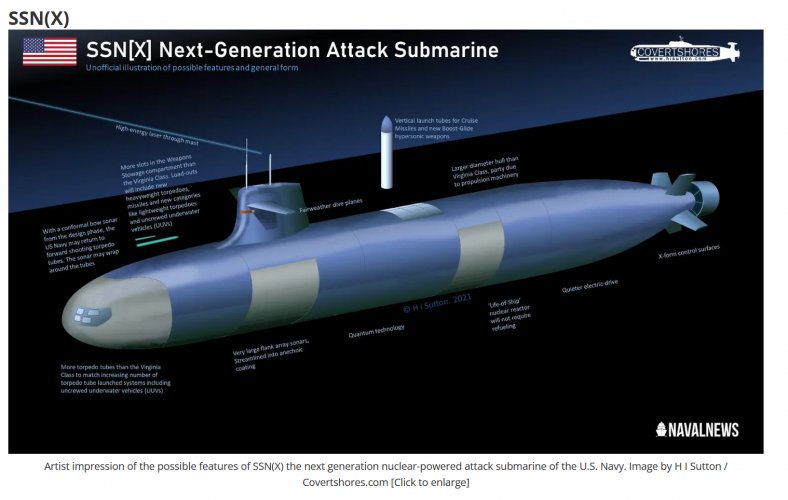
I haven't kept super close tabs on this program but I saw the illustration below in another article just posted on the Columbia class thread. A lot of these improvements make sense but the return to fairweather dive planes surprises me as I was under the impression that the bow mounted, retractable planes are superior for arctic operations. I seriously doubt that arctic operations will become a lesser priority for this boat. Perhaps I am wrong.

1778769099423.png
 
Mister Sutton should know better, maybe Ducking Autocorrupt got him. "Fairwater" not "fairweather"

I'm also trying to figure out how (and why) you'd shoot a laser out a mast.


I haven't kept super close tabs on this program but I saw the illustration below in another article just posted on the Columbia class thread. A lot of these improvements make sense but the return to fairweather dive planes surprises me as I was under the impression that the bow mounted, retractable planes are superior for arctic operations. I seriously doubt that arctic operations will become a lesser priority for this boat. Perhaps I am wrong.
Maybe it's a return to the 637-class fairwaters, where they can go dead vertical for punching through ice?

Though that does (re)introduce the possibility of a failure where the fairwaters go into under-ice and the sub cannot stay submerged. Happened to my Senior Chief on IIRC his first boat.
 
Even going vertical, fair water planes are way too vulnerable to damage coming up through the ice. If they were to do it they'd probably just re-use the boomers' sail and planes. It would mean giving up on surface ice ops and impose limitations on operating under the ice as well, but it's possible.
 
I haven't kept super close tabs on this program but I saw the illustration below in another article just posted on the Columbia class thread. A lot of these improvements make sense but the return to fairweather dive planes surprises me as I was under the impression that the bow mounted, retractable planes are superior for arctic operations. I seriously doubt that arctic operations will become a lesser priority for this boat. Perhaps I am wrong.
I'm thinking we may see a day where under the ice is the ONLY safe place for SSBNs. Moving the planes back to the sail seems short-sighted. Did they state why they changed their mind?
 

Similar threads

Back
Top Bottom