R&E Log # 64-248

DAMAGE LIMITING: A rationale for the allocation of resources by the US and USSR

Prepared for the Director of Defense Research & Engineering

21 Jan 1964

-----------

Attack

(1) [DELETED] payload against defended targets (Equivalent of 5 MT + 10 objects) (SS-8 or SS-X-1)

(2) [DELETED] payload against undefended targets (Equivalent of 5 MT) (SS-7)

Above missile threats from DDR&E "ICBM Threat Analysis -- Re-Entry Systems" - 18 SEP 1963)

(3) Attacker given full knowledge of defenses and has option, for maximum kill, to attack defenses or avoid them.

(4) No collateral damage from military attacks is included here on Figure 3) -- design for defenses uses values of intact targets.

BMD Defense

(1) NIKE-X System. SSPK = 0.8 for a single interceptor against an object. (Re-programming of interceptors for early aborts is not considered)

Central radar and associated installation costs $400 million.

Interceptors cost $1.25 million each including warhead and associated equipment.

(All 5-year system costs).

(2) Each defense unit provides an "Effective Exclusion Radius" of 10 n.mi. Defense units are deployed at each aim point (determined in the undefended case). Possible economies in radars covering adjacent exclusion areas are not treated here.

(3) Firing doctrine for interceptors: Prim-Read strategy.

(4) Ratio of interceptors/radar is optimum for each size of attack and for each size of BMD program.

(5) Final design -- used following Figure 3 -- is for 400 missile attack. That design involves a ratio of interceptors/radars which tends to minimize effects of design not being optimum for other sizes of attack.


....

(1) The dashed lines show the effect of deploying interceptors for a given number of radars. The number of interceptors can be found by taking the cost increment for interceptors and dividing by $1.25 million (cost per interceptor). e.g.: for 400 missile attack, 30 targets defended, the "interceptor curve" is tangent to the envelope at a total cost of $16.9. billion - $12.0 billion of this is on radars (30 targets defended). This leaves $4.9 billion on interceptors. This buys about 3900 interceptors.

...

(3) Mixture of radars and interceptors is a function of size of attack. Optimm mixture for larger attacks requires more interceptors per radar. Thus at a given total cost, optimum design is to defend fewer target areas, but with more interceptors, as attack size increases."
 
Congress eventually started releasing classified minutes from the 1960s back in 2007-2010 -- I only just found this, this is how bad modern search engines are:


1967 NIKE-X cost estimates given to the Senate Subcomittee in secret were:

MAR @ $350M
TACMAR @ $270M
PAR @ $133M
MSR @ $146M

SPARTAN @ $1.41M/ea
SPRINT @ $0.636M/ea

$600~K isn't that bad of a cost to defeat an incoming ICBM RV.

EDIT: I would like to remind people that the PAR/MSR of 1965-67 aren't the later PAR/MSR of 1972+ that were actually deployed; the PAR and MSR "picked up" a lot of capabilities as time went on and computers/radars got cheaper.
 
$600~K isn't that bad of a cost to defeat an incoming ICBM RV.

EDIT: I would like to remind people that the PAR/MSR of 1965-67 aren't the later PAR/MSR of 1972+ that were actually deployed; the PAR and MSR "picked up" a lot of capabilities as time went on and computers/radars got cheaper.
Especially considering it comes with a nuke.
 
The cost of the nuke(s) in SPARTAN and SPRINT may be separate from missile airframe cost as the table has a line "total AEC Investment cost" which is:

$1B for 1200 SPARTAN + 1100 SPRINT
$2B for 1200 SPARTAN + 7300 SPRINT.

This according to Grok, gives us a rough cost of

$685,000~ for 5 MT
$161,000~ for 2 KT

(figures rounded off to nearest thousand)
 
Well now this is interesting.

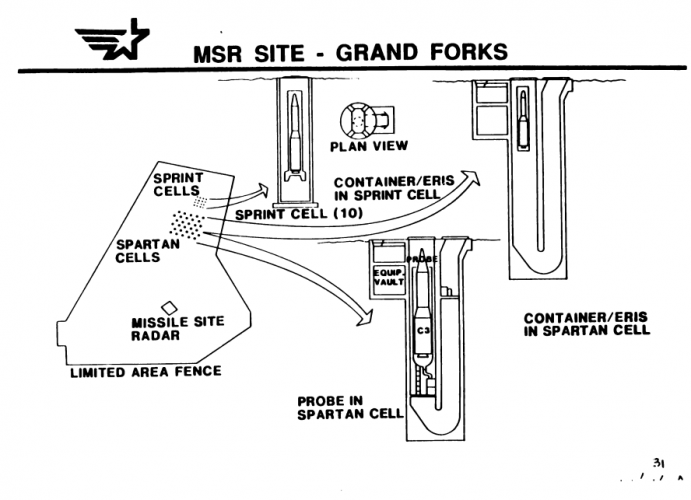
MSR SITE-GRAND FORKS

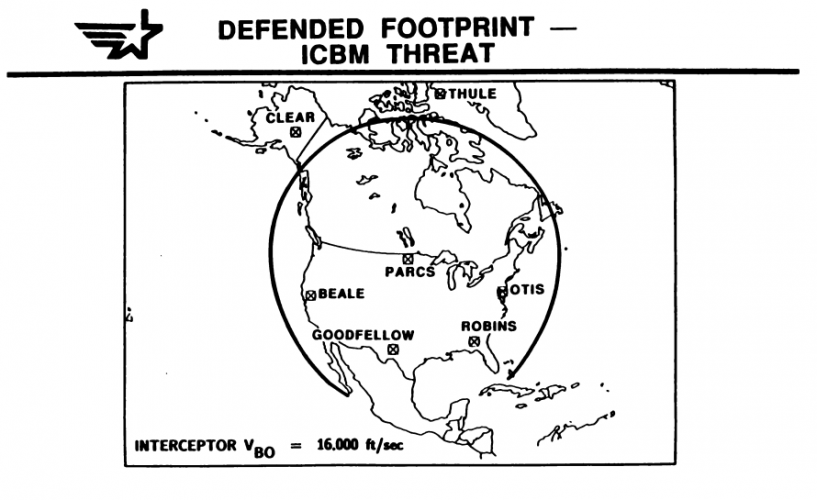
EXISTING FACILITIES AT GRAND FORKS NORTH DAKOTA ARE MORE THAN ADEQUATE TO HOUSE AN ERIS/ALPS DEFENSE SYSTEM. THIRTY SPARTAN CELLS AND SEVENTY SPRINT CELLS REMAIN FROM THE SAFEGUARD SYSTEM. HERE WE HAVE SHOWN AN ERIS/ALPS 25000 FEET/SEC BOOSTER (LARGER THAN THE 16000 FEET/SEC VERSION) IN BOTH A SPARTAN AND A SPRINT CELL. FOUR INTERCEPTORS COULD BE PLACED IN A SPARTAN CELL, BUT MORE THAN ONE INTERCEPTOR PER LAUNCHER (CELL) IS PROBABLY A VIOLATION OF THE ABM TREATY.

THE LWIR PROBE, SHOWN HERE ON A REFURBISHED C3 POSEIDON BOOSTER, COULD ALSO EASILY BE HOUSED IN A SPARTAN CELL.

NEITHER THE MISSILES OR THE LWIR PROBE NEED BE HOUSED IN SPARTAN OR SPRINT CELLS. THEY COULD BE PLACED ON A LAUNCH PAD UNDER A "BUTLER" BUILDING, HOWEVER, USING EXISTING CELLS IS MORE ECONOMICAL.
 

Attachments

  • SDI_GrandForks.png
    SDI_GrandForks.png
    53.3 KB · Views: 184
  • GBI_GrandForks.png
    GBI_GrandForks.png
    88.4 KB · Views: 88
Last edited:
The original MAR-I at White Sands Missile Range (WMSR) was built by Sylvania.

The successor MAR-II to be built at Kwajalein was by Raytheon. Specifications of the MAR-II are insane (even in 2026) -- 100 MW peak and 3 MW average power. Because of the limits of tech at the time, MAR-II continued the use of separate transmit and receive arrays.

MAR-II could form multiple radar beams simultaneously and do elaborate signal processing functions.

So you can see why production MARs would have cost $400M or so in the late 1960s.

In order to support MAR-II testing at Kwaj, the Army actually built a specific dedicated floating power ship:


On April 24, 1968, the Sentinel Systems Command issued General Order Number 1. The order states in part that the Multifunction Array Radar, or MAR, II Floating Power Plant is hereby designated as Power Ship Andrew J. Weber in honor of Master Sgt. Andrew J. Weber.

Posthumously awarded the Legion of Merit, Weber had served with the Nike-Zeus and Nike-X program from December 1961 until his death on April 29, 1965 as a military equipment technician (radar) and a test observer.

During this period Weber "distinguished himself by exceptionally meritorious service" as the test noncommissioned officer in the engineering/service test effort at White Sands Missile Range, New Mexico and Kwajalein Missile Range.

The citation notes that Weber "achieved outstanding effectiveness" with a "technical skill, professional competence, and willingness to assume responsibilities far greater than those normally expected."

While in White Sands, Weber helped to implement the audio visual information system test -- "a new and revolutionary approach to the maintenance of radar equipment." Weber was commended for "his sound judgment, discernment and diplomacy" as well as "his perseverance, foresight, and professional knowledge" which insured the success of the highly technical project.

In February and March of 1965, range operations on Kwajalein required a black out across the island. Weber and Sgt. 1st Class Nick Charnego were victims of an automobile accident on Feb. 28, 1965. Walking back to their quarters after a party, Weber and Charnego were struck by a station wagon driven by a co-worker.

While Charnego was treated at the Kwajalein hospital, Weber, suffered more serious injuries and was evacuated to Tripler Hospital in Honolulu the next day. With continued improvement, on March 23, Weber transferred to William Beaumont Hospital at Fort Bliss, Texas. On April 29, however, Weber passed away at the age of 38. He was survived by his mother Elsie, wife Aria, and children Cynthia and Paul.

In January 1968, as the general order was issued, the newly named Power Ship Andrew Weber was still under construction. As part of the Nike-X complex on Kwajalein Missile Range, the ship was developed by General Electric company under a $9 million contract the Honolulu Engineering District of the Corps of Engineers.

Built upon a surplus World War II U.S. Navy dry dock, the MAR II Power Plant measured 240 feet long and 101 feet wide. Equipped with three 1,650-kw diesel generators and two 8,400 kw gas turbine sets, the floating power plant was designed to provide 20,000 kw of power, enough electricity for a community of 25,000 people, to support the Multifunction Array Radar II, a tactical version of the MAR, under construction on Kwajalein's Roi-Namur.

It was the first American floating power plant designed with both diesel and gas-turbine power units. With three modes of operation -- standby, surveillance and maximum traffic - the frequency and voltage could be controlled either from the barge itself ore remotely from Kwajalein Island.

In June 1968, however, while transiting the Panama Canal en route from Maryland to Kwajalein Missile Range, the Secretary of the Army Stanley Resor redeployed the Power Ship Andrew Weber, assigning it to the Panama Canal Zone. The Panama Canal Zone, which operated under the jurisdiction of the secretary of the Army on behalf of the president, received its electrical power from the hydroelectric plant on Gatun Lake.

In 1968, political unrest in the country coupled with a severe drought threatened the power supply. While in Panama, the USS Weber would supplement the USS Sturgis, the first floating nuclear power station. According to Corps of Engineer's records the combined operations of the Sturgis and the Andrew Weber, saved more than one trillion gallons between October 1968 and October 1972.

This volume of water would allow fifteen additional ships to pass through the Panama Canal each day supporting the increased traffic at the height of the Vietnam War.

During this period, the Andrew Weber remained under the jurisdiction of the Honolulu Engineering District giving it the largest geographical range of operations of all districts in the Corps. In spring 1970, however, management of the ship and the power plant transferred to the Office of the Corps of Engineers.

We next find the Andrew Weber in the records, in Fort Lauderdale in 1976. From 8 Nov. 8 to Dec. 15, 1976, an LT 529 ocean going tug from the Army's 73rd Transportation Company towed the Andrew Weber from Florida to Fort Belvoir, Virginia; where it probably joined the USS Sturgis in the James River Reserve Fleet outside Fort Eustis, Virginia.

On April 16, 2015, the USS Sturgis left the reserve fleet for Galveston, Texas to be decommissioned.

The USS Weber, on Oct. 1, 1977, along with other Army operated barges and ships, transferred to the U.S. Navy. In the next decade or so, the Andrew Weber made it to the Pacific Ocean with a transfer to Guam. There it would provide power to military bases and support the Guam Power Authority.

Following Typhoon Omar in 1992, the government of Guam authorized the refurbishment of the Andrew Weber to provide 16 megawatts of electricity to address the emergency requirements. As costs rose, however, the project was terminated in 1994.

The Andrew J. Weber was one of 16 vessels scuttled as part of a military target practice program in 2001. The 6,000 ton Andrew Weber was sunk July 19, 2001. It currently lies at a depth of 12,600 feet, about 250 nautical miles south east of Agana, Guam.

Raytheon began work on a common-aperture version of MAR-II through the CAMAR program (Common Aperture Multi-function Array Radar); which in turn later led to COBRA DANE, FPS-115 PAVE PAWS, FPS-120 SSPAR, FPS-126 SSPAR, etc.

CAMAR itself was picked up by another program, called GUARDIAN; to develop discrimination techniques.

CAMAR construction began on Kwajalein; but the GUARDIAN/CAMAR program for discrimination was cancelled in 1969; leaving the empty shell of the DCCB (Defense Central Control Building), which would have housed the Data Processing and Control Computer (DPCC) for the system.

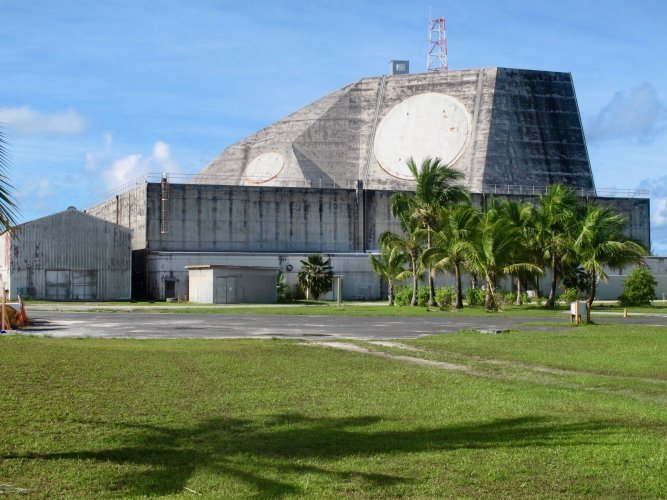
In 1988, they went to the roof of the DCCB (Defense Central Control Building) and tested it as part of plans to mount the SDIO GBR-X prototype on the roof of the DCCB -- you can see the DCCB here:

8.725769985129936, 167.71541612237127

Image attached of DCCB.
 

Attachments

  • DCCB_Summer_2018.jpg
    DCCB_Summer_2018.jpg
    1.1 MB · Views: 52
Last edited:
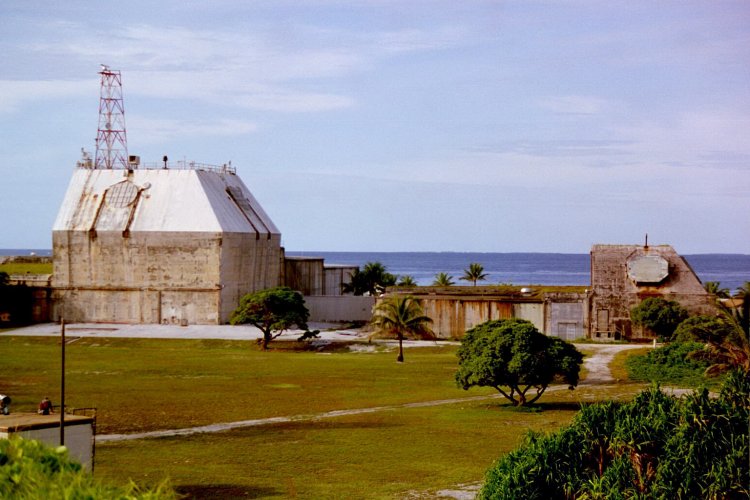
This image shows the Missile Site Radar (MSR) built on Meck in the late 1960s and early 1970s. The building on left is the original testbed MSR system. Normally it would be buried so only the angled portion on top was out of the ground, but as Meck is only a few feet over sea level, it was decided to build the entire building above ground. A production MSR would have four angled faces to produce a truncated pyramid, but only two faces were built for this installation. The data processing equipment (computers) were placed in the smaller building extending out the back of the radar to the south, just visible as the dark building projecting to the right. Behind it is another building that controlled launch operations.

The original MSR used a "space array" system for its radar. The circular disks on the angled faces contained a number of phase shifter devices with antennas on either end. Inside the building was a single transmitter and receiver which was aimed at the back of the disk. The transmitted signal was picked up by the antenna on the back of the phase shifter, shifted, and then rebroadcast from the front. This allowed a single microwave source to feed all of the elements in the phased array system. It also meant that there had to be considerable room behind the radar face, which is why the building is so much larger than the disk of antennas. Production MSRs reduced this ratio somewhat, and looked more pyramidal, less truncated. The rusted metal rails on either side of the radar face were used to hold a window-washer like servicing platform, and could be extended to the ground with additional rails that plugged into sockets that can be made out on the concrete pad surrounding the building. In this image the antennas have been removed and the openings sealed off with covers, and the lower section of the servicing rails have been removed.

Safeguard development on Meck was curtailed with the signing of the ABM Treaty in 1972. Testing continued for a time until a single operational Safeguard base was built in the US and became operational in 1975. This was quickly removed from service in 1976 after less than a year of operation.

This did not end Army research into ABM systems, however, and through the mid-1970s they began development of the improved Site Defense Radar as part of a more flexible set of technologies that could be rapidly deployed in case the Soviets "broke out" of the Treaty. The building on the right was built as the prototype of this system. This version is much smaller, although the radar disks are about the same size, which suggests it does not use the space array concept. 1960s photography of the site shows the shoreline approximately at the door into this radar's building, the land it sits on was backfilled in 1977.

The image is taken looking towards the south end of Meck. Kwajalein Island can just be made out on the horizon between the two radar buildings. What appears to be a walkway running diagonally across the image is a buried cable conduit to the missile launch sites. The photographer appears to be standing on the southernmost section of the launch site, which is built up and thus explains the slight down-angle shot. This image was taken while the island was reactivated for the Homing Overlay Experiment of the late 1980s. The roof of the MSR now hosts a small shipborne radar on the red mast, as well as a camera pointed at the launch site. Grass is growing on the roof of the former equipment building.
 

Attachments

  • Meck_Island_MSR_decaying.jpg
    Meck_Island_MSR_decaying.jpg
    342.3 KB · Views: 56
I have a big article in the works about satellite intelligence collection about Soviet ABM capabilities. It was becoming very clear to US intelligence by 1968/69 that the Soviet ABM system was not a threat to the US deterrent. The US military approach to the ABM defenses around Moscow was to just throw a lot of warheads at it. The Soviets were going to run out of ABM missiles before the US ran out of RVs.

With no national Soviet ABM system, that meant that Moscow was the only concern, and the intel made it clear that Moscow was not that well-defended. With the Soviet ABM threat understood and not considered important, that really undercut the need for a US system.
 
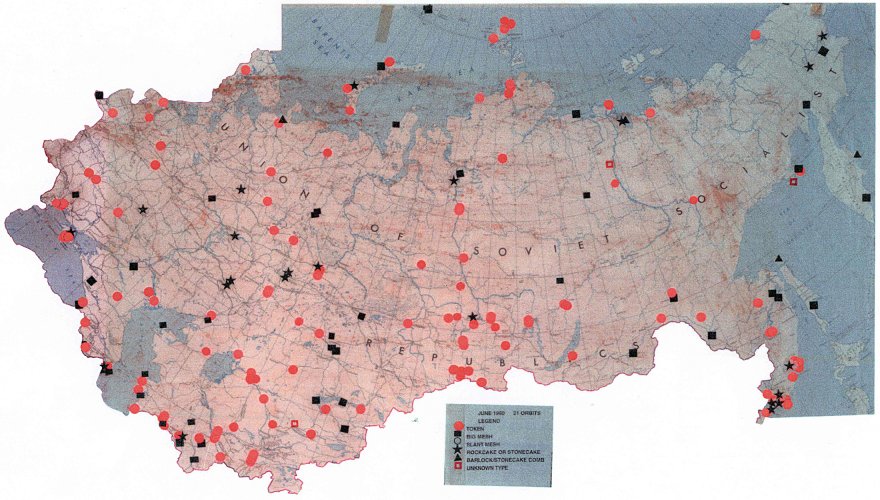
I know of US ELINT satellite coverage of the Soviet Air Defense system.

In the early 1960s, we were able to pinpoint almost every major long range radar, even in Central Russia through ELINT satellites (see attached). That means they're getting a visit by ICBMs within one hour of WW3 executing.

It was becoming very clear to US intelligence by 1968/69 that the Soviet ABM system was not a threat to the US deterrent. The US military approach to the ABM defenses around Moscow was to just throw a lot of warheads at it. The Soviets were going to run out of ABM missiles before the US ran out of RVs.

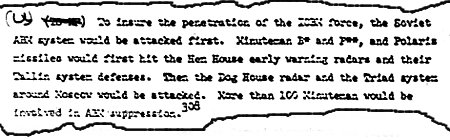
Stop and think about this. We know what war planners were thinking re: the early ABM system:

“To ensure the penetration of the ICBM force, the Soviet ABM system would be attacked first. Minuteman E and F and Polaris missiles would first hit the Hen House early warning radars, and their Tallin system defenses. Then the Dog House radar and the Triad system around Moscow would be attacked. More than 100 Minuteman would be involved in the ABM suppression.”

Source: U.S. Strategic Air Command, History of U.S. Strategic Air Command January-June 1968, February 1969, p. 300.

If you have to expend a tenth of the early Minuteman force to destroy a "simple" ABM system, then the Soviet ABM system has done it's job by absorbing all those warheads which could have fallen onto other targets in Russia.

This was the main problem I found when examining the logic of "Damage Limiting" studies and their advocates; because they kept pointing out that in the presence of ABM, the enemy could simply ignore defended targets and attack undefended targets.

What if the enemy decides to stack defenses around targets that MUST be hit? You can't just ignore Moscow.

It's also important to keep in mind that GALOSH is fundamentally a different missile than Nike-ZEUS; because the Soviets were not limited by interservice rivalries and disputes which limited the range of ZEUS -- right from the start, they had a very long range area defense missile in GALOSH which was continually improved with new features as time went on, including loiter mode for the upper stage for later marks of GALOSH (something planned for the cancelled IMPROVED SPARTAN).

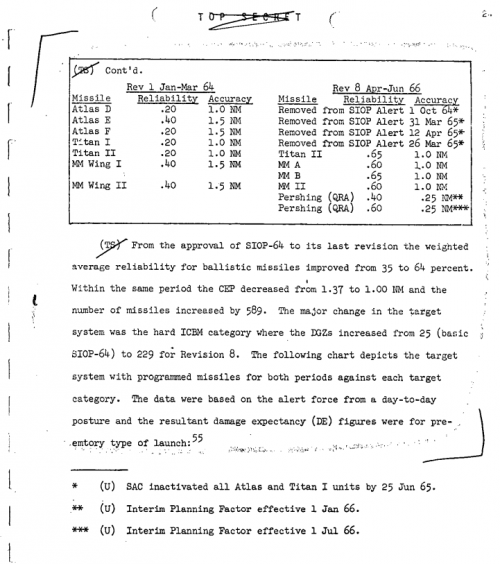
EDIT: Also consider the actual reliability ratings of US ICBMs with no ABM.
 

Attachments

  • sigint-targets-ussr.jpg
    sigint-targets-ussr.jpg
    1.4 MB · Views: 55
  • abmtxt.jpg
    abmtxt.jpg
    45 KB · Views: 44
  • SIOP_Reliability.png
    SIOP_Reliability.png
    154.4 KB · Views: 73
I know of US ELINT satellite coverage of the Soviet Air Defense system.

In the early 1960s, we were able to pinpoint almost every major long range radar, even in Central Russia through ELINT satellites (see attached). That means they're getting a visit by ICBMs within one hour of WW3 executing.


Stop and think about this. We know what war planners were thinking re: the early ABM system:

“To ensure the penetration of the ICBM force, the Soviet ABM system would be attacked first. Minuteman E and F and Polaris missiles would first hit the Hen House early warning radars, and their Tallin system defenses. Then the Dog House radar and the Triad system around Moscow would be attacked. More than 100 Minuteman would be involved in the ABM suppression.”

Source: U.S. Strategic Air Command, History of U.S. Strategic Air Command January-June 1968, February 1969, p. 300.

If you have to expend a tenth of the early Minuteman force to destroy a "simple" ABM system, then the Soviet ABM system has done it's job by absorbing all those warheads which could have fallen onto other targets in Russia.

This was the main problem I found when examining the logic of "Damage Limiting" studies and their advocates; because they kept pointing out that in the presence of ABM, the enemy could simply ignore defended targets and attack undefended targets.

What if the enemy decides to stack defenses around targets that MUST be hit? You can't just ignore Moscow.

Tallinn turned out not to be an ABM system. It did not need to be attacked. And MIRVs changed the picture.

The ABM threat evaporated by 1970.
 
Raytheon began work on a common-aperture version of MAR-II through the CAMAR program (Common Aperture Multi-function Array Radar); which in turn later led to COBRA DANE, FPS-115 PAVE PAWS, FPS-120 SSPAR, FPS-126 SSPAR, etc.

CAMAR itself was picked up by another program, called GUARDIAN; to develop discrimination techniques.

CAMAR construction began on Kwajalein; but the GUARDIAN/CAMAR program for discrimination was cancelled in 1969; leaving the empty shell of the DCCB (Defense Central Control Building), which would have housed the Data Processing and Control Computer (DPCC) for the system.

According to the Bell Labs ABM history and testimony given to the House Appropriations Subcommittee for Defense, CAMAR evolved out of TACMAR rather than MAR-II. In 1969 CAMAR was described as not having the power or the range to perform the role of the PAR. However, it could perform the MSR role and would offer a better capability for 'discriminating heavy decoys from large warheads' (which I take to mean discriminating RVs from large decoy clouds) though it was also more expensive than the MSR.

An interesting set that was never built is the Advanced Field Array Radar (AFAR), it was supposed to be developed from a demonstrator called Camel and would have been a solid-state phased array. There is a good summary of the associated Digital Convolver System used for signal processing in the article here. This 1974 GAO letter states that AFAR was to be operational at Kwajalein in 1977. Its kind of contemporaneous with Sprint II ISMS and shows how the basic Nike-X ABM architecture could have evolved.
 
Last edited:
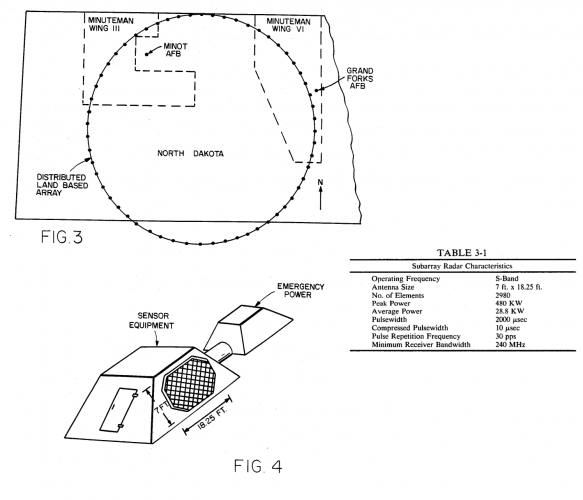
This is what happens when you let the Air Force go crazy with the idea of "distributed dispersed hardsite radars" to get cost as low as possible; these were hardened only to 2 PSI.
 

Attachments

  • US4683474_Specs.png
    US4683474_Specs.png
    94.2 KB · Views: 72
  • US4683474.pdf
    1.8 MB · Views: 23
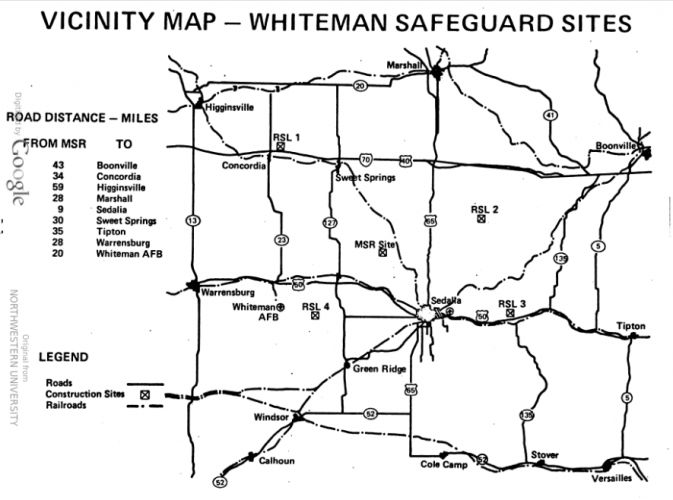
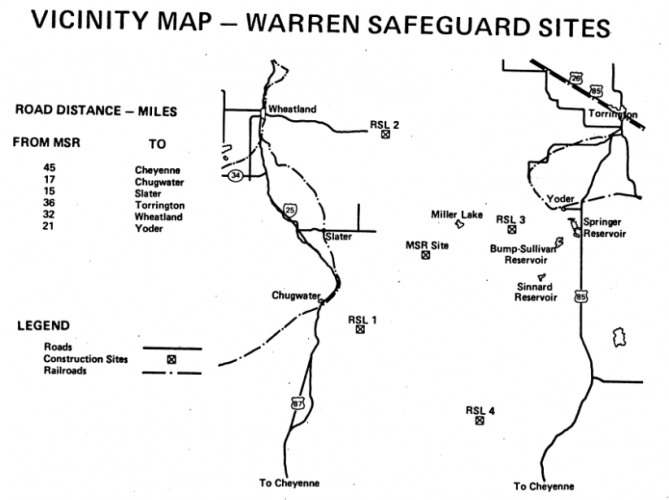
Rough location of the Minuteman SAFEGUARD sites planned (but cancelled) from a environmental impact review:


EDIT: The MSR would consume about 900+ gallons of diesel fuel an hour during attack conditions; while in "surveillance" mode, the entire complex would consume about 1000 gallons/day.
 

Attachments

  • Safeguard_Whiteman.png
    Safeguard_Whiteman.png
    99.2 KB · Views: 44
  • Safeguard_Warren_2.png
    Safeguard_Warren_2.png
    59 KB · Views: 60
EDIT: The MSR would consume about 900+ gallons of diesel fuel an hour during attack conditions; while in "surveillance" mode, the entire complex would consume about 1000 gallons/day.
One is struck that under attack conditions, an MSR would probably not be running for very many hours, and afterwards the amount of diesel fuel consumed would be quite a long way down on the list of environmental impacts.
 
My dear Yellow Palace,

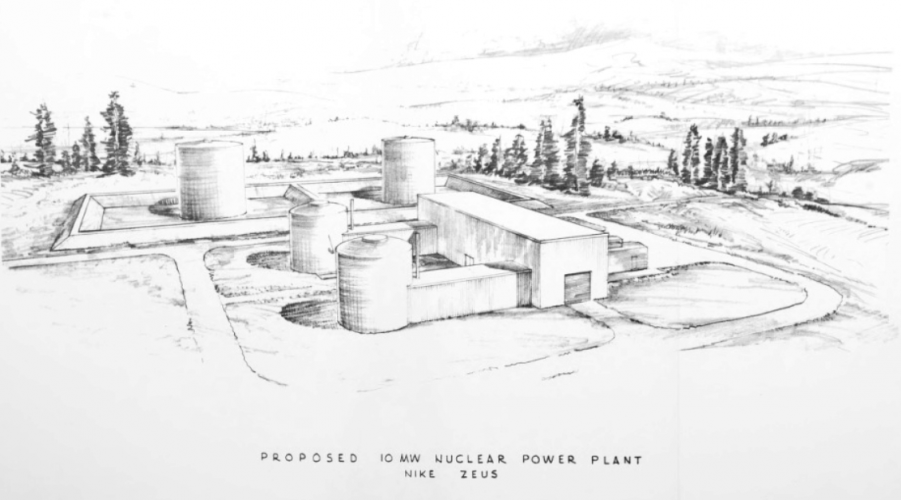
There were serious studies done during NIKE-X into nuclear power plants for ABM; because of the possibility of a lengthy, protracted nuclear war; as well as the issues involving making the large cooling intakes / exhaust valves blast-proof.

==========

Study of remote military power applications. Report no. 8, Nike-Zeus FAR Site.

==========

(you want NYO no. 2937)

========

history of the NIKE-X power plant program

===========

UTILIZATION OF NUCLEAR POWER PLANTS IN UNDERGROUND INSTALLATIONS

b. National Academy of Sciences (NAS) Zeus Multi-Function Array Radar (ZMAR) Study (reference 15). When this study was published there were two ZMAR utilization concepts, Urban and Hardsite Defense Systems. Both of these systems required hardened power plants; the Urban Defense system requiring a larger plant than the Hardsite Defense System.

The NAS conclusion as to the power source set forth in reference 15 are as follows:

(1) For Urban and Hardsite installations, where adequate water is available for normal heat-rejection system, the nuclear-steam plant is preferred because it has no requirement for combustion air or exhaust.

(2) For Urban installations, where water supplies are so limited that evaporative cooling is necessary for heat rejection, the conventional-steam plant is preferred if underground cooling towers are used. The nuclear-steam plant becomes second choice because it requires about one-fifth of the energy for blowing air through the underground cooling tower, twice as much as is required for the conventional plant. If hardened spray ponds are feasible at these sites, the nuclear plant would be preferred because it has no requirement for combustion air.

(3) For Hardsite installations, where water supplies are so limited that evaporative cooling is necessary for heat rejection, the diesel engine is preferred. However, if hardened spray ponds are feasible, the nuclear steam plant may be a better solution.

(4) For Hardsite installations, where air cooling is required, the diesel engine plant is preferred.

(5) There does not appear to be any Urban installation where air cooling will be required.
 

Attachments

  • NikeZeusReactor.png
    NikeZeusReactor.png
    216.2 KB · Views: 82
The cost of the nuke(s) in SPARTAN and SPRINT may be separate from missile airframe cost as the table has a line "total AEC Investment cost" which is:

$1B for 1200 SPARTAN + 1100 SPRINT
$2B for 1200 SPARTAN + 7300 SPRINT.

This according to Grok, gives us a rough cost of

$685,000~ for 5 MT
$161,000~ for 2 KT

(figures rounded off to nearest thousand)
1200 Spartan & 7300 Sprint? Damn.
 
One is struck that under attack conditions, an MSR would probably not be running for very many hours, and afterwards the amount of diesel fuel consumed would be quite a long way down on the list of environmental impacts.
Assuming it gets hit. Not a given.
 
1200 Spartan & 7300 Sprint? Damn.

The HI MAR Phase III proposal listed by McNamara (which I showed last page as an image) was a pure SPRINT configuration with 20,000 SPRINTs protecting 30 cities; or about roughly 666~ SPRINTs per city for a total cost of $25.3B over 10 years from 1966 to 1976, with $4.8B for the Warheads alone, or about $240K per SPRINT warhead.
 
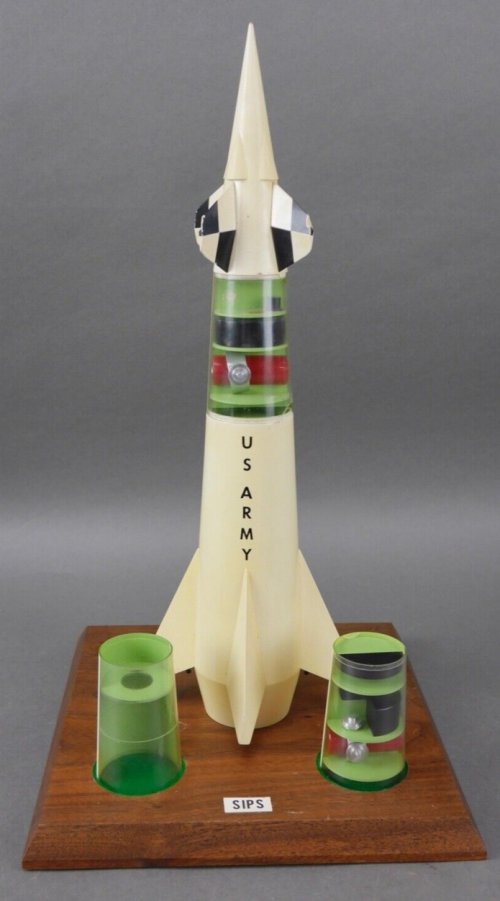
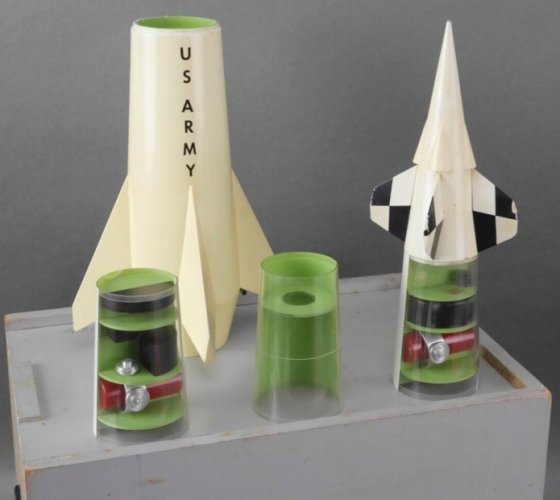
I think I figured out what this SIPS proposal that OBB found on ebay back in 2012 means.

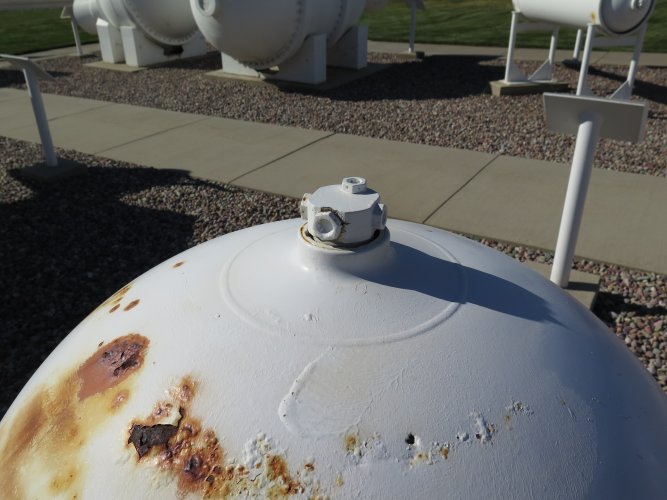
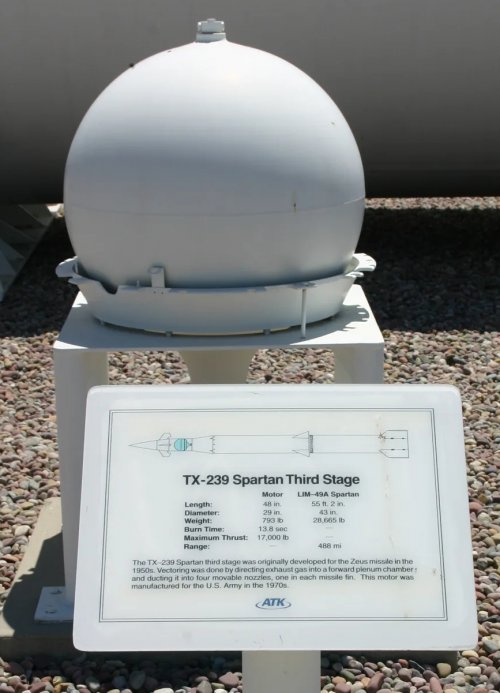
As you can see, "Basic/Old" Spartan has the warhead where you would expect the third stage motor to be. Instead, the third stage has a weird propellant generator mounted in the nose that can generate about 17,000~ lbf of thrust for 13.8 seconds; with the pressure being bled off into those four moveable jetvators through the nut you see in the top of the motor.

I think with Improved Spartan, they were going to totally redesign the missile third stage -- it would have been slightly longer than Basic Spartan's third stage -- the launch cells at Mickelson would have been long enough to accommodate the longer missile with only minor internal changes required; but the SPARTAN launcher(s) on Meck Island at Kwajalein had been built early enough in the program to require modification to extend them to support the new Improved Spartan.

Now; as to the SIPS model; this is what I think it means:

The solid top portion is the "Manuvering Section" using a slightly improved nosecone + jetvator system from Old Spartan.

The clear middle portion is the "Component Section" -- the three different models for that section are meant to show:

1. Total Volume Available (the clear empty one)
2.) One configuration of assembling guidance/control/fuzing [Black Boxes] with the Warhead [RED].
3.) Another configuration of guidance/control/fuzing [Black Boxes] with the Warhead [RED].

The bottom portion is the "High Performance Third Stage (HPTS) Section". I believe that the HPTS would also have bled off some of it's output to run it's own jetvators (the big fins) to enable maneuvering exoatmospherically during powered third stage flight.

It's also possible that once the High Performance Third Stage was done thrusting, it would be jettisoned, so as to maximize delta-V and maneuvering capability of the nosecone jetvator for terminal engagement.

EDIT: I just realized I can use the nosecone/jetvator to figure out how much bigger/longer Improved Spartan was going to be as a rough guess; but no time now...

EDIT II: I wonder how much of that "Warhead" is simply notational as the shape/size of warheads is/was a very closely held secret. It could be that the clear module is the space available for the 1 MT warhead + guidance/control on the baseline Improved Spartan, while the other two modules are notational ADVANCED SPARTAN (Notational made up name by me) proposals to incorporate much smaller warheads as potential options.
 

Attachments

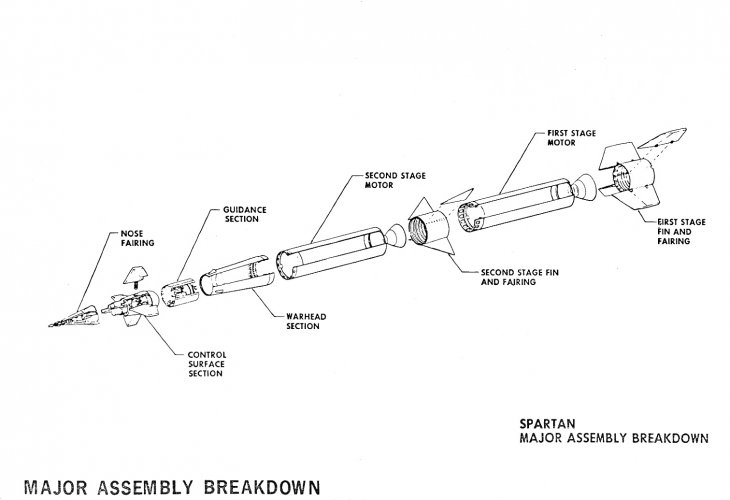
  • SpartanDiagram.jpg
    SpartanDiagram.jpg
    133 KB · Views: 72
  • SpartanMotorCloseup.jpg
    SpartanMotorCloseup.jpg
    2.7 MB · Views: 55
  • SpartanWarhead2.jpg
    SpartanWarhead2.jpg
    357.3 KB · Views: 54
  • SIPS-07.jpg
    SIPS-07.jpg
    160.5 KB · Views: 59
  • SIPS-09.jpg
    SIPS-09.jpg
    82.1 KB · Views: 68
Last edited:
From something I'm OCRing now, it's testimony circa 1969 or so:

Mr. Long. If the missile site radar is the heart and eyes of the system and is so vulnerable to attack, why is there only one missile site radar per site ?

General Starbird. It was planned as one per site, sir, because that was the number that it was felt were necessary to insure the survival of the number of our own missiles that we were told to try to cover.

Specifically, as I think you may remember, we were told to insure the survival of [DELETED] against a specific attack. One could put in
more radar, but the radar is the expensive part of the system. One was believed adequate for the purpose, according to our calculations.

COST OF MISSILE SITE RADARS

Mr. Long. The missile site radars cost approximately $140 million each. Is that an accurate figure ?

General Starbird. I would like to correct that, but it is in that neighborhood. It is higher than that.

(The information follows:)

Estimates of average MSR on-site investment costs associated with the full Phase 2 deployment are $170 million. These radar costs include the hardware costs of the radar, its data processor and associated equipment, installation costs and the construction of the radar building and support facilities. The unit costs do not include a pro-ration of overhead costs such as management and the cost of production facilities. Neither do they include costs related to the deployment such as training, and the costs for software development.

Mr. Long. It is designed to protect cities, as I understand. To protect Minuteman, would it not be better to design a cheaper, less sophisticated radar, and to deploy more of them ?

General Starbird. Of course, we have always had as a part of our mission since the decision was made to deploy, the protection of Minuteman as an option, and the radar was designed with that in mind, as well as protecting cities and protecting areas.

Mr. Long. Right, but since you had a dual purpose, and that dual purpose presumably no longer is there, why not then design something for the single purpose of protecting the Minuteman.

General Starbird. We have examined over the years—not me, but those who went before me, and I since I have been there—various suggestions that have been made. The suggestions generally come down to why don’t you design a radar so you can have one per silo or one or two per silo, and you have a few missiles for each silo, and that protects that silo or one or two silos.

Invariably, when we have looked at this, the costs have been significantly higher. The problems of control and accuracy, considering the short time scale you get into if you use very short-range and cheap missiles and cheap radar, are such that they look almost impossible to handle.

Basically, to give you the answer, this appears to be the cheapest way of doing the mission, as well as the effective way.
 
Tallinn turned out not to be an ABM system. It did not need to be attacked.

"THINKING ABOUT AMERICA’S DEFENSE: An Analytical Memoir" by General Glenn A. Kent actually deals with Tallinn briefly on Pages 32-37:

Now, back to the OSD critique [of the Joint Strategic Targeting Planning Staff / SIOP].

The analysts identified, as I recall, ten issues that they regarded as evidence of the JSTPS’s incompetence.

One of these (item 4) caught my eye: “The weight of effort allocated to attack the Tallinn complex is ridiculous.”

They actually used these words verbatim. This intemperate language stood out and made this item a likely candidate for rebuttal.

If I could show that the planners in Omaha were about right in this allocation, we would have a leg up in tarnishing the report by the three OSD analysts.

The Defense Intelligence Agency (DIA) had for some time—up to five years—been reporting on worrisome activities by the Soviets near Tallinn, the capitol of Estonia. Their estimate was that the Soviets were installing an antiballistic missile (ABM) complex to shoot down U.S. missile reentry vehicles (RVs) as they made their way to targets in the Soviet Union. Activities had been observed at some 40 separate sites around Tallinn. DIA was not certain how many interceptors had been deployed (or were to be deployed) at each site and was not all certain of the effectiveness of each interceptor, but it did give a range: between 20- and 80-percent effective--whatever that meant.

The planners in Omaha, in the presence of these tentative assessments by DIA, assumed (1) that 15 interceptors had been (or might be) deployed at each of the 40 suspected sites and (2) that each interceptor had around a 65-percent probability of kill (Pk) given a launch.

In the presence of these assumptions, the planners had allocated five RVs per site, for a total of 200 weapons, to suppress the Soviet ABM system. It was the number 200 that bothered the OSD analysts. It seemed like overkill, especially in view of the uncertainty surrounding the complex. Accordingly, they had labeled the allocation “ridiculous.”

In truth, at first blush it does seem like overkill (allocating five weapons per site)--if the lethality of each weapon is such that one is all that is required to destroy all the interceptors at one site. But DIA had stated that the probability of intercept might be as high as 80 percent (or words to that effect).

The Soviets would use the interceptors at the site in self-defense, and there would be only a 20-percent probability (at worst) of each U.S. RV penetrating, as long as the ABM system is operating.

So, it makes some sense to put a sizable number of weapons onto the Tallinn ABM system to ensure that the complex is destroyed and that the U.S. RVs attacking other DGZs are not intercepted.

The question remains: What is the optimum number of RVs to commit to attack this complex?

I began to consider ways to quantify the value of suppressing this defense.

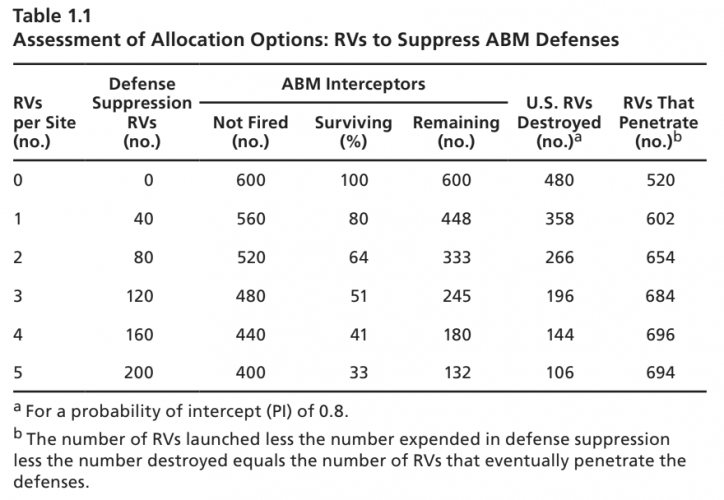
Starting from the simple case of a single RV against a single ABM site, we can calculate (on an expected-value basis) that the RV would cause one interceptor to be launched in self-defense and destroy 2.8 of the remaining Soviet interceptors:

0.2 × (15 – 1) = 2.8. (The 0.2 comes from 1 – 0.8.)

Thus, 11.2 Soviet interceptors would remain.

If two RVs were allocated per site, 8.32 Soviet interceptors would remain:

0.8^2 × (15 – 2) = 8.32.

So there is merit in allocating more than one RV per site.

I saw that we should expand these calculations to determine the “optimum number of RVs per site.” My measure of optimum in this case was obvious: It is the number of RVs used in defense suppression that maximizes the number of RVs that penetrate the defense and proceed to attack other (non–ABM-related) targets on the territory of the Union of Soviet Socialist Republics (USSR).

A discussion with the planners in Omaha revealed that the weight of effort (200 RVs) expended against the Tallinn complex had been discussed—albeit very briefly—with the OSD analysts during their trip to Omaha.

The SAC planners were somewhat amazed that the analysts had chosen the word ridiculous to characterize this allocation (200 RVs total).

The SAC planners pointed out that, if they assumed a probability of intercept of around 65 percent, it took a little more than five weapons per site to attain a damage expectancy (DE) of 0.90 per site.

That is, 0.65^5 = 0.12, and 1 – 0.12 = 0.88 DE.

And that was about the extent of the discussion on that item.

During their visit to SAC, the analysts from OSD did not challenge the number of sites (40) or the possible number of interceptors per site (15), mostly because the subject was not discussed in detail.

Rather, they challenged the requirement for 0.90 DE. They opined that while the 0.90 DE might have been sacred to the planners in Omaha, it had no firm basis in policy or mathematical analysis.

I then undertook a simple analysis. The measure of merit was the
number of RVs to penetrate the defense and reach DGZs in the USSR.

Suppose that 1,000 RVs were involved in an attack. The planner would be willing to divert 200 of these RVs to defense suppression if, by doing so, the number of RVs available to attack other DGZs would increase.

The notional characteristics of the Tallinn ABM complex were as follows:

1. 40 surface-to-air missile (SAM) sites
2. 15 interceptors per site
3. for a total of 600 interceptors.

Table 1.1 reveals that, for the conditions stated, the optimum number of RVs per site in defense suppression is between four and five.

This allocation maximizes the number of U.S. RVs that penetrate the Soviet defense, as shown in the far right column of the table.

So it turns out, fortuitously, that the planning factor of 0.90 DE and a probability of intercept of 0.65, as used by the SIOP planners, gave approximately the right answer, though perhaps not for entirely compelling reasons. But I was not obliged to defend the reason.

The OSD analysts in their report to the Secretary of Defense had not directly challenged the use of a DE of 0.90.
Rather, they had challenged only the number of RVs diverted. So with regard to item 4, OSD was wrong, and the planners in Omaha were right.

I explained all this to General McConnell and, in turn, to Dr. Brown.

Dr. Brown went through my calculations number by number and was satisfied that the logic was sound.

Dr. Brown then convened a meeting with the general, with the three OSD analysts who had written the report and myself in attendance. I started with a dissertation on the strategy to be followed when planning in the face of uncertainty. I noted that planners must make choices about the allocation of forces and that their choices must be predicated on judgments about a wide range of factors whose precise values are unknown.

To be robust, a plan must be executable in the face of adverse circumstances. Hence, the correct strategy is to maximize the outcome for the case in which the factors in question are adverse.

We should, in the vernacular, “maximize the min.” We should plan against the worst case. In this case, that meant planning for the case in which the probability of intercept (PI) for the Soviet ABM system was 80 percent. It would be imprudent to adopt a planning factor that maximized the outcome when the PI was 20 percent.

Notice that I had reduced the problem to whether the PI to use was 20 percent or 80 percent. This spread was derived from the DIA estimates.

I announced then that allocating five RVs per site, a total of 200 RVs against 40 sites, was about right for the factor of 0.80. I added that simple math could be used to demonstrate this.

I had expected that rather than challenge my math, the analysts from OSD would challenge the assumptions about the structure of the complex I had assumed—especially that the number of interceptors per site was 15. If one assumed that fewer than 15 interceptors were present, the optimum number of RVs per site would be less than five.

To my surprise, they chose not to challenge either my math or my assumptions. Instead, they declared that they were “not going to get in a numbers game” with me.

I replied, “You raised the issue of numbers. You stated that an allocation of 200 RVs (five per site and 40 sites) was ‘ridiculous.’ My math demonstrates that five is about right. Where is your analysis that shows that five is so far wrong that it warrants the characterization of ‘ridiculous’?”

At that point, Dr. Brown observed that my confrontational tone was not conducive to a productive discussion, whereupon General McConnell, to my surprise and chagrin, stated that he agreed with the secretary and summarily dismissed me from the room.

As usual, the general was one step ahead. In about 30 minutes, he called me to his office. “I got you out of the room,” he said, “before they could change tactics and try to challenge your analysis. After you left, I made the point that, if they continued to pursue this matter, I would make the point that they, when faced with your analysis, refused to be drawn into a numbers game. I would certainly make this known to the Secretary of Defense—and anyone else who would listen.”

The general went on: “While they did not agree to cease and desist, I think we have heard the last of this matter. They, of all people, should avoid making sweeping statements before they do their homework.”

And so it was.

Their report withered on the vine. They no longer pushed the matter. Their choice of the word ridiculous was ill advised, and I had turned it into a fatal error."
 

Attachments

  • KentTable1-1.png
    KentTable1-1.png
    38.3 KB · Views: 72
Another section of "THINKING ABOUT AMERICA’S DEFENSE: An Analytical Memoir" deals with more modern ABM, and is actually a bit instructive to read, in that you need to "read between the lines" and look at his basic underlying assumptions.

Pages 37 – 42

Calculating the “SIOP Degrade”

In 1991, Maj Gen Robert Linhard was the Director of Plans and Resources at SAC in Omaha. I had retired from the Air Force and was working at the RAND Corporation. There had been some discussion in Washington about deploying an active defense to counter any attack against the United States by a third country (that is, one other than the Soviet Union) with nuclear-armed ballistic missiles. Such a deployment would not be consistent with the ABM treaty of 1972. Rather than withdraw from the treaty, the United States was considering a concept that would allow the Soviets to deploy a similar defense along their southern borders to guard against an attack by their neighbors to the south.

General Linhard wanted to know how such a defense, if allowed, would affect the United States’ ability to execute the SIOP. In the terms he used, he sought to understand the “SIOP degrade.” To this end, he invited a group of analysts to convene in Omaha to address this question. The invitees included analysts from the Los Alamos, Livermore, and Sandia National Laboratories; two analysts from the RAND Corporation (Dean Wilkening and myself); one representative from the U.S. Arms Control and Disarmament Agency (ACDA); someone from the Department of Defense (DoD) Office of Research and Engineering (DDR&E); and others.

The meeting opened promptly at 0830. General Linhard stated his question and problem. The three analysts from the national labs set forth their approach to answering the question. After further questions and discussions, we finally disbanded for lunch. After lunch, General Linhard opened with a statement: “What I learned this morning is that, if I gave each of you a million dollars, after six months of ‘computer crunching,’ you could provide some tentative answers.” They all nodded affirmatively.

At two o’clock it was my turn. I opened by saying, “General Linhard, I am prepared to provide you considerable insight as to the implications of such a Soviet defense, this afternoon and for free. First, the bottom line: The degrade to the SIOP will be minimal (something like 10 percent), provided (1) that you employ decoys based on the latest decoy technology and (2) that you forbid the Soviets to deploy any forward engagement radar in the northern part of their country (a radar to control the engagement of a Soviet interceptor engaging U.S. RVs).”

To scope the problem,

1. Assume that each side is allowed no more than 200 interceptors.

2. Assume that each interceptor has a P_k (for a given engagement) of 0.7, for a total kill potential of 140.

3. Assume that the attack by Blue is 1,000 RVs against 1,000 targets, one RV per target.

4. Assume that 1,000 targets contain people and industrial facilities amounting to 1,000 units of “worth”—the proper choice of a scaling factor can make this true. Note that, for convenience, one unit of worth is an erdel (erdel is a fabricated word and means nothing).

5. Assume that the distribution of worth (erdels) among the 1,000 targets obeys the distribution according to the equation by the renowned economist Vilfredo Pareto, in which

V_cum = [ (n / N)^0.5 ] * w

where V_cum is the cumulative value, n is the stated number of targets, N is the total number of targets in the set, and w is the worth in the total set. The 1/2 is the exponent Pareto derived, which of course indicates the square root. It follows that one-half of the total value is in the first one-fourth of the targets.

Note that I was not breaking new ground with regard to the distribution according to Pareto. Many analysts have used this distribution, including the assignment of one-half as the value of the exponent.

6. Assume that the Soviets are not allowed to deploy an “engagement” radar to the north of the tier of provinces in the south of their empire.

7. Without an engagement radar to the north, they cannot engage in “threat-tube sorting.” That is, they cannot determine the intended target DGZ of each attacking RV and thus employ their 200 interceptors against the 200 RVs that are destined for the 200 most lucrative targets. Note that the defense has great leverage if it has a control system that provides this capability. Without it, the defender has to engage the incoming RVs without regard to the value of the target that each RV is intended to destroy.

8. Also, by not allowing the Soviets to deploy an engagement radar to the north, we assume that they cannot discriminate between decoys and RVs in the attack by Blue.

For the base case (no defense), the defense of course saves no worth (zero erdels), and there is no degrade to the SIOP.

Now take the case of a defense with a kill potential of 140 (200 * 0.7). There are 1,000 RVs versus 1,000 targets, and each target contains (on the average) one erdel of worth. Thus, the defense “saves” 140 * 1.0, or 140 erdels. This amounts to a 14-percent degrade.

For the next case, add 400 decoys to the attack. The decoys are, perhaps, Mylar balloons and very light. Assume that we must allocate 20 weapon spaces to employ the 400 decoys—a rate of 20 to one. The 980 remaining weapons attack 980 targets. These 980 targets contain 990 erdels:

1,000 * SQRT(980 / 1000) = 990.

Now, with 400 decoys (and 1,380 total objects), the expected erdels saved per object killed by the defense has been reduced from 1.0 to 0.717:

990 / 1,380 = 0.717,

assuming that the Soviet defense system is unable to distinguish between RVs and decoys.

Then, the erdels saved by killing 140 objects is equal to 100. To this number, we must add the erdels saved by replacing 20 weapons with decoys. This number is 10. So, the total erdels saved by the defense is 110, and the degrade is 11 percent.

If the technology of lightweight decoys permits 40 decoys per weapon space allocated rather than 20, the degrade will be a little less. The defense now “saves” less per object killed, 0.556 versus 0.717, as was the case for 400 decoys. Now, the defense saves 78 erdels (140 * 0.56)—plus the 10 erdels in the 20 targets not attacked—for a total of 88 erdels, a degrade of slightly under 9 percent for the case of 800 decoys.

On the other hand, if the Soviets can do threat-tube sorting, the problem takes on a different complexion. With threat-tube sorting (and no credible decoys), the Soviets would allocate their 200 interceptors to attack (selectively) the 200 RVs that are directed toward the 200 most lucrative targets. These 200 RVs put at risk nearly 45 percent of the total value of the system of 1,000 targets. The expected value saved by the defense per RV destroyed is now 2.25, and a kill potential of 140 saves 315 erdels. Now, the degrade is a whopping 32 percent.

We can see the powerful reasons for outlawing forward engagement radars:

(1) There is no threat-tube sorting, and
(2) there is no discrimination between RVs and decoys.

At this point, some of the other analysts could see their prospects for substantial future work slipping away and proclaimed that the problem could not reliably be reduced to such a simple calculus. Both General Linhard and the gentleman from ACDA thought otherwise, and they stated that they now had adequate insight to inform some key policy decisions:

1. Outlaw forward engagement radar (or radars).

2. Hold the number of interceptors the Soviets were allowed to a low number—a few hundred.

3. Pursue a vigorous program to develop lightweight decoys.

In the presence of these three provisos, the problem of SIOP degrade was minimal and presented no compelling argument against negotiating with the Soviets to allow both countries to deploy a limited defense to counter the threat of attack by third countries.

The key here is to scope the problem and address the key assumptions in a manner distinct from a focus on “computer crunching.” In other words, just sit back and think. Often, doing this can provide a basis for calculations that, while quite straightforward, yield new insights into the most important aspects of the problem.

For reasons external to those examined here, the whole concept of each side deploying a limited defense was lost in the turmoil surrounding the collapse of the Soviet Union and the United States’ decision, in 2001, to withdraw from the ABM treaty of 1972.
 
Another section of "THINKING ABOUT AMERICA’S DEFENSE: An Analytical Memoir" deals with more modern ABM, and is actually a bit instructive to read, in that you need to "read between the lines" and look at his basic underlying assumptions.

Pages 37 – 42

"One of these (item 4) caught my eye: “The weight of effort allocated to attack the Tallinn complex is ridiculous.”


What was the date of that meeting?

Tallinn was first spotted around 1963, and claims that it was an ABM site grew during 1964-1965. The missiles at Tallinn were SA-5s, and those started to show up throughout the Soviet Union (I believe that they often replaced SA-2s). DIA claimed that those missiles were part of a national ABM system. So "TALLINN" was shorthand for the type of missile, not simply the location of those missiles around Tallinn. And although the range of the missiles was not great, people argued that they would be able to provide point defense of locations against ABM attack.

The CIA was apparently not convinced. It just did not fit the profile of an ABM system. They were not being deployed in the best locations, for example, and in some cases they were being deployed far from ABM radars, so it was not clear how they would be cued.

The whole time that argument was raging, there was an obvious ABM system going up around Moscow. But it was becoming clear that the Soviets were slowing down deployment of that system, because they did not think it would work that well.

So on the one hand you had some military intelligence analysts in the US arguing that the Soviets were building a big ABM capability, and on the other, the CIA was saying that the Moscow system was not that impressive and "TALLINN" was not really an ABM. Eventually, the DIA position shifted a bit to claim that although "TALLINN" was not currently an ABM, it could possibly be "upgraded" to an ABM. (That's a very dubious position to take, because upgrading would have required a lot of work.)

By 1967 there was a major push in the US intelligence community to increase collection of Soviet ABM capabilities. New satellites were deployed and I'm sure other things were done as well. And by 1968/69 it was pretty clear that the Soviets had not filled out their ABM capabilities. There were sites around Moscow that did not have ABM missiles, there were early warning radars that had been canceled, and there were gaps in their radar coverage. After a lot of effort, the intelligence community was able to conclude that Soviet ABM was not a threat to the US deterrent.

The CIA never believed "TALLINN" was an ABM, but the "upgrade" argument still stuck. There was just enough ambiguity in the data that DIA never fully backed down. And finally, during SALT talks with the Soviets, a Soviet official was pressed about the SA-5/TALLINN. The Soviets had previously refused to talk about the capabilities of their weapons systems at all, but they seemed to be mystified/annoyed that the Americans kept insisting that TALLINN be counted as an ABM. So finally a Soviet official said "Nope, it's not an ABM, and to 'upgrade' it to an ABM would mean replacing everything, including the radars, missiles, etc."

The CIA was relieved, because the Soviets conceded that they were right. It did not completely end the argument, because some in the DIA/military kept making TALLINN claims, but they were increasingly viewed as wackos who should be put in a corner to mutter to themselves.
 
What was the date of that meeting?

The time was the mid- to late 1960s. Gen John McConnell was Chief of Staff of the Air Force, and Dr. Harold Brown was Secretary of the Air Force. I was head of Air Force Studies and Analysis (AFSA).

Tallinn was first spotted around 1963, and claims that it was an ABM site grew during 1964-1965. The missiles at Tallinn were SA-5s, and those started to show up throughout the Soviet Union (I believe that they often replaced SA-2s).

There's a bunch of backstory missing, here.

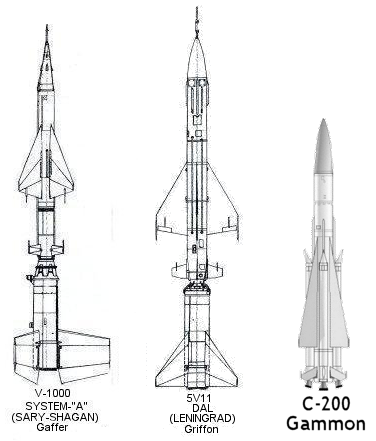
There were actually two SA-5s:

SA-5 GRIFFON (5V11 Dal)
SA-5 GAMMON (S-200)

As you can see from the attached image, the 5V11 "Dal" missile has considerable similarities with the V-1000 "System A" ABM system in terms of configuration.

Construction of five DAL sites were begun around 1960; with each site designed to hold a full regiment of five firing battalions.

Three sites were built before the DAL system was cancelled in 1963:

Leningrad D34
105th Anti-Aircraft Missile Regiment (Pervomayskoye)
60.44921, 29.72154

Leningrad B05
106th Anti-Aircraft Missile Regiment (Uglovo)
60.08659, 30.73564

Leningrad D25
104th Anti-Aircraft Missile Regiment (Lopukhinka)
59.71757, 29.30691

Two further sites were under construction when the halt order came down

Kingisepp Site
59.52850, 28.50202

Tikhvin Site
59.72599, 33.39260

Three issues then converged:

1.) Despite the DAL system being cancelled, the Soviets continued to parade it during May Day.

2.) The two unfinished DAL sites (Kingisepp and Tikhvin) were later rebuilt into S-200 sites, as part of the S-200 construction program (aka Tallinn Line) which started shortly after the DAL program was killed.

3.) The positioning of the initial S-200 sites (Tallinn Line) were along an arc that would be ideal for intercepting POLARIS MRBMs launched against NW Russia.

DIA claimed that those missiles were part of a national ABM system. So "TALLINN" was shorthand for the type of missile, not simply the location of those missiles around Tallinn. And although the range of the missiles was not great, people argued that they would be able to provide point defense of locations against ABM attack.

It wasn't just DIA vs CIA -- per NIE 11-3-67 (9 Nov 1967); Pages 20-21

DIA Position on the Tallinn System

Lt. Gen. Joseph F. Carroll, the Director, Defense Intelligence Agency, believes that the above statements on the Tallinn system convey a much higher degree of confidence in the judgments being rendered than are supported by the available evidence; and that these statements do not adequately portray the ABM possibilities of the Tallinn system. He believes that on the basis of information obtained over the past year, the Tallinn system, throughout its deployment, will consist of: the Tallinn complexes, usually 3 or 5 sites, 6 launchers at each site; an engagement radar for each 6 launchers; air defense radars for early warning, and acquisition; and supporting command and control.

In this configuration he believes, with high confidence, that the system has the mission to defend against the aerodynamic threat and that it can engage aerodynamic vehicles at altitudes up to about 120,000 feet and at speeds of Mach 2 to 3. At medium and high altitudes the flyout range would be about 70-80 n.m. At low altitudes the flyout range would be about 30-40 n.m. He agrees that the Tallinn system deployment is not indicative of a low altitude SAM and that its low altitude capabilities are probably no better than those of the SA-2.

However, recognizing the uncertainties, he considers that this system, if equipped with appropriate ABM nuclear warheads and appropriate computers and fire control, would have a local and self-defense capability against ICBMs. (Local and self-defense is defined as a capability to defend against present US reentry vehicles targeted either against the Tallinn sites or to points within a radius up to 20 n.m. from the site.)

Further, if the Tallinn system described above were additionally provided radar data from long range acquisition and target tracking radars such as HEN HOUSE and DOG HOUSE, a centralized command and control system and necessary links to the complexes, then the system would have a limited ABM area defense capability, but only at about 30 of the presently observed complexes; and at this time only against attacks from the north and northwest. Based on an assessment of the flyout characteristics of the missile, as now understood, the altitude capability would be limited to a maximum of about 100-110 n.m. at ranges of about 75 n.m. from the sites, and to about 50 n.m. at ranges of about 150 n.m. The system effectiveness would be dependent on several factors such as warhead characteristics, radar performance and missile performance.

If such an ABM capability did exist and the long range radars were destroyed or denied, the capability of the Tallinn complexes would be reduced to that of a SAM against aerodynamic vehicles, and at most to local and self-defense against ICBMs.

He notes the deployment of long range acquisition and tracking radars at Olengorsk, Skrunda and at Moscow, and that a command and control system to use the data from these radars is essential to the GALOSH/Moscow system. He also notes that no additional long range radars have been detected in deployment and that the Tallinn missile, as presently assessed, does not seem to be optimized for an ABM role.

He believes that, despite the different and additional information that has been obtained over the past year on the Tallinn system, there remain significant areas of uncertainty, especially concerning the development objectives and operational concept for the system and performance capabilities of important components. He believes that the state of available evidence does not permit excluding the possibility of an ABM role for the Tallinn system. However, considering the various additional postulated conditions that would have to be met and the lack of any tangible evidence of their existence, together with the fact that the missile as presently assessed does not seem to be optimized for an ABM role, on balance, he believes it is unlikely that the system presently being deployed possesses an ABM capability.

He believes there are on-going developments in ABM related technologies throughout the Soviet Union, particularly at Sary Shagan, which may provide an improved ABM capability either for the Tallinn system or for some other approach. While we have no evidence that these developments are specifically for the Tallinn system, he believes the continuing deployment of this system should be evaluated with these possibilities in mind.

Army Position on the Tallinn System

Maj. Gen. Wesley C. Franklin, the Acting Assistant Chief of Staff for Intelligence, Department of the Army, believes that the extensive analysis which has been made of the presently available and limited evidence is still insufficient to estimate with confidence the full capabilities and mission of the Tallinn system, including the design intent. He agrees that the available evidence does support a conclusion that the Tallinn sites have a defensive capability against the aerodynamic threat.

However, he also believes that the system, when augmented by the HEN HOUSE radar, has a capability against ballistic missiles over a substantial portion of the present deployment area. He also believes, however, that those complexes not now covered by such long-range radars probably have no area ABM capability although all currently deployed complexes do have a self and local defense capability. Further, he believes that the Tallinn system has considerable growth potential. He therefore would evaluate its continuing development and deployment with these capabilities and potentialities in mind.

Navy Position on the Tallinn System

Rear Adm. E. B. Fluckey, the Assistant Chief of Naval Operations (Intelligence), Department of the Navy, believes that the Tallinn system has negligible capabilities against ballistic missiles.

Air Force Position on the Tallinn System

Maj. Gen. Jack E. Thomas, the Assistant Chief of Staff, Intelligence, USAF, associates himself with the footnote of Lt. Gen. Carroll, Director, Defense Intelligence Agency, except that he believes that the Tallinn system probably was designed for and now possesses an area anti-ballistic missile (ABM) capability even without inputs from the HEN HOUSE/DOG HOUSE radars.

He agrees that the Tallinn system, as any ABM system, requires timely and continuing threat information to function properly in that role. In considering the equipment available in the Soviet Union to provide this information besides the HEN HOUSE/DOG HOUSE radars, he notes that the present electronic environment in the Soviet Union contains a variety and number of radars whose precise capability and mission have not yet been established. And he notes continued deployment of these, as well as older, radars to a degree that is not compatible with his view of the aerodynamic threat.

He considers that the configuration of the Tallinn missile, if in fact this element of the Tallinn system is correctly assessed, indicates a capability for exoatmospheric intercepts at a 150 n.m. range at 50 n.m. altitude or a 70 n.m. range at 100 n.m. altitude.

He recognizes that a national command and control system and communications links to the Tallinn complexes would be essential to the effective functioning of the complexes in an ABM role but notes that current evidence neither proves or disproves the existence of such a system.

Lastly, against submarine-launched missiles, he expects OTH radars will be developed which will provide launch detection information for the Tallinn network.

On balance, he believes that no new evidence has become available which would dispel his earlier conviction that the Soviets are probably deploying the Tallinn system against both the aerodynamic and ballistic missile threats, and that the Tallinn system possesses significant capabilities in both a terminal defense and area ABM role.

[...]

By 1967 there was a major push in the US intelligence community to increase collection of Soviet ABM capabilities. New satellites were deployed and I'm sure other things were done as well. And by 1968/69 it was pretty clear that the Soviets had not filled out their ABM capabilities.

In 1970, Kissinger went to SAC HQ in Omaha for briefings and he recounted later:


K: What shakes me; I was at SAC for a briefing about war plans. They have some limited options--take out something with a few bombers and an enormous number of missiles, this number or missiles to take on the SA-5.

They treat it as an anti-missile weapon. They were just showing me what they could do in a limited mode. I made them back up. They told me they've discovered some radars which make sense only with the SA-5.

In 1973-74, the US detected radars associated with the SA-5 during ballistic missile tests at the Sary Shagan ABM test range; enough times (50~) that we formally protested to the Soviets that this was a potential ABM Treaty violation.

Around 1975, Nuclear Storage Areas began to appear at certain SA-5 sites per NIE 11-3/8-7 (17 Nov 1975) page 36:

Evidence [DELETED WORDS] has confirmed previous indications that nuclear warheads are available to some SA-1 and SA-5 units. We further believe that a considerable portion of the SA-2 force is so equipped.

The CIA earlier in NIE 11-3-68 had argued that "a suitable nuclear warhead" would be necessary for the SA-5 to have an exoatmospheric capability.

In 1995, Anatoly Dobrynin (Soviet Ambassador to the US 1962-82) wrote his Memoirs, "In Confidence" and there are certain interesting passages that he makes:

p.153 "By the middle of the decade, Soviet researchers were working on the design of the first ABM networks around Moscow and in the western part of the country near Tallinn in Estonia. A defense against missiles, specifically for the protection of civilians, was considered in Moscow as a legitimate matter and was not supposed to arouse suspicion abroad."

p.171: "At dinner he [Kosygin] told me that night he was disappointed by it. At dinner he [Kosygin] commented on the report by pointing out that Soviet missile defense systems around Moscow and Tallinn were designed to save the lives of Soviet citizens and that instead of negotiating them away, we first ought to agree on reducing the offensive missiles in the strategic systems."

[Context -- McNamara himself had given Kosygin a CONFIDENTIAL-level briefing on ABM earlier that day using classified information prepared in DOD.]
 

Attachments

  • Tallinn.png
    Tallinn.png
    85.6 KB · Views: 70
There's a bunch of backstory missing, here.

SNIP

It wasn't just DIA vs CIA -- per NIE 11-3-67 (9 Nov 1967); Pages 20-21

SNIP

In 1973-74, the US detected radars associated with the SA-5 during ballistic missile tests at the Sary Shagan ABM test range; enough times (50~) that we formally protested to the Soviets that this was a potential ABM Treaty violation.

Around 1975, Nuclear Storage Areas began to appear at certain SA-5 sites per NIE 11-3/8-7 (17 Nov 1975) page 36:


The CIA earlier in NIE 11-3-68 had argued that "a suitable nuclear warhead" would be necessary for the SA-5 to have an exoatmospheric capability.

In 1995, Anatoly Dobrynin (Soviet Ambassador to the US 1962-82) wrote his Memoirs, "In Confidence" and there are certain interesting passages that he makes:

1-I was not writing a thesis. I didn't think an extensive backstory was necessary.

2-I was using DIA as shorthand. I was aware of the Army, Navy, and Air Force positions. Notably, Army had a reason to assume a big Soviet ABM system because the Army was trying to justify funding their own big ABM system.

3-As for the later stuff, I don't get your point. It wasn't an ABM system. We know that. There might have been some blurry data in later intelligence collection, but so what? We know that it was not an ABM system.

A good source: https://www.thespacereview.com/article/3677/1

As Manteuffel notes, by the 1971 NIE there was "no footnoted objections to the main text’s characterization of the missile as a surface-to-air missile." The issue was settled by then.

I've written on intelligence collection on Soviet ABM systems. For example, here: https://www.thespacereview.com/article/4091/1

In that article I recounted a story told by CIA official Sayre Stevens in his own article titled "The SAM Upgrade Blues." My version:

"Stevens was involved in Strategic Arms Limitation Treaty discussions carried out in Vienna, Austria, and in June 1970 found himself at the American embassy there when the subject of SAM upgrades came up. As Stevens explained, after the formal discussions, the two sides would retire for refreshments—vodka and caviar when they met at the Soviet embassy, and bourbon and peanuts at the American embassy.
At the meeting Stevens attended, the SAM upgrade question finally came to a head. The Soviets, Stevens said, stated that SAM upgrade was “an extraneous matter the U.S. was introducing to complicate the negotiations.” After the tense discussion had ended, various groups were mingling in the embassy, drinking and engaging in informal discussions. “In one such group, Lt. General Royal Allison of our Air Force was conferring with Col. General N. M. Alekseyev and Col. General A. A. Gryzlov, both of the Soviet General Staff, and Minister P. S. Pleshakov of the Ministry of the Radio Industry on the matter of SAM upgrade,” Stevens recounted. “Pleshakov (whose ministry had built the Soviets' huge ABM radars) was arguing that SAM upgrade was not feasible. Allison countered by insisting that if this were so the Soviets should have no objections to accepting a prohibition on SAM upgrade. The Soviets insisted that since it was not feasible no prohibition was necessary. Allison pointed out that he wasn't so sure it couldn't be done and finally called upon the Soviets to tell us in forthright fashion about the capabilities of the Tallinn (SA-5) system if they really wanted to allay our fears about this matter.”

The bitter battles that had been taking place within the senior levels of the US intelligence and defense communities over SAM upgrades were now being played out between Soviet and US officials in the American embassy in Vienna. Lubricated by American bourbon.

“The Soviet generals were tough birds,” Stevens remembered. “Gryzlov, a former head of the GRU, not only looked like a horror-movie principal, but hovered in the background much as a military conscience to the delegation. The Soviets had said almost nothing about their weapons, and had taken pleasure in our obvious discomfiture about the SA-5. The Soviets continued to evade, but Allison persisted. Alekseyev, the senior military delegate then in Vienna, at long last shot a look at Gryzlov, gulped visibly, and answered that the Tallinn System was an air defense system like Nike-Hercules or Hawk, and that if it were to be used in an ABM role, virtually all its components, including missile and radar, would have to be replaced.”

This was, in fact, what the CIA had been telling American officials for years.

“Standing on the edges of this conversation, I somehow saw a whole life of battles about the capabilities of the SA-5 system and the possibilities of SAM upgrade flash before my eyes,” Stevens recalled. “Though I returned to further battles on both issues, I somehow felt more relaxed about it all.”


The TALLINN debate, like several other Cold War intelligence community arguments such as "the bomber gap," "the missile gap," and the Backfire bomber controversy, demonstrated what Dwight Eisenhower had warned about, that military intelligence officials would interpret data in ways that benefited the interests of their service.

 
The TALLINN debate, like several other Cold War intelligence community arguments such as "the bomber gap," "the missile gap," and the Backfire bomber controversy, demonstrated what Dwight Eisenhower had warned about, that military intelligence officials would interpret data in ways that benefited the interests of their service.

[Yeah, I'm responding to my own post]

Eisenhower, when he made the decision on the U-2 (that it should be built and run by the CIA and not the Air Force) did so because he did not trust the military to collect and interpret intelligence. The CIA was not perfect, but the CIA did not have an institutional reason to bias its intelligence collection, whereas the military intelligence services did. Thus, the Air Force could claim that the Soviet Union had more bombers or more ICBMs in order to justify the Air Force building more bombers and ICBMs.

I mentioned the Backfire bomber controversy. You can read more about that here:

 
CIA did not have an institutional reason to bias its intelligence collection, whereas the military intelligence services did.

By the mid 1970s; the McNamara era NIEs of 1961-1968 had proven so wrong in their estimates of what the Soviets would actually do in terms of force procurement + the action-reaction theory of "arms racing" was so discredited by this that something like Team B was inevitable.

Thus, the Air Force could claim that the Soviet Union had more bombers or more ICBMs in order to justify the Air Force building more bombers and ICBMs.

Actually, the biggest problem was the USN, which constantly pushed FBM [Fleet Ballistic Missile]/SLBM/SSBN papers which were totally unrealistic; i.e. Bombers + ICBMs were totally vulnerable to Soviets, but in the same papers, Polaris/Poseidon suffered minimal to zero losses; which was quite unrealistic if one sat down from first order principles + access to then-classified information, i.e.:

A.) First 5 SSBN (George Washington) were VERY noisy as they used the Skipjack front/rear hulls.
B.) First 10 SSBN (GW/Ethan Allen) could only launch 1 missile per minute and could not be refitted to Poseidon.

I mentioned the Backfire bomber controversy. You can read more about that here

I skimmed that; all the "interesting" information regarding engineering analyses was redacted in the source material on CREST other than a few summaries; and a key point that you raised:

For example, Team B predicted that the Soviets would have 500 Backfire bombers by 1984. By 1983, NPIC determined that the Soviets produced 30.5 aircraft per year from July 15, 1982 to July 15, 1983

It's worth noting that during SALT II negotiations in Vienna during 1979; Brezhnev handed to Carter a note saying among other things:

The Soviet side states that it will not increase the production rate of this airplane as compared to the present rate.

Per the NPIC summary on CREST, BACKFIRE production rate in 1979 was 30/yr -- this number was stated by the US side in the SALT negotiations at the time and later in congressional debates in the mid/late 1980s regarding Soviet Compliance with Arms Control Agreements.

That little tidbit about production was found out by going to the Russian side of the web regarding the BACKFIRE.
 
By the mid 1970s; the McNamara era NIEs of 1961-1968 had proven so wrong in their estimates of what the Soviets would actually do in terms of force procurement + the action-reaction theory of "arms racing" was so discredited by this that something like Team B was inevitable.

I wasn't discussing the accuracy of the intelligence estimates, I was discussing the bias of the organizations performing the estimates. The military services, including DIA, all had clear biases in their own favor. The CIA did not need to bias the intelligence data to support building more CIA missiles, bombers, submarines, etc.

And Team B was a mess. They didn't do better.

For example, Team B predicted that the Soviets would have 500 Backfire bombers by 1984. By 1983, NPIC determined that the Soviets produced 30.5 aircraft per year from July 15, 1982 to July 15, 1983

It's worth noting that during SALT II negotiations in Vienna during 1979; Brezhnev handed to Carter a note saying among other things:

The Soviet side states that it will not increase the production rate of this airplane as compared to the present rate.

Per the NPIC summary on CREST, BACKFIRE production rate in 1979 was 30/yr -- this number was stated by the US side in the SALT negotiations at the time and later in congressional debates in the mid/late 1980s regarding Soviet Compliance with Arms Control Agreements.

That little tidbit about production was found out by going to the Russian side of the web regarding the BACKFIRE.

I don't really understand your point. My point was that the CIA was better than the military services at producing accurate intelligence estimates about the Backfire. The Air Force (and DIA) estimated a higher range for the Backfire than the CIA. They were wrong, and the CIA was right. Team B (which was heavily biased by the military intelligence services) predicted 500 Backfires by 1984, which would have required a substantial increase in Soviet production (more than double the annual rate, depending on the time when production theoretically ramped-up). The Soviets did not produce 500 by 1984. When production ended in 1993, they had produced 497 aircraft, including pre-production aircraft.

And I only brought up that example to reinforce the point that I made about the "TALLINN" missile--the CIA said it was not an ABM, the Air Force (DIA, hangars-on) said that it was an ABM, then claimed that it could be "upgraded" to an ABM. But like the Backfire, the CIA was right and the military intelligence services were wrong.
 

Finally, in the Martlet 2 series, the Martlet 2G-1 is currently being constructed at Highwater for firing in January 1967. This vehicle is to be used for re-entry purposes (as a target for Nike-X) and contains a rocket payload.


The application of the HARP vehicles has been in upper-atmosphere scientific programs and military research.

[..]

Numerous military experiments and studies have also been conducted; for example the Martlet 2G-1 has been studied as a re-entry target for Nike X, where the vehicle is reoriented at apogee and fired downward to create re-entry phenomena.

I found this reference buried in a DTIC catalog on sabots:

"AN EVALUATION OF PAYLOAD DELIVERY SYSTEMS FOR NIKE-X," Brown Engineering, Report No. TN AS-214, September 15, 1966

It makes sense that they looked at Bull's HAARP stuff as a way to get RV targets coming in fast; because the alternative was to buy a full fledged Atlas or Titan from the USAF for a re-entry vehicle signature test.
 

DOD used SPRINT launches in 1967-68 for live tests to see whether OTH (Over the Horizon) Radar could be used to detect ABM operations.

The ground range from the radar site to the Sprint launch site at WSMR is approximately 1500 naut. mi. The expected slant range to the area of interest will vary from 1550 to 1650 naut.mi. depending upon propagation mode...

Two guesses as to what they wanted to do...

This has a bunch of details on SPRINT which help fill in some of the performance envelope:

First Stage: 650-750 klbf motor burning for 1.8 to 2.0 seconds; providing up to 130G acceleration; burnout velocity 5,500 ft/sec (1.6764 km/sec).

Second Stage: 150 klbf motor burning for 2 seconds; providing up to 90G acceleration; burnout velocity between 9,500 to 10,200 ft/sec (2.895 to 3.108 km/sec).

Context:

THAAD burns out at around 2.7 km/sec, SM-3 Block IA is about 3.0 km/sec, and Block IIA is somewhere between 4.5 and 5.5 km/sec.

SPRINT burns for 3.8 seconds to hit 2.895 km/sec; or about 0.761 km/sec average acceleration (77.65G).

THAAD burns for 13.5 seconds to hit 2.7 km/sec; or about 0.2 km/sec average acceleration (20.38G)

The missile is ejected from it's launch cannister by a gas generator; rather than Stage 1 thrust; as shown by FLA-17 (Flight 17) of 26 FEB 1968 which failed due to no first stage ignition; the missile emerged from the silo, pitched forward 390 degrees and fell to the ground.

Missile control during first stage flight is through the injection of freon into the engine throat for TVC, with the second stage being controlled via the use of hydraulically driven aerodynamic vanes.

Staging takes approximately 0.2 seconds; per FLA-8 (Flight 9) (18 JUL 1967) which staged 2.4 seconds into flight, followed by Stage II Ignition at 2.6 seconds.

Flights are terminated after a pre-set time, or when the second stage descends below 5000 ft altitude. For most of the flights, the auto destruct went off between 32 and 39.8 seconds into flight.

SPRINT is capable of doing repeated 30-50G lateral maneuvers and 30-60G vertical (pitch/dive) maneuvers, even after second stage burnout due to the aforementioned hydraulically driven vanes, as shown by FLA-13 on 11 DEC 1967 which sustained 5 maneuvers:

3.6 seconds - 50G Maneuver Begins
4.7 seconds - Second Stage Burnout
5.9 seconds - 50G Maneuver Ends
7.9 seconds - 50G Maneuver Begins
9.9 seconds - 50G Maneuver Ends
11.9 seconds - 50G Maneuver Begins
13.9 seconds - 50G Maneuver Ends
14.4 seconds - 32G Pullup Maneuver
14.9 seconds - 63G Dive Maneuver
16.5 seconds - 32G Dive Maneuver Ends
20~ seconds - Coast Period Begins
32.4 Seconds - Automatic Destruction

SPRINT missile structural limits are revealed through the following tidbits:

FLA-15 (Flight 14) (20 NOV 1967) - Destroyed 7 seconds into flight after being subjected to a severe 218G lateral maneuver.

FLA-16 (Flight 16) (5 FEB 1968) - Lost shortly after 2nd stage ignition due to an inadvertent 109G maneuver.
 
Figuring out defended zone of SPRINT -- the WSMR tests mentioned previously had a limit of about 39 seconds (likely due to WSMR range limitations); while a classified 1969 position paper that was reprinted in Foreign Relations of the United States, 1969–1976, Volume XXXIV, National Security Policy, 1969–1972: LINK described the SPRINT as:

The Sprint was developed to carry a nuclear warhead with a yield of a few kilotons and to fly 50 miles at altitudes to 100,000 feet in about 50 seconds.

Digging further in Bell Labs ABM history; I find:

Division of energy between the two [SPRINT] stages is not optimized for maximum missile velocity, but is biased in favor of making the second stage smaller for better maneuver control.

[...]

Second-stage ignition may be delayed either to extend [SPRINT] interceptor range or to assure a higher dynamic pressure and higher maneuverability for end-game guidance to intercept.

[...]

The flight time and maximum range capabilities of the initial [SPRINT] missile design were later extended by adding a lubrication system to the second stage hydraulic motor pump and by enlarging the second-stage gas generator.

Using Flyout Sim (using a very crude drag model):

50 sec Flight Time with 0.2 second coast @ 45 deg = 41 km (134,514 ft) intercept altitude out to 44.4~ km (27.5 miles)

50 sec Flight Time with 8 second coast @ 45 deg = 68 km (223,097 ft) intercept altitude out to 70~ km (43 miles)

So it DOES seem that the claim in the 1969 position paper of a 50 mile range for SPRINT is...plausible in the words of Mythbusters.

BTW; in the 21 January 1964 study by McNamara's DDR&E gang (DAMAGE LIMITING: A RATIONALE FOR THE ALLOCATION OF RESOURCES BY THE US AND THE USSR) NIKE-X's High Acceleration Interceptor's range was described as:

Each defense unit provides an "Effective Exclusion Radius" of 10 n.mi. [18.5 km]

Going back to FLYOUT SIM; SPRINT hits 18.5 km range at 20.40 km (66,900~ ft) altitude about 17.3 seconds into flight; which accords with public statements thrown around that intercepts would take about 15 seconds or so.

That's a "thumb on scale" that's very subtle in these debates:

A.) If you assume that you can't discriminate decoys from RVs until they hit 85,000 ft or so; your terminal defenses end up having extremely short ranges (and thus are inordinately costly/expensive to build).

B.) If you can discriminate starting in the 80~ km (262,000 ft) regime; you can just fire SPRINTs ahead of time towards the estimated impact zones and radio course correction commands as discrimination data comes in; significantly boosting the area that each SPRINT Remote Missile Launcher can defend.

To put this in context; if you want to defend Washington DC:

A.) With the DDR&E estimate of 18.5 km defended zone; you'd have to put a SPRINT launcher at Bolling AFB; and it would only be capable of defending the District of Columbia along with Arlington VA (and the Pentagon).

B.) With the 70 km estimate; you can put a SPRINT launcher at Olney, MD at an old NIKE site; and it would defend Washington DC, Baltimore MD, Annapolis MD, Dulles Airport, Frederick MD -- and it would be significantly harder to use the "surface burst a warhead to dust a defended city with fallout" tactic.
 
Last edited:
BTW:

SPRINT is capable of doing repeated 30-50G lateral maneuvers and 30-60G vertical (pitch/dive) maneuvers, even after second stage burnout due to the aforementioned hydraulically driven vanes, as shown by FLA-13 on 11 DEC 1967 which sustained 5 maneuvers:

3.6 seconds - 50G Maneuver Begins
4.7 seconds - Second Stage Burnout
5.9 seconds - 50G Maneuver Ends
7.9 seconds - 50G Maneuver Begins
9.9 seconds - 50G Maneuver Ends
11.9 seconds - 50G Maneuver Begins
13.9 seconds - 50G Maneuver Ends
14.4 seconds - 32G Pullup Maneuver
14.9 seconds - 63G Dive Maneuver
16.5 seconds - 32G Dive Maneuver Ends
20~ seconds - Coast Period Begins
32.4 Seconds - Automatic Destruction


BGRV - Boost Glide Reentry Vehicle

It was capable of making turns at 25g acceleration. This was significantly less than the turn rate required by MBRV

MBRV - Maneuvring Ballistic Reentry Vehicle

The flight of the second MBRV happened in March 1967, when the vehicle successfully performed a 20g pull-up manoeuvre. Unfortunately, the recovery system failed, causing the loss of the last MBRV flight carrying the experimental heat shield for the Mark-12 reentry vehicle. The third MBRV flight was a success in July 1967: the vehicle performed a 25g manoeuvre and the telemetry payload successfully established a two-way transmission through the reentry plasma. During the fourth and final flight of MBRV in October 1967, an attempt was made to perform a pull-down dive manoeuvre. The vehicle successfully performed the manoeuvre with 80g acceleration at hypersonic speeds, by which fulfilled its mission goals.

Pershing II

A guidance and navigation system was used to actuate four fins on the base of the [Pershing II] vehicle to perform evasive manoeuvres at 25 g during descent.

Let's recap; none of the performance demonstrated by MARV tech demo programs is severe enough to strain SPRINT missiles too badly. If "advanced" MARVs with 100G+ maneuvers are eventually deployed, causing us to worry a little...

Well, then...we can just deploy UPSTAGE, per IDA PAPER P-2429 DARPA TECHNICAL ACCOMPLISHMENTS VOLUME II:

UPSTAGE, a maneuvering HIBEX second stage, demonstrated over 300 g lateral acceleration

[...]

"Finlet" injections were used to provide transverse thrust. UPSTAGE reached several hundred lateral g's with response times of milliseconds. The UPSTAGE maneuvers were controlled in a simulated MARV chase but no actual interceptions were attempted.

[...]

UPSTAGE also had a very ambitious objective of demonstrating a capability for chasing MaRV's, a mission not emphasized in the SPRINT system design, and possibly coming close enough for non-nuclear kill.
 
Last night; while getting ready for bed; I remembered this line from the Bell Labs History:

Second-stage ignition may be delayed either to extend [SPRINT] interceptor range or to assure a higher dynamic pressure and higher maneuverability for end-game guidance to intercept.

And literally did the "brain ask question, angry face in bed" meme.

This morning I did some more sims:

An 8-second Coast results in a 70~ km range, with a 1950~ m/sec velocity at that point.

15-second coast, your range increases only slightly to 73~ km, but your end velocity is now 2395~ m/sec.

25-second coast, your range decreases to 64~ km, but your end velocity is now 2630~ m/sec.

I also went and rechecked FLA-13's manuvers, which occurred between 3.6 and 16.5 seconds; or around 12,200 to 46,850 ft altitude (guessing with my simulation; since I don't have access to an actual flight report for SPRINT.

I went and measured dimensions from a side profile diagram we have of SPRINT from the Bell Labs History and got:

Stage II Length: 16.55 ft
Stage II Lower Diameter: 2.89 ft
Stage II Ignition Mass (est): 1730.6 lb
Stage II Burnout Mass (est): 692 lb
Stage II Air Vane Control Area: 0.48 ft2 (4 Vanes = 1.92 ft2 total area)

I went and asked Grok (I know, I know) to estimate the maximum altitudes the missile could manuver at a given set of G forces if it had those specifications at an average velocity of 2,286 m/sec.

I asked Grok to do it using ignition mass and burn out mass and got the following ranges for manuver limits:

60G: 47 to 66,000 ft (loaded to burnout mass)
40G: 55 to 74,000 ft (loaded to burnout mass)
20G: 69 to 88,000 ft (loaded to burnout mass)
10G: 84 to 103,000 ft (loaded to burnout mass)
2G: 199,300 ft (burnout mass only)
1G: 207,700 ft (burnout mass only)

It's incredibly crude and "there be dragons here", but I'm circling back to the DDR&E statement of

Each defense unit provides an "Effective Exclusion Radius" of 10 n.mi. [18.5 km]

As noted before; that range's altitude is about 66,900~ ft; or right about when SPRINT is at it's maximum maneuverability potential.

I'm getting a strong:

"You are technically correct. The best kind of correct."

vibe here from DDR&E's range estimates.

I believe DDR&E was using SPRINT capability against the hardest, worst possible threat -- a incoming MARV with 60G or more maneuver capability -- to define the defended zone of the system for their analyses; counting on the extreme classification of the system to cover their tracks.
 
Last edited:
From EM1 Chapter 16: Damage to Missiles (ADA955400)

[https://nige.files.wordpress.com/2009/10/em1-ch-16-ada955400.pdf]

There are several models referenced on hard copy page 16-38:

HARTS A (Minuteman III Mk 12 RV) (USAF) (2150 lb/ft2 B)
HARTS B (Minuteman I/II Mk 11A RV) (USAF) (680 lb/ft2 B)
AIRS I (SPRINT) (ARMY)
AIRS II (SPARTAN) (ARMY)

HARTS stood for Hardening Technology Study.

There's a lot of interesting stuff [REDACTED] but enough leaked through to make some interesting conclusions.

Page 16-66 says:

"Assume that a reentry vehicle is hardened to survive 200 cal/cm2 [DELETED] incident X-Ray environment."

Pages 16-102 to 16-105 are a series of graphs labelled "RV Target A, Dynamic Pressure as a function of Time, 30 Deg Intercept" -- with the graphs themselves containing:

"30 K FT ALT
100 FT RANGE
30 deg INTERCEPT"

Followed by Page 16-110 having a deleted graph but the label still exists saying "Figure 16-67 [DELETED] SPRINT Blast Loads, RV Target A, 30 kilofeet Altitude, Aft Bay [DELETED]"

So we know what the design intercept range for SPRINT is now.

The Bibliography has some interesting titles...(typed this for later reference)
 

Attachments

  • AIRS-1.png
    AIRS-1.png
    82.4 KB · Views: 26
  • AIRS-2.png
    AIRS-2.png
    75.5 KB · Views: 33
It's incredibly crude and "there be dragons here"

This morning, I realized that I made a serious error in my analysis; I was using the figure of 1.92 ft2 for control surface area -- all four control vanes -- when in reality the most control surfaces you could get with 1960s guidance would be two, enabling either side to side or pitch up/down movement.

I redid everything with the use of 0.96 ft2 control surface area (half that of my earlier estimate), with a 1975 m/sec velocity and the following numbers shook out:

Code:
100G - 35,876 ft / 10,935 m 
80G - 40,558 ft / 12,362 m 
60G - 46,545 ft / 14,187 m 
40G - 54,980 ft / 16,758 m 
20G - 69,304 ft / 21,124 m 
10G - 83,527 ft / 25,459 m 
5G - 98,035 ft / 29,881 m 
2G - 117,208 ft / 35,725 m
1G - 132,313 ft / 40,329 m

They got me to thinking -- there's a SPRINT flight envelope diagram for the missions flown from Meck in Kwajalein in the Bell ABM History that has had the scale removed.

In theory if you fired SPRINT straight up at 89 degrees; you could hit 124~ km (406,824 ft) altitude; but the flight envelope attached doesn't show that.

If we assume the very top of that envelope (straight up) is 30 km (5G~ manuver); then scaling off that makes the M2-48 mission at the far right to be at a range of 78 km (48.46 miles).

The first isochrone line turns out to be 8.8 km high, or about 4.3~ seconds' flight time.

The second isochrone line is about 20 km high, or about 10 seconds flight time.

There are ten isochrone lines; and if we assume they represent 5 seconds' flight time per line - that comes out to 50 seconds flight time; precisely the time limit mentioned in the 1969 Policy Paper.

The 30 km altitude I went with based off simple vibes (5G manuver) also seems to line up with that Policy Paper's words:

"The Sprint was developed to carry a nuclear warhead with a yield of a few kilotons and to fly 50 miles at altitudes to 100,000 feet in about 50 seconds. "

100,000 feet is 30.48 km.
 

Attachments

  • SPRINT_Meck_Envelope.gif
    SPRINT_Meck_Envelope.gif
    33.9 KB · Views: 32
More detail on SPRINT Control Vanes:


Graphite fiber/reinforced epoxy resin composites have been developed and fabricated for aerospace vehicle structural applications since the early 1960s. Early applications were oriented toward secondary structures to establish confidence and reliability under a service environment. The advances made in the past decade have caused acceptance of composite materials for primary structures on aircraft, missiles, and space vehicles. During the 1970s, the cost of these composite structures began to be cost competitive with metal structures.

Martin Marietta’s experience with ablative air vanes dates to the 1950s with the development of the Pershing I missile. During the 1960s, Martin Marietta continued development on the Sprint and SAM-D (Patriot) missiles. In 1969, Martin Marietta Orlando Aerospace demonstrated net molding and primary bonding on the Sprint air vane, and also the potential cost savings during manufacturing. However, the high pressures required for molding caused excessive deflections of the metallic substructure, and the process was not implemented. This problem was eliminated later by net molding the composite structure and post-bonding it to the substructure.

Pershing II (PII), started in the 1970s, used proven air vane technologies developed for Sprint. The Pershing vanes consisted of metallic substructures, designed to accept the air loads, and heat shields, designed to protect the substructures from severe aerodynamic heating and rain erosion.

The main cost driver for air vane fabrication, such as for Pershing II and Patriot, was the need to separately fabricate and apply heat shield panels to the basic metallic structure, which is a costly operation. To avoid this cost, Martin Marietta fabricated the heat shield and structural composite in a single cocured net molded operation. In 1979, Martin Marietta Orlando Aerospace demonstrated cocuring ablative materials to graphite/polyimide skins, which were then bonded to a steel substructure.

Attached are images that "rocketguy101" on NASA Spaceflight Com posted of the SPRINT at the Fort Sill Museum in 2017.
 

Attachments

  • Sprint-06.jpg
    Sprint-06.jpg
    302.4 KB · Views: 25
  • Sprint-11.jpg
    Sprint-11.jpg
    243.5 KB · Views: 18
  • Sprint-08.jpg
    Sprint-08.jpg
    275.4 KB · Views: 16
  • Sprint-07.jpg
    Sprint-07.jpg
    332.9 KB · Views: 17
  • Sprint-12.jpg
    Sprint-12.jpg
    258.3 KB · Views: 15
  • Sprint-13.jpg
    Sprint-13.jpg
    331.9 KB · Views: 13
  • Sprint-15.jpg
    Sprint-15.jpg
    113 KB · Views: 14
  • Sprint-09.jpg
    Sprint-09.jpg
    85.5 KB · Views: 16
  • Sprint-14.jpg
    Sprint-14.jpg
    303.9 KB · Views: 16
  • Sprint-10.jpg
    Sprint-10.jpg
    360.9 KB · Views: 31
This is my attempt at reverse engineering the "sanitized" SPRINT Envelope from ABM History. I figured out that every three ticks was 5 miles; and that both altitude and range were measured in miles.

As mentioned previously, this based off two throwaway lines that I noticed:

FRUS: "The Sprint was developed to carry a nuclear warhead with a yield of a few kilotons and to fly 50 miles at altitudes to 100,000 feet in about 50 seconds. "

Bell ABM History: "Second-stage ignition may be delayed either to extend [SPRINT] interceptor range or to assure a higher dynamic pressure and higher maneuverability for end-game guidance to intercept."
 

Attachments

  • SPRINT_Meck_Envelope_Corrected.png
    SPRINT_Meck_Envelope_Corrected.png
    241.8 KB · Views: 30
Last edited:
This morning, I realized that I made a serious error in my analysis; I was using the figure of 1.92 ft2 for control surface area -- all four control vanes -- when in reality the most control surfaces you could get with 1960s guidance would be two,
Are you sure? I could swear I read somewhere that Nike Hercules used all four to reduce peak load on the wings during turns.
 
Are you sure? I could swear I read somewhere that Nike Hercules used all four to reduce peak load on the wings during turns.

I'm not exactly wedded to my postulate of only two fins in use at any one time, but that sandbagging helped me inadvertently find the correct range scale for that SPRINT envelope.

BTW; since we're speaking of NIKE; I realized from my simulations to find maneuverability at high altitudes why NIKE ZEUS A had such ludicrous fin area:

A.) It was a straightforward evolution of Hercules which had them for high altitude intercepts of supersonic bombers.

B.) If you're limited to only 58 miles of range by DOD policies assigning very long range missiles to the Air Force, why not take advantage of that restriction and optimize your missile for extreme high altitude maneuverability? The drag of the big wing isn't a negative as you can't go further than 58~ miles without DOD slapping you.

C.) In doing so, you make ZEUS have potential as a Super Hercules with capabilities against air-breathing targets as well; allowing you to stock one missile at existing NIKE sites to do both missions (SAM/ABM).
 
I'm not exactly wedded to my postulate of only two fins in use at any one time, but that sandbagging helped me inadvertently find the correct range scale for that SPRINT envelope.

BTW; since we're speaking of NIKE; I realized from my simulations to find maneuverability at high altitudes why NIKE ZEUS A had such ludicrous fin area:

A.) It was a straightforward evolution of Hercules which had them for high altitude intercepts of supersonic bombers.

B.) If you're limited to only 58 miles of range by DOD policies assigning very long range missiles to the Air Force, why not take advantage of that restriction and optimize your missile for extreme high altitude maneuverability? The drag of the big wing isn't a negative as you can't go further than 58~ miles without DOD slapping you.

C.) In doing so, you make ZEUS have potential as a Super Hercules with capabilities against air-breathing targets as well; allowing you to stock one missile at existing NIKE sites to do both missions (SAM/ABM).
Always thought Zeus A should have been the Hercules replacement. It did have a 3rd stage with TVC for control.
 

Similar threads

Back
Top Bottom