Some Future Titles of Interest for SPF Members

I have all 3 (Fiat, Macchi, S. 79). Since my to-read pile is massive, I have not read them fully or even close but the parts I have read seem to be in good English. And I think the contents are overall good and worth the price. I have not checked do they have handling reports etc. Interestingly, the Fiat-volume is printed in Turkey!
Definitely on my "To Buy" list. After this one, I hope he does lesser Italian fighter designs, such as Caproni-Vizzola.

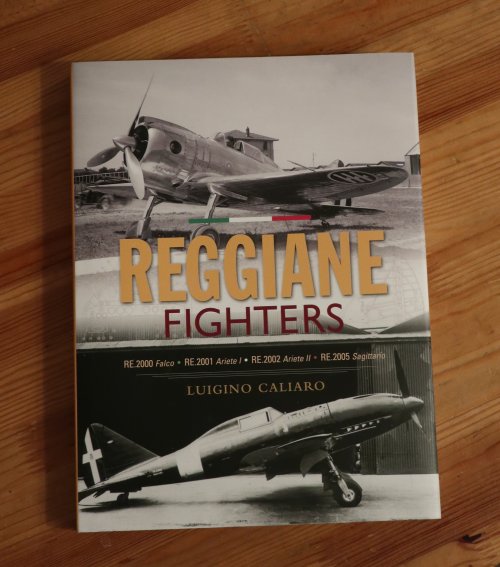
A welcome arrival from Amazon: the newly published third volume of Luigino Caliaro's trilogy about Italian fighter planes of WW2, this one on airplanes from Reggiane, a spinoff from Caproni. The book appears well laid out and well produced (by Crecy), and I look forward to reading it. This volume has a reserved place on my shelf next to the excellent second volume, on Fiat fighters.

(Despite Dagger's good advice [post #901 above], I still haven't been able to find at a reasonable price the too-soon-out-of-print first volume, on Macchi fighters. A Crecy representative confirmed to me that they have no plans to reprint that first volume, or Mr Caliaro's book on the S.79 Sparviero bomber. Disappointing.)
 

Attachments

  • Reggiane_book.jpg
    Reggiane_book.jpg
    1.9 MB · Views: 43
I do wish he'd do a fourth book on lesser-known Italian fighter manufactures.

I do have all three of his fighter books and they are fascinating. I do wish, though, that the projects section had more on the Re2004 and Re2006.
 
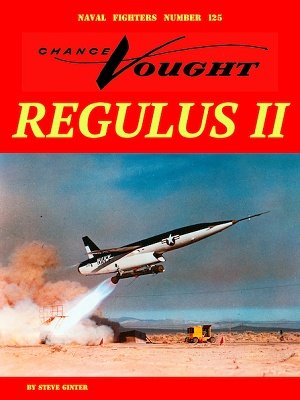
Chance Vought Regulus II
Steve Ginter
Naval Fighters Number 125
I have a Schiffer book on Regulus. Came out a couple of decades ago. Some great photos of the subs as well as line drawings.


Sorry, not Schiffer, and more than a couple of decades ago:

Regulus: America's First Nuclear Submarine Missile by David K Stumpf, Turner Publishing Company, 1996.
 
Last edited:
Available from July 2025
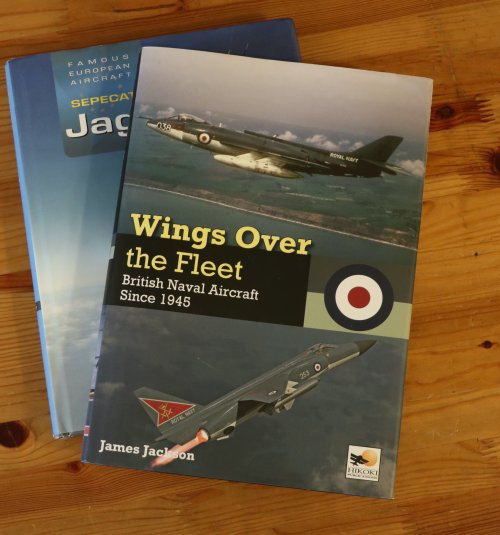
"All the major types are covered, from all-weather fighters, interceptors, strike aircraft, anti-submarine helicopters and airborne early warning aircraft. as are many design studies and proposals that remained on the drawing board. Guided missiles during the post-war period and the evolution of the Royal Navy's aircraft carriers and the new technologies required to operate jet aircraft from ships are also analysed."
Promising... :)
Another book by forum member @Hood. Looks good.
Got my copy of Wings Over the Fleet yesterday and would highly recommend it based on just the initial flick through. Great looking book James!

Received my purchased copy of Wings Over the Fleet: British Naval Aircraft Since 1945 by James Jackson yesterday; US$29.42 via Amazon. The book proves to be quite hefty, with good paper and binding, and (like SteveO praised) is attractively laid out and well produced. I look forward to digging in. May this new book be the bestseller it deserves—congratulations to the author.
 

Attachments

  • Wings_book.jpg
    Wings_book.jpg
    2.3 MB · Views: 28
That could be an interesting topic if done well. There was a Yamato movie done in the past decade, and of course there's Space Battleship Yamato. Clearly the ship is symbolic of something for the Japanese, but symbolic of what? Was it their lost cause during the war, or an honorable sacrifice, or the folly of sending 3055 men to their deaths?
Dunno. Pretty much every culture has some variant of the "Lost Cause" myth. Maybe in portraying the Yamato as honorable their portraying everyone who died in the war as honorable.?
 
Dunno. Pretty much every culture has some variant of the "Lost Cause" myth. Maybe in portraying the Yamato as honorable their portraying everyone who died in the war as honorable.?

We'll have to read the book to find out, right?

Yes, the lost cause myth is persistent. And powerful. You can see that in various aspects of American history like The Alamo. If you're old enough, you might remember school textbooks that mentioned "Custer's Last Stand" which portrayed him as losing honorably. Only later did historians point out that Custer was a horrible person and the battle was not the heroic fight that was mythologized.

The final stages of the War in the Pacific have been studied in many books. Japan really romanticized their sacrifice during the war (not just after). Many pilots and sailors knew they were going to die and turned that into something romantic, with poetry and paintings. It's different than how Western cultures addressed warfare, although I'm sure there are many parallels. (See, for instance, how the British sent whole villages of young men off to fight in World War I with a romanticized idea of what they were doing.)
 
Fonthill Media, an imprint of Pen and Sword, will be publishing Graf Zeppelin this month (February 2026)...

US publication of Fonthill's new book Graf Zeppelin: The Story of Hitler's Aircraft Carrier by Daniel Knowles has been pushed back to late April, according to Barnes & Noble and Amazon.
 
...Even Iran's Revolutionary Guard now has a semi-carrier. And the number of carrier-equipped navies continues to grow: as discussed in a different thread, Indonesia has expressed serious interest in acquiring Italy's Giuseppe Garibaldi.
Just to be clear, for about 20 years after WWII, a bunch of nations besides the US and UK operated aircraft carriers. That number dropped a lot in the 1970s and 1980s. In the past decade, a bunch of nations have started building carriers again, or helicopter carriers that have wider use such as disaster response.

Following up on post #1122 discussing an opportunity for a new updated reference on world aircraft carriers, note that Indonesia's acquisition of Italy's retired Giuseppe Garibaldi is proceeding, and the aircraft carrier is planned to arrive in Indonesian waters later this year.

But remove Iran from the list: according to news reports, the Islamic Revolutionary Guard Corps' 40,000-ton semi-carrier Shahid Bagheri has been destroyed.
 
Following up on post #1122 discussing an opportunity for a new updated reference on world aircraft carriers, note that Indonesia's acquisition of Italy's retired Giuseppe Garibaldi is proceeding, and the aircraft carrier is planned to arrive in Indonesian waters later this year.

But remove Iran from the list: according to news reports, the Islamic Revolutionary Guard Corps' 40,000-ton semi-carrier Shahid Bagheri has been destroyed.

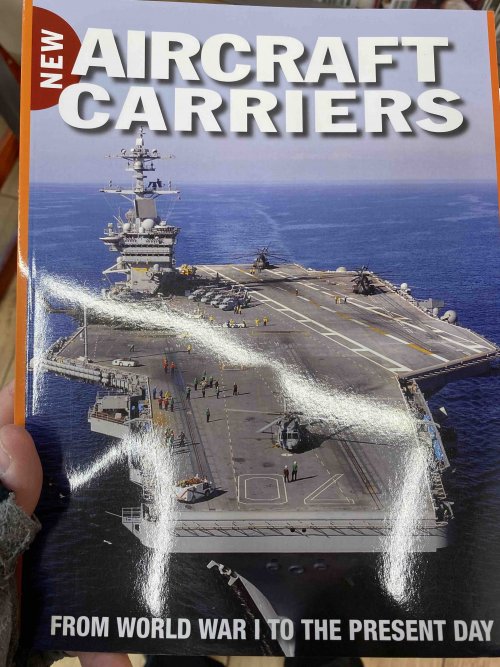
There is a current Key Publishing "bookazine" available (it is on the magazine shelves at Barnes & Noble) on aircraft carriers. The end chapter is a quick overview of current carriers.

There have been a number of recent publications that have also focused on current world carriers. Softcover. They are generally a bit superficial and don't go into detail about the ships or their operations.

I am not sure that the Shahid Bagheri story is accurate. Another ship with a large helicopter flight deck was attacked and in satellite photos is visibly burning. However, I saw a report that the Bagheri may have moved yesterday. So reports of its demise may have been premature. (Note: I am not saying that it was not destroyed, just that the reports may not have been totally accurate. It certainly is a sitting duck.)


Update: attached photo of a new bookazine I just found on the magazine IMG_1562 copy.jpg shelf at Barnes & Noble.
 
Last edited:
The only issue is that David Baker has written a loooot of books about, maybe, too many themes: rockets, spacecrafts, nuclear bombs, migs...
Certainly this is a matter of taste, but I'm a firm believer in "Jack of all trades, master of none". Some minor examples: In [David Baker's] book about the mig-29 (haynes) he makes some statements against the Luftwaffe reports and public knowledge (like the 29 being well beyond western counterparts... ). In the one related to nuclear weapons there are surprising errors describing basic physics like defining the electron as neutrally charged...
...Having had occasion to study some of ex-Dr. Baker's work in great detail, I wonder how and where he became an expert in combat aircraft.
I would call the Key bookazine a condensed version of the Haynes and Crecy titles, since Baker was responsible for all three.

I have enjoyed the writing of British author David Baker, PhD since I read his speculative space technology articles in Air International during the 1990s, and I have since purchased several of his books. According to the back cover of his 2015 Haynes Owners' Workshop Manual: Rocket, "Dr David Baker worked with NASA on the Gemini, Apollo, and Shuttle programmes between 1965 and 1990. He has written more than 90 books on spaceflight technology..." This (see attached PNG file) is the author photo that Amazon uses, which shows a man at least forty years younger than a Gemini engineer would look. Unless Dr Baker truly has Bilbo Baggins-level preservation, this must be an Amazon error. Or perhaps the author of recent aviation books like Fifth Generation Fighters and US Air Power 1945-1990 is an entirely different person from the space-related Dr Baker, and may or may not be related? 'David Baker' is of course a common name. Anybody here know about this matter?

Good to see, Baker's earlier works are excellent
Look what I found in my mail box this morning: The book has 384 pages A4/Letter size, and they corrected the cover flub that starviking noted earlier.

Following up on post # 810 above, an editor at Crécy told me that publication of (the space-related) David Baker's book NASA Lost Missions: 1964-75 is unlikely in 2026. Also delayed out of this year is Dr Baker's big Saturn V companion volume to his successful Saturn I/IB book by Crécy. (These are orphaned Haynes projects.)
 

Attachments

  • Amazon_Baker.png
    Amazon_Baker.png
    637.2 KB · Views: 29
I have enjoyed the writing of British author David Baker, PhD since I read his speculative space technology articles in Air International during the 1990s, and I have since purchased several of his books. According to the back cover of his 2015 Haynes Owners' Workshop Manual: Rocket, "Dr David Baker worked with NASA on the Gemini, Apollo, and Shuttle programmes between 1965 and 1990. He has written more than 90 books on spaceflight technology..." This (see attached PNG file) is the author photo that Amazon uses, which shows a man at least forty years younger than a Gemini engineer would look. Unless Dr Baker truly has Bilbo Baggins-level preservation, this must be an Amazon error. Or perhaps the author of recent aviation books like Fifth Generation Fighters and US Air Power 1945-1990 is an entirely different person from the space-related Dr Baker, and may or may not be related? 'David Baker' is of course a common name. Anybody here know about this matter?
Not sure from which Amazon you got that photo, but the Amazons that I know show a different photo, for example amazon.co.uk:

David Baker.jpg

However there seems to be some doubt about his actual work experience at NASA:
https://en.wikipedia.org/wiki/David_Baker_(author)
 
Not sure from which Amazon you got that photo, but the Amazons that I know show a different photo, for example amazon.co.uk:

Yes, the photo for David Baker that I showed is on Amazon USA. Your photo looks more believable.

However there seems to be some doubt about his actual work experience at NASA:

Thanks, Dagger. So he admits that he never had a PhD, and nobody at NASA can vouch for his claimed labor on Gemini, Apollo, and Space Shuttle? This is distressing. Dr (er, Mr) Baker has done good work, e.g. as editor of Jane's Space Directory, but I will have to consider whether I wish to continue supporting a fabulist by purchasing his books.
 
There are so many interesting titles coming out from Helion I think it'd be easier to link to their page so you can see for yourself what they have to offer: https://www.helion.co.uk/forthcoming-military-history-books.php

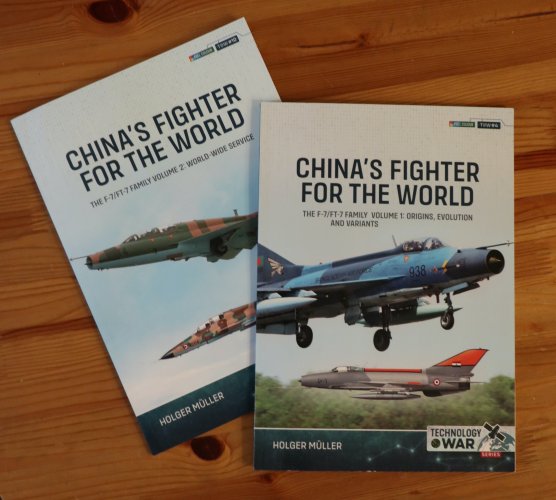
I hadn't heard of military history publisher Helion & Company Ltd of Warwick, England before Alberchico's post #1064 above, nor do I recall ever seeing their titles on the shelves of American bookstores. I have purchased via Amazon two newly published books about the F-7 fighter plane (Communist China's version of the MiG-21) by Holger Müller, who in his youth maintained MiG-21s for the air force of East Germany. The books apparently are translated from Mr Müller's original German, but the text reads well. I see that Helion paperbacks have a larger trim size and more pages than the popular titles of Osprey Publishing which they resemble. Good binding, and quality glossy paper.

I will watch their website for forthcoming Helion titles of interest. Thanks, Alberchico.
 

Attachments

  • Helion_books.jpg
    Helion_books.jpg
    2.6 MB · Views: 26
Sorry if it is out of topic, but I have an article here on David Baker for anyone who may be interested ....

The link would not allow me access, but I found your referred article "Space editor [David Baker] quits over fraud claims" on page 11 of the May 2021 issue of Physics World in my local public library. Baker resigned on 25 March 2021 as editor of the journal SpaceFlight after "allegations" that he hadn't worked for NASA on Gemini, Apollo, and Space Shuttle as he claimed, and never earned a doctoral degree. Baker declined comment for the article, and apparently has not provided any extenuating evidence for himself in the five years since, so it seems the allegations are confirmed, sadly. A lesson for all not to lie on one's resumé.
 
The link would not allow me access, but I found your referred article "Space editor [David Baker] quits over fraud claims" on page 11 of the May 2021 issue of Physics World in my local public library. Baker resigned on 25 March 2021 as editor of the journal SpaceFlight after "allegations" that he hadn't worked for NASA on Gemini, Apollo, and Space Shuttle as he claimed, and

I had lunch with Baker in February 2016 and he told me a fantastic story about his early work in the space program. It did not involve Gemini or Apollo. A few years later he called me and told me another really interesting story. I now believe those stories to be fabrications. I concluded that he had invented many stories about himself. It is clear he never had a Ph.D. It's not that hard to prove if you do have one. (If you want to know about mine, you can contact my alma mater. They provide that information for employee references and background checks.) Over many years he has written many articles and books. You can judge the quality of them for yourself and consider whether his personal fabrications are relevant to the quality of his publications.
 
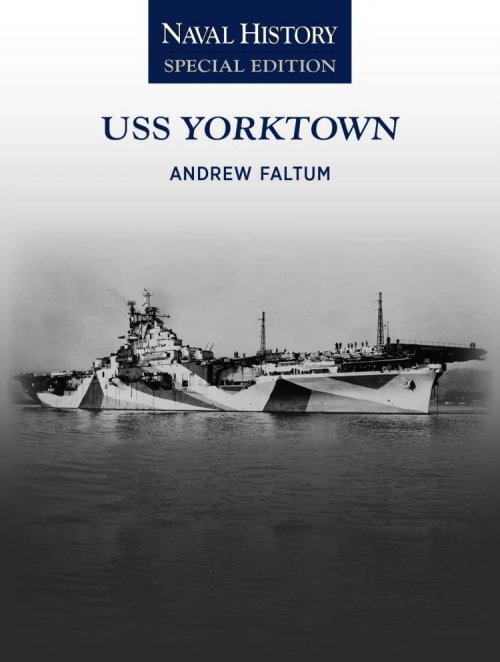
Just got notice from USNI Press that this has shipped. If you have their other books in this series you can envision the overall layout and content.

My impression is that these titles are tied to museums so that they can sell them in museum gift shops. The museum ships have more books about them for that reason. I wish some of the other Essex-class carriers would get better coverage, but I also wish that horses could fly.


9781682479810 copy.jpg
 
Looking foward to this "

Edit: This author has previously written a 3 volume history of the Israeli Air Force so this book would be Volume 4 for all intents and purposes.

https%3A%2F%2Fsubstack-post-media.s3.amazonaws.com%2Fpublic%2Fimages%2Fd7f5e479-cc64-4ea1-949f-0c074d017cbc_591x835.jpeg
 
Last edited:
Hawker's Secret Projects, Cold War Aircraft That Never Flew. By Christopher Budgen, expected November 2023.
Pen and Sword. Search engine https://www.startpage.com in two seconds flat
Oooh nice! [Budgen is] managing the archive at Brooklands, so this will be based on the archival materials there.
A good surprise of course,but I hope it sheds light on Hawker Type 1000 series,
Nice! I hope the Star Destroyer is in it. Hopefully be a Telford.

After his well-received 2023 volume Hawker's Secret Projects: Cold War Aircraft That Never Flew, Christopher Budgen has a new book Hawker's Naval Fighters: Camel to Sea Harrier to be published imminently. Sounds a bit short to do justice to the expansive subject, but let's see. The page is < https://www.pen-and-sword.co.uk/Hawkers-Naval-Fighters/p/58520 >.
 
After his well-received 2023 volume Hawker's Secret Projects: Cold War Aircraft That Never Flew, Christopher Budgen has a new book Hawker's Naval Fighters: Camel to Sea Harrier to be published imminently. Sounds a bit short to do justice to the expansive subject, but let's see. The page is < https://www.pen-and-sword.co.uk/Hawkers-Naval-Fighters/p/58520 >.
I knew Christopher was working on this, good to see it has come to fruition. Based on his previous books, it should be a good read and of course he has intimate access to the Brooklands archive so will be well researched.
 
I knew Christopher was working on this, good to see it has come to fruition. Based on his previous books, it should be a good read and of course he has intimate access to the Brooklands archive so will be well researched.
Me too - discussed it when I visited Brooklands in January this year.
 
Bill Gunston's 2009 book Nimrod: The Centenarian Aircraft doesn't include much about that plane's service during the 1982 Falklands War. On pp96-97, Gunston wrote that the upgrade from Nimrod MR.1 to MR.2 was about half done when Argentina invaded, and thereafter a rushed effort was made to add flight-refueling probes to MR.2s, for maritime reconnaissance in the South Atlantic to support Britain's Operation Corporate. But "whether MR.2 Nimrods played a direct role in Operation Corporate has not been revealed". The three Nimrod R.1 SIGINT spy planes also hurriedly got FR probes. Gunston wrote (p107) that at least one R.1 "was able to play an active role in the [Falklands War]. After the conflict, No. 51 Sqn proudly added 'South Atlantic' to the battle honors on its standard, but how it operated, and from which airfield(s), has yet to be disclosed".

Under continual attack by Argentine warplanes, the UK's Task Force came to rue that it had no airborne early warning. Yet sending one of the prototype Nimrod AEW.3s to the war zone seems to have been judged unworkable.

In his bestselling memoir, Admiral Sandy Woodward affirmed (pp289-291) that Nimrod MR.2s appeared over his task force, but he panned their effectiveness. "My basic annoyance with the Light Blue [i.e. Royal Air Force] involved their expeditions down to the war zone in the big RAF Nimrod maritime patrol aircraft with its excellent Searchwater radar. The idea had always been that they would fly over the area at a suitable height and report anything they found to us. This they did with whole heart, tireless effort and great enthusiasm. The trouble was they kept getting it wrong..." Woodward gave some examples of very mistaken surface contact reports from patrolling Nimrods. He was incited to send a rude signal of complaint to London, "indeed it set a new benchmark for rudeness". In its response HQ "informed me coldly that I appeared to have upset the entire High Command of the Royal Air Force. My reply was impolite. I intimated that I did not give a **** how upset they were, they had better start concentrating on accurate factual reporting".

In his 1992 book Sea Harrier Over the Falklands: A Maverick at War, Fleet Air Arm squadron leader Nigel 'Sharkey' Ward contradicts Admiral Woodward but evinces similar disdain for Nimrod MR.2s and for the RAF's efforts (p218): "The Nimrod was never once in evidence over the Task [Force] or in adjoining areas. If it had been it would, like the Vulcan, have been clamouring for fighter cover... The nearest the Nimrod came to the scene of action during the fighting was 600 miles to the north—and that was a one-off occasion". After the war as the RAF massaged the record (p270) "even the Nimrod with its Sidewinder fit was passed off as a genuine threat to Argentine fighters, and the papers were written in a manner which suggested that the Nimrod had actually appeared in the skies over the Task Force and the islands—which it did not".

Richard J. Aldrich mentions in his book GCHQ (rev 2019 edition, p390) that during the Falklands War, "The poor performance of the Nimrods, on which Britain had blown such a large slice of its sigint budget, is still a mystery. Lt Colonel David Chaundler, who served in the Defence Intelligence Staff until halfway through the campaign, asserted 'The Nimrods were achieving very little', despite the enormous effort that was being put into refueling them. At least eight maritime reconnaissance Nimrods operated from Ascension Island, and one R1 sigint aircraft seems to have flown from the Chilean base at Punta Arenas".

Aldrich's last sentence above cites Jon Lake's article in the July 2001 issue of Air International, "Nimrod R.1: The RAF's SIGINT Platform Extraordinaire". Lake wrote (p31) regarding the single Nimrod R.1 sent south for the Falklands War that "the operating base used by XW664 remains secret, but it is believed that it left [RAF Wyton in Cambridgeshire] on May 5, transiting via Bermuda... It has been rumoured that the [R.1] operated from Ascension Island, or even from Punta Arenas in Chile, perhaps alongside a detachment of 39 Squadron Canberra PR.9s, but this is pure speculation and cannot be confirmed". For his 2009 book Bill Gunston either overlooked Jon Lake's article or (unlike Richard J. Aldrich) considered its Chile speculation doubtful.

In his 2014 book Exocet Falklands: The Untold Story of Special Forces Operations, Ewen Southby-Tailyour claimed (pp173-174) that Nimrod R.1 XW664, backed by a VC10 tanker, made three flights from Chile's San Félix Island in May 1982, staying within Chilean airspace. It would have flown more as was requested by Admiral Sandy Woodward, but the reveal of Operation Plum Duff's landed Sea King helicopter made Chile get cold feet, and XW664 returned to RAF Wyton on 22 May. Southby-Tailyour provided no source for the above.

Perhaps Chris Gibson's forthcoming new book Hawker Siddeley HS.801 Nimrod: Outstanding in the Role, intended as a definitive technical history, will provide fuller info about Nimrod service during the Falklands campaign. With Nimrods retired fifteen years ago (and Chile now openly backing Argentina's claim to the Falklands, so no need to continue shielding them), maybe His Majesty's Government has since declassified formerly secret matters, allowing richer detail. A representative at Crécy Publishing tells me that publication of Gibson's book has been pushed back to October of this year. I look forward to it.

 
Will projects be discussed in this new book by Bugden, or only those designs which flew or were manufactured?
 

Similar threads

Back
Top Bottom