The X-37 shows you don’t have to hide everything behind a cranked delta wing….still…
 
I never said it did...most of shuttle was on top of a Delta...X-37 has a somewhat more conventional tail
 
Early version of the "Blackhorse" design?

Randy
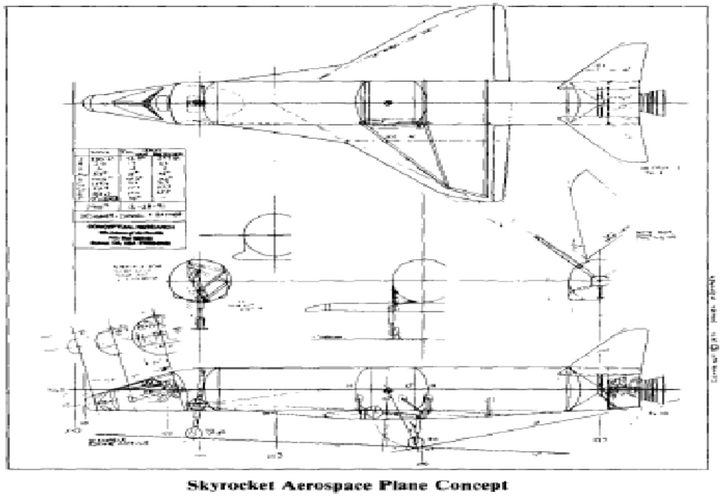
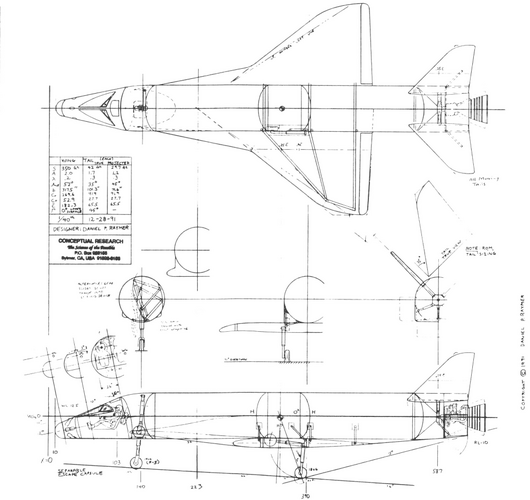
No, unrelated. It was an RL-10-powered vehicle to be carried by a large jet aircraft and then boost to orbit. I've never seen much on it. The diagram is, I'm sure, in at least one edition of Raymer Conceptual Design books, but it seems to be an edition I don't have.
 
Last edited:
I never said it did...most of shuttle was on top of a Delta...X-37 has a somewhat more conventional tail
No, not really. From the back side, the X-37 almost looks like the shuttle. The part of the fuselage that extends past the wing is like the shuttle tail flap.
 
The X-37 shows you don’t have to hide everything behind a cranked delta wing….still…
Additionally, you don't write how most people think and you make references that nobody else understands

"hide everything behind a...." So, does this mean that the fuselage of the X-37 extends past the delta wing, unlike the shuttle? or is it in reference to the payload bay location?
 
What could be the operational use of that "spaceplane"? I can make speculations only.
 
What could be the operational use of that "spaceplane"? I can make speculations only.
"Cheap" space launch. Just heard back from Dan Raymer; it was a 1991 design for Hudson. All I have now is the diagram; it seems that the entirety of the payload was the two crew. Unsurprising given that it's a relatively small LOX/LH2 vehicle.

This was before the X Prize, before the space launch boom/bust bubble later in the 90's.
 
"Cheap" space launch. Just heard back from Dan Raymer; it was a 1991 design for Hudson. All I have now is the diagram; it seems that the entirety of the payload was the two crew. Unsurprising given that it's a relatively small LOX/LH2 vehicle.

This was before the X Prize, before the space launch boom/bust bubble later in the 90's.

Any military kind of use???
 
Any military kind of use???
Presumably, though no reports on this design are currently available. But without much payload, it'd be something like the X-37 I suppose... assuming an unmanned variant. The crew and their capsule seem to consume the full payload potential of the vehicle.
 
The SkyRocket project lasted a few months, in Mountain View CA, in 1990. I worked on it for Gary Hudson. Tom Clancy was the financier. It was a single stage to orbit, unassisted, spaceplane. We were building a prototype, but were 'all thumbs' as they say when it came to graphite epoxy aircraft assembly. Our team members include Jim Grote, Marvin Horton and Dave Hoerr. And, of course, Gary's wife, Anne Hudson. This was 3-4 years before Bevin McKinney joined our team. Anyway, once we realized how inexpensive the SkyRocket was, off the shelf engine and graphite epoxy vehicle construction, we canceled the project. And returned the unspent money to Tom Clancy, with the apologies for our lack of aircraft construction competence! You can see an artist's render of the SkyRocket here: https://www.facebook.com/photo?fbid=1294574122937&set=a.1293829864331

 
Bless you for trying.

Maybe a different propellant choice and release from Stratolaunch’s ROC might allow a metal body. Neutral Hexanitrogen will store as a modest cryogenic—but has twice the energy density of RDX.

That should allow a rugged airframe—and perhaps allow individuals like yourself to kick composites to the curb.
 
No, unrelated. It was an RL-10-powered vehicle to be carried by a large jet aircraft and then boost to orbit. I've never seen much on it. The diagram is, I'm sure, in at least one edition of Raymer Conceptual Design books, but it seems to be an edition I don't have.
The SkyRocket project lasted a few months, in Mountain View CA, in 1990. I worked on it for Gary Hudson. Tom Clancy was the financier. It was a single stage to orbit, unassisted, spaceplane. We were building a prototype, but were 'all thumbs' as they say when it came to graphite epoxy aircraft assembly. Our team members include Jim Grote, Marvin Horton and Dave Hoerr. And, of course, Gary's wife, Anne Hudson. This was 3-4 years before Bevin McKinney joined our team. Anyway, once we realized how inexpensive the SkyRocket was, off the shelf engine and graphite epoxy vehicle construction, we canceled the project. And returned the unspent money to Tom Clancy, with the apologies for our lack of aircraft construction competence! You can see an artist's render of the SkyRocket here: https://www.facebook.com/photo?fbid=1294574122937&set=a.1293829864331

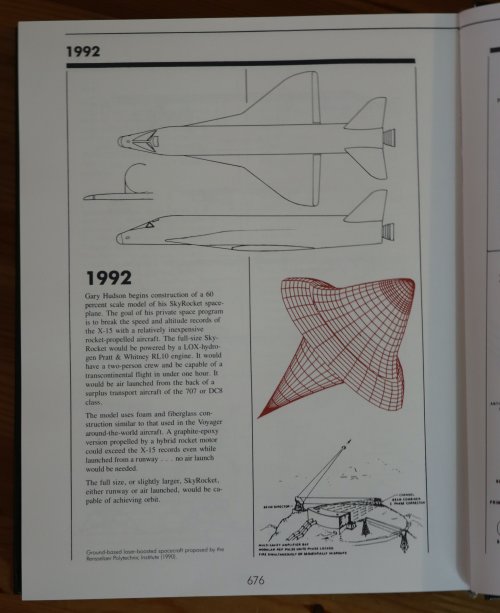
Ron Miller's hefty 1993 book The Dream Machines: A Pictorial History of the Spaceship in Art, Science and Literature included an entry on Gary Hudson's proposed SkyRocket; see my attached JPEG. The same illustration as Millenium linked to is also included in this book, in a color insert. The rocket plane shown here and in the sketch Hesham found is too small to get anywhere near orbital velocity; instead it was (as Mr Miller's text describes) intended to exceed the X-15's max speed and altitude. A space version of SkyRocket would have to approach the size of the Teledyne Brown Spaceplane (173t) or Interim HOTOL (250t)—rather heavy for a repurposed airliner to bear aloft. In any case, launch from the back of an airplane is by definition not a single-stage-to-orbit vehicle.

Nonetheless, I applaud the late Tom Clancy's farsighted aerospace investments (also in Rotary Rocket Company, which flew a Roton testbed before collapsing).
 

Attachments

  • SkyRocket.jpg
    SkyRocket.jpg
    1.9 MB · Views: 38

Similar threads

Back
Top Bottom