it originated in the Klemm-Flugzeugwerke Halle that had been founded in 1934
as a branch of Leichtflugzeugbau Klemm in Böblingen. Its name changed to Siebel Flugzeugwerke when it was taken over by Friedrich Siebel in December 1937.
After World War II the company was revived as Siebel Flugzeugwerke ATG (SIAT) in West Germany in 1948, with its headquarters in Munich. In 1956, its headquarters were moved to Donauwörth and the company became WMD-Siebelwerke ATG (WMD/SIAT) in 1958 in cooperation with Waggon- und Maschinenbau GmbH Donauwörth (WMD). In 1968 the company was absorbed by Messerschmitt-
Bölkow-Blohm after MBB became the major shareholder.
Its products were;
Fh.104,Si,201,Si.202,Si.204,Si.304,Si.308,SIAT.311,SIAT.313,SIAT.222,SIAT.223,SIAT.224 & BS.210,later I will talk about them.
Fh.104 Hallore was a low-wing twin engined small transport monoplane,powered by two 280 hp Hirth HM 508D V-8 inverted air-cooled piston engines Si.201 was a two-seat shoulder-wing STOL reconnaissance,observation and army cooperation monoplane,powered by one 240 hp Argus As 10C air-cooled inverted V8 engine Si.202 Hummel was a side-by-side two-seat low-wing sporting monoplane,it was appeared in three versions;
Si 202a: with 45 hp nine-cylinder radial Salmson 9Ad engine
Si 202b: with 55 hp four-cylinder in-line air-cooled Zundapp 9-092 engne
Si 202c: with 60 hp four-cylinder in-line air-cooled Hirth HM 515 engine,this variant had slightly extended and noticeably rounded tips to wings and tail surfaces Si.204 was a low-wing light transport and trainer monoplane,based on Fh.104,powered by two 590 hp Argus As 411-A1 V-12 inverted air-cooled
piston engines,its variants;
Si.204 was a prototypes each given a separate V number; Fifteen built by Siebel
at Halle
Si.204A was a pre-production A-0 and initial production A-1 passenger transports built at SNCAN (Société Nationale de Constructions Aéronautiques du Nord) in France.
Si.204D was a blind flying trainer developed by ČKD (BMM) in the Protectorate of Bohemia and Moravia; the first D-0 pre-series aircraft was delivered in January 1943 plus another 44. Production of the D-1 was carried out by Aero and BMM.
D-3 aircraft were built with wooden wings and tailplanes in an effort to relieve pressure on the aluminum supply
Si.204E was a version of Si.204D,fitted with DL-131 gun turret SIAT Fighter was a fighter or fighter-bomber project,no more details SIAT Mistel it was the Mistel aircraft project with Focke-Wulf FW,190bis,and powered by four rocket engines,
early 1944 SIAT Volksjäger was not known,but may it was a Volksjäger proposal fighter project of 1944/9
**** Postwar :-
SIAT XXX was not known,but may it was a further development of DFS.346,there have been some changes
in the design of the machine, have improved the sealing of the fuselage, landing fences at the ends of the
wing BS 210 (Bolkow-Siebel) was a STOL utility transport aircraft project,had a high wing and powered by two Turbomeca Astazou X engine SIAT 222 Super-Hummel was developed from Si.202 Hummel as a side-by-side two seat trainer and sporting monoplane,
later became SIAT-223 SIAT 223 Flamingo was based on SIAT-222,it had a conventional low-wing monoplane with fixed tricycle undercarriage. The cockpit was enclosed by a large bubble canopy,its versions;
SIAT-223A-1 Flamingo Trainer A1 Two or four-seat trainer aircraft, powered by a 200-hp Avco Lycoming IO-360 piston engine
SIAT-223K-1 Flamingo Trainer K1 Single-seat aerobatic aircraft, powered by a 200-hp Avco Lycoming AIO-360 piston engine
SIAT-223T-1 Flamingo Trainer T1 One aircraft fitted with a turbocharged 210-hp Avco Lycoming TO-360-C1A6D piston engine
SIAT-223-M4 The Model 223T-1 Flamingo Trainer T1 was later fitted with a Porsche PFM 3200 engine.One aircraft only SIAT 224 was twin engined low-mid-wing STOL military observation and photographic aircraft project of the 1960s SIAT 224/II was a four-seat sports aircraft, dated April 20, 1963 SIAT 225 was a four-seat sports aircraft, dated November 10, 1963 SIAT 226 was a VTOL and STOL multi-role aircraft, dated December 13, 1961 SIAT 227 was a VTOL and STOL multi-role aircraft, dated December 29, 1961 SIAT 228 was a VTOL and STOL multi-role aircraft, dated January 2, 1962 SIAT 229 was a VTOL and STOL multi-role aircraft, dated April 3, 1962 SIAT 230 was a VTOL and STOL multi-role aircraft from January 5, 1962 SIAT 231 was a VTOL and STOL multi-role aircraft from January 9, 1962 SIAT 232 was a VTOL and STOL multi-role aircraft from January 12, 1962 SIAT 233 was a VTOL and STOL multi-role aircraft from December 4, 1961 SIAT 234 was a VTOL and STOL multi-role aircraft from December 12, 1961 SIAT 235& 235T were an Experimental aircraft, undated SIAT 236 was a Preliminary design of an S-type aircraft from July 20, 1961 SIAT 237 was a Preliminary design of an S-type aircraft from July 25, 1961 SIAT 238 was a Preliminary design of an S-aircraft dated July 26, 1961 SIAT 239 / 240 were not included SIAT 241 / 243 was a Preliminary design of a ground attack aircraft, undated SIAT 244 was a STOL ground attack aircraft, design I, dated March 18, 1963 SIAT 245 was a STOL ground attack aircraft, design II, dated March 26, 1963 SIAT 246 was a STOL ground attack aircraft, design III, dated April 9, 1963 SIAT 247 / 300 were not included SIAT 301A was a STOL multi-role aircraft, dated January 24, 1962 SIAT 301B was a STOL multi-role aircraft, dated March 15, 1962 SIAT 301C was a STOL multi-role aircraft, dated July 17, 1962 SIAT 301E was a Multi-role aircraft from March 28, 1962 SIAT 301 was a STOL multi-role aircraft from July 31, 1962 SIAT 302 was a Ground attack support aircraft from April 16, 1962 SIAT 303 was an Experimental aircraft from February 10, 1962 SIAT 303A was an Experimental aircraft from May 11, 1962 SIAT 303F was an Experimental aircraft from August 24, 1962 SIAT 304 was a Ground attack support aircraft from April 26, 1962 SIAT 305E was a STOL experimental aircraft from May 18, 1962 SIAT 305 was a Research aircraft from June 25, 1962 SIAT 306 was a VTOL and STOL ground attack support aircraft from June 2, 1962 SIAT 307 E1 was a VTOL and STOL Ground Support Aircraft project,1962 SIAT 307 E2 was a STOL Ground Support Aircraft project,1962 SIAT 307 was a VTOL Aircraft project,1962 SIAT 308 was a three-seat light aircraft,based on Hummel,I don't know if it was built or not SIAT 309 ------? SIAT 310 was a STOL multi-role aircraft from April 12, 1962 SIAT 311A was a high-wing twin turbofans regional small transport aircraft project,could accommodated two crew and 20 passenger SIAT 311-I was a STOL cruise aircraft from February 11, 1962 SIAT 311-II was a Cruise and courier aircraft (12-14 passengers) dated July 13, 1962 SIAT 311E was a STOL light commercial aircraft (10+2 passengers) dated July 26, 1962 SIAT 311 was a Tourist and courier aircraft dated August 20, 1962 SIAT 311-1 was a Tourist and courier aircraft (17+13 seats) dated January 30, 1963
(comment: I am sure this is a typing error, should be 17+3 instead of 17+13) SIAT 311A was a STOL tour aircraft (17+3 seats) dated March 9, 1965 SIAT 312 was Not included SIAT 313 was probably developed from SIAT-311,as a short-takeoff ground attack aircraft Project,
studied the possibility of turbofan engines with high by-pass ratio air for blowing out at to branch
off wings. SIAT 313 was a Research aircraft dated December 1, 1962 SIAT 313-III was a Research aircraft dated December 11, 1962 SIAT 313-IV was a Research aircraft from December 19, 1962 SIAT 313-A was a Research aircraft from November 13, 1963 SIAT 313 S-I was a Research aircraft from March 14, 1964 SIAT 313 S-II was a Research aircraft from April 24, 1964 SIAT 313 S was a Research aircraft from May 20, 1964 SIAT 313 E (handwritten addition) was a Test aircraft from April 28, 1965 SIAT 313 (handwritten addition) was a Ground attack aircraft from May 5, 1965 SIAT 314 (handwritten addition) was a Ground attack aircraft from May 3, 1965 SIAT 315 / 322 were Not included SIAT 323 was a Test aircraft from November 5?? SIAT 333 was a Test aircraft from October 30?? SIAT 333 II (handwritten addition, no further information) SIAT 410 was a Multi-role aircraft from September 8, 1961 SIAT 411 was a STOL touring aircraft (48-52 seats) from January 28, 1964 SIAT 413 was a Ground attack support aircraft from March 21, 1964 SIAT XXX was a proposal for Airbus,as a jet airliner project,led to
developed A.300
SIAT
Sorry for the late response, Hesham, I was busy in some other topics during the past few months.
The SIAT table has:
222 to 238 dated 1961/63
239/240 missing
241 to 246 dated 1963
247 to 300 missing
301 to 307, which are all dated 1962.
then there is a gap 308-309
310 to 314 with missing 312 dated 1962/65
next is 323 and 333 experimentals
and finally 410, 411 and 413 of 1964.
As far as I yet found out ...
... the "222" designator was already picked up in 1952 by Friedrich Siebel as the followup development of the Siebel Si 202.
... the SIAT 222 was delayed in 1955 due to the massive workload from the Luftwaffe license production, but continued in early 60s
.... the use of designators 222-4xx started in 1961 and ended in 1965, when Bölkow took over the SIAT Development Office to
his development team. No SIAT developments post 1965.
... Developments before 1961 (I did only find a few) seem not to have systematic designator numbers.
i.e. Bölkow-SIAT BS210 or the Mirage Canard Proposal
by the way ... my origin question .... the Macchi 308 was designated in 1952 as Siebel-Macchi Si-MB308
... I did not find any reasons for the different blocks 2xx, 3xx, 4xx or why they stopped at 246 and continue with 301
from the development dates and the type of aircraft development you find everything in every block
A probable answer might be, that the blocks are built to separate different subvention sources for the development,
i.e. financed by BMVg or financed by the Ministry of Economics, or Ministry of Traffic .... BUT THIS IS AN ASSUMPTION UNPROVED!
- The single missed numbers in the sequence might have been deleted (i.e. not started or hidden development)
because the table has blank lines, where the numbers should have been explained.
I will add the SIAT list soon here.
There are copyright restrictions on the package,
otherwise I would have added a scan of the list here already
Let me start the Siebel designator list with a few comments about the early designators before 1946.
1. Originally the new facility in Halle was planned as Klemm facility, where the Boblingen plant should be moved to in 1936
2. Fecher's Klemm Development Office moved from Boblingen to Halle in spring 1936
3. they brought three development projects from Boblingen to Halle, originally named Klemm Kl101, Kl102, Kl104
(I am quite sure, there must have been a Kl103 as well, but I never saw any document or reference for that)
4. At the same time the "Klemm Flugzeugwerke Halle" was renamed into "Flugzeugwerk Halle"
when the decision was made to keep the Klemm Boblingen plant open for the civil aircraft production.
5. The Klemm Kl104 was already under development in Boblingen and was soon continued at Halle
getting the designator Fh (Flugzeugwerk Halle) 104.
This Fh104 designator was kept even after the company was renamed to Siebel Flugzeugwerke in 1938,
as the development was finished and the aircraft was approved as Fh104
6. Development of the 101/102 was not started in spring 1936
Therefore a new specification was issued by RLM for both developments in summer 1936
most probably with the designator Fh201 and Fh202
which changed to Si201 and Si202, when the company was renamed to Siebel Flugzeugwerke
7. Miracle still is the 103/203 (of which the first later became the V1)
Since the beginning of the Halle plant, it was mostly a production facility.
Following the above developments there was only one development request for an improved Fh104, called the Si204.
Following the Si204, the development capacities in Halle were reduced to the "workfloor" engineering.
A few things were still developed in Halle, but mostly modifications of existing designs.
The 346 is not a Siebel designator and it is even not a Siebel development
This development started at DFS in Ainring, but when the design was finished, DFS needed a facility to built the prototype.
This brought the 346 to Halle, which was never called Si346 or something like that.
Later this development was moved to Podbersje by the Soviets, where it was continued by Siebel staff in OKB2 design office
and sometimes mentioned as OKB2 I346. Btw. the OKB2 also developed the I-446, I-466, I-468, I-478 rocket fighters
which from my point of view also belong to the Siebel development line.
I have no further developments in Halle until 1945
Would be nice, if some of you have some.
...
Later this development was moved to Podbersje by the Soviets, where it was continued by Siebel staff in OKB2 design office
and sometimes mentioned as OKB2 I346. Btw. the OKB2 also developed the I-446, I-466, I-468, I-478 rocket fighters
which from my point of view also belong to the Siebel development line.
...
for the Podbersje part of the Siebel work, I would recommend:
Sobolew / Deutsche Spuren in der sowjetischen Luftfahrt
It is still the most reliable work, even if it missed some things.
You also find a lot in the CIA reports from the 1946/1955s,
however there is quite often a lot of nonsense reported
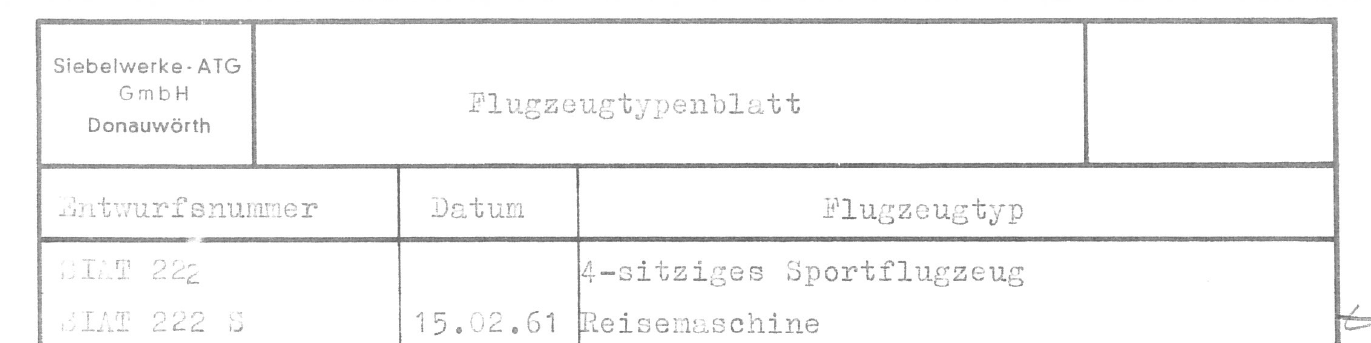
And here is the postwar SIAT designator list from the SIAT FLUGZEUGTYPENBLATT
Background of this list is unknown, most probably it was generated as a SIAT drawing list.
Last machine written entry is vom March 1965, handwritten additions from May 1965.
That was the time, when the SIAT Development Team was transfered to Bölkow Entwicklungen KG.
No further SIAT developments after 1965.
Interesting is, that no designs from pre 1961 are included, i.e. Bölkow-SIAT BS210, Siebel-Macchi Si-MB308
I kept it in German as mentioned in the list
I would recommend to keep this list unchanged as the original SIAT docu
and combine it with Heshams list above.
Would be great, if we get some more infos about the individual designs.
A few, we have already here.
Let's start with a copy of the list layout
And here we go with the entries:
SIAT 222
4-sitziges Sportflugzeug, ohne Datum
SIAT 222S
Reisemaschine vom 15.02.1961
SIAT 223
2-sitziges Sportflugzeug, ohne Datum
SIAT 224
4-sitziges Reiseflugzeug vom 20.04.1963
SIAT 225
4-sitziges Reiseflugzeug vom 10.11.1963
SIAT 226
VTOL- und STOL-Mehrzweckflugzeug vom 13.12.1961
SIAT 227
VTOL- und STOL-Mehrzweckflugzeug vom 29.12.1961
SIAT 228
VTOL- und STOL-Mehrzweckflugzeug vom 02.01.1962
SIAT 229
VTOL- und STOL-Mehrzweckflugzeug vom 03.04.1962
SIAT 230
VTOL- und STOL-Mehrzweckflugzeug vom 05.01.1962
SIAT 231
VTOL- und STOL-Mehrzweckflugzeug vom 09.01.1962
SIAT 232
VTOL- und STOL-Mehrzweckflugzeug vom 12.01.1962
SIAT 233
VTOL- und STOL-Mehrzweckflugzeug vom 04.12.1961
SIAT 234
VTOL- und STOL-Mehrzweckflugzeug vom 12.12.1961
SIAT 235 und 235T
Versuchsflugzeug, undated
SIAT 236
Vorprojekt eines S-Flugzeugs vom 20.07.1961
SIAT 237
Vorprojekt eines S-Flugzeugs vom 25.07.1961
SIAT 238
Vorprojekt eines S-Flugzeugs vom 26.07.1961
SIAT 239 / 240
not included
SIAT 241 / 243
Vorprojekt eines Erdkampf-Flugzeugs, ohne Datum
SIAT 244
STOL-Erdkampfflugzeug Entwurf I vom 18.03.1963
SIAT 245
STOL-Erdkampfflugzeug Entwurf II vom 26.03.1963
SIAT 246
STOL-Erdkampfflugzeug Entwurf III vom 09.04.1963
SIAT 247 / 300
not included
SIAT 301A
STOL-Mehrzweckflugzeug vom 24.01.1962
SIAT 301B
STOL-Mehrzweckflugzeug vom 15.03.1962
SIAT 301C
STOL-Mehrzweckflugzeug vom 17.07.1962
SIAT 301E
Mehrzweckflugzeug vom 28.03.1962
SIAT 301
STOL-Mehrzweckflugzeug vom 31.07.1962
SIAT 302
Erdkampf-Unterstützungsflugzeug vom 16.04.1962
SIAT 303
Versuchsflugzeug vom 10.02.1962
SIAT 303A
Versuchsflugzeug vom 11.05.1962
SIAT 303F
Versuchsflugzeug vom 24.08.1962
SIAT 304
Erdkampf-Unterstützungsflugzeug vom 26.04.1962
SIAT 305E
STOL-Versuchsflugzeug vom 18.05.1962
SIAT 305
Forschungsflugzeug vom 25.06.1962
SIAT 306
VTOL und STOL-Erdkampf-Unterstützungsflugzeug vom 02.06.1962
SIAT 307E1
VTOL- und STOL-Erdkampf-Unterstzungsflugzeug vom 21.06.1962
SIAT 307E2
STOL-Erdkampf-Unterstzungsflugzeug vom 22.06.1962
SIAT 307
STOL-VTOL-Flugzeuge vom 01.12.1962
SIAT 308 / 309
Not included
SIAT 310
STOL-Mehrzweck-Flugzeug vom 12.04.1962
SIAT 311-I
STOL-Reiseflugzeug vom 11.02.1962
SIAT 311-II
Reise- und Kurier-Flugzeug (12-14 Pers.) vom 13.07.1962
SIAT 311E
STOL-Kleinverkehrs-Flugzeug (10+2 Pers.) vom 26.07.1962
SIAT 311
Reise- und Kurierflugzeug vom 20.08.1962
SIAT 311-1
Reise und Kurierflugzeug (17+13 Sitze) vom 30.01.1963
(comment: I am sure this is a typing errror, should be 17+3 instead 17+13)
SIAT 311A
STOL-Reiseflugzeug (17+3 Sitze) vom 09.03.1965
SIAT 312
Not included
SIAT 313
Forschungsflugzeug vom 01.12.1962
SIAT 313-III
Forschungsflugzeug vom 11.12.1962
SIAT 313-IV
Forschungsflugzeug vom 19.12.1962
SIAT 313-A
Forschungsflugzeug vom 13.11.1963
SIAT 313 S-I
Forschungsflugzeug vom 14.03.1964
SIAT 313 S-II
Forschungsflugzeug vom 24.04.1964
SIAT 313 S
Forschungsflugzeug vom 20.05.1964
SIAT 313 E (handwritten addition)
Erprobungsflugzeug vom 28,04,1965
SIAT 313 (handwritten addition)
Erdkampfflugzeug vom 05.05.1965
SIAT 314 (handwritten addition)
Erdkampfflugzeug vom 03.05.1965
SIAT 315 / 322
Not included
SIAT 323
Versuchsflugzeug vom 05.11.??
SIAT 333
Versuchsflugzeug vom 30.10.??
SIAT 333 II (handwritten addtion, no further info)
SIAT 410
Mehrzweckflugzeug vom 08.09.1961
SIAT 411
STOL-Reiseflugzeug (48-52 Sitze) vom 28.01.1964
SiAT 413
Erdkampf-Unterstützungs-Flugzeug vom 21.03.1964
Boxite ...
probably you have seen the Russian И?
I guess, this is the abbreviation for fighter aircraft (истребитель)
The "I"-Prefix is mostly found with Siegfried Günter's designs at the OKB2,
probably because Günter was explicit developing fighter aircraft designs,
while the Roessing team was working on the 346 experimental design.
SIAT 311
Tourist and courier aircraft dated August 20, 1962
SIAT 311-1
Tourist and courier aircraft (17+13 seats) dated January 30, 1963
(comment: I am sure this is a typing error, should be 17+3 instead of 17+13)
SIAT 311A
STOL tour aircraft (17+3 seats) dated March 9, 1965
SIAT 312
Not included
SIAT 313
Research aircraft dated December 1, 1962
SIAT 313-III
Research aircraft dated December 11, 1962
SIAT 313-IV
Research aircraft from December 19, 1962
SIAT 313-A
Research aircraft from November 13, 1963
SIAT 313 S-I
Research aircraft from March 14, 1964
SIAT 313 S-II
Research aircraft from April 24, 1964
SIAT 313 S
Research aircraft from May 20, 1964
SIAT 313 E (handwritten addition)
Test aircraft from April 28, 1965
SIAT 313 (handwritten addition)
Ground attack aircraft from May 5, 1965
SIAT 314 (handwritten addition)
Ground attack aircraft from May 3, 1965
SIAT 315 / 322
Not included
SIAT 323
Test aircraft from November 5??
SIAT 333
Test aircraft from October 30??
SIAT 333 II (handwritten addition, no further information)
SIAT 410
Multi-role aircraft from September 8, 1961
SIAT 411
STOL touring aircraft (48-52 seats) from January 28, 1964
SIAT 413
Ground attack support aircraft from March 21, 1964
Looks more like one of the SIAT 226/234
Mühlbauer mentions in his article, that the SIAT 224 was used twice ... for the STOL multirole aircraft and for the 4 seater sports aircraft.
Mühlbauer's source was a SIAT-study "SIAT 224" dated 28.11.1961, which fits with the dates of 226/234
JUST A GUESS:
Probably this multirole aircraft was intially developed under the SIAT 224 designator
Mühlbauer shows at least three configurations of that SIAT 224.
Probably the different configurations were reallocated later as individual SIAT types 226/234
and 224/225 were reserved for further developments of the 222/223.
That might explain, why the list does not mention a double use of the 224 designator.
If this is correct, that must have happened shortly after the SIAT 224 multirole Study was finished in Dec. 1961
BUT UNPROVED ASSUMPTION!
I try to check with Airbus, if there is any drawing of the 224 sports aircraft or if they have more infos about 226/234.
Siebelwerke ATG GmbH was engaged in almost all Luftwaffe aircraft equipments since 1956. WMD built major aircraft parts for the German production of Noratlas (tail), Starfighter (rear fuselage, nose radom), Breguet Atlantic (tail and bottom flap), Transall (tail plus ...). At least Starfighter and Atlantic were produced under NATO survey.
However, I am not sure, if some of their own designs were done on behalf of NATO. Especially the VTOL-designs were handled on behalf of the German government. The 223 came up from a low cost trainer competition in 1961, which was organised by the DLR. As far as I found out yet, most of their designs were competing with designs of other German aircraft manufacturers.
Siebelwerke ATG GmbH was engaged in almost all Luftwaffe aircraft equipments since 1956. WMD built major aircraft parts for the German production of Noratlas (tail), Starfighter (rear fuselage, nose radom), Breguet Atlantic (tail and bottom flap), Transall (tail plus ...). At least Starfighter and Atlantic were produced under NATO survey.
However, I am not sure, if some of their own designs were done on behalf of NATO. Especially the VTOL-designs were handled on behalf of the German government. The 223 came up from a low cost trainer competition in 1961, which was organised by the DLR. As far as I found out yet, most of their designs were competing with designs of other German aircraft manufacturers.
Most of the SIAT Military Designs are still classified.
However, I am quite sure, that SIAT was never in direct contact with NATO regarding aircraft designs
as the leading organisations were MTT or Dornier and later FUS and EWR.
SIAT worked on behalf of one of these leading organisations or on their own development risc.
Probably the 2xx, 3xx, 4xx designators give a hint for the kind of SIAT development
Just a guess:
2xx SIAT published own designs
3xx SIAT designs on behalf of EWR/FUS
4xx SIAT initiated proposals for i.e. EWR/FUS.
Hard to approve that without the classified drawings.
From my current view, SIAT just had three development lines between 1961 and 1965
aside from the 222/223 sport aircraft design
a) V/STOL multipurpose transporter
b) V/STOL ground attack support aircraft (VAK)
c) STOL passenger- and business aircraft
which one can trace sequentially through the 2xx-3xx-4xx designators.
Interesting, that EWR/FUS mostly concentrated on the VJ design,
while SIAT as an EWR member was exclusively focusing on the VAK design.
And none of the SIAT VAK designs were continued (at least I did not find one),
when the SIAT construction office was absorbed by Bölkow in 1966.
Surely because Bölkow was thinking of helicopters instead of aircraft for VAK-missions.
Also interesting, that SIAT 311 implemented Bölkows boundary ideas,
which he originally would have implemented in the Ryan BLC-7 cooperative design.
So SIAT 311 seems to be Bölkow-initiated at SIAT.
Probably someone has more infos/ideas about these ASSUMTIONS (!!!) ?
Probably the 2xx, 3xx, 4xx designators give a hint for the kind of SIAT development
Just a guess:
2xx SIAT published own designs
3xx SIAT designs on behalf of EWR/FUS
4xx SIAT initiated proposals for i.e. EWR/FUS.
Hard to approve that without the classified drawings.
From my current view, SIAT just had three development lines between 1961 and 1965
aside from the 222/223 sport aircraft design
a) V/STOL multipurpose transporter
b) V/STOL ground attack support aircraft (VAK)
c) STOL passenger- and business aircraft
which one can trace sequentially through the 2xx-3xx-4xx designators.
Interesting, that EWR/FUS mostly concentrated on the VJ design,
while SIAT as an EWR member was exclusively focusing on the VAK design.
And none of the SIAT VAK designs were continued (at least I did not find one),
when the SIAT construction office was absorbed by Bölkow in 1966.
Surely because Bölkow was thinking of helicopters instead of aircraft for VAK-missions.
Also interesting, that SIAT 311 implemented Bölkows boundary ideas,
which he originally would have implemented in the Ryan BLC-7 cooperative design.
So SIAT 311 seems to be Bölkow-initiated at SIAT.
Probably someone has more infos/ideas about these ASSUMTIONS (!!!) ?
That's a shock for me,and in some books of DDL,they mentioned this relationship and
how MBB was taken over SIAT 311 & 313 developments,and I have a two drawings for
EWR projects,without the source,and may they are belonged to also SIAT as you claimed,
who knows ?!.
This site uses cookies to help personalise content, tailor your experience and to keep you logged in if you register.
By continuing to use this site, you are consenting to our use of cookies.