Shuttle Single Orbit Mission

Byeman

ACCESS: Top Secret
Senior Member
Joined
8 January 2010
Messages
3,463
Reaction score
3,062
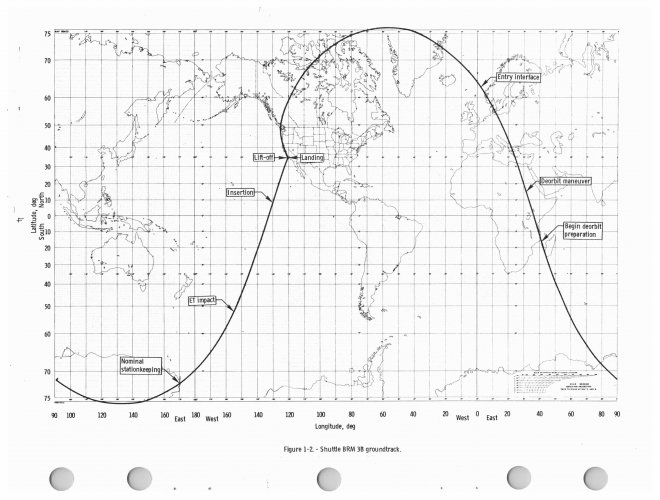
This is the ground track of the shuttle single orbit mission, Baseline Reference Mission - 3A/B. BRM-3A was a deployment mission and 3B was a retrieval mission. Notice it avoids the Soviet land mass and the deployment/rendezvous would occur over Antarctica. There were some that thought this was the mission that was to "steal" a Soviet satellite. But there was a little issue with this: what Soviet satellite flew at 104 degrees inclination?

 

Attachments

  • Pages from shuttle_baseline_reference_missions_vol4_mission_3b.jpg
    Pages from shuttle_baseline_reference_missions_vol4_mission_3b.jpg
    2.4 MB · Views: 38
Very well explained here by the top historians on the matter
Asif Siddiqi
Bart Hendrickx
Dwayne A. Day

https://www.thespacereview.com/article/3873/1
https://www.thespacereview.com/article/3876/1
That specific part is of interest here

Despite the benefit of 40 years of hindsight, Sikharulidze does not appear to have any second thoughts about the conclusions he formulated in the report. He even seems to believe an outlandish assertion made by space program veteran Vyacheslav Filin that the shuttle actually performed a “dive over Moscow” during one of its missions. Filin, who was a deputy chief designer of the Energiya rocket, first made this totally unsubstantiated claim in an interview in 1998 and has reiterated it several times since, most recently in an interview published in November 2018.

Although the shuttle never flew from Vandenberg, Sikharulidze notes that it still could have made such a maneuver when returning from a mission in a 57-degree inclination orbit launched from the Kennedy Space Center. He does admit that such missions would have lost their surprise effect because the orbiter would not have been able to return to Earth after the first orbit and, instead of approaching Moscow from the south, would have had to overfly the entire country from east to west, giving Russian early warning systems ample time to detect it. For some reason, he singles out three shuttle missions that flew in 57-degree inclination orbits (STS-64, 68 and 99), but without specifically linking any of those to the alleged “dive over Moscow” (there were actually 20 shuttle missions that used this inclination.) Filin has usually referred to a mission in 1985, but has never specified which one.
 
Back
Top Bottom