I think the OP’s point is that the J-16 is simply much more thoroughly developed for modern A2A combat than Russian-/export-Flankers, which isn’t exactly a difficult point to agree with... It also ties into the visual evidence of the signature-reduction work done on the J-16...
In this case the answer will be no. Chinese aircraft community tend to iterate chinese fighters upwards every cycle some voice thinks of something.

Signature reduction work is far more prominent on 2010s iterations of Russian aircraft (su-35s, mig-29k) than on Chinese ones(flankers at least; j-10c is more controversial); the only Chinese 4th gen fighter aircraft where visual part of signature management really becomes apparent is J-15T.

Even there it's hard to tell if it's thorough hotspot control, or just outflow of already available tech process, applied "may as well" (like on Su-30sm2).

Serration on trailing edge is nice, but on the overall signature of a flanker with weapons it's going to be as effective as a cargo cult.
 
Last edited:
In this case the answer will be no. Chinese aircraft community tend to iterate chinese fighters upwards every cycle some voice thinks of something.

Signature reduction work is far more prominent on 2010s iterations of Russian aircraft (su-35s, mig-29k) than on Chinese ones(flankers at least; j-10c is more controversial); the only Chinese 4th gen fighter aircraft where visual part of signature management really becomes apparent is J-15T.

Even there it's hard to tell if it's thorough hotspot control, or just outflow of already available tech process, applied "may as well" (like on Su-30sm2).

Serration on rear edge is nice, but with overall signature of flanker with weapons it's going to be as effective as a cargo cult.
You are too fixated on the RCS-reduction part -- we know that the J-16 relies extensively on composites, and we have now seen this as well, but we don’t know what else is present. The broader point is the consistent upgrading of the platform, which is in fact an area where the Chinese Flankers beat their non-Chinese sisters outright through upgrades to their sensors, weapons, and airframe design...

Signature reduction work is far more prominent on 2010s iterations of Russian aircraft (su-35s, mig-29k) than on Chinese ones(flankers at least; j-10c is more controversial); the only Chinese 4th gen fighter aircraft where visual part of signature management really becomes apparent is J-15T.
Jein... The Su- and MiG- did receive extensive redesigns specifically aimed at reducing RCS, but the Chinese have been moving in the same direction as well (skipping the subvariants: J-11A -> J-11B -> J-15 -> J-16 -> J-11D -> J-15T).

Not to mention that no Flanker so far has ever been as RCS-optimized as the J-11D, and much of what was done there has now found its way onto the J-15D/DT as well...

Serration on rear edge is nice, but with overall signature of flanker with weapons it's going to be as effective as a cargo cult.
As I said, we don’t know a lot about what exactly was done to the J-16 beyond the extensive use of composites and what we can now see. But this does at least indicate that signature reduction was a major consideration in the design, and pursued in a reasonably achievable manner, rather than something simply bolted on afterwards.

And if trailing-edge serrations on the horizontal stabilizers are indeed present, then it wouldn’t be outrageous to expect RAM treatment to be present at the very least on the leading/trailing edges and inlet ducts as well (along with treatment of some of the more obvious hot spots)...

And that’s really the point... The F-15 received none of this, and if the Su-35 can really be around ~2 sqm clean (~3.5-5 sqm armed) rather than ~10-15 sqm, then that has a major impact on its potential in a hypothetical A2A duel against its fellow 4.5th-gen rivals; and even better performance can be expected from in-production Chinese Flankers...
 
Last edited:
You are too fixated on the RCS-reduction part -- we know that the J-16 relies extensively on composites, and we have now seen this as well, but we don’t know what else is present.
Composites by themselves don't mean rcs reduction, at all. Composites are valuable by themselves, primarily for weight reduction. This was Chinese forte since the late 1980s - China got production composites into production aircraft ahead of Russia.
Jein... The Su- and MiG- did receive extensive redesigns specifically aimed at reducing RCS, but the Chinese have been moving in the same direction as well (skipping the subvariants: J-11A -> J-11B -> J-15 -> J-16 -> J-11D -> J-15T).
I mean, some of the key RCS control features are visible on airframes(have glass and similar efforts elsewhere are a good reference on what to look for). You either have main hotspots treated, or gou don't. In case of all J-11 airframes, visible part is largely not there.
In case of Russian ones, it's visible.
As I said, we don’t know a lot about what exactly was done to the J-16 beyond the extensive use of composites and what we can now see.
I know. But that's the point, knowing what was not done (and visible) in this case is enough to consider pre J-15T RCS reduction as marginal.
Broadly, you can even cover your engine faces with blockers, but main sources of flanker-specific RCS (specifically, service hatches and superimposed twin cockpit) are left in place, untouched.
That means that J-16 RCS will broadly match other flankers. Overall, it is more of a J-11BS/Su-30mkk hybrid with state of the art electronics (which it quite likely didn't get right immediately, forcing a very early production upgrade).
This isn't a low bar by any stretch, but it shouldn't be overestimated either. J-16 is a next installment of PLAAF flanker(from their 2000s level), and it's functionally superior to Russian aircraft due to a more ambitious electronics level (or perhaps a more generalist, less specialized setup; either interpretation is valid). But it is not a global revolution by any stretch.
 
Last edited:
@Ainen I don't know whether you're reading selectively or intentionally quoting parts of my posts out of context that just happen to be followed by a sentence addressing the very same point you're making in your reply, but my previous post already answers pretty much everything you've brought up; If it's the latter, please kindly re-read my previous post.

1) I never said that J-11B followed J-11A with a reduced signature? I brought up J-11B together with J-11A when listing the later Chinese Flanker variants because I was talking about the overall progression -- from assembling kits, to producing a copy with Chinese avionics, and eventually to heavily upgraded and reasonably redesigned aircraft with reduced RCS compared to a vanilla Flanker. That's literally what that sequence was meant to show...

2) I never said that the vague descriptions of extensive composite usage somehow directly and visibly translate into specific RCS reduction. But composites do have a positive effect on reducing the RCS -- that much we know -- and that's what I meant when I brought it up. Hence why I included it among the RCS-reduction measures we can actually confirm on the J-16, together with the serrations. We simply don't have enough evidence to say what other specific measures are definitely present -- obviously, comparing it with similar cases can give us some idea and we have heard about extensive RAM and whatnot, but I was specifically talking about applications we can more or less confirm.

3) You're missing the literally stated point of my posts, which is that there had indeed been non-negligible consideration of signature reduction during the development of the later Chinese Flanker variants (J-16 specifically in this case). And this matters to the overall point about Chinese Flankers being the ultimate Flankers, because no Russian or export Flanker has been upgraded to this extent. This combination of RCS reduction (no matter to what specific extent) and sensor upgrades matters because the F-15, which was born around roughly the same time to address similar problems, hasn't received the same level of upgrades to realize its A2A potential, whereas the J-16, J-11D and J-15T have.

And it's the combination that matters -- RCS reduction alongside the sensor and weapon upgrades. The F-15 was developed around roughly the same time to deal with many of the same A2A problems, yet it hasn't received anything comparable in terms of serially-produced upgrades to the fuselage to actually realize that A2A potential. The J-16 and J-15T have (and Russian aircraft to a lesser degree).
 
1) I never said that J-11B followed J-11A with a reduced signature? I brought up J-11B together with J-11A when listing the later Chinese Flanker variants because I was talking about the overall progression -- from assembling kits, to producing a copy with Chinese avionics, and eventually to heavily upgraded and reasonably redesigned aircraft with reduced RCS compared to a vanilla Flanker. That's literally what that sequence was meant to show...
It's obvious, I don't know what needs a comment here.
The only point is J-16 is not the reduced RCS flanker you looking for. J-15T, maybe. "Maybe", as we don't know how much. It can be a lot, but it can very well be very little.
2) I never said that the vague descriptions of extensive composite usage somehow directly and visibly translate into specific RCS reduction. But composites do have a positive effect on reducing the RCS
By themselves, they don't. They can even let signal through to bounce off far worse RCS offenders. See access hatches.
We simply don't have enough evidence to say what other specific measures are definitely present -- obviously, comparing it with similar cases can give us some idea and we have heard about extensive RAM and whatnot, but I was specifically talking about applications we can more or less confirm.
We have eyes. Engineering isn't magic - you can't eye gauge RCS(unless you worked in silent room for a while), but you certainly can tell when visible elements are taken.
3) You're missing the literally stated point of my posts, which is that there had indeed been non-negligible consideration of signature reduction during the development of the later Chinese Flanker variants (J-16 specifically in this case).
And I'm telling you it isn't. Please look at the airframe. Of you don't believe photos, Zhuhai is couple months away. J-16 isn't a state secret, it'll be there. Pearl river isthmus a worthwhile trip.
And this matters to the overall point about Chinese Flankers being the ultimate Flankers, because no Russian or export Flanker has been upgraded to this extent.
...and Russian flankers, su-35s specifically, do.
"Even" su-30sm2 has more visible elements of treatment, though admittedly it's a much younger aircraft.
Basically, J-16 RCS legend was born in a food chain picture you probably saw. And this is not the only deniable sinoflanker rumor floating around.
Too much PLA watching is done by watching leaves, from abroad, in English, rather than with equipment.
This combination of RCS reduction (no matter to what specific extent) and sensor upgrades matters because the F-15, which was born around roughly the same time to address similar problems, hasn't received the same level of upgrades to realize its A2A potential, whereas the J-16, J-11D and J-15T have.
... which comes to me as a wrong conclusion because of that. J-16 isn't treated in an operationally significant way, and as such F-15EX isn't a "worse aircraft produced a decade later".
It could've been better, sure, but the only flanker which is likely to be better than it in any detectable way is J-15T.

 
Last edited:
Signature reduction work is far more prominent on 2010s iterations of Russian aircraft (su-35s, mig-29k) than on Chinese ones(flankers at least
Out of curiosity, what are signature reduction done on Su-35S and Mig-29K?
Not to mention that no Flanker so far has ever been as RCS-optimized as the J-11D, and much of what was done there has now found its way onto the J-15D/DT as well...
I have very limited knowledge of China fighters, so what are RCS optimized treatment done on J-11D and J-15D/DT? does J-15T and J-16 not have it?
 
Out of curiosity, what are signature reduction done on Su-35S and Mig-29K?
Mig-29k is more or less similar to have glass; there was an article somewhere on the forum. Broadly, Mikoyan was ahead of Sukhoi in RAM treatments, and Mig-29k at a glance does all the same things Su-35s does. Though I'll admit I've never really looked seriously - not the most interesting or consequential aircraft for our age.

Su-35s is more complicated - Flanker RCS(sometimes reminiscent of a pax jet) is chiefly a result of very numerous cockpit/maintenance/engine/fuel hatches spread all over the aircraft. (though despite their number, it's still a known b*ch to service).
I.e. before any substantive hotspot treatment, it has to be rearranged internally to cut their numbers down. Otherwise, entire aircraft is a hotspot, composites or no.
J-11/16 hatches are close enough to vanilla flankers - equipment takes roughly same spots inside, being directly substituted with native Chinese replacements.

Then come hotspot treatments - engine bays (internal duct RAM; unobservable, but assumed applied on any modern jet); cockpit(RAM on canopy; observable); radar array (unobservable, but usually known).
 
However I must admit that regarding the J-15T, the information is somewhat outdated by now, as the book was published (Nov 2022) before the aircraft was confirmed as the J-15T (Nov 2024) in PLAN service—it was still being referred then to as the J-15B at the time. However, I think that is acceptable—unless, of course, one is interested solely in the J-15T... In any case, additional units have since converted to the "Sino-Flankers," and therefore I plan to release an updated one exclusively as an e-book.
I didn’t have much time so only got to J-15T chapter today.
So I just want to ask some question:
1) Is there any physical different between J-15B and J-15T? Or it just the different in name between prototype and production version?
2) J-15T have weight of 17.5tons or that the weight of basic J-15?
3) Is WS-10 strictly only for prototype J-15 or some operational J-15 have it now?
 
Thanks for the reply and indeed, unfortunately, this is one of the points that, with hindsight, must be acknowledged as a mistake.

1. As things stood at the time, the J-15Ts were merely the catapult-launch-capable prototypes – in other words, effectively J-15 airframes with reinforced nose landing gear – and the subsequent production aircraft, which were already known fitted with the J-11D’s AESA radar, were expected to be designated J-15Bs. I cannot say why the PLAN has now retained the designation J-15T, especially as they are very different.

2. There is no information available on the weight of the J-15T.

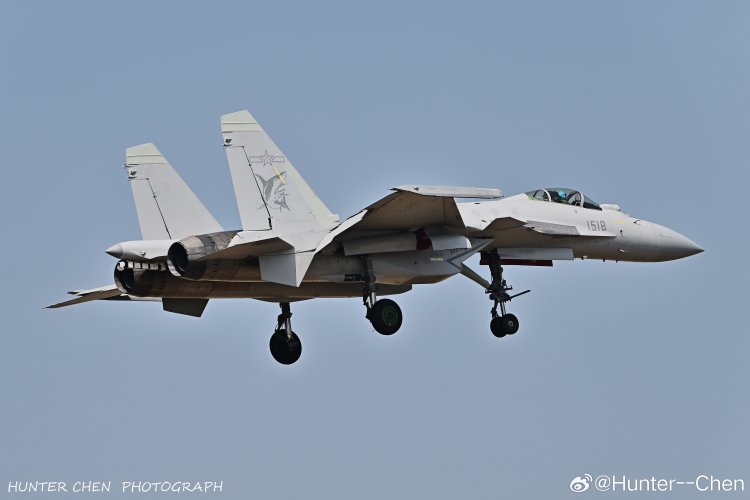
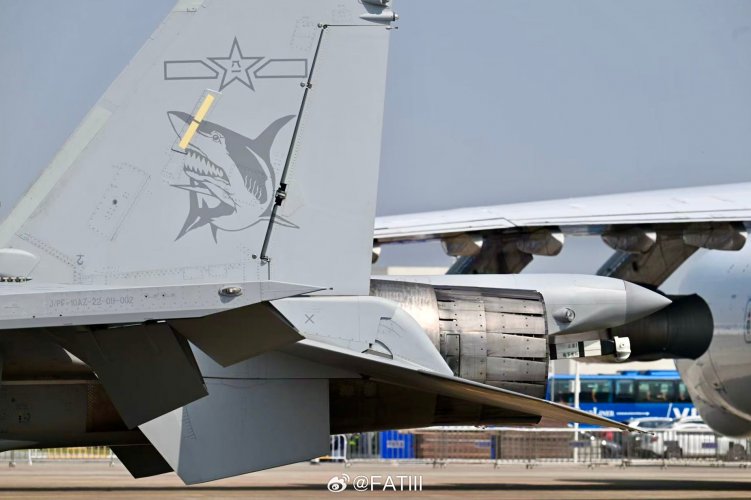
3. Yes, it appears that there was at least one older J-15T prototype fitted with the WS-10, and the new J-15T prototype no. 1518 displayed at Zhuhai in 2024 also has the WS-10. Operationally, for whatever reason, there are still none fitted with the Taihang engine.
Translated with DeepL.com (free version)
 
3. Yes, it appears that there was at least one older J-15T prototype fitted with the WS-10, and the new J-15T prototype no. 1518 displayed at Zhuhai in 2024 also has the WS-10. Operationally, for whatever reason, there are still none fitted with the Taihang engine.
Translated with DeepL.com (free version)

According to this post below, might be some J-15T now does use WS-10? at least when testing Ashm?
Amusingly, they noted:


...but not the fact that this particular J-15T (whether it's a pre-production prototype or a production unit) that's carrying the AShMs already uses WS-10H(2)s.

View: https://twitter.com/i/status/2075281138957095388
 
According to this post below, might be some J-15T now does use WS-10? at least when testing Ashm?
It's just a prototype or a demo, it in fact possibly might just be 1518. Anyways all observed J-15Ts are still using AL-31F with no indication that there will be a switch to WS-10 anytime soon.
 
According to this post below, might be some J-15T now does use WS-10? at least when testing Ashm?


Yes, as I said no. 1518 has it installed, but so far no serial aircraft was confirmed:
 

Attachments

  • J-15T 1518 cn. 010014 - Zhuhai 2024 - Hunter--Chen - 45.jpg
    J-15T 1518 cn. 010014 - Zhuhai 2024 - Hunter--Chen - 45.jpg
    1.8 MB · Views: 19
  • J-15T 1518 cn. 010014 - Zhuhai 2024 - FATIII - 26.jpg
    J-15T 1518 cn. 010014 - Zhuhai 2024 - FATIII - 26.jpg
    344.6 KB · Views: 19

Similar threads

Back
Top Bottom