

Ravinoff
Hoodoo Operator
- Joined
- 5 October 2017
- Messages
- 155
- Reaction score
- 381
I wasn't entirely sure whether to post this here or on a proper alt-history board, but...actually I might do both eventually, but as it's less of a history with a plot and more just an alternate (deranged) weapon system, this seemed like a better fit.
I'll just assume anyone reading this is likely familiar enough with Project Pluto and the Supersonic Low Altitude Missile, AKA the SLAM, "Flying Crowbar", or for those of you with good taste in scifi, XK-PLUTO from Charles Stross' excellent Lovecraft mythos novella A Colder War. In brief, cruise missile powered by an unshielded air-cooled nuclear reactor, designed to fly at Mach 3+ a thousand feet off the ground, popping out nuclear warheads on targets along the way.
Now for the interesting part. It's relatively obscure, but the US Navy operated a limited submarine-based nuclear deterrent prior to Polaris: the SSM-N-8 Regulus. Those were deployed on five boats, two modified WWII fleet subs (USS Tunny and USS Barbero), two conventional-powered purpose-built Regulus subs (USS Growler and USS Greyback), and the nuclear-powered USS Halibut, which was planned to be the first of a series of SSGNs but...long story, doesn't matter. What caught my eye though was its planned successor, the SSM-N-9 Regulus II.

It's purely a matter of appearance, but the Regulus II (and AGM-28 Hound Dog) looks a lot like the concept models of the SLAM that are floating around.

And that got me thinking. What if, for whatever reason, Polaris turned out to be a dud? Regulus doesn't have the range the Navy wants. Vought/LTV was the primary contractor for the SLAM, and had Navy connections. The Halibut proved the viability of nuclear-powered subs carrying multiple cruise missiles, and better yet the ability to store, load, prep and launch those missiles with fully automated systems not exposing the crew. Enter the SeaSLAM, or the SSGN from hell. Now you can't just stuff a SLAM in the Halibut, it could only carry two Regulus IIs, which were 57' long and had a payload section 50" in diameter, with a weight around 23,000lbs. A proper design for the SLAM was never settled on, but one proposal puts it at 88' long, with a 58" payload section and weighing ~60,000lbs. But let's look at the Halibut's basic design.
The missile hangar system is a solved problem. Sure, the SLAM is going to be longer and that will need to be scaled up appropriately, but it also doesn't have the 20-foot wingspan of the Regulus II to deal with. Everything behind that is just standard nuclear sub design. Launching them at sea at least partially nullifies the radioactive exhaust problem. Crew never has to interact with the missiles, the whole system is remote-operated, and by the time the boosters run out and the reactor-ramjet kicks in it'll be miles away. Absolutely insane? Yes. But plausible? I think it could be.
I'll just assume anyone reading this is likely familiar enough with Project Pluto and the Supersonic Low Altitude Missile, AKA the SLAM, "Flying Crowbar", or for those of you with good taste in scifi, XK-PLUTO from Charles Stross' excellent Lovecraft mythos novella A Colder War. In brief, cruise missile powered by an unshielded air-cooled nuclear reactor, designed to fly at Mach 3+ a thousand feet off the ground, popping out nuclear warheads on targets along the way.
Now for the interesting part. It's relatively obscure, but the US Navy operated a limited submarine-based nuclear deterrent prior to Polaris: the SSM-N-8 Regulus. Those were deployed on five boats, two modified WWII fleet subs (USS Tunny and USS Barbero), two conventional-powered purpose-built Regulus subs (USS Growler and USS Greyback), and the nuclear-powered USS Halibut, which was planned to be the first of a series of SSGNs but...long story, doesn't matter. What caught my eye though was its planned successor, the SSM-N-9 Regulus II.
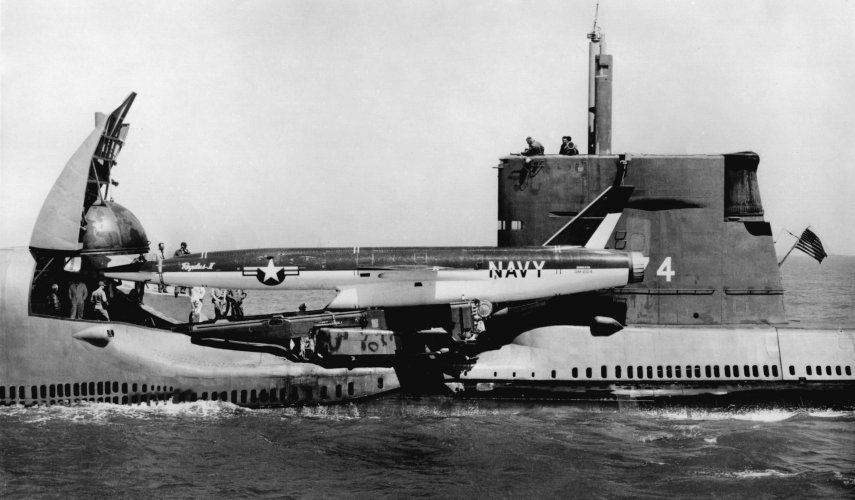
It's purely a matter of appearance, but the Regulus II (and AGM-28 Hound Dog) looks a lot like the concept models of the SLAM that are floating around.

And that got me thinking. What if, for whatever reason, Polaris turned out to be a dud? Regulus doesn't have the range the Navy wants. Vought/LTV was the primary contractor for the SLAM, and had Navy connections. The Halibut proved the viability of nuclear-powered subs carrying multiple cruise missiles, and better yet the ability to store, load, prep and launch those missiles with fully automated systems not exposing the crew. Enter the SeaSLAM, or the SSGN from hell. Now you can't just stuff a SLAM in the Halibut, it could only carry two Regulus IIs, which were 57' long and had a payload section 50" in diameter, with a weight around 23,000lbs. A proper design for the SLAM was never settled on, but one proposal puts it at 88' long, with a 58" payload section and weighing ~60,000lbs. But let's look at the Halibut's basic design.

The missile hangar system is a solved problem. Sure, the SLAM is going to be longer and that will need to be scaled up appropriately, but it also doesn't have the 20-foot wingspan of the Regulus II to deal with. Everything behind that is just standard nuclear sub design. Launching them at sea at least partially nullifies the radioactive exhaust problem. Crew never has to interact with the missiles, the whole system is remote-operated, and by the time the boosters run out and the reactor-ramjet kicks in it'll be miles away. Absolutely insane? Yes. But plausible? I think it could be.


