Triton

Donald McKelvy
Senior Member
Joined
14 August 2009
Messages
9,704
Reaction score
3,632
Website
deeptowild.blogspot.com
In the mid-1950s it was decided to increase the Royal Navy presence in the Falkland Islands dependencies. It was hoped to build a new icebreaker and the United States Navy made the plans of the Wind-class icebreaker available. British engines were selected that made the ship much longer. The cost rose and the project was abandoned. HMS Protector, a former net layer, was chosen instead with a minimum of changes. She was reclassified in 1955 as an Antarctic Patrol Ship.

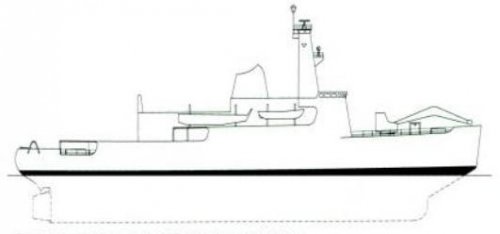
A few years later, another design study was progressed in more detail for a vessel to be called Terra Nova. This impressive icebreaker/oceanographic survey vessel made use of Canadian, American, and Scandinavian experience in its design. Deep displacement was approximately 7,000 tons with dimensions 278 feet by 64 feet. Powerplant suggested was four Ruston AO engines developing 15,000bhp; ASR1 diesels were also considered. The project was canceled in 1967 as an economy measure, her replacement being the Denmark-built Anita Dan. She was converted by Harland & Wolff and renamed HMS Endurance (A 171).

Source: Rebuilding the Royal Navy: Warship Design Since 1945 by DK Brown and George Moore and Wikipedia.

Outboard profile of Design Study I of HMS Terra Nova.
 

Attachments

  • HMSTerraNova.JPG
    HMSTerraNova.JPG
    9.9 KB · Views: 348
Triton said:
In the mid-1950s it was decided to increase the Royal Navy presence in the Falkland Islands dependencies. It was hoped to build a new icebreaker and the United States Navy made the plans of the Wind-class icebreaker available. British engines were selected that made the ship much longer. The cost rose and the project was abandoned. HMS Protector, a former net layer, was chosen instead with a minimum of changes. She was reclassified in 1955 as an Antarctic Patrol Ship.

A few years later, another design study was progressed in more detail for a vessel to be called Terra Nova. This impressive icebreaker/oceanographic survey vessel made use of Canadian, American, and Scandinavian experience in its design. Deep displacement was approximately 7,000 tons with dimensions 278 feet by 64 feet. Powerplant suggested was four Ruston AO engines developing 15,000bhp; ASR1 diesels were also considered. The project was canceled in 1967 as an economy measure, her replacement being the Denmark-built Anita Dan. She was converted by Harland & Wolff and renamed HMS Endurance (A 171).

Source: Rebuilding the Royal Navy: Warship Design Since 1945 by DK Brown and George Moore and Wikipedia.

Outboard profile of Design Study I of HMS Terra Nova.

Before returning to the UK to work on the nuclear submarine program, Sir Rowland Baker was working in Canada on the design of a slightly modified Wind Class icebreaker, which was named "Labrador."

It's hardly a surprise that the Wind Class would have influenced a British design in this period. What is surprising is that the RN considered building a single icebreaker when there was no obvious pressing need?
 
TinWing said:
What is surprising is that the RN considered building a single icebreaker when there was no obvious pressing need?

HMS Protector wasn't an icebreaker. I presume that she was limited to the times of the year in which she could navigate waters around Antarctica. There are permanent bases on the continent of Antarctica that are part of the British Antarctica Survey (BAS) that need to be supplied. Plus there is the ownership dispute between the UK and Argentina over the Falkland Islands, or Islas Malvinas.
 
Triton said:
TinWing said:
What is surprising is that the RN considered building a single icebreaker when there was no obvious pressing need?

HMS Protector wasn't an icebreaker. I presume that she was limited to the times of the year in which she could navigate waters around Antarctica. There are permanent bases on the continent of Antarctica that are part of the British Antarctica Survey (BAS) that need to be supplied. Plus there is the ownership dispute between the UK and Argentina over the Falkland Islands, or Islas Malvinas.

I was referring to the icebreaker design depicted.
 
The HMS Terra Nova would probably had 4 six cylinder Ruston AO diesels if she had been built. The link says 3,000 hp for locomotive application variant, so 3,750 hp for naval application is plausible.
Curiously enough we've discussed the Ruston AO before, in threads on the competing Mirrlees OP and a proposed submarine depot ship.

At 500 hp/cylinder, that works out at 30 cylinders installed, which is awkward - probably a 6-cylinder and a 9-cylinder engine on each shaft, unless electric drive is used. Uprating to 625 hp/cylinder was anticipated, which would get the specified 15,000 hp from four 6-cylinder engines.
 
Indeed. An option for as cheap as possible all diesel propulsion would be Mirrlees OP? I looked into the thread for Mirrlees OP and twin 8-cylinder of those would have 16,000 hp, so perfect. Only 2 engines.

Or 2 x Mirrlees K Major with 18 cylinders and about the double size for the same hp. However, I think that the Terra Nova would be powered by 4 x Mirrlees K Major 8-cylinder, totally 14,240 hp. Four engines were quite common in that era, giving both economy with two engines working and all four for high speed. Also, if one engine broke down, there are another 3 good ones.
 
Last edited:
Indeed. An option for as cheap as possible all diesel propulsion would be Mirrlees OP? I looked into the thread for Mirrlees OP and twin 8-cylinder of those would have 16,000 hp, so perfect. Only 2 engines.
Unlikely.

Remember this is an Icebreaker they run on completely different rules as from normal vessels.

Conventionally power Icebreakers general ran on 4 to 8 diesels.

The USS Glacier is extremely close to the Terra Nova and had 10 Fair Bank Morse Diesels, the later Polar twins have 6.

This was done for a very simple reason.

Redundancy.


Cause if you lose engine power in the ice?


Well you are ABSOLUTELY FUCKED.

Especially in the 1950s and 60s when the Ice was thicker.

Help is unlikely to be coming.

So you prepared for when not if something breaks. With both the US and Canada Icebreakers carrying enough parts to utterly rebuild an engine insitu so long as the block good

Add in the fact that while icebreaking you be red lining the engines for literal days and the general lack of reliability of that generation of diesels?

It very much be WHEN they break not if.

So having multiple engines be very much appreciated by the crews.
 
Regardless of any of our feelings around the qualities of the proposed engines, the power we might like to see, or the number of engines we might expect to see - four Ruston AO engines for 15,000 hp is stated by Brown for TERRA NOVA. Unless someone has been into the archives (DEFE 24/90, if anyone's going and fancies a look) we have nothing else upon which to go.
 
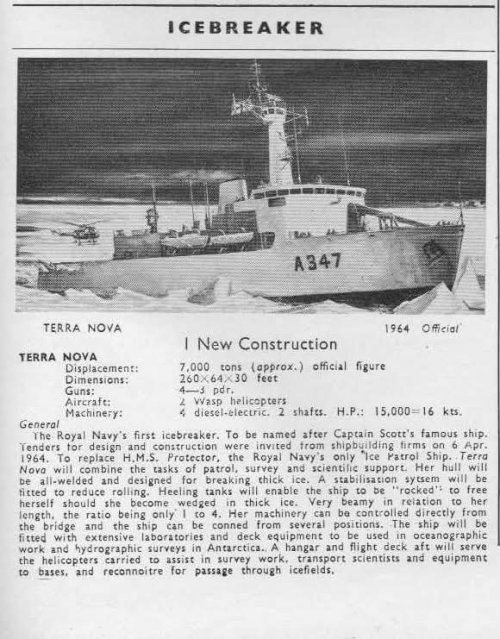
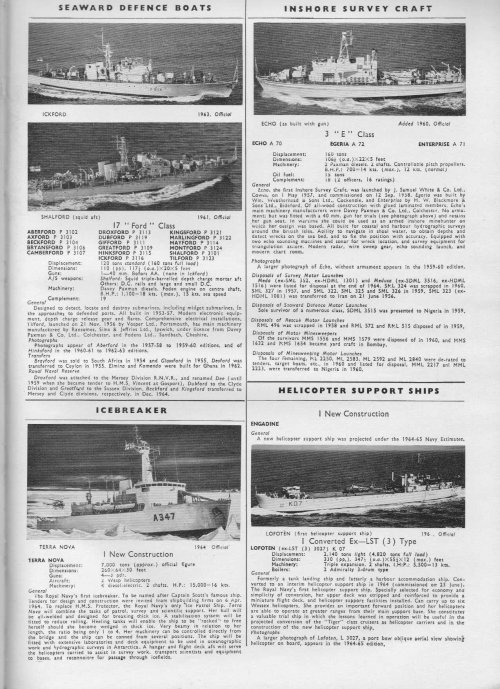
Is says "1964" below the A347 Terra Nova artistic image from that book. When she would enter service, if we suppose that Terra Nova was given the green light for construction;
 
A347 Terra Nova
I assume that's the 1965-1966 edition of Janes? I have a photocopy of the RN section from the 1964-1965 edition which has an identical image and text.
Is says "1964" below the A347 Terra Nova artistic image from that book. When she would enter service, if we suppose that Terra Nova was given the green light for construction;
With tenders invited in 1964, I'd guess you might imagine approval for construction in late 1964 or early 1965 and construction taking two to three years.

The near-contemporary, but smaller, Hecla-class survey ships were a little over eighteen months from order to commissioning.
 
So Terra Nova would have entered service in 1967-1968. And probably served until early 1990's.

Thanks a lot!
It's speculation of course - if the project was cancelled in 1967, that implies it could have proceeded somewhat later. And even with an order, it might be removed for any number of reasons.
What is surprising is that the RN considered building a single icebreaker when there was no obvious pressing need?
It may be worth reflecting on the 1952 Hope Bay incident and the 1953 Deception Island incident, which saw military confrontation between the UK, Argentina and Chile. I suspect it's not coincidence that the first icebreaker studies and the refit of PROTECTOR as an ice patrol ship came shortly thereafter.

The mid-1950s also coincides with a return of interest in Antarctic exploration, with 1955 seeing the Commonwealth Trans-Antarctic Expedition, the first Soviet Antarctic Expedition, and the first Operation Deep Freeze.
 
Yes, all these started after the Antarctic Confrontation between UK, Argentina and Chile.

And then came Antarctic Treaty in 1959.
 
My opinion is that HMS Terra Nova and RRS Endurance (1967) would be a very good pair for British Antarctic Survey work.

Plus RRS Bransfield (1970).

In Falkland War Terra Nova would probably had Westland Lynx helicopters (of course if she had been built).
 
Last edited:
Let's see the ship herself. The image from Jane's refers that she would have heeling tanks to "rock" her for freeing from ice. Interesting method. Any idea about her capabilities of breaking ice?
 
Some minor comment in Hansard suggesting thatOn 11 May 1965, the icebreaker project was still live, but by 31 January 1966, it had been abandoned. A further question from Rear-Admial Morgan Giles on 2 February elicited no further information beyond a statement that the Governement had great interest in the position 'down there'.

Kerby returned to the matter on 6 May, on this occasion getting a response from Denis Healey that the provision of a suitable ship was 'under consideration'. Other than that, the only real Parliamentary discussion of the matter was Julian Critchley (then MP for Rochester and Chatham) asking in 1963 if the replacement for PROTECTOR - alongside sundry other ships - would be considered for building in Chatham Dockyard.
My opinion is that HMS Terra Nova and RRS Endurance (1967) would be a very good pair for British Antarctic Survey work.
ENDURANCE was the substitute ice patrol ship after TERRA NOVA was abandoned - it's an either/or situation. The argument was made in 1967-1968 that procurement of the ENDURANCE was cheaper than building an icebreaker, but it does seem clear that TERRA NOVA was abandoned (I don't believe it got as far as needing cancellation) well before ENDURANCE was on the cards.

In the time period under question, BAS was served by the RRS SHACKLETON, the RRS JOHN BISCOE, and the RRS BRANSFIELD. It does appear that on several occasions in the late 1950s resupply of the (then) Falkland Islands Dependencies Survey bases required assistance from US icebreakers, and that even then some of the southerly ones were inaccessible. Which again demonstrates why the Royal Navy might have wanted one of its own.
Interesting method.
Standard for icebreakers, as filtered through Janes.
 
Let's see the ship herself. The image from Jane's refers that she would have heeling tanks to "rock" her for freeing from ice. Interesting method. Any idea about her capabilities of breaking ice?
4.5 to 5 feet continuous at 3 knots going by the similar USS Glacier and the Winds class (3.5 to 4ft) that she is base.

Both those also had heeling tanks and that idea was first done on one of the early Finnish Icebreakers.
 
Indeed the purchase of MV Anita Dan and the conversion to HMS Endurance was cheaper than a new ship. A conversion is most of time more money efficient than a new ship (but it depends on the condition of the ship found and how extensively she would be converted). I found original Anita Dan photos to compare with HMS Endurance.

It seems that the critical period for HMS Terra Nova was from May 1965 to January 1966.
 
So, the Terra Nova would have been between Glacier and Wind in icebreaking capabilities.

This is HMS Endurance (1967) as originally built. The Dan family ships (4 in total) were built for Denmark as ice-strenghened freighters. And HMS Endurance was strengthened further during her conversion, but again she was not a true icebreaker, like Terra Nova.

https://www.shipsnostalgia.com/media/anita-dan.424139/
https://thedockyard.co.uk/news/wars...sbDWWl_Pi6lyTKM1l_-ELDc15tN2-Gu56Fhhgn0L5X06c
https://upload.wikimedia.org/wikipedia/commons/7/77/Antarctica_Station_Map.png
Here are the research bases of Antartica. Rothera (opened in 1975) and Halley (opened in 1956) would need an icebreaker for resupply in the winter.

Antarctic sea-ice at 'mind-blowing' low alarms experts - BBC News https://share.google/JEnNpX8yN5LdnL5QM

Don't forget that in 1960's and 1970's Antarctic sea ice was probably thicker as well as more extensive.
 
Last edited:
https://www.tapatalk.com/groups/war...s/leopard-salisbury-class-engines-t17275.html
http://www.submarinesailor.com/bbs2/forums/thread-view.asp?tid=11191&posts=5
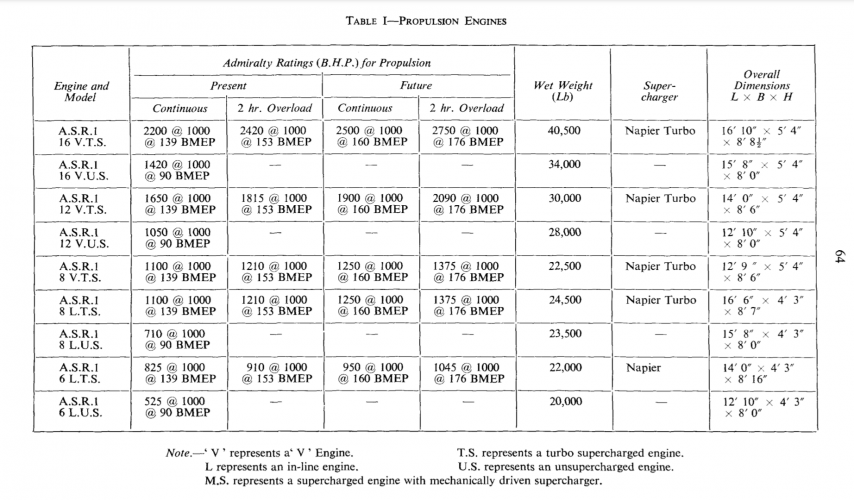
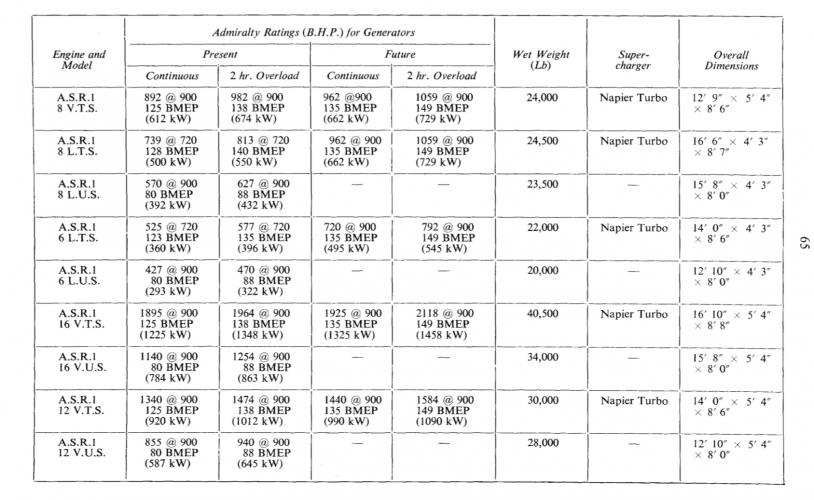
The second engine option considered for Terra Nova is interesting.

The ASR1 diesel was used in Oberon submarines (V16) and in Type 41/Type 61 frigates. Any option would make sense to have commonality with the RN. 4 x 3,650 hp = 14,600 hp, close to 15,000 hp.

Type 41 frigates had 8 x 1,800 hp (probably 8 cyl inline) diesel for 14,400 hp.

In that era, more diesels added in reliability, as someone said above. Also, don't forget that in 1960's the ships of British Antarctic Society were part of RFA, later they separated and were registered as Royal Research Ships. So, is is very possible for the Terra Nova to have some armament, like HMS Endurance (1967) did.
 
Last edited:
8 x ASR.1 12 VTS together develop 15,200 hp. Or the quadruple Ruston AOs.
Probably would be political choice, but doesn't matter, because TerraNova remained a paper project in real world. But either engine choice would work.

Or 4 x ASR.1 8VTS + 4 x ASR.1 16VTS (4 x 1,250 hp + 4 x 2,500 hp).
 
HMS Protector wasn't an icebreaker. I presume that she was limited to the times of the year in which she could navigate waters around Antarctica. There are permanent bases on the continent of Antarctica that are part of the British Antarctica Survey (BAS) that need to be supplied. Plus there is the ownership dispute between the UK and Argentina over the Falkland Islands, or Islas Malvinas.
While there is a dispute, between Britain and Argentina, over the Falkland Islands, there is no such dispute over the Islas Malvinas. The Islas Malvinas are in Lake Carerra, in Chile, and thus are Chilean Sovereign Territory.
 
https://en.wikipedia.org/wiki/QF_3-pounder_Hotchkiss
The Jane's edition says that Terra Nova would have 4 x Hotchkiss 3-pdr. Probably because these guns were available from storage and because of the 1950's incidents with Argentina and Chile.

I'd have though these were more likely intended as saluting guns. If they had wanted functional weapons, there were lots of 20mm Oerlikons that would be more useful.
 
I'd have though these were more likely intended as saluting guns. If they had wanted functional weapons, there were lots of 20mm Oerlikons that would be more useful.
IIRC the Royal Navy still uses a derivative of the Hotchkiss 3pdr as a saluting gun.
 

Similar threads

Back
Top Bottom