Raytheon AIM-424 Malice LRAAM

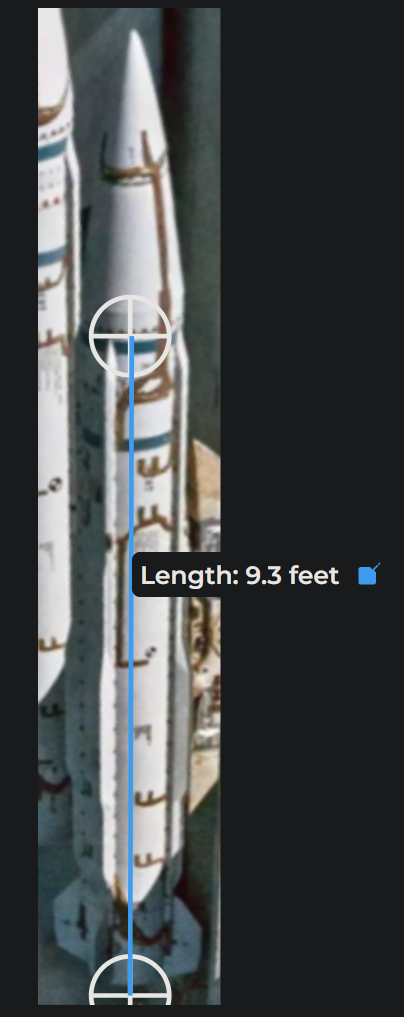
I was looking at the high-res versions of the images. On those, the ring of bolts behind the foremost blue band have semicircular rather than full circle holes in the skin. Also, the leading edges of the strakes are welded to the fuselage aft of those bolts and don't seem to be attached forward of them. So my hunch is that's where it stages. But also bear in mind that all we have seen are inert rounds that might not be fully representative of those details.
I agree that’s the where the separation plane would be based on that inert round, but assuming it carries through to a live round, it would leave you 1m or under for a terminal stage.

It’s certainly not impossible for a unpowered effector; the guidance and warhead of something like Stinger would fit those dimensions, but other than reducing mass to optimise range, I don’t know if you get enough space for something more ‘interesting’ like
divert motors.
 
Last edited:
If the weight is really 1500lbs, in a package 2 feet shorter than SM-2 at 1588lbs, I'm thinking it might not use the Mk104 motor but something better.

The proportions seem to be a bit off. Do you know where the drawing came from?

AIM-174 launch weight went up to 1850 lbs, so mk104 still seems reasonable. It would use an off the shelf component, so I could see the value of using that with a much lighter guidance and warhead section.
 
Regarding designation, aside from being likely obfuscation as pointed out, someone in a group chat noted that 174+250=424.
So?

It's also 53*8, i.e. a prime number multiplied by a power of 2. I'm sure there is a conspiracy theory, which explains why this cannot be a coincidence. And if there is none, feel free to invent one.
Also, 424 contains "42" - both normal and backwards. Maybe someone thought this missile is the "answer for everything", in all aspects.
Then, 4-2-4 can be read as the tactical lineup of a soccer team, with emphasis on defense and attack at the cost of reduced midfield control.

Seriously, though, who cares? It's just another out-of-sequence number, which is nothing out of the ordinary nowadays. Maybe it's an inside joke, and maybe it's just some random number arrived at by 3 dice rolls.
 
I think it is entirely possible for it to be using something of similar size and dimension to MK 104. The weight differential over the SM-2, even adding some additional pounds on top of that 1588 lbs can probably be done on the back of a significantly lighter guidance section and perhaps a smaller warhead. They've literally stripped out an entire AMRAAM's mass out of a AIM-174B to get the AIM-424.
Yeah but IIRC they added ~200lbs of steel doublers there in the middle to get an AIM-174 from an SM-2. That's why I compared it to a late model SM-2 instead of the AIM-174. AIM-174 is ~ 1890lbs vs 1558lbs for a late model SM-2. They add an entire AMRAAM to SM-2 to get to AIM-174.

So they ditch the 140lb warhead, and two feet of airframe, but only lost 58lbs? AIM-424 is significantly more dense than SM-2. Bigger motor, much more dense front end? Just thinking out loud here. The Mk104, good as it is is getting long in tooth but maybe?
 
Well they mention Solid Rocket Motor when describing the AIM-424, and DTRM when describing AIM-174 so perhaps they are different. Or they are just not yet ready to share details on the 424 motor so just kept it vague.
 
LOSAT had PAC-3-like divert motors. The SM-3 KKV does as well albeit more like THAADs with a gas generator, manifold, and nozzles.
We are getting into the interesting territory of at what altitude RCS vs aerodynamic controls become more effective. My understanding is that THAAD uses its thrusters (in a ~2.3m+ KV) across the flight regime, while the SM3 is purely exoatmospheric, so needs comparatively less thrust.

Well they mention Solid Rocket Motor when describing the AIM-424, and DTRM when describing AIM-174 so perhaps they are different. Or they are just not yet ready to share details on the 424 motor so just kept it vague.

In recent years at least two alternative providers of the Mk104 motor have been qualified (X-Bow and Ursa Major), as well as Raytheon partnering with Avio to increase production rates. It’s entirely possible that one of those sources is offering something different to the standard motor.

https://www.rtx.com/news/news-cente...ollaboration-to-accelerate-mk-104-rocket-moto

https://ursamajor.com/media/press-release/us-navy-awards-mk104-development-contract/

https://www.prnewswire.com/news-rel...mk-72-and-mk-104-rocket-motors-302658560.html
 
Last edited:
We are getting into the interesting territory of at what altitude RCS vs aerodynamic controls become more effective. My understanding is that THAAD uses its thrusters (in a ~2.3m+ KV) across the flight regime, while the SM3 is purely exoatmospheric, so needs comparatively less thrust.

THAAD has a floor of roughly 50 km altitude as currently configured.
 
At speed, assuming it's still in atmosphere, maybe AIM-424 pulls something really exotic out of the bag, like external burning for its divert system. Now you don't need to carry oxidizer for your divert system.
 
As for diver systems - if it is designed as a counter hypersonic, then yeah you might need that. If it is purely an A2A weapon, it can just use control surfaces once it drops down deeper into atmosphere. I still doubt we are looking at a two stage weapon.
 
Phoenix lite;).
Phoenix heavy, more like. Malice is 1500lbs, Phoenix missile proper is "only" 1000lbs.


However I'd like to see an AIM-172 ESSM deployed as while it's significantly bigger and heavier than the AMRAAM and Sparrow it's still lighter than the AIM-174B SM-6.
I think the ESSM rocket is optimized for acceleration-from-zero, not acceleration-from-300+knots. So you're likely to only get 100km out of it, not 150km.


Yes, but I asked in the context of the assumption it may have a ballistic trajectory. Would they still be useful in that case?
Useful in the pull-up into the ballistic trajectory, and useful for adding strength during any maneuvers.
 
That’s a pretty generous description of “endo atmospheric”; I had no idea it was so high.

Yes its pretty high. Original requirements for the system was lower but the program struggled to meet those and nearly got cancelled until the min altitude was relaxed. Created a pretty sizable gap between upper altitude for Patriot and lower altitude for THAAD for adversaries to exploit (that the Army has been trying to plug ever since).
 
Yes its pretty high. Original requirements for the system was lower but the program struggled to meet those and nearly got cancelled until the min altitude was relaxed. Created a pretty sizable gap between upper altitude for Patriot and lower altitude for THAAD for adversaries to exploit (that the Army has been trying to plug ever since).
Hey, look, SM6 to the "rescue".

For better or worse, the Army doesn't hate the Navy nearly as much as the USAF does, so they're happier about buying into systems designed for the USN or USMC.
 
Yes its pretty high. Original requirements for the system was lower but the program struggled to meet those and nearly got cancelled until the min altitude was relaxed. Created a pretty sizable gap between upper altitude for Patriot and lower altitude for THAAD for adversaries to exploit (that the Army has been trying to plug ever since).
I wonder if it had to do with window heating.
 
Could very well be. The MDA and contractors kept working on this after thaad was fielded ( I believe they had a few SBIR awards lead to better thermal protection for the windows) and there was a public announcement several years ago highlighting thaad achieving its lowest altitude intercept but I have never heard an MDA program official ever claim that the program can meet its original requirement for min altitude engagement. The Army has also rolled in a higher altitude intercept requirement for its future interceptor (MSE follow on) to cover some of that gap.
 
Could very well be. The MDA and contractors kept working on this after thaad was fielded ( I believe they had a few SBIR awards lead to better thermal protection for the windows) and there was a public announcement several years ago highlighting thaad achieving its lowest altitude intercept but I have never heard an MDA program official ever claim that the program can meet its original requirement for min altitude engagement. The Army has also rolled in a higher altitude intercept requirement for its future interceptor (MSE follow on) to cover some of that gap.
HEDI was able to go pretty low, and a lot faster, but its window didn't have to last as long so. . . I do recall reading a comment from one of the engineers involved saying it was a race to hit the target before window coolant ran out.
 

The AFRL LRAAM program went on for several years with Raytheon as a major subcontractor to prime Boeing.

Not the same as the Navy weapon, but Raytheon is using what they did during the AFRL program on the Navy program.

DoD has been investing in many new air to air missile programs and will probably field at least several more of them in the next few years. They are also investing in non traditional counter air / air to air weapons.

To the best of my knowledge none of the air launched air to air weapons in development have an ABM capability, and the AIM-174 does not have a surface attack capability.
 
To the best of my knowledge none of the air launched air to air weapons in development have an ABM capability, and the AIM-174 does not have a surface attack capability.
That seems odd, since RIM/BIM-174 does have a surface attack mode.
 
How come? Isn’t it basically SM-6 without booster?
Must be a software-related deliberate choice. I recall an interview with an official from the SM-6 program, and he said the surface-attack capability was achieved solely through software upgrades. It was from TWZ, as far as I remember.
 
Must be a software-related deliberate choice. I recall an interview with an official from the SM-6 program, and he said the surface-attack capability was achieved solely through software upgrades. It was from TWZ, as far as I remember.
Still seem strange that they deliberately get rid of that capability. A dual role missile would be super useful
 
I doubt the Navy would pay to exclude a capability already inherent in the weapon. It could be a case of them simply not testing this particular role and focusing their test and integration efforts on the F/A-18E/F solely around the long-range air to air role.
 
Personally, I suspect that there may not be a second stage.Assuming mid-course separation is indeed feasible, the concept might involve a lofted trajectory to reach high altitude, followed by warhead jettison to reduce mass and extend range. However, the resulting degradation in the ballistic coefficient and increased drag due to the lower length-to-diameter ratio of the lightweight glide vehicle would severely penalize the overall range. Furthermore, unlike the SM-3's KKV, which does not rely on aerodynamic control surfaces, it remains highly questionable how a two-stage architecture could preserve sufficient terminal maneuverability at lower altitudes.
 
Here's my very rough estimation based on the stated 13.5ft length. If it's using the 9.3ft Mk-104 rocket motor (from AIM-174B/SM-6/etc.) then the second stage must be just the nose section (unpowered second stage?). That would make it more like an air-launched ballistic missile with a separating maneuverable warhead than a traditional air-to-air missile.
 

Attachments

  • 2026-08-24 .png
    2026-08-24 .png
    454.8 KB · Views: 88
Last edited:
Personally, I suspect that there may not be a second stage.Assuming mid-course separation is indeed feasible, the concept might involve a lofted trajectory to reach high altitude, followed by warhead jettison to reduce mass and extend range. However, the resulting degradation in the ballistic coefficient and increased drag due to the lower length-to-diameter ratio of the lightweight glide vehicle would severely penalize the overall range. Furthermore, unlike the SM-3's KKV, which does not rely on aerodynamic control surfaces, it remains highly questionable how a two-stage architecture could preserve sufficient terminal maneuverability at lower altitudes.
The second stage thing is something that a journalist blabbed about to get more words into the article, it comes from old concepts for the LREW, there's 0 reason to think the AIM-424 has 2 stages as it doesn't even resemble the 2 stage missile concept.
 
第二级导弹的概念是某个记者为了凑字数而胡乱编造的,它源自 LREW 导弹的旧概念,没有任何理由认为 AIM-424 导弹有两级,因为它根本不像两级导弹的概念。
I think so.
 

Similar threads

Back
Top Bottom