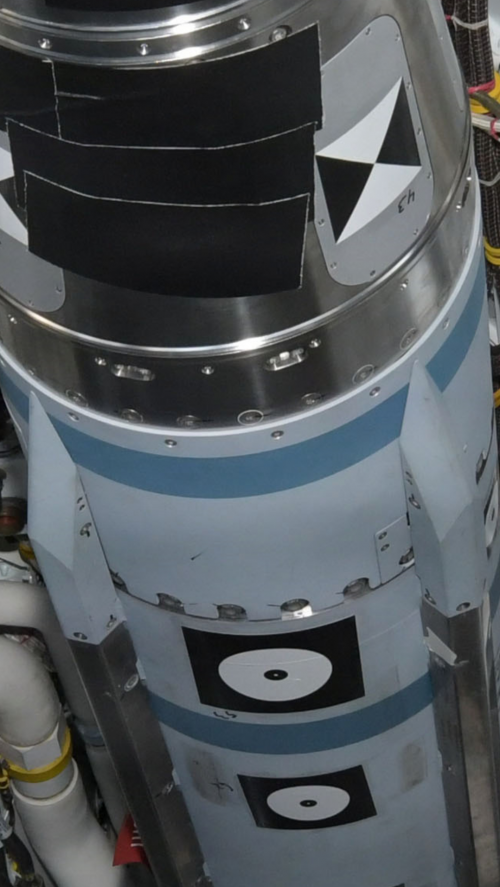
Raytheon AIM-424 Malice LRAAM

Gents, this is everything I've pulled out of people familiar with the program's development. It's not a lot of new details but it's something.

- Brand-new datalink designed specifically for this missile
- Cyber mitigation complete for F-47, F-35, and F/A-18
- Outranges all current and known adversary AAMs
- Longer range than AIM-174B, with unique aerodynamic capabilities that allow it to retain agility / maneuverability akin to an AMRAAM

https://www.navalnews.com/naval-news/2026/08/us-navy-unveils-aim-424-malice-lraam/
 
So this will be used on USAF F-35A, F-47 (and possibly F-15E)? Is this the USAF LREW afterall?
 
So this will be used on USAF F-35A, F-47 (and possibly F-15E)? Is this the USAF LREW afterall?

Well, the fact that AF cyber mitigation teams worked on this doesn't mean they will use it. A lot of overlap in cyber between USAF and USN aviation per source. If anyone knows, it's the 85th TES and 28th TES. All I know is that they made sure Malice and F-47 could talk to each other if the time came
 
Putting that absolutely disgusting designation aside. This does make the AIM-174B feel a bit redundant, maybe the 174 was a duplicate program to serve as a stop-gap measure or a backup?

Alternatively, maybe AIM-174 was never intended exclusively, or even primarily, for the A2A role. SM-6 can hit sea and ground targets; maybe AIM-174 was always meant to be more of a multi domain weapon.

What seems a little odd is that the press releases do not mention the USAF, when presumably they could use this off the F-35A with little to no integration work one the USN did all the work with the Charlie.
 
What I can't understood is why it's numbered "424". What happened with the numbers assigned? There is only one missile with "200" number - AIM-260 - and no missiles with "300" numbers. Why 424?
 
What I can't understood is why it's numbered "424". What happened with the numbers assigned? There is only one missile with "200" number - AIM-260 - and no missiles with "300" numbers. Why 424?
We don't use typewriters anymore, so the designation system isn't necessary. Outside of AAMs, the Navy doesn't use tri-service designations in real life anyways. The Navy uses TLAMs, SM-6s, and its own Mark designations.
 
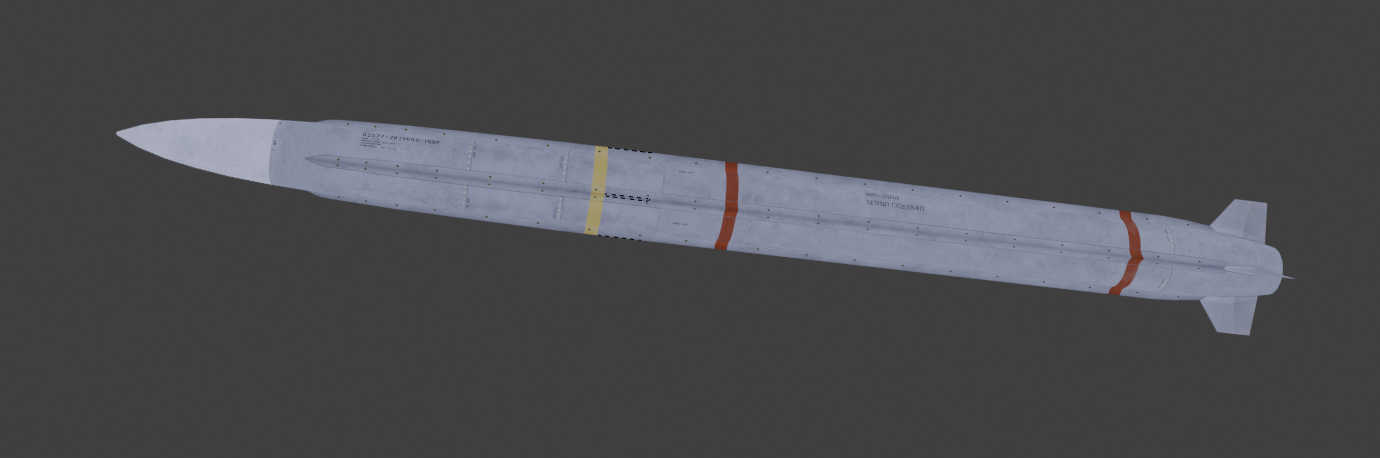
It's a two-stage missile though. I suspect it separates just aft of the leading edge of the strakes, between the two forward-most marking bands. In any case, the upper stage is very small relative to the booster. And it doesn't seem to have aerodynamic control surfaces, so I'm betting on thrusters but not one-shots like in PAC-3. Think something more like the DACS in THAAD. And I'll bet that taped over spot is a side-looking sensor. Missile presumably flies and up-and-over trajectory, stages at very high altitude, then acquires the target and dives, using side thrusters for terminal steering.

What makes you think this is multi stage? Is it just the change from raw metal to a painted section aft? That would be a tiny second stage.
 
Active duty naval officers literally said AIM-174B was an interim solution in various interviews

What seems weird is how short the window was between the interim solution and the purpose built missile. 1-2 years?
 
What makes you think this is multi stage? Is it just the change from raw metal to a painted section aft? That would be a tiny second stage.

The Aviation Week article says it's two-stage.

I believe this is very much a preview of what we can expect from the Navy Modular Missile effort, which also involves a fairly small terminal stage interceptor on top of various large booster stacks.
 
What seems weird is how short the window was between the interim solution and the purpose built missile. 1-2 years?

Well, there is also the possibility that AIM-174B remains in play as a strike weapon.
 
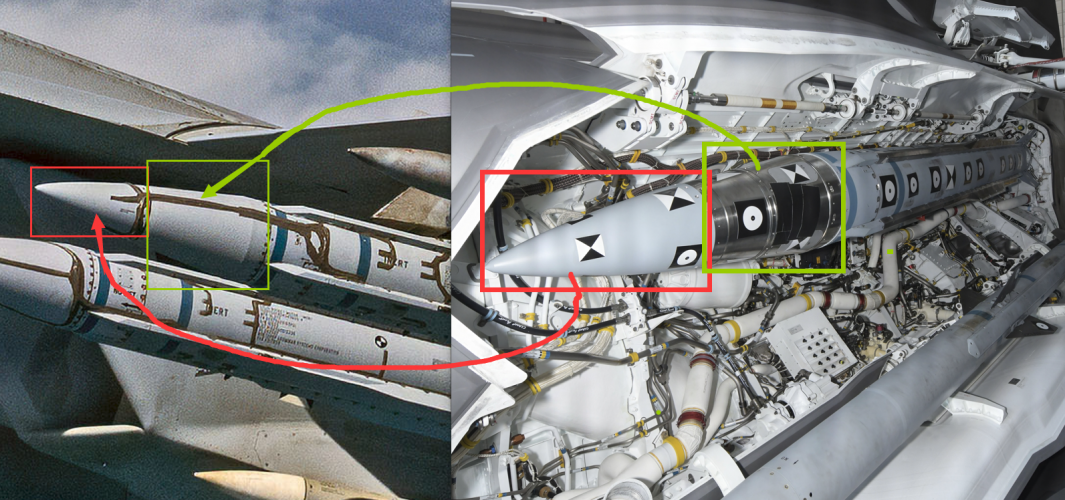
So has anyone noticed that the diameter of this missile's radar antenna is much smaller than the diameter of the missile body?
You see, the section where the missile's nose cone begins to taper is made of metal; only the very front part is a radome. Just like the PAC-3MSE, this means the radar antenna is not the same 13.5 inches as the missile's diameter.
Perhaps the seeker head is related to the PAC3 or AIM120?
 

Attachments

  • ~U8KEA_DJL`{VOS[C~0I65V.png
    ~U8KEA_DJL`{VOS[C~0I65V.png
    1.9 MB · Views: 198
  • 5EBH~`E7L1CPA_W(5)]YF07.png
    5EBH~`E7L1CPA_W(5)]YF07.png
    288.1 KB · Views: 212
Last edited by a moderator:
RTX makes AIM-120 but none of the others mentioned outside AIM-120/SM-6. I am assuming an AESA seeker, which might make it something new.
 
What I can't understood is why it's numbered "424". What happened with the numbers assigned? There is only one missile with "200" number - AIM-260 - and no missiles with "300" numbers. Why 424?

They went from linear to exponential numbering. According to my calculations, the next missile should be AIM-691.
 
What seems weird is how short the window was between the interim solution and the purpose built missile. 1-2 years?

The Navy confirmed that the AIM-174B was operational in early 2025 so likely the capability was deployed in the 2024 timeframe if not earlier. We don't know the status of this. But if you were aiming to a set capability by 2027, and another enduring capability in place by 2030s then this strategy would work very well. Would also help derisk the concept of operation and tactics.
 
Last edited:
Some thoughts, observations, assumptions, and inferences:

- As is typical, AIM-174b was operational for several years before publicly disclosed.
- Aim-174b is a stopgap missile: a genuine long range air-to-air and air-to-surface missile.
- AIM-174b also has some (terminal?) ABM capability.
- AIM-424 is newer than JATM.
- It is the LREW in some form, certainly using technology and expertise gained from that program.
- AIM-424 is overall more technologically advanced than JATM.
- AIM-424 is more expensive than JATM.
- AIM-424 has more advanced sensors and higher sensing capacity than JATM, partially out of necessity due to its greater range.
- This is why it also has microstrakes.
- AIM-424 is slightly slower than JATM.
- AIM-424 is longer ranged than JATM and AIM-174b.
- This is because USAF jets have lower RCS, infrared, EW, and other types of shielding than Navy jets.
- Thus USAF can afford to use missiles, like JATMs, with (slightly) lower range. Instead USAF might prioritize speed.
- Navy and USAF will still primarily use JATM for air-to-air.
- Much like they did with AIM-7 vs AIM-54.
- Similarly to AIM-54 the AIM-424 might be somewhat of a doomsday weapon.
- The AIM-424 will acquire a reputation analogous to that of the AIM-54 in the 70s and 80s.
- AIM-424 is even better at ABM than than AIM-174b.
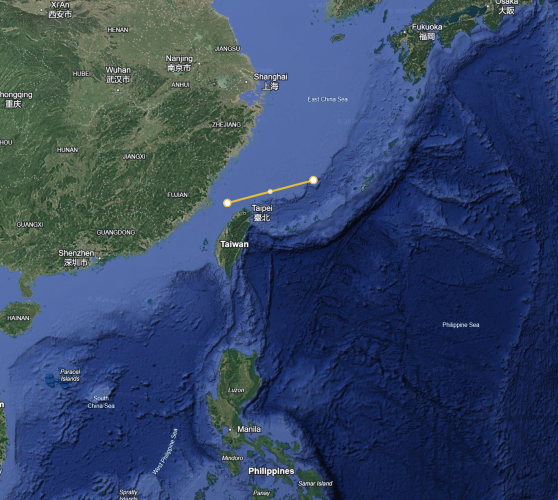
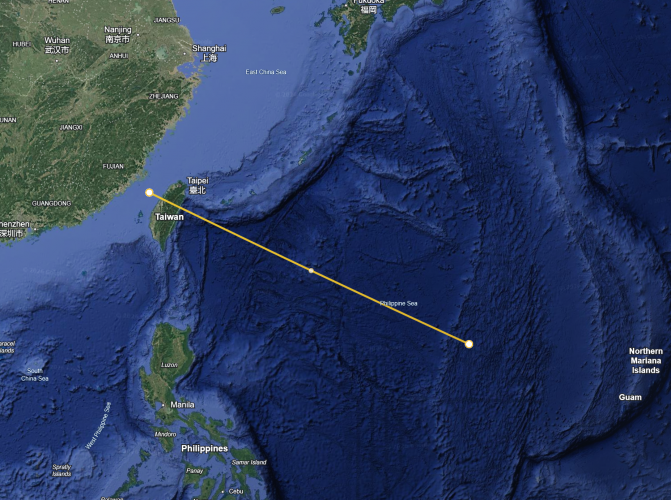
- Imagine F35s performing BARCAP about 400 nm in front of a carrier group. They notice DF-21s, YJ-20s, and YJ-21s incoming. Using their Malice missiles they are able to substantially thin the herd, saving the AEGIS magazine depth of SM-3s, SM-2s, SM-6s, ESSMs, and the NMMs.
- Imagine if they could do the same orbiting off the coast of North Korea to intercept ICBMS in boost phase.
 
Last edited:
PAC-3 seeker heads are still a rate limiting reagent for those interceptors ppa rates although Boeing is trying to improve that in AL.

IF Malice is coming in volume, I would think it would need to circumvent or avoid any of the same critical reagent issues JATM, or Gunslinger, or PAC-3, or THAAD or come to think of it any pre COVID based design brings…
 
Last edited:
The Navy confirmed that the AIM-174B was operational in early 2025 so likely the capability was deployed in the 2024 timeframe if not earlier. We don't know the status of this. But if you were aiming to a set capability by 2027, and another enduring capability in place by 2030s then this strategy would work very well. Would also help derisk the concept of operation and tactics.

IIRC, and I do not have references in front of me, but IOC was actually much earlier than 2025 and testing was occurring in the 2019 timeframe. with a Point Mugu aircraft photographed around that time (2020?).
 
- Imagine F35s performing BARCAP about 400 nm in front of a carrier group. They notice DF-21s, YJ-20s, and YJ-21s incoming. Using their Malice missiles they are able to substantially thin the herd, saving the AEGIS magazine depth of SM-3s, SM-2s, SM-6s, ESSMs, and the NMMs.
Doesn't work, this will require THAAD like capabilities. Missiles on trajectory fly too high for an aerodynamic interceptor working off forward deployed sensors.
Space layer, maybe - but usual question is how reliable it is in a highest tier fight.
- Imagine if they could do the same orbiting off the coast of North Korea to intercept ICBMS in boost phase.
To overcome an ICBM in a boost phase, you have to accelerate several times faster, and still do a space, chase trajectory intercept. Boost phase intercept with missiles is a nasty task.
Almost certainly not with this missile.
- AIM-424 is overall more technologically advanced than JATM.
May or may not be. Given the deployment timeline, may equally be same tech level, but with more volume to work with. Equally, effect of more advanced tech may be lesser on a bigger weapon: the smaller the weapon, the more important are tech margins.
- This is because USAF jets have lower RCS, infrared, EW, and other types of shielding than Navy jets.
Mission. USAF jets primary target other jets (opfor air power) in offense or defense.
Navair is air arm of the fleet (3rd object problem). It's much more centered around air defense of the fleet(defense) and suppression (rather than destruction) of enemy airpower (offense).
 
The Aviation Week article says it's two-stage.

I believe this is very much a preview of what we can expect from the Navy Modular Missile effort, which also involves a fairly small terminal stage interceptor on top of various large booster stacks.
I just don’t see where the separation plane would sensibly be; if it’s as far forward (forward of the strakes) as some have suggested, the effector would be tiny in comparison to the booster. In the NMM graphics, the terminal interceptor is about 50% of the length of the quad-pack ESSM successor.

I do wonder if this is a description of a dual pulse/ dual thrust solid motor being lost in translation. It would give some extra weight to the theory that this is reusing (or at least uses a motor derived from) the existing Mk104 DTRM.

Solidus has a much better expansion of this possibility earlier in the thread at post 72. https://www.secretprojects.co.uk/threads/aim-424-malice-lraam.52214/page-2#post-936532
 
Last edited:
I think those are 1000 pound max and the AIM-424 is 1500 pounds
If the weight is really 1500lbs, in a package 2 feet shorter than SM-2 at 1558lbs, I'm thinking it might not use the Mk104 motor but something better.
AIM-424 - 680 kg
AIM-174 - 857 kg
The proportions seem to be a bit off. Do you know where the drawing came from?
 
Last edited:
If the weight is really 1500lbs, in a package 2 feet shorter than SM-2 at 1588lbs, I'm thinking it might not use the Mk104 motor but something better.
I think it is entirely possible for it to be using something of similar size and dimension to MK 104. The weight differential over the SM-2, even adding some additional pounds on top of that 1588 lbs can probably be done on the back of a significantly lighter guidance section and perhaps a smaller warhead. They've literally stripped out an entire AMRAAM's mass out of a AIM-174B to get the AIM-424.
 
I just don’t see where the separation plane would sensibly be; if it’s as far forward (forward of the strakes) as some have suggested, the effector would be tiny in comparison to the booster. In the NMM graphics, the terminal interceptor is about 50% of the length of the quad-pack ESSM successor.

I do wonder if this is a description of a dual pulse/ dual thrust solid motor being lost in translation. It would give some extra weight to the theory that this is reusing (or at least uses a motor derived from) the existing Mk104 DTRM.

I was looking at the high-res versions of the images. On those, the ring of bolts behind the foremost blue band have semicircular rather than full circle holes in the skin. Also, the leading edges of the strakes are welded to the fuselage aft of those bolts and don't seem to be attached forward of them. So my hunch is that's where it stages. But also bear in mind that all we have seen are inert rounds that might not be fully representative of those details.
 

Attachments

  • Screenshot_20260823-165411.png
    Screenshot_20260823-165411.png
    1.4 MB · Views: 191
I was looking at the high-res versions of the images. On those, the ring of bolts behind the foremost blue band have semicircular rather than full circle holes in the skin. Also, the leading edges of the strakes are welded to the fuselage aft of those bolts and don't seem to be attached forward of them. So my hunch is that's where it stages. But also bear in mind that all we have seen are inert rounds that might not be fully representative of those details.
To be honest, when I first saw it, I thought it may be a "mutant"(articulated warhead). But IMHO there's nothing so serious, and it's just a different material section on hottest part of a hypersonic missile.
Strake cavities carry cabling/some electronics around composite engine section.

Multiple "hot"(fast, for extended period of time) Soviet/Russian AAMs and AGMs are just like what we see here.
 

Similar threads

Back
Top Bottom