Proliferation of Nuclear Weapons

EmoBirb

E.S.T
Joined
18 January 2025
Messages
2,211
Reaction score
5,628
If I was Japan I’d announce tomorrow that they are building a deterrent force to match China.
And you're thinking this would lead to China just saying "yeah, we should let the people that killed millions of us not too long ago through genocidal policy have nuclear weapons"?

If anything you'd get the Israel-Effect, just that China would make the anti-nuke operations carried out against the likes of Iran or Iraq look like childs play.

Nuclear Japan is not on the table, for domestic reasons, because China wouldn't allow it and because it would alienate other countries like Korea or the Philippines as well. I'm not aware if you're quite familiar with how Japan is historically being perceived across South East and East Asia, but let's just say that the opinions are not positive at all.

In essence, it wouldn't be deterrence, it would accelerate the probability of conflict and could very well lead to a fracturing between the countries currently connected by belonging to the Western Bloc in Asia. It would also most likely mean South Korea would have to develop a nuclear arsenal, as it's now surrounded by 3 nuclear powers of varying degree of historical hostility towards them. This would mean that North Korea would see the need to ramp up expansion of their arsenal to retain a nuclear edge, which in turn could be seen as an immediate threat by Japan or the ROK, or even the US and suddenly East Asia is at the brink of nuclear war.

Nuclear Japan is not a particularly well thought out idea and reeks of simple cheerleading for any country vaguely aligned with the US to develop nuclear weapons. Because more nuclear weapons in the posession of countries of varying levels of stability and government structures is definitely making the world safer...not.
 
I'm not aware if you're quite familiar with how Japan is historically being perceived across South East and East Asia, but let's just say that the opinions are not positive at all.
For one moment I thought you were talking about DPRK. Sorry!
 
For one moment I thought you were talking about DPRK. Sorry!
Thing about the nuclear development of the DPRK is that their allies support it, meaning Russia and China, and historically Koreans didn't massacre millions across all of Asia. The same cannot be said for Japan where key US allies would be abhorred by the idea of that specific country having weapons of mass destruction. It's seen, across Asia, as a universally bad idea.

From a technical POV it's possible for Japan, from a political and social POV it isn't.
 
Last edited:
Silly me, who could object to lovely, cuddly DPRK having nuclear weapons. Oh, I know they sometimes fly off the handle with threats to all and sundry, but that's just banter, right? Neighbours always shooting and torpedoing each other, that's just what neighbours do. Hardly worth noticing. Like accidentally bumping off your opponents in other countries, of pilfering money on the internetz. What was I thinking
 
Last edited:
And you're thinking this would lead to China just saying "yeah, we should let the people that killed millions of us not too long ago through genocidal policy have nuclear weapons"?

If anything you'd get the Israel-Effect, just that China would make the anti-nuke operations carried out against the likes of Iran or Iraq look like childs play.

Nuclear Japan is not on the table, for domestic reasons, because China wouldn't allow it and because it would alienate other countries like Korea or the Philippines as well. I'm not aware if you're quite familiar with how Japan is historically being perceived across South East and East Asia, but let's just say that the opinions are not positive at all.

In essence, it wouldn't be deterrence, it would accelerate the probability of conflict and could very well lead to a fracturing between the countries currently connected by belonging to the Western Bloc in Asia. It would also most likely mean South Korea would have to develop a nuclear arsenal, as it's now surrounded by 3 nuclear powers of varying degree of historical hostility towards them. This would mean that North Korea would see the need to ramp up expansion of their arsenal to retain a nuclear edge, which in turn could be seen as an immediate threat by Japan or the ROK, or even the US and suddenly East Asia is at the brink of nuclear war.

Nuclear Japan is not a particularly well thought out idea and reeks of simple cheerleading for any country vaguely aligned with the US to develop nuclear weapons. Because more nuclear weapons in the posession of countries of varying levels of stability and government structures is definitely making the world safer...not.
Don’t worry I didn’t forget S. Korea and Australia. I don’t fear these countries getting independent arsenals.
 
Given the deteriorating situation between Japan and the PRC I wonder how long it will be before the Japanese government decides to quietly and covertly start separating out the Plutonium from its' massive stockpile of spent fuel-rods in preparation to produce weapons-grade Pu-239 via isotopic separation (Probably using something like MLIS or SILEX processes)?

Doubtful that this idea would find much public support in the only country in history that has been the target of nuclear attacks. If proliferation in North Korea didn't cause Japan to panic, then the status quo with the PRC doesn't either. And their relations were never easy, especially when it comes to territorial matters and exclusive economic zones and the likes.
Actually given Japan’s ruling party’s strong indication of revising their constitution. I can see things changing very fast in relation to Japan and nuclear weapons. What’s different now is the US has proved itself to be unreliable partner. Apparently when Japan sent a high ranking minister to the US recently he came back deeply unimpressed and seemingly also insulted.
 
The external factors remain in place, even if Japan went full IJA again, with regards to re-arming. It's certainly a quick an easy way to get nuclear sites in Japan airstriked by China and Korea (both Koreas). I don't think non-asians realize that this would be seen as worse than Iran (or the DPRK) in East Asia.
 
It's certainly a quick an easy way to get nuclear sites in Japan airstriked by China and Korea (both Koreas).

That would start a hot war and you'd have an extremely unhappy US stepping in.
 
Highly unlikely. No way. Dream on.
You do remember that the South Korean government told the Japanese that their warships were not allowed to fly the Rising Sun flag when making a port call in Korea, right? The "Man of War" flag that is required to be flown under international law?

Yes, I suspect that the Republic of Korea would in fact launch one or more of those superheavy SRBMs at a Japanese plutonium production plant.
 
The external factors remain in place, even if Japan went full IJA again, with regards to re-arming. It's certainly a quick an easy way to get nuclear sites in Japan airstriked by China and Korea (both Koreas). I don't think non-asians realize that this would be seen as worse than Iran (or the DPRK) in East Asia.

That seems problematic for everyone involved. It seems rather improbable either Korea even has the capability. As for China, the US has a defense treaty with Japan that would heavily complicate things. That is not to say there would not be huge consequences; China would probably use every single economic and diplomatic leverage it has. But military action essentially requires a lack of US involvement, and the US military is highly integrated and colocated within Japan. It is possible that China is simply willing to take a high risk of war with the US to stop Japan. It is also possible that forcing China to strike before it is ready is the goal of Japan or potentially even the US.

ETA: the biggest impediment to Japan going nuclear historically has been its own population followed by the US. But I have to wonder whether the current administration would even care: typically they are pro local strength and increased defense spending; they might even applaud the idea as Japan taking responsibility. This might be a unique window of opportunity for Japan to go nuclear - certainly no previous administration would have ever allowed it, within the extent of their soft power to oppose it. As for popular opinion, I have no idea, but the rise of China combined with the loss of trust in the US has massively altered the security landscape in the region.
 
Last edited:
All this talk implies that the US would willingly accept this kind of unfathomable destabilization in East Asia which would antagonize all it's regional allies. The Americans are most likely also aware that this would be a road straight towards all out war against China, which is not in the interest of the US. Thus the US would also use every leverage it has to prevent that outcome, and the US has a lot of leverage over Japan.
 
Furthermore I don't think entertaining the wishful thinking of cheerleaders regarding a hypothetical nuclear armed Japan is not necessary from here on.

Also: this kind of theory crafting has little to do with "modern nuclear weapons development" and is more so "potential nuclear proliferation in the 21st century" or something like that. It doesn't belong here.
 
Last edited:
Banning the Rising Sun flag and firing SRBMs at Japan are two very different things. ROK would be trapped between DPRK (far more likely as a target) and Japan, with DPRK and PRC happily watching if ROK and Japan were to slug it out. Imperial Japan's atrocities ended more than 80 years ago, nuclear armed DPRK's hostile posturing - and worse - much, much more recent.

I think animosity in ROK against Japan is real. I also think an ROK strike against Japan, or vice versa, exceedingly unlikely. As long as neither country fires first. Over the past few decades, firing first has been the DPRK's domain. I think DPRK is, and will be for a long time, considered the greater threat by ROK.

The US on its current course is driving (soon to be former?) US allies to consider acquiring (more of) their own nuclear weapons. In the current international mood, Japan looks like one of those. With ROK to follow, if Japan goes ahead. I would not be surprised at all if ROK was already contemplating getting nukes. DPRK did.
 
All this talk implies that the US would willingly accept this kind of unfathomable destabilization in East Asia which would antagonize all it's regional allies. The Americans are most likely also aware that this would be a road straight towards all out war against China, which is not in the interest of the US. Thus the US would also use every leverage it has to prevent that outcome, and the US has a lot of leverage over Japan.

The current administration is not known for treating its regional allies well. I could easily see them telling the ROK and PI to pound sand. I would not support that position, but I think it is entirely possible with the current president.
 
Which is why Japan won't acquire nuclear weapons.​

I disagree, given how the events have been going in that part of the world I see it changing quite rapidly with the main impediment being the Japanese population NOT foreign countries, so never say never.
Nuclear Japan is not on the table, for domestic reasons, because China wouldn't allow it​

The PRC has no say as to whether or not Japan would develop and acquire nuclear-weapons also such objections would be extremely hypocritical (The CCP and the PRC are masters of hypocrisy) given that China's nuclear arsenal until recently was capped at ~400 warheads but is now 600 and rising (China is rapidly increasing the size of its' nuke stockpile).​
 
Continuing the discussion about a Nordic nuclear deterrent is a "Finnish blogger in reserve, defence and national security", Corporal Frisk. References the earlier post on War on the Rocks by Johannes Gibsgaard. A quite thoroughly researched piece and a lengthy one as well, hard to summarize on one reading. Frisk comes off as skeptical but sees value in the Nordics starting to hedge, mainly in order to clarify the positions of allies and develop overall strategic thinking but also, in extremis, provide the simplest possible path towards an independent deterrent.

 
The big difference between Nordic nations and Japan is that Japan already has the material and delivery system.

That said, I am pro both regions/nations assertion of their sovereignty. But one group would take work and the other has been preparing for decades and could do it in a year.
 
The current administration is not known for treating its regional allies well. I could easily see them telling the ROK and PI to pound sand. I would not support that position, but I think it is entirely possible with the current president.
The current administration in the US is known to tell Europe to fuck off, which in many ways is actually more than fair. Especially when their focus is and should be on the Western Pacific. A place where US commitment remains very strong and hands on.

Then there's the issue is that the current administration will not always be in charge. Lastly when you have the japanese public oppose the idea, especially the older majority, when you have the entirety of Asia being against it including the conventionally powerful ROK as well as the nuclear armed China and DPRK, possibly even Russia too although I don't think they would particularly care and when you then consider that the US itself possibly strongly opposes this action (because they already provide deterrence, because it would weaken their position in Asia by alienating allies and pushing them towards China into a counter-japanese coalition and because the PLA would have to respond thus increasing the chance of all out war between the US and China). With all that in mind, it's far more likely that the US would either tell Japan to pound sand and find out after the fuck around phase, ensuring that US assets remain unharmed in the process. Or that the US themselves would put on political and economic pressure on a country they essentially 100% occupy until they let go of their nuclear delusions.

Again, and I know it's hard for people with a eurocentric world view to understand, nuclear Japan is seen as something infinitely worse across the entire Region than nuclear Iran or the DPRK acquiring their deterrent. And Iran has been at the receiving end of intervention and the DPRK has been heavily sanctioned. These are the only two outcomes for that kind of wishful thinking. And I personally wish neither upon anyone.
 
I think quite everybody in Asia would be unhappy somehow manages to acquire/develop nuclear weapons.
 
On this forum, someone has already said that China would no longer exist under a US nuclear strike. I guess quite a few people in the US Department of Defense think the same. To prevent such a situation, and to avoid a moment in history when leaders of certain countries might believe that a nuclear strike on China would bring many benefits, it is reasonable and necessary for China to expand its nuclear arsenal to achieve sufficient nuclear deterrence.

The reasoning is simple: if an agricultural country with 10 nuclear warheads is struck with 1,000 nuclear missiles, it would be pointless. But if this is the world’s number one industrial power with only 10 nuclear warheads, the situation changes. You could physically eliminate your competitor with 1,000 nuclear missiles (or even more), while the opponent could only retaliate with 10 warheads, many of which might be intercepted along the way. Moreover, China's population density is even higher. Unless the United States and Russia immediately reduce their nuclear arsenals to numbers acceptable to China, China has no choice but to expand its nuclear arsenal. This is an inevitable situation.
 
For one moment I thought you were talking about DPRK. Sorry!
Silly me, who could object to lovely, cuddly DPRK having nuclear weapons. Oh, I know they sometimes fly off the handle with threats to all and sundry, but that's just banter, right? Neighbours always shooting and torpedoing each other, that's just what neighbours do. Hardly worth noticing. Like accidentally bumping off your opponents in other countries, of pilfering money on the internetz. What was I thinking
If you don't understand history, it's best to keep your tone serious; joking around isn't conducive to a healthy discussion.

DPRK's nuclear weapons have not killed twenty million Asians.
 
The reasoning is simple: if an agricultural country with 10 nuclear warheads is struck with 1,000 nuclear missiles, it would be pointless. But if this is the world’s number one industrial power with only 10 nuclear warheads, the situation changes. You could physically eliminate your competitor with 1,000 nuclear missiles (or even more), while the opponent could only retaliate with 10 warheads, many of which might be intercepted along the way. Moreover, China's population density is even higher. Unless the United States and Russia immediately reduce their nuclear arsenals to numbers acceptable to China, China has no choice but to expand its nuclear arsenal. This is an inevitable situation.
Therefore, as long as China’s nuclear warheads do not exceed 1,500 deployed , it can disregard U.S. accusations.
As for Trump, his stance may simply stem from a sense of frustration that China can expand its nuclear arsenal without restraint while the US cannot.
 
DPRK's nuclear weapons have not killed twenty million Asians.
I also quite frankly believe that, given there was not too long ago a coup and false flag attempted in the ROK, that the DPRK has shown to be actually fairly restrained beyond the bounds of saber rattling rhetoric and cyberwarfare. And to be honest, even with lots of domestic issues, even the ROK would be more likely to develop a nuclear deterrent and get away with it than Japan. That still wouldn't be good in my opinion and as someone with relatives on the peninsular I hope tensions never go that high. But from a wider Asian perspective it's more acceptable than Japan.
 
Therefore, as long as China’s nuclear warheads do not exceed 1,500 deployed , it can disregard U.S. accusations.
As for Trump, his stance may simply stem from a sense of frustration that China can expand its nuclear arsenal without restraint while the US cannot.
The problem there is that the US see both Russia and China as working as one in many instances. So it would need to counter both, probably by increasing its stockpile higher and the UK and France would also have to step up some too.

DPRK's nuclear weapons have not killed twenty million Asians.
Mao killed several times that during peacetime.
 
The problem there is that the US see both Russia and China as working as one in many instances. So it would need to counter both, probably by increasing its stockpile higher and the UK and France would also have to step up some too.
When all is said and done, it was the West’s behind-the-scenes prodding in Ukraine that pushed Russia and China into a de facto alliance — thanks to Sleepy Joe.
Considering the state of equipment R&D projects advanced during TACO’s first term—like the Constellation-class frigates, the six or eight hypersonic programs, and the Sentinel project—hoping the Pentagon and the White House can be just as optimistic as you are.
 
Therefore, as long as China’s nuclear warheads do not exceed 1,500 deployed , it can disregard U.S. accusations.
As for Trump, his stance may simply stem from a sense of frustration that China can expand its nuclear arsenal without restraint while the US cannot.

The US has a large number of warheads in storage and has no restrictions on deploying them. There would likely be a financial cost that perhaps no one currently is willing to pay this particular budget year, but if the administration wanted to increase the number of deployed strategic weapons above ~1700 it easily could.
 
The US has a large number of warheads in storage and has no restrictions on deploying them. There would likely be a financial cost that perhaps no one currently is willing to pay this particular budget year, but if the administration wanted to increase the number of deployed strategic weapons above ~1700 it easily could.
"Es wird alles wieder gut, wenn Steiner angreift."
You should say this to the news about the repeated delays of the Sentinel project.
 
"Es wird alles wieder gut, wenn Steiner angreift."
You should say this to the news about the repeated delays of the Sentinel project.

Sentinel’s delays do not alter the fact that the US has far more warheads in storage than it has deployed, and that its current fleet of ICBMs and SLBMs could roughly double their current load of ~1400 warheads. Additionally the number of deployed AGM-86s (~250) could be roughly doubled as well.
 
Mao killed several times that during peacetime.
Seriously? Then why did Americans join WWII?

More Americans were killed by Americans in the Civil War than by Japanese at Pearl Harbor or in the entire WWII. "Oh, the Japanese didn't kill enough, we can accept that, we're not angry, and we won't resort to war."

The Allied forces in WWII—Britain and France were colonial empires, the Soviet Union and China were ruled by dictators—and they all killed tens of millions of people. So why did the U.S. cooperate with them? Do Americans not see the Ukrainians or Russians starved to death by the Soviet Union, or do they not see the Irish or Indians starved by the British?

What allowed colonizers and dictators to fight side by side? A form of extreme evil. If you don’t know what that evil is, just open a textbook. Oh, but I suppose none of that matters anymore—it’s out of fashion now, after all: “Iwo Jima embodies our shared warrior ethos; our shared devotion to nation and to duty; and our shared reverence for the men of valor who preceded us.”

First, the U.S. started sharing values with a corrupt nation in Eastern Europe—and now it’s sharing values with the fascists of the 1940s.

If Greece and Russia both oppose Germany possessing nuclear weapons due to the painful memories of World War II, then I don’t think you can treat the concerns of Greece and Russia differently. That is their history, and you should respect it—or rather, this is the history of the victors of World War II, and we should all respect it.
 
@TwoTribes there's no use in trying to explaining the dynamics in East Asia to Atlanticists and Eurocentrists. It's unfortunately wasted typing, the wishful thinking won't cease.
 
Sentinel’s delays do not alter the fact that the US has far more warheads in storage than it has deployed, and that its current fleet of ICBMs and SLBMs could roughly double their current load of ~1400 warheads. Additionally the number of deployed AGM-86s (~250) could be roughly doubled as well.
Since old nuclear warheads and delivery vehicles are part of the nuclear balance constructed by the START/New START treaties.Even if New START has ended, I don’t think the U.S. can redirect warheads aimed at Russia toward East Asia unless it completely abandons its nuclear commitment to Europe. And China doesn’t have that burden.
Russia and China into a de facto alliance, thanks to Sleepy Joe again.

Then, are you sure you want to compare production capacity with China? The U.S. military’s 21st-century track record of procurement and delays could wallpaper an entire wall—including but not limited to the M10 Booker, Arleigh Burke Flight III, Arleigh Burke Flight IIA, Columbia-class submarine, various hypersonic programs, F-35 upgrades, Constellation-class frigate, etc. The Navy even had to ask South Korea to refurbish a shipyard. At this rate, maybe Elon Musk should take over the Sentinel project?
 
I don't think it belongs in this thread

True. But you raised the topic. In case you´re willing to reply, you don´t necessarily have to do it in this (or another) thread, there are other means to communicate. (It´s not my intention to start a hotted debate with you, I´m just interested in the reasons why you wrote what you did.)
 
MDG1.jpg

A new report (February 2026) charting Europe's position in relation to trends and contingencies in deterrence. Has been in the works for a year now and highly topical for the Munich security conference and the emergent EU/European discussion on nuclear weapons in general.

The European Nuclear Study Group is a joint effort of MSC, Centre for International Security at the Hertie School, and the Institute of Political Science at the University of St. Gallen. It is co-chaired Dr. Tobias Bunde, Dr. James W. Davis and Dr. Claudia Major. The report evaluates five policy options discussed in European defense and security circles:

  1. Continued reliance on US extended nuclear deterrence (Option A)
  2. Strengthening the role of British and French nuclear forces in European deterrence (Option B)
  3. Developing a common European deterrent (Option C)
  4. Pursuing new, independent national nuclear deterrents (Option D)
  5. Investing in conventional deterrence without a nuclear component (Option E)
Each option reflects a distinct way of distributing the costs and risks of nuclear deterrence between the United States, existing European nuclear powers, and nonnuclear European Allies, and each entails specific trade-offs between
  1. Credibility
  2. Feasibility
  3. Legal aspects
  4. Political risk.
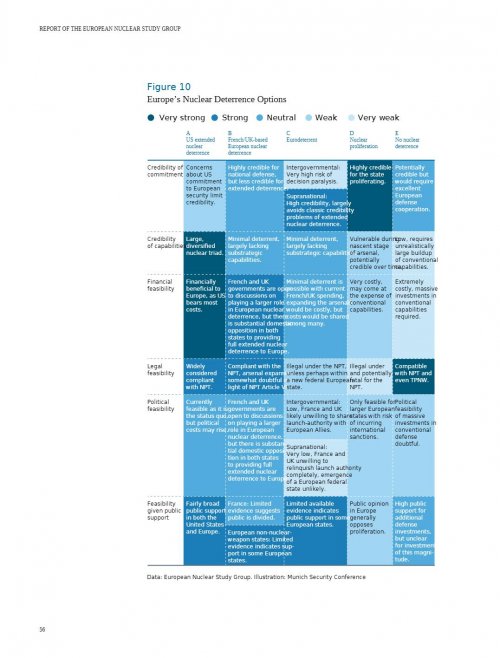
The entire report is well worth reading, but here's a chart summarizing the prospects of these options in their tradeoff dimensions:

MDG2.jpg

ENSG said:
... avoiding this debate would be the most dangerous choice of all. A deterrence gap would not emerge overnight; it would develop through hesitation, complacency, and failure to prepare. While every option entails significant costs, the costs of failing to think seriously about Europe’s nuclear deterrence posture could prove far higher – particularly in a crisis where credibility matters most and time is shortest.

...

Above all, Europeans can no longer outsource their thinking about nuclear deterrence to the United States. The era in which Europe could afford strategic complacency has ended. However uncomfortable the debate may be, the new security environment requires Europeans to confront the role of nuclear weapons in the defense of the continent directly and without delay – and to invest the resources needed to do so competently. Thinking seriously about these questions today is the price of avoiding strategic failure tomorrow.

The report is available here:


One of the chairs (Dr. Major) recently discussed the matter (in a slightly German centric framework) on a podcast (Braucht Deutschland die Bombe?), I'll include it here.

View: https://youtu.be/gKEk9lF3vjc
 
Last edited:
The entire report is well worth reading, but here's a chart summarizing the prospects of these options in their tradeoff dimensions:

View attachment 802158
After the events of 2014 and 2022, I think we can consider the entire NPT dead. I don't believe any nation with a nuclear-armed neighbor will want to be without nukes of their own.
 
Europe would be well served by encouraging Germany to change its laws to allow itself getting nukes. But at the same time, i don't see Europe wanting to let Germany get nukes. Let alone outside players like the US or Russia.

Some pan-european nuclear force where not just one country csn launch on its own might see a bit less pushback from Europe, but it would still be opposed by UK and France. Let alone US and Russia.

Financially, such a pan european force would be the least bad solution. A fleet of submarines financed by big EU economies, on patrol in the Med, which can already be made very secure and closed off to third party warships when the need arises, and controlled by a board of its financiers, with multinational crews.

Of course, first a more intregrated and united foreign policy within Europe needs to be devised. Good luck with that.
 

Similar threads

Back
Top Bottom