I recall this Geologist (charming man!) aboard the Hughes Glomar Explorer (including while in Lahaina) but I also quibble with this Captain saying he's the "last living member" of that ships crew. I started working aboard the Glomar Challenger in 1972 as a Seaman/Diver while just 20 years old, I subsequently got hired to be a Seaman/Welder after passing their brutal welding tests in Sun Shipyard where the Explorer was being made. Thereafter I primarily worked on the "Delivery" crew (what you call the "B" crew) but, unusually so, I also worked on the "Recovery " crew (A) at important times. I am currently ALIVE and just turned 75 ... and have many, many more tales to tell than have ever been written about. I liked Pasho's recent article Marine Technology and he should feel free to reach out to me at his pleasure.

You are using an out of date browser. It may not display this or other websites correctly.
You should upgrade or use an alternative browser.
You should upgrade or use an alternative browser.
Project Azorian
- Thread starter NERVA
- Start date
For anyone interested the article can be found at https://magazines.marinelink.com/nwm/MarineTechnology/202511/
I am nearing completion of a book about the seabed mining cover story for Azorian. It’s based on my involvement with a small group that had the job of convincing the world the project was about mining manganese nodules in the Pacific
I am nearing completion of a book about the seabed mining cover story for Azorian. It’s based on my involvement with a small group that had the job of convincing the world the project was about mining manganese nodules in the Pacific
be please to chat. I'm at [email protected]
- Joined
- 26 September 2008
- Messages
- 2,220
- Reaction score
- 1,544
Some thoughts (broken up into multiple posts because of length)
First off, I think it's worth discussing the acoustic data and it's pedigree. Agreement on the validity of this recording is of critical importance as it's one a very few actual quantifiable data points we have; the only other one being the observed condition of the forward part of the wreck. Unlike all of the various folks providing opinions based on what they saw/heard/thought/remember during the project, these are data point we can all examine analyze. In particular, the acoustic data is critical as there are numerous things that could sink a submarine and cause the damage seen in the wreck. It is far more difficult to find one that also matches the acoustic data.
I haven't seen any actual primary sources for the data. Polmar & White's book provides the below (pg 164) which seems to be the closest to a primary source available. It is of course of indeterminant accuracy, but given what I know of Mr Polmar's reputation and other works I think it is unlikely to be made up. (this isn't to say Mr White isn't reputable, just that I don't know enough about him to judge).
Additionally, while CAPT Newman does not agree with the conclusion of White & Polmar, his articles and subsequent letter to the editor in USNI Proceedings (here) does implicitly concur that this is accurate. Sharp's book doesn't speak specifically to the acoustic data, but he does say "It seems reasonable to assume, though, that these <acoustic> records might hold the keys to the puzzle of K-129's demise" (pg 289).
Given this, I think it reasonable to assume the chart shown is accurate. The analysis of data timing, duration, etc. also appears reasonable, and again there doesn't seem to be disagreement in the timing or duration of the events.
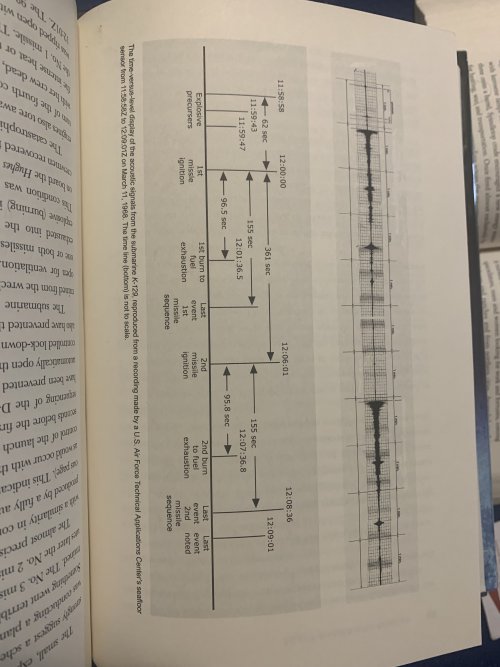
Specifically, there are several critical aspects of this data:
1) primary event starts at exactly midnight zulu and second main event is precisely 6 min later. It is extremely unlikely that any form of accidental event would occur this precisely.
2) duration of the high energy events. Explosion, impact, implosion, etc produce a signal with short duration pulses - similar to what is seen between about 2:30 and 3:30 in this chart. The signals at midnight and 0006 were generated by something that not only produced high energy, but a continual source of relatively consistent energy over a significant duration. Fire, explosion, battery failure, implosion, hull breakup, etc. don't do this.
3) repetitiveness of the main events. We have 2 very nearly identical signatures, both of which have abnormal characteristics as discussed above. It's not impossible that some weird combination of events could generate a difficult to explain abnormal signature, but to have it happen twice in a row with the same characteristics in for all practical purposes impossible, especially with the very precise 6 minute spacing and multiple sequential events.
3) overall sequence duration. This sequence lasts about 10 min in total. This requires minimal damage to the pressure hull during the event, as she would sink below crush depth much more quickly with any significant damage. Thresher for instance took about 5 minutes from first report of problems to implosion, and that's a boat with a much deeper crush depth.
I know where the acoustic traces came from, that is to say the person who was the final source for these acoustic tracings. How he obtained them some 40 years after they were made I am unsure of. But I personally cannot verify the authenticity (because I don't know), nor which of the acoustic arrays (there were five hydrophone arrays which detected the events associated with the loss) this event was picked up from. The hydrophone arrays are multiple hydrophones laid out in a line, and the time of arrival of an event at each individual hydrophone allows a calculation of the axis angle of detection. Using the axis angle data from the five different arrays (Adak, Hawaii, Midway and others) allowed the triangulation of the approximate location of the event within a few nautical miles. Other sources have also mentioned two distinct acoustic detection of events associated with the loss.
Just to add: the R-21 missiles that were carried by the K-129 (Project 629A) were liquid propellants, with Tonka fuel (50% triethylamine and 50% xylidine) and passivated nitric acid, AKA IRFNA (Inhibited Red Fuming Nitric Acid). These two are hypergolic upon mixing, no ignition required. That said, it is unclear how the missiles could run for the 93 seconds burn time without destroying both the launch tubes and subsequently the missile themselves. Since the fuels were hypergolic, the fuel and oxidizer tanks would have had to stay intact for the entire burn period. And it requires that a second, immediately adjacent missile tube could survive the conflagration of the first event to have a second ignition event and 93 second burn time. The entire aft section of the sail structure is missing on the forward section of the wreck. There were no signs of the expended missiles near the wreckage. One silo (the most forward) was twisted and bent, but there was hope that the warhead and other parts (guidance) could be recovered with the forward section.
At the end of the day, any attempt at explanations of the K-129 loss are speculations, some more probable than others.
We do now know that the Ken Sewell thesis (Red Star Rogue) that the K-129 was much closer to Hawaii and supposedly emulating a launch by the single Chinese Golf I is mistaken. Subsequent to his book, the CIA released the details of the dive by Trieste II bathyscaphe close to Hawaii. He had used the evidence of this dive as a clue that the K-129 wreck was much closer to Hawaii. The dive was specifically to recover one of the initial film capsules ejected from the then new KH-9 Hexagon satellite. The parachute had failed and the film capsule impacted and sank down to 16,000+ feet. You can download the booklet describing the mission as a PDF here: An Underwater Ice Station Zebra
Inteviews with the late Admiral Dygalo by Michael White indicate that the K-129 was to reach the 40N/180 point on March 8 and "phone home". Bu the acoustic event was recorded on March 11, within just a few miles of the 40N/180 point. The wreck was found at 40.06N 179.57E, initially by the submarine Halibut using the five acoustic array detections to triangulate the search location. This implies that the K-129 was well behind schedule for its traverse to the patrol area. It may have had snorkel problems as that system was at the time less than reliable. In any case, this is a mystery as the navigator and captain were responsible for keeping the submarine on a prescribed course and speed of advance. To our knowledge, they did not report any difficulties to Dygalo at headquarters.
There were no survivors of the K-129 loss, and the photographic evidence is that it was in three large pieces on the bottom. Only the forward section was of interest to the CIA for recovery; the aft end contained diesel engines and stern gear. One can speculate on the loss, but it's up to you to decide if any of this is definitive. When investigating Project Azorian, we primarily concentrated on the actual attempt at the forward section recovery, and the technology developed to make that possible.
Just to add: the R-21 missiles that were carried by the K-129 (Project 629A) were liquid propellants, with Tonka fuel (50% triethylamine and 50% xylidine) and passivated nitric acid, AKA IRFNA (Inhibited Red Fuming Nitric Acid). These two are hypergolic upon mixing, no ignition required. That said, it is unclear how the missiles could run for the 93 seconds burn time without destroying both the launch tubes and subsequently the missile themselves. Since the fuels were hypergolic, the fuel and oxidizer tanks would have had to stay intact for the entire burn period. And it requires that a second, immediately adjacent missile tube could survive the conflagration of the first event to have a second ignition event and 93 second burn time. The entire aft section of the sail structure is missing on the forward section of the wreck. There were no signs of the expended missiles near the wreckage. One silo (the most forward) was twisted and bent, but there was hope that the warhead and other parts (guidance) could be recovered with the forward section.
At the end of the day, any attempt at explanations of the K-129 loss are speculations, some more probable than others.
We do now know that the Ken Sewell thesis (Red Star Rogue) that the K-129 was much closer to Hawaii and supposedly emulating a launch by the single Chinese Golf I is mistaken. Subsequent to his book, the CIA released the details of the dive by Trieste II bathyscaphe close to Hawaii. He had used the evidence of this dive as a clue that the K-129 wreck was much closer to Hawaii. The dive was specifically to recover one of the initial film capsules ejected from the then new KH-9 Hexagon satellite. The parachute had failed and the film capsule impacted and sank down to 16,000+ feet. You can download the booklet describing the mission as a PDF here: An Underwater Ice Station Zebra
Inteviews with the late Admiral Dygalo by Michael White indicate that the K-129 was to reach the 40N/180 point on March 8 and "phone home". Bu the acoustic event was recorded on March 11, within just a few miles of the 40N/180 point. The wreck was found at 40.06N 179.57E, initially by the submarine Halibut using the five acoustic array detections to triangulate the search location. This implies that the K-129 was well behind schedule for its traverse to the patrol area. It may have had snorkel problems as that system was at the time less than reliable. In any case, this is a mystery as the navigator and captain were responsible for keeping the submarine on a prescribed course and speed of advance. To our knowledge, they did not report any difficulties to Dygalo at headquarters.
There were no survivors of the K-129 loss, and the photographic evidence is that it was in three large pieces on the bottom. Only the forward section was of interest to the CIA for recovery; the aft end contained diesel engines and stern gear. One can speculate on the loss, but it's up to you to decide if any of this is definitive. When investigating Project Azorian, we primarily concentrated on the actual attempt at the forward section recovery, and the technology developed to make that possible.
Last edited:
You might enjoy my recent book, Covering Azorian: First-hand Account of how the CIA Mined the Seabed for a Sunken Soviet Submarine”. As the last surviving member of the team behind the seabed mining cover story on the Project, I wanted to add my account to what has been written on other aspects of the Project.Covering Azorian is available on Amazon at https://www.amazon.ca/s?k=covering+...fix=covering+azorian,aps,115&ref=nb_sb_noss_1
Similar threads
-
-
 Stealing secrets from the ether: missile and satellite telemetry interception during the Cold War
- Started by Flyaway
- Replies: 4
-
 Eyes in the Sky: Eisenhower, the CIA and Cold War Aerial Espionage
- Started by overscan (PaulMM)
- Replies: 0
-
 Royal Navy Future Surface Combatant (FSC) - until late 2004
- Started by Triton
- Replies: 13
-
