Project 1164 Slava Class capabilities discussion

M Raffa putra H

ACCESS: Restricted
Joined
10 September 2021
Messages
16
Reaction score
12
Can someone help me to find this ship blueprint?

I forgot what is the ship " project" name
I remember I find this ship in this forum

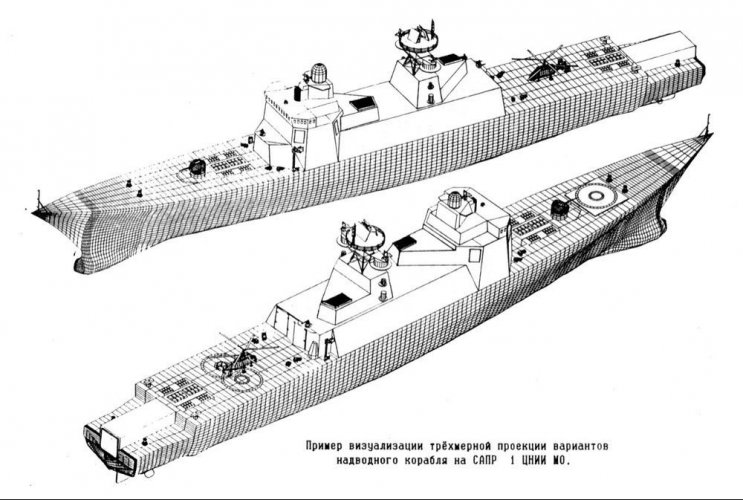
The shape almost like Ticonderoga class cruiser (Blocky)but it's made by Soviet (3d sketch from I remember)
 
There was no "Ticonderoga copy", possibly you are thinking of the Project 1165 Fugas (https://www.secretprojects.co.uk/threads/soviet-navy-project-1165-“fugas-cgn.8284/)

Not sure I can help much with such a vague description but I would suggest starting here:
https://www.secretprojects.co.uk/threads/soviet-cruiser-projects.1171/
and
https://www.secretprojects.co.uk/threads/soviet-unbuilt-naval-projects.766/
Well no, it's very different it's really closer to Ticonderoga,that have front brige more like renhai (not project anchor from I remember)

And not project fugas too
 
The Soviet equivalent of the Ticonderoga is Project 1164 Slava.
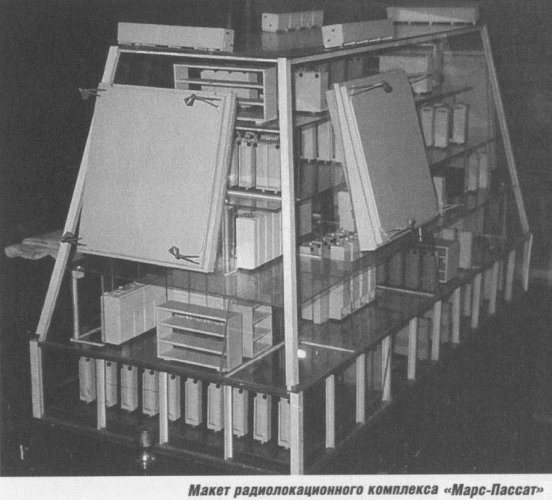
Soviet phased array antennas were huge and were only installed on aircraft-carrying cruisers. As far as I know, they were never put into operation. Therefore, ships of a smaller displacement with such devices could not physically appear in the 1980s.
 

Attachments

  • 16-10983341-mars-passat.jpg
    16-10983341-mars-passat.jpg
    308.5 KB · Views: 88
The Soviet equivalent of the Ticonderoga is Project 1164 Slava.
I seriously doubt that Slava could be considered equivalent of Ticonderoga. They are just of very different purpose; Tico is a fleet escort ship with emphasis on air defense system, Slava is surface action ship with emphasis on long-range strike weapon. Tico have superior area defenses (even Mk-I Tico) by order of magnitude, while Slava have superior anti-ship weaponry by order of magnitude. Those ships are essentially opposites, not equivalents.
 
The thesis that Tikonderoga's air defense is "an order of magnitude" or ten times better than the air defense of the Slava cruiser requires proof

  • «Slava» (Project 1164): Already had a vertical launch system of the B-204 deck-type for the S-300F Fort complex, which was advanced for the USSR. The 5V55RM missiles were launched using the "cold" method (the rocket was ejected from the cell using a powder catapult, after which the main engine was activated). The missile load was 64 missiles.
  • "Ticonderoga" (CG-47): Equipped with two two-gantry Mk 26 Mod 5 guided launchers. SM-2MR (Rim-66C) missiles were fed to the gantries from a below-decks conveyor. The total air defense ammunition capacity was 68 missiles (44 in the forward and aft magazines, minus the ASROC anti-submarine missile-torpedoes).
Comparison of rate of fire: It took about 8-10 seconds to aim the Mk 26 girders and load the missiles. The Soviet S-300F revolver drum took 3 seconds to rotate and launch the next missile. In terms of volley density, the Slava had an advantage in 1983.

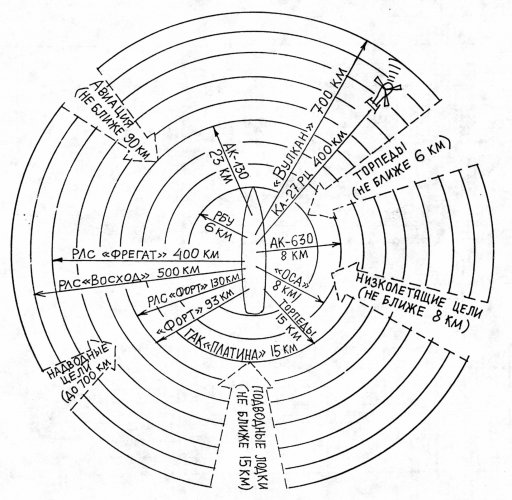
OSA-MA 2 x 2 SAM system, 10 km range, 40 missiles
Ticonderoga does not have this system

6 x 6 AK-630M (30 mm) Volley weight: ~32.5 kg/sec * 6 = 195 kg/sec
2 x 1 Phalanx CIWS Block 0 (20 mm) Volley weight: ~5.0–5.1 kg/sec * 2 = 10.2 kg/sec
 

Attachments

  • 05.jpg
    05.jpg
    271.5 KB · Views: 107
Last edited:
Well no, it's very different it's really closer to Ticonderoga,that have front brige more like renhai (not project anchor from I remember)

And not project fugas too

I know the image you are talking about, posted on @paralay own forums back in 2011, see here: https://paralay.iboards.ru/viewtopic.php?p=163027#p163027

I can't access the full size images, would be nice to see them, including the one with the text, on this forum though I have no idea as to their provenance.
 

Attachments

  • HNW7Gt6bQAAnbS7.jpg
    HNW7Gt6bQAAnbS7.jpg
    108.5 KB · Views: 17
The thesis that Tikonderoga's air defense is "an order of magnitude" or ten times better than the air defense of the Slava cruiser requires proof
Isn't that obvious?

Aegis system allowed for multiple tracking, multiple simultaneous guidance, multiple interceptions, in 360 degrees area around the ship. Granted, it have its deficiences (especially in early models), but it was the first such system that could really handle saturation attacks from several directions at once. It was achieved by having four AN/SPY-1 phased arrays providing search, tracking and missile guidance around the ship - 360 degrees coverage - with four AN/SPG-62 radars for target illuminations.

The "Slava" did not have anything comparable. While she is equipped with S-300F system, capable of multiple interceptions, it have only single 3P41 "Volna" fire control radar, which handled both the tracking and interceptions. Which means, that she could engage multiple targets only within the relatively narrow angle (about 50-60 degrees azimuth) at which radar is currently looking in. If two groups of targets arrive from several directions, the system would be very hard-pressed to defeat them.
 
Slava has two independent Voskhod radars with a range of 500 km and a Fregat radar with a range of 300 km, both with a 360-degree view. In addition, there are three independent Fort radars with a range of 130 km and Osa radars with a range of 27-40 km.

When attacking from one side, as is usually the case, the SLAVA cruiser's SAM system can engage 7 targets, while the TICONDEROGA cruiser's SAM system can engage 16 : 4 = 4 targets, as it only sees them with one antenna.
 
Slava has two independent Voskhod radars with a range of 500 km and a Fregat radar with a range of 300 km, both with a 360-degree view. In addition, there are three independent Fort radars with a range of 130 km and Osa radars with a range of 27-40 km.
Voskhod and Fregat are search sets that are not capable of doing tracking like SPY-1. They are largely irrelevant for a comparison to the Ticonderoga class and their tracking/fire control capabilities. Similarly, AFAIK there are no three independent Fort radars; just the Volna set for tracking and targeting, with search handled by the Voskhod set.

When attacking from one side, as is usually the case, the SLAVA cruiser's SAM system can engage 7 targets, while the TICONDEROGA cruiser's SAM system can engage 16 : 4 = 4 targets, as it only sees them with one antenna.
This is just flat-out incorrect. SPY-1 is capable of tracking over 100 targets simultaneously, not 16; even with just two faces and prototype systems USS Norton Sound was more than capable of tracking 20 targets at once. One face (which, I might add, is only possible on fairly narrow angles straight broadside, ahead, and aft) absolutely has more tracking capability than the one Volna, and the Volna as a massive blind spot forward that SPY-1 on the Ticos doesn't because it has four faces for 360-degree coverage.

OSA-MA 2 x 2 SAM system, 10 km range, 40 missiles
Ticonderoga does not have this system

6 x 6 AK-630M (30 mm) Volley weight: ~32.5 kg/sec * 6 = 195 kg/sec
2 x 1 Phalanx CIWS Block 0 (20 mm) Volley weight: ~5.0–5.1 kg/sec * 2 = 10.2 kg/sec
That the Slavas nominally have better point defenses than the Ticos is largely irrelevant in the context for which both were built, which as part of larger task forces providing area air defense. Also, I say nominally because to be blunt by the time both ships were built OSA is obsolescent and the AK-630 advantage is not as large as it seems - the fire control system had one channel per pair of guns, leaving them with three axes of fire to two on a Tico. This is, IMO, a more important metric than how much metal is being thrown downrange.
 
The SAM system can track as many targets as it wants, but how many can it shoot at simultaneously? Sixteen, with four antennas. How many can it shoot at with one antenna?
It is said that the Aegis missile defense system can fire 18 missiles simultaneously, but it does not specify how many targets. To ensure a guaranteed hit, a minimum of two missiles is required, resulting in a simultaneous attack on nine targets.

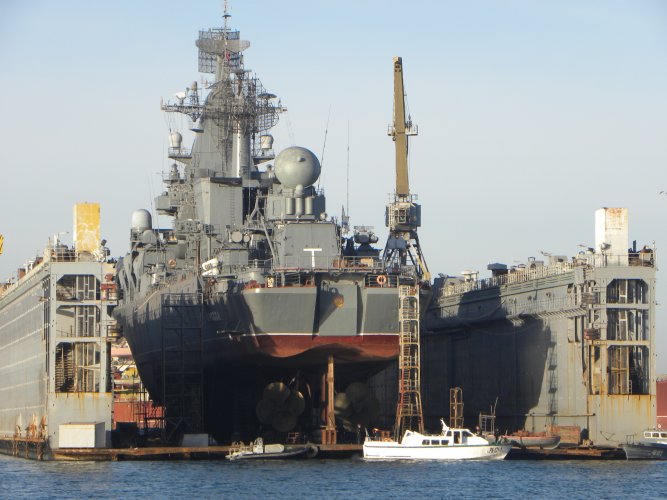
One "Fort" + 2 "Wasp"
 

Attachments

  • 01-4199728-dscn1930.jpg
    01-4199728-dscn1930.jpg
    2.2 MB · Views: 98
Last edited:
Slava has two independent Voskhod radars with a range of 500 km and a Fregat radar with a range of 300 km, both with a 360-degree view. In addition, there are three independent Fort radars with a range of 130 km and Osa radars with a range of 27-40 km.
You missed my point, She could detect incoming targets, true. But she could engage them with S-300F only in relatively narrow angle of her single missile control radar. The Aegis have no such limitation.

When attacking from one side, as is usually the case,
Erm... sorry to disappoint you, but attacks from several directions at once was standard tactics for aviation both of USSR and USA against enemy naval forces.

the SLAVA cruiser's SAM system can engage 7 targets, while the TICONDEROGA cruiser's SAM system can engage 16 : 4 = 4 targets, as it only sees them with one antenna.
The 3P41 could track & engage three targets and guide up to six missiles agains them in 60 degrees area.

The basic Aegis could track up to 100 targets, engage up to 8 simultaneously, and guide up to 18 missiles at the same time (if pressed, more could be launched with interception course pre-programmed). Up to four simultaneous interceptions could be executed (the SM-2 missile require AN/SPG-62 illumination only during terminal stage, so four available illuminators weren't a problem).
 
The SAM system can track as many targets as it wants, but how many can it shoot at simultaneously? Sixteen, with four antennas. How many can it shoot at with one antenna?
Eight in basic model, in any direction. The radar antennas aren't limitation; the limitation was a processing capabilities, required to quickly move the beam, track the target in real-time and calculate corrections to the missiles in flight.

It is said that the Aegis missile defense system can fire 18 missiles simultaneously, but it does not specify how many targets. To ensure a guaranteed hit, a minimum of two missiles is required, resulting in a simultaneous attack on nine targets.
Aegis (baseline) could CONTROL up to 18 missiles simultaneously on midcourse.
 
Is it possible to fire at 8 targets from one direction? That's the question

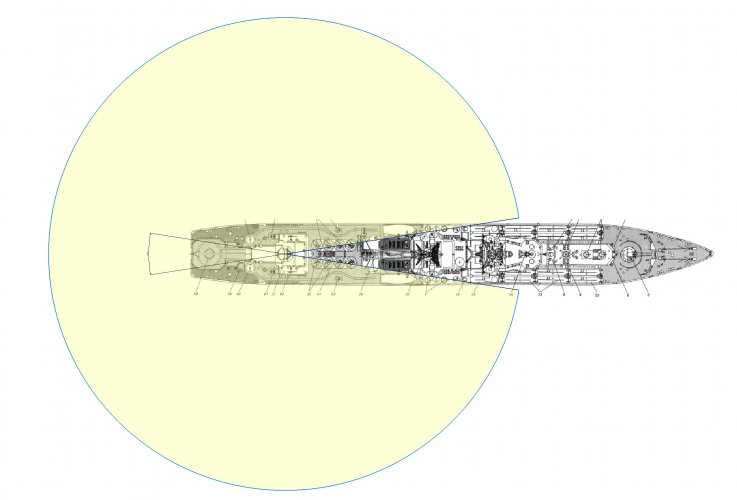
Sector that does not track "Fort" 17 degrees, 343 degrees under control, 95.3%
 

Attachments

  • 17.JPG
    17.JPG
    212.1 KB · Views: 59
Sector that does not track "Fort" 17 degrees, 343 degrees under control, 95.3%
No. You misunderstood again.

The problem is, that there is only one 3P41 radar system on cruiser. Its antenna could - at any given moment - scan through roughly 60 degrees angle. To scan outside this angle, the antenna need to rotate.

So the system could engage simultaneously only targets within roughly 60 degrees of antenna scan arc. To engage targets outside this arc, the antenna must be turned. I.e. the system could only engage target groups sequentially; first group of targets engaged, then antenna turned, engaged the other one, ect. While antenna is focused on first group of targets, the next one could not be engaged.

So if cruiser attacked from more than one direction - the S-300F system could only be used to fire at targets incoming from one directions. Other targets could not be engaged until S-300F finished firing at first ones and rotates to engage others.
 
I understand everything perfectly well.
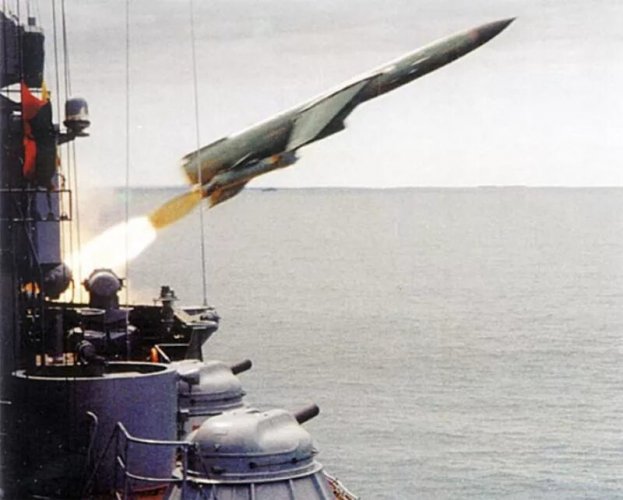
I'm probably the only person on this forum whose head was passed by two P-35 cruise missiles fired from a submarine at an altitude of 50 meters, five minutes apart. They were not shot down by the Uragan air defense system, followed by two AK-130 and two AK-630 cannons.
 

Attachments

  • 35.jpg
    35.jpg
    62.1 KB · Views: 52
Each technical solution has both advantages and limitations. If we consider an unrealistic scenario where a ship is alone at sea, each of the Aegis missile defense antennas must be operational 100% of the time. If one antenna malfunctions or is damaged, it deprives the entire 120-degree protection sector of its capabilities.
The ship's roll has a negative impact on the detection capabilities of the fixed antenna. The detection range in the 45-degree sector between the antennas is significantly lower than advertised. The five-antenna system of the Slava cruiser is free of these drawbacks, but it does have its own disadvantages.
 
Each technical solution has both advantages and limitations. If we consider an unrealistic scenario where a ship is alone at sea, each of the Aegis missile defense antennas must be operational 100% of the time. If one antenna malfunctions or is damaged, it deprives the entire 120-degree protection sector of its capabilities.
You realize, of course, that if sole 3P41 antenna would be damaged, the whole S-300F would be completely inoperable?
 
Each technical solution has both advantages and limitations. If we consider an unrealistic scenario where a ship is alone at sea, each of the Aegis missile defense antennas must be operational 100% of the time. If one antenna malfunctions or is damaged, it deprives the entire 120-degree protection sector of its capabilities.
The ship's roll has a negative impact on the detection capabilities of the fixed antenna. The detection range in the 45-degree sector between the antennas is significantly lower than advertised. The five-antenna system of the Slava cruiser is free of these drawbacks, but it does have its own disadvantages.
What's the point if later Soviet designs(and even later - actual Russian warships) came to an ~aegis setup more or less.

Slava is a 1970s design (revised anti-ship version of the 1134A/Berkut), roughly corresponding to Spruance, not Tico.

I seriously doubt that Slava could be considered equivalent of Ticonderoga. They are just of very different purpose; Tico is a fleet escort ship with emphasis on air defense system, Slava is surface action ship with emphasis on long-range strike weapon.
In the surface action part, I'd bet on Tico as a much stronger surface combatant.
What Slava does differently is having a huge array of theater ASCMs. Which isn't really surface action; rather, it's more aligned with what Kitakami (or, a better analogy, Japanese heavy cruisers) were during World War II.
Fleet salvo, at the disposal of the acting fleet flag officer(rather than individual captains), in a (theater-scale) kantai kessen fleet action.
That the Slavas nominally have better point defenses than the Ticos is largely irrelevant in the context for which both were built, which as part of larger task forces providing area air defense.
To be fair, major surface combatants (and, to a large degree, modern Russian ones to this date) defend themselves to a much larger extent, more in a WW2 style.
3 or even 4(1144) layers of defenses are the norm.
 
Last edited:
In the surface action part, I'd bet on Tico as a much stronger surface combatant.
With all respect, but Mk-1 Tico anti-surface capabilities were limited to eight Harpoon missiles, and pair of 127-mm gun. Slava carried sixteen P-500 Bazalt missiles (supersonic, longer range, much smarter, with onboard ECM's and terminal evasion capability) and dual 130-mm mount.
 
With all respect, but Mk-1 Tico anti-surface capabilities were limited to eight Harpoon missiles, and pair of 127-mm gun. Slava carried sixteen P-500 Bazalt missiles (supersonic, longer range, much smarter, with onboard ECM's and terminal evasion capability) and dual 130-mm mount.
Main surface-to-surface weapons are either SAMs(which are DP), or light ASCMs (which are well capable of short-range targeting of various ships, from small cutters onwards if so necessary).
This is a big advantage - the SAM battery is larger(twice as large with VLS), and light ASCMs exist - and are notoriously difficult targets as of the early 1980s (perfectly targetable, but the ship needs to be in perfect material condition).

P-500 is limited in many ways - they have substantial launch procedures, and a very respectable Dmin. To be effective, they also need to assemble the salvo.

As such, P-500 is broadly out of the equation, unless there's a clear possibility to set up a salvo - and(often) permission to do so. Remember that P-500s are not just beyond the usual disposal of the ship commander; good chunk requires launch permissions and codes as they're flashy gits.

Secondary ASuV weapon is indeed the gun, and two are two engagement axes instead of one.

Among Soviet weapons and ship classes, (by far) the most straightforward capable surface combatants(with the exception of monstrous Kirovs ofc) were the 956s. Not Slavas.
And the first truly multi-purpose do-it-all kind of ship was the very late Soviet 1154...
 
As such, P-500 is broadly out of the equation, unless there's a clear possibility to set up a salvo - and(often) permission to do so. Remember that P-500s are not just beyond the usual disposal of the ship commander; good chunk requires launch permissions and codes as they're flashy gits.
Okay:

1) The S-300F SAM could also be used against surface targets, so hardly any advantage there;

2) The "two engagement axes" advantage is rather unclear. What do you means? That shells would be imlacting fron slightly different angles? Not sure what advantage it gave. Or that you could engage two targets at once? Well, there is an advantage, but AK-130 compensated with higher rate of fire and heavier shells;

3) The Bazalt was under the squadron commander jurisdiction mostly because Soviet command structure was more centralized as whole. How exactly it affects the missiles efficiency, I don't understood. The Slava, as well as Tico, were supposed to operate as part of the fleet, and not alone. In most situations, Tico's Harpoons would also be launched only by squadron commander order (should I remind you, that Cold War era Harpoons have no IFF, and could not be used if friendly warships were on threat vector?)
 
1) The S-300F SAM could also be used against surface targets, so hardly any advantage there;
x2 the DP ammo depth with 4 independent(rather than coaxial) channels is quite an advantage.
Furthermore, again, Harpoons...
2) The "two engagement axes" advantage is rather unclear. What do you means? That shells would be imlacting fron slightly different angles? Not sure what advantage it gave. Or that you could engage two targets at once? Well, there is an advantage, but AK-130 compensated with higher rate of fire and heavier shells;
Ship can engage 2 targets simultaneously. Which is important, as ship under fire will either maneuver (which will throw off its own aim), or gets hit(and we're in an unarmored era, with ships covered in antennas and exposed armament).
3) The Bazalt was under the squadron commander jurisdiction mostly because Soviet command structure was more centralized as whole. How exactly it affects the missiles efficiency, I don't understood. The Slava, as well as Tico, were supposed to operate as part of the fleet, and not alone. In most situations, Tico's Harpoons would also be launched only by squadron commander order (should I remind you, that Cold War era Harpoons have no IFF, and could not be used if friendly warships were on threat vector?)
Harpoon is under the skipper's authority (and in fact were famously launched in this exact manner v Libyan missile corvettes)
But overall, it's a low, minimal engagement range missile with a short launch/targeting cycle and a minimal initial trajectory.

More broadly, both are multipurpose ships. But Tico is a more - substantially more - capable ship in surface action and/or independent operations. 1164 is above all a (discounted) theater ace for the entire area.
There's a quite clear difference between Soviet missiles (as well as with ships and submarines) here: tactical (тактического назначения), intermediate(оперативно-тактического назначения, ОТН), theater(оперативного назначения).
Different purposes.
 
x2 the DP ammo depth with 4 independent(rather than coaxial) channels is quite an advantage.
Furthermore, again, Harpoons...
With all respect, but it's not so relevant in surface-to-surface action. More important disadvantage is that S-300F have only a single point of failure, frankly.

Ship can engage 2 targets simultaneously. Which is important, as ship under fire will either maneuver (which will throw off its own aim), or gets hit(and we're in an unarmored era, with ships covered in antennas and exposed armament).
The 1980s gunnery FCS have no problems with ship maneuvering for a long time. Its not gonna "throw off its own aim".


Harpoon is under the skipper's authority (and in fact were famously launched in this exact manner v Libyan missile corvettes)
But overall, it's a low, minimal engagement range missile with a short launch/targeting cycle and a minimal initial trajectory.
Which means that Tico must survive to get into Harpoons range first. And when the opponent have basically triple your range in missiles, it would be tricky.

There's a quite clear difference between Soviet missiles (as well as with ships and submarines) here: tactical (тактического назначения), intermediate(оперативно-тактического назначения, ОТН), theater(оперативного назначения).
Different purposes.
With that I agree.
More broadly, both are multipurpose ships. But Tico is a more - substantially more - capable ship in surface action and/or independent operations.
Its more due to Tico destroyer origins.
 
But overall, it's a low, minimal engagement range missile with a short launch/targeting cycle and a minimal initial trajectory.
I should point that USN viewed its lack of missile range as serious concern, and thus created TASM to at least partially compensate.
 
With all respect, but it's not so relevant in surface-to-surface action. More important disadvantage is that S-300F have only a single point of failure, frankly.
Opening number and flexibility of engagement channels is the general trend of naval fire control.
First major post-soviet surface combatant for Russian navy looks like this:
images

nothing to add here, really.
The 1980s gunnery FCS have no problems with ship maneuvering for a long time. Its not gonna "throw off its own aim".
Fire control had(to a degree still have) sea state/maneuvering limitations when firing weapons and conducting operations. The same is true for gun accuracy.
Yes, CW ships can fire during sustained maneuvers, but this is nowhere near close to freedom of maneuver.
Which means that Tico must survive to get into Harpoons range first. And when the opponent have basically triple your range in missiles, it would be tricky.
It would really help if our world were a flat, featureless, and space without any complications. Alas, it is not.
Note that even now, with actually usable Kh-35s and P-800s, Russian preferred instrument for ship engagement is Geran.
Its more due to Tico destroyer origins.
Partially. But major reason is generational - aegis CMS, deeper primary battery, more modern and multi-purpose cruise missile, and earlier availability of TLAM.

Against all that, the Soviet cruiser has much more layered self-defenses (though mostly of previous generation, as up-to-date systems took a better part of the decade to develop), and theater missiles.
I should point that USN viewed its lack of missile range as serious concern, and thus created TASM to at least partially compensate.
Certainly, as USN ships didn't have a matching theater ASCM capability at all.
And developed one, much like Soviet Union went to get Onyx, Kalibr, and Uran families.

 
Fire control had(to a degree still have) sea state/maneuvering limitations when firing weapons and conducting operations. The same is true for gun accuracy.
Yes, CW ships can fire during sustained maneuvers, but this is nowhere near close to freedom of maneuver.
With the Tico having the upper hand compare to even the Kirov, the SPY1 can do surface tracking.

And even in the early 70s on the Norton Sound the USN found that the ship need to be extremely aggressively turning, as in taking hull life off type of turns, in bad sea states to make Aegis lose a surface track.

Resulting in the limitations being on the gun mount over the FCS and the MK45 is a quick bastard with a very solid stabilization system with the ability to do 3 complete 360s before needed to unwind itself. The SPG62 directors had the same gear as well, apperantly the newer ones have optic sliprings to remove the spin limits.

Results in the Tico able to nearly dance in heavy seas before losing track compare to other ships of the era. The Burkes with both its better seakeeping and radar return damping, has like half the RCS of a Tico, is even better.

Throw in the fact taht standard SOP then and now was to load Proxy Time Fuses and not impacts to shred the anteanas?

Results in a ship you done not want to mess with if you cant focus or backstab it.
 
With all respect, but Mk-1 Tico anti-surface capabilities were limited to eight Harpoon missiles, and pair of 127-mm gun. Slava carried sixteen P-500 Bazalt missiles (supersonic, longer range, much smarter, with onboard ECM's and terminal evasion capability) and dual 130-mm mount.
Don't forget the TASMs. But IIRC those weren't all that much bigger boom than Harpoons.
 
I witnessed the Fregat radar detecting a surface target at a distance of 250 km. As far as I know, this is related to the state of the atmosphere

i
 
SPY-1 performs azimuth and elevation search, target acquisition, classification, and tracking, as well as controlling the autopilots of anti-aircraft missiles during the launch and flight stages of the trajectory.

The only issue with SPY-1 is that the radar has difficulty distinguishing between fast-moving targets flying near the water surface.

The fire control system is archaic, relying on four SPG-62 target illumination radars. It is interesting to note that in this aspect, the Ticonderoga once again has an advantage over the Arleigh Burke (4 illumination radars versus 3 for the destroyer).

The main and irreparable drawback of the SPG-62 is its mechanical scanning (72°/sec turn rate). At any given time, each radar can only illuminate a single target. As a result, while the SPY-1's capabilities allow it to monitor up to 18 anti-aircraft missiles, it can only engage four air targets simultaneously (and, crucially, no more than two from each side).
 
I witnessed the Fregat radar detecting a surface target at a distance of 250 km. As far as I know, this is related to the state of the atmosphere
It's possible in specific conditions, when an atmospheric waveguide is formed - usually in calm weather with intence sun heating. Alas, I know little about exact mechanics, but as far as I know, the rapid changes of air humidity and temperature with altitude create sort of reflective layer, and radar beams that normally went through start to bounce between this layer and sea surface. Using such waveguide, the radar could actually increase the detection range beyond the horizon (at the cost of becoming blind to the targets that flew over reflective layer).
 
The only issue with SPY-1 is that the radar has difficulty distinguishing between fast-moving targets flying near the water surface.

It's mainly because the frequency of the AN/SPY-1 radar is optimized to detect high-altitude targets (it was designed mainly with Tu-22M launching X-22 Burya in mind), and near to surface the reflection from sea surface become a problem. To solve this problem, US engineers just linked the surface search/gunnery radar into Aegis, thus bypassing AN/SPY-1 limitations.
The main and irreparable drawback of the SPG-62 is its mechanical scanning (72°/sec turn rate). At any given time, each radar can only illuminate a single target. As a result, while the SPY-1's capabilities allow it to monitor up to 18 anti-aircraft missiles, it can only engage four air targets simultaneously (and, crucially, no more than two from each side).
No and no. The AN/SPG-62 is required only for 1-2 seconds per engagement - to illuminate target for missile seeker, for terminal homing. It lights up only when missile is close enough to the target to require terminal guidance. So the limitation is basically "no more than four targets could be engaged per 2 seconds."
 

Similar threads

Back
Top Bottom