Power sources for Ships, nuclear, gas turbines, solar, etc .

I am complaining that you nitpick a VERY small detail and leaving everything else out.

Again you did not mention the speed, which changes the boundary conditions, nor hull the hulls size or conditions which add more changes you just said. Didnt mention any factors or any similar designs or details. You just said.


Which is an EXTREMELY NARROW VIEW OF THINGS that is borderline Spherical Cow in the Sky type of conditions which is no were near realistic.


So again. What is the factors of the ship you use to do the math?
The problem is, you dislike facts. My first calculation was just a simple result based on your data, without any evaluation. This already provoked an angry answer.

I could choose any parameter in the world and it wouldn't satisfy you. Let's turn it around, give us an example for a cruiser which drives from an harbor in the US to the straight of Hormuz or the South China sea and back. You can freely decide the cruise speed and ship seize and we will see what the result looks like...
 
Last edited:
From a few years ago, when I was a member of ASME, I remember an article (in one of ASME's journals) analyzing a nuclear closed Brayton cycle for destroyer-sized ships. They found considerable weight and volume savings vs the PWRs used in naval ships.

In general, gas turbines -- and I love those machines -- are less efficient at all powers than diesels. They are, however much lighter and produce less vibration and the noise from gas turbines is much easier to control than the lower frequency noise from diesels. Which is "better" depends on design factors, like endurance, operating and first costs, and packaging. I doubt the Ticos could use an all-diesel plant (CODAG or CODOG are a different story ) and still perform their roles, but there is no reason to use gas turbines in an oiler or a replenishment ship.

Right now, nuclear power still ends up with greater life cycle costs than hydrocarbon fuels. I suspect this will remain so unless there is a major, and very unlikely, shift in reactor systems used by most fleets.
 
I didn't promote a Diesel only solution, but replacing one turbine by a Diesel would have increased the range and reduced the cost significantly. So far, we have only concidered relativly fast cruising, but not loitering around a certain place, docking, escorting slow civil vessels and so on. In those operations, gas turbines (even with only one out of four) are terrible inefficient.

Nuclear power is shurly becomming an option, even for merchand ships.
 
I didn't promote a Diesel only solution, but replacing one turbine by a Diesel would have increased the range and reduced the cost significantly. So far, we have only concidered relativly fast cruising, but not loitering around a certain place, docking, escorting slow civil vessels and so on. In those operations, gas turbines (even with only one out of four) are terrible inefficient.
How much of a ship's operating time is spent doing that?

Actually, how much of a ship's time spent in those conditions before it becomes worthwhile having one diesel in the ship, what with needing to have the extra weight for engine and silencing, the additional school and spare parts, etc?


Nuclear power is shurly becomming an option, even for merchand ships.
Not really.

Merchant ships are looking for ways to minimize their crew costs. So you'd need a reactor design that doesn't need 8+ bodies manning it at all times, insurers willing to insure a ship with said reactor design, and ports willing to accept nuclear-powered vessels.

We could make an argument for nuclear-powered icebreakers, but those are generally government-owned/operated.
 
I would want deisel to provide power for cruise speed plus hotel load. After that it should be a focus on power to volume density which the turbine provides. I would also want a way to sustain enough electrical generation and storage for several hours at a useful speed that is not necessarily close to a cruise speed. If you take damage that disables your main shafts then I want to keep moving somehow even if it is just bow thrusters. Sitting as a target and waiting for help is not a valid solution as history has proven time and again.
 
I didn't promote a Diesel only solution, but replacing one turbine by a Diesel would have increased the range and reduced the cost significantly. So far, we have only concidered relativly fast cruising, but not loitering around a certain place, docking, escorting slow civil vessels and so on. In those operations, gas turbines (even with only one out of four) are terrible inefficient.

Nuclear power is shurly becomming an option, even for merchand ships.
You add a Rankine cycle turbine to a gas turbines and you hit ~60% efficiency. This combo can be sized to provide hotel + 12kn ish crusing so you always hit 60% effiency. This beats out diesel on efficiency, power density, and allows you to solely have one type of fuel.

Don't say it's too large as they had planned for and reserved space for this setup on the first few AB's.
 
You add a brayton cycle turbine to one of your existing gas turbines and you hit ~60% efficiency. This combo can be sized to provide hotel + 12kn ish crusing so you always hit 60% effiency.
And greatly reduces flue gas temperatures, which reduces your thermal signature.


This beats out diesel on efficiency, power density, and allows you to solely have one type of fuel.
The USN uses the same fuel for diesels and the various GTs. Jet fuel is basically kerosene is basically diesel (the difference is additives and filtering). It's not like modern cargo ships and their Bunker C sludge.
 
Jet fuel is graded by specific gravity and the size of free floating impurities. The U.S. has tight standards compared to most others, which has caused some problems when American equipment uses fuel below their expectation.
 
The Burke for Example can kill two turbines bout 50k shp and still hit 18 knots.
Wow so much incorrect info. The Burke does 26 knots with 2 turbines. I provided the speeds with 1, 2 and 4 engines only a few posts above yours. Here it is again.


Gaining both the max efficiency of Turbines while also saving fuel by not running two.
No it doesn't. The Arleigh-burke does 20 knots with just one of the four gas turbines running at peak efficiency. The problem is this is not an efficient cruising speed and it it only has one prop spinning. 20+% efficiency is lost with the turbines. The Arleigh-burke has two thirds of the range of the similar size Type 45 destroyer.

Enough savings that adding Prime Moving diesels, IE ones that get the 10k plus horsepower is not worth the weight of them.
The single 1.9MW electric motor fitted to one shaft of the Arleigh burke test ship proved the savings are well worth it. Japan took all the lessons learned and implemented it onto their latest Maya-class desteoyers which is an evolution of the Arleigh-burke. They added an electric motor to both shafts and they then added a couple extra diesel generators. They took all the advice found from the report I had previously posted.

All US Navy ships moving forward will be fitted with smaller generators optimised for that 15-18 knot cruise.

For a Burke you need 4 of the Diesels to make the 50k shp 18 knot cruise needs, which basically 500 tons of weight. Compare to the lm2500 50 tons for all.
No you don't. You would only need one of those diesels. The Type 45 destroyer does 18 knots running off less than 10,000hp on diesel power only.

That weight is something you need to consider for warships.

Is the 15 percent efficiency increase worth the over 150 percent increase in weight?
Your weight increase is totally wrong because you assumed four engines instead of one to achieve your speed.

This is why the latest destroyers all use diesels. Spain, Australia, UK, France, Italy, Japan and Canada all their latest destroyers in production or under development use diesels.

When it comes to boats amateurs always overestimate the power consumed at lower speeds. Don't feel bad for getting it wrong by a factor of 2, most people are off by a factor of 10.
Firefinder you are off by a factor of 4. Even worse than Scott Kenny.
 
Last edited:
You add a Rankine cycle turbine to a gas turbines and you hit ~60% efficiency. This combo can be sized to provide hotel + 12kn ish crusing so you always hit 60% effiency. This beats out diesel on efficiency, power density, and allows you to solely have one type of fuel.

Don't say it's too large as they had planned for and reserved space for this setup on the first few AB's.
If this would be true, all ships would be like this ... Combined power doesn't beat Diesels in power density and it doesn't beat the Diesel in part load efficiency. You could promote four combined power propulsion systems per ships, meaning eight (!) turbine/generator combinations, but this would be an overkill

BTW, Diesels are doing fine with Kerosin, so you don't need different fuels for Diesels and gas turbines
 
How much of a ship's operating time is spent doing that?

Actually, how much of a ship's time spent in those conditions before it becomes worthwhile having one diesel in the ship, what with needing to have the extra weight for engine and silencing, the additional school and spare parts, etc?


Not really.

Merchant ships are looking for ways to minimize their crew costs. So you'd need a reactor design that doesn't need 8+ bodies manning it at all times, insurers willing to insure a ship with said reactor design, and ports willing to accept nuclear-powered vessels.

We could make an argument for nuclear-powered icebreakers, but those are generally government-owned/operated.

Most missions are loitering around. you can see it now in the Streight of Hormuz. Standing still would turn you into a very predictable target and a large swarm of military vessels all driving around at max speed in a bathtub like freighten chickens is no option either....

Small modular reactors are often in the same power range as the engines of large container ships. Actually, the Koreans are very active in this area and have even got a design certified.
 
If this would be true, all ships would be like this ... Combined power doesn't beat Diesels in power density and it doesn't beat the Diesel in part load efficiency. You could promote four combined power propulsion systems per ships, meaning eight (!) turbine/generator combinations, but this would be an overkill

BTW, Diesels are doing fine with Kerosin, so you don't need different fuels for Diesels and gas turbines
No you would just need one combined cycle turbine set, for hotel and cruise. The others could stay normal Brayton cycle as you use them so rarely. As mentioned before the early AB literally had a spot reserved for a rakine cycle turbine
 
There was a reason why they didn't use it....

Note, the efficiency of gas and steam turbines is more related to their size than for combustion engines. The mentioned 60 % efficiency is only possible with large and complex steam cycles, shurly not for such a cruise power configuration.

At part load, the exhaust temperature of the turbine will be to low for steam production, so this system might work well for cruise, but not for hotel load or slow loitering
 
There was a reason why they didn't use it....

Note, the efficiency of gas and steam turbines is more related to their size than for combustion engines. The mentioned 60 % efficiency is only possible with large and complex steam cycles, shurly not for such a cruise power configuration.

At part load, the exhaust temperature of the turbine will be to low for steam production, so this system might work well for cruise, but not for hotel load or slow loitering
The reason they didn't use it, was because they didn't want to deal with increased maintenance from a steam plant. Due to bad past experiences with heating co-generation on other ships and insufficient fuel cost savings. Despite this being completely different due to a much smaller amount of steam piping in a single part of the ship.

The original LM2500, a design from the late 60s, was 37% efficient. The racer which was to go on the AB increased power production by 6MW (LM2500 was 18 MW). So this increases efficiency to 50%.

The MT30 derived from an early 90s engine gets 40% efficiency with the latest aero turbines getting into the mid/high 40s. If you put a similar rakine cycle turbine on it you'll get to the high 50s
 
The first part of your posting doesn't really make sense, what has power to do with efficieny?

Gas turbines for combined cycle are optimized for high exhaust temperatures and use low pressure ratios. The efficiency of the turbine itself is lower than that of solo gas turbines. The higher exhaust temperatures increase the efficiency of the steam cycle and thus the overall efficiency.

You are very mucg oversimplifiyng the thermodynamics!
 
The first part of your posting doesn't really make sense, what has power to do with efficieny?

Gas turbines for combined cycle are optimized for high exhaust temperatures and use low pressure ratios. The efficiency of the turbine itself is lower than that of solo gas turbines. The higher exhaust temperatures increase the efficiency of the steam cycle and thus the overall efficiency.

You are very mucg oversimplifiyng the thermodynamics!
You're generating more power with the same fuel consumption. So efficiency has gone up.

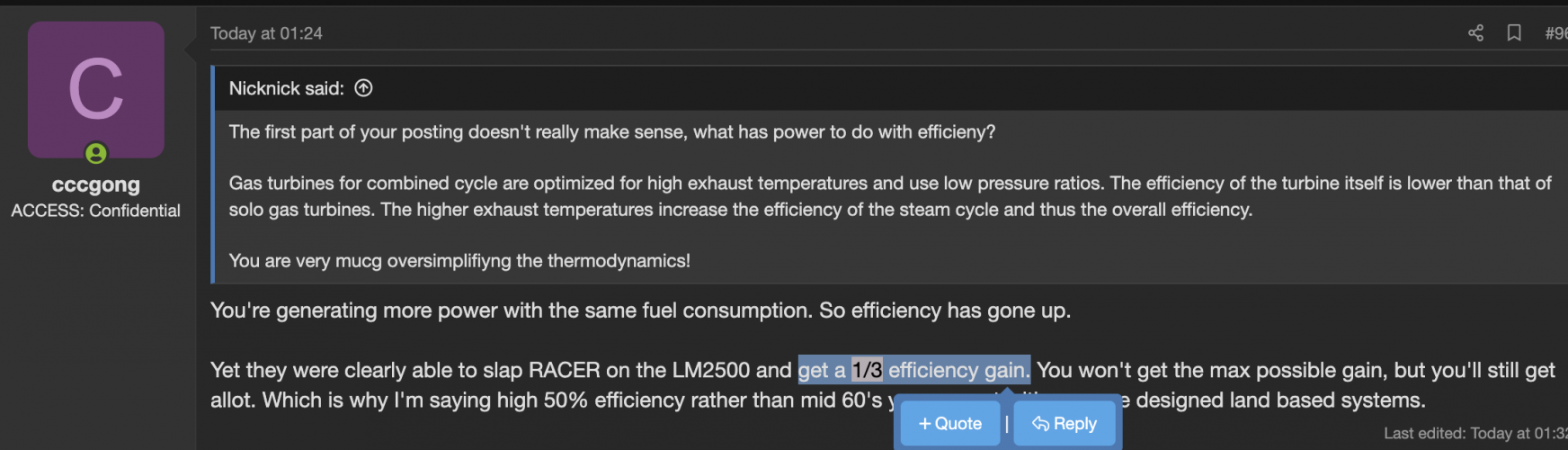
Yet they were clearly able to slap RACER on the LM2500 and get a 1/3 efficiency gain. You won't get the max possible gain, but you'll still get allot. Which is why I'm saying high 50% efficiency rather than mid 60's you can get with purpose designed land based systems.
 
Last edited:
The single 1.9MW electric motor fitted to one shaft of the Arleigh burke test ship proved the savings are well worth it. Japan took all the lessons learned and implemented it onto their latest Maya-class desteoyers which is an evolution of the Arleigh-burke. They added an electric motor to both shafts and they then added a couple extra diesel generators. They took all the advice found from the report I had previously posted.

All US Navy ships moving forward will be fitted with smaller generators optimised for that 15-18 knot cruise.
Apparently USS Truxtun is now due for its extended maintenance. Is it likely to get upgrades sufficient to fix some of those issues? Is it time to start putting the upgraded configuration into the new flt III?
 
You're generating more power with the same fuel consumption. So efficiency has gone up.

Yet they were clearly able to slap RACER on the LM2500 and get a 1/3 efficiency gain. You won't get the max possible gain, but you'll still get allot. Which is why I'm saying high 50% efficiency rather than mid 60's you can get with purpose designed land based systems.
What is a racer? Whatever it is, it shurly didn't increase to 55 %....

Again, combined cycles are good at 100 % uitilisation but not for hotel load and slow steaming. A Diesel will still be more efficient everytime you are out of a very small power range.
 
What is a racer? Whatever it is, it shurly didn't increase to 55 %....

Again, combined cycles are good at 100 % uitilisation but not for hotel load and slow steaming. A Diesel will still be more efficient everytime you are out of a very small power range.
RACER was the rankine cycle heat recovery steam turbine studied for the firat OHPs & presumably Burkes. I googled it. Apparently there were problems with water treatment for the steam plant. The boiler did produce steam for hotel load though.
 
What is a racer? Whatever it is, it shurly didn't increase to 55 %....

Again, combined cycles are good at 100 % uitilisation but not for hotel load and slow steaming. A Diesel will still be more efficient everytime you are out of a very small power range.
I never said 55%. I said it got the LM2500 to ~50%.

Once again you size the system for hotel + 12ish kn cruise.
 
W
I never said 55%. I said it got the LM2500 to ~50%.

Once again you size the system for hotel + 12ish kn cruise.
Well, you said 50 % improvment over 37 % .This means either 55 or 87 %. ...

An additiinal system for higher efficiency should cover the whole cruise range.
 
W

Well, you said 50 % improvment over 37 % .This means either 55 or 87 %. ...

An additiinal system for higher efficiency should cover the whole cruise range.
No.... I said 1/3 improvement over 37%. Giving about 50%.

You can likely get to mid/high 50's with current technology.

1776507278634.png
 
Last edited:
Apparently USS Truxtun is now due for its extended maintenance. Is it likely to get upgrades sufficient to fix some of those issues? Is it time to start putting the upgraded configuration into the new flt III?
The overall result of the testing with the Truxton was the Arleigh-Burkes would need a second electric motor for the second shaft to cruise at 15 knots. The ships generators could not support two electric motors. There is not enough space in the two engine rooms for additional generators.

The Japanese solved this issue with the Maya class by removing two of the large LM2500 gas turbines. This allowed room for two diesel generators without making the engine rooms bigger. It also has the extra electric motor on the second shaft. The newer LM2500 engines have 20-25% more power than the ones fitted to the early Arleigh-burke ships so the Maya class can still hit 30 knots with just two large turbines and the electric motors.

I prefer the propulsion layout of the Maya class with the smaller electric motors. This layout was proven with the Type 23 frigates and now the FREMM frigates. Keep the large gas turbines directly connected to the props for high speed. Then have sufficient generators to power the small electric motors and the ships systems. The destroyers need 50+ MW of power to hit 30 knots. They don't need 50 MW of continuous power generation to run a laser/radar/rail gun. These systems have very low duty cycle so 10 MW continuous generation is more than sufficient.
 
Last edited:
I'm surprised there aren't deployable outriggers to increase motor capacity on sprints. Bow thrusters are high drag the way they work. But if you were aiming for an efficient use of motor then it would be a high pitch, small diameter propeller. The main propellers are too generalized to provide efficiency in every speed range so they brute force their way through the efficiency losses. These ships do not exactly get up on plane like a leisure boat, so I do not mean to mimic them in any way. But an external outrigger that can power the ship when the main shaft is offline is intriguing.

I remember a scifi mag from the 70s where the artist depicted warships of the future being triangular shaped planar hulls and using what amounted to a waterski to lift the main mass out of the water, and thrust was provided by articulating arms that swung down under water. Minimal mass was creating drag as huge jets of water trailed the ship. Would hate to see what slamming the nose into a wave at 100 knots would do to a design like that.
 
Again, combined cycles are good at 100 % uitilisation but not for hotel load and slow steaming. A Diesel will still be more efficient everytime you are out of a very small power range.
That's why you have multiple engines. One of which happens to be sized for your hotel load plus a little speed. A second or third engine then gives you more speed, and yet-one-more engine gives you battle power for things like high-powered jamming and/or DEW
 
I'm surprised there aren't deployable outriggers to increase motor capacity on sprints.
It adds drag and for large ships you still need large propellers to add miningful additional power.

But an external outrigger that can power the ship when the main shaft is offline is intriguing.
The shafts and propellers on large ships are heavy, their inertia is substantially larger than pleasure ships. Keeping them spinning might be far more efficient than on smaller ships.
I remember a scifi mag from the 70s where the artist depicted warships of the future being triangular shaped planar hulls and using what amounted to a waterski to lift the main mass out of the water, and thrust was provided by articulating arms that swung down under water. Minimal mass was creating drag as huge jets of water trailed the ship. Would hate to see what slamming the nose into a wave at 100 knots would do to a design like that.
Hydrofoil ships have been around for more than a century and yet no ship is heavier than 260 tonnes. Guess why?
We are looking at large ships at least in the 7500 tonnes class or more.
Besides at lower speed the drag from the foils add ups. The break even point seems to be above ~13.5 kn and the stallspeed in the 50 kn.

I would be interested to see deployment of Mazda's new wankel engine that combined as hybrids appears to be most efficient (advertised at 20% more than conentional). Obviously, since there's no large version this would only work for smaller ships atm.
 
That's why you have multiple engines. One of which happens to be sized for your hotel load plus a little speed. A second or third engine then gives you more speed, and yet-one-more engine gives you battle power for things like high-powered jamming and/or DEW
If the hotel load is only 50% or less than the maximum power of the subsystem, the efficiency is allready much worse than that of a Diesel running on 50 % of it's power.
 
It adds drag and for large ships you still need large propellers to add miningful additional power.


The shafts and propellers on large ships are heavy, their inertia is substantially larger than pleasure ships. Keeping them spinning might be far more efficient than on smaller ships.

Hydrofoil ships have been around for more than a century and yet no ship is heavier than 260 tonnes. Guess why?
We are looking at large ships at least in the 7500 tonnes class or more.
Besides at lower speed the drag from the foils add ups. The break even point seems to be above ~13.5 kn and the stallspeed in the 50 kn.

I would be interested to see deployment of Mazda's new wankel engine that combined as hybrids appears to be most efficient (advertised at 20% more than conentional). Obviously, since there's no large version this would only work for smaller ships atm.
The rotating energy of the propellers will be less than 0.0001% of the bunkered fuel.

Wankel engines are terrible inefficient and no one can change it. What exactly is 20 percent more efficient and to which basis? Don't get fooled so easily!
 
Last edited:
If the hotel load is only 50% or less than the maximum power of the subsystem, the efficiency is allready much worse than that of a Diesel running on 50 % of it's power.
Have you not been reading anything I’ve been typing? You size the combined cycle turbine such that it’s operating near max with hotel +12kn cruise. This means you have a small smaller turbine for that specifically.
 
Last edited:
Yes, but I can help you understand why this system is less efficient than a Diesel over most part of the power range.

Try to use your brain
Does it allways work with constant power?
Will the hotel load be disapearing when cruising slowly?
Will the hotel load be constant independant from wether and system use?

All this indicates a very flexible power demand, which can be much better covered by a Diesel engine.
 
You’re going to be moving around 12kn most of the time. Your hotel load doesn’t reduce based on speed. If it’s really cold or hot, likely have even higher hotel loads so you can decide how you want to size and optimize that system.

You can’t seem to understand that there’s optimization to be done on sizing and there’s plenty of space to drop in efficiency when you start at 60% efficiency and still be better than diesels.
 
So the system has to cover very diffent hotel loads as well as hotel loads plus slow steaming. I gues, it needs to work between 15 and 100 % of iys maximum output, but it can only be optimized for one single, point (max power or slightly less). You got it?

Furthermore, the system needs to react very fast to load changes (eg during docking or when switching of the main turbines). This is hard to do with steam cycles and even gas turbines.

60 percent is impossible with such a small system and so higher the efficiency, so more difficult any change in power output will become. You cannot finetune a system with multible feed water heating stages, 3 times reheating, supercritical high pressure tubes and operate like a car engine.
 
Last edited:
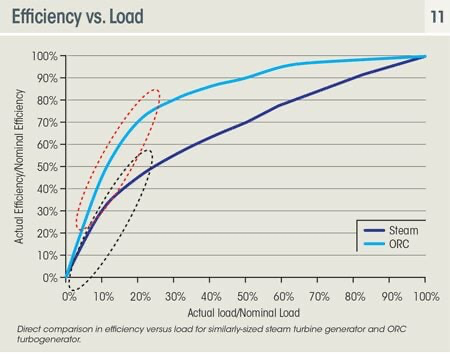
It doesn’t vary anywhere near that much. I would expect 70-100% load the vast majority of the time. See the light blue line for combined cycles turbines. Notice how it’s mostly flat till ~55% load?


You don’t need for it to react quickly, as you’re always loading this set close to maximum capacity. At 70% you would have 12 cruise, radars, light hvac, lighting, plumbing, cooking happening. At 100% you would have ewar, and heavy hvac added on top.

1776583244618.png
 
How shall that be the case? Even the hotel load will easily change by a factor of two. Just compare beeing docked in a moderate clima or in the heat of the middle east. The radar system are also a part of the equation. Or night and day...

Ship generators are often operating with less than 25 % of the max power as avarage over their lifetime (personal received information).
 
Last edited:
How shall that be the case? Even the hotel load will easily change by a factor of two. Just compare beeing docked in a moderate clima or in the heat of the middle east. The radar system are also a part of the equation. Or night and day...

Ship generators are often operating with less than 25 % of the max power as avarage over their lifetime (personal received information).
Are any of these ships with IEP and also turbines or generators sized appropriately for what I’m proposing?
 
Sized for what? Slow cruising pkus air conditioning in extreme heat plus radar? In this case the system will typically operate with 20 % power in avarage.

I could be wrong, but than the navies of the world would be as stupid as.me....
 
If you have a non-iep system, relying on diesels to generate power, you wont have any propulsion load of ~3mw for 12 kn. Driving your percentage load on the generators lower. On IEP (without diesels) or something like the ABs propulsion system, a single turbine is 20mw or more. So your load will also be low.

Something around 8-10mw of a combined cycle system would be ideal. Also average electrical load during peacetime will be lower as the radars and other systems will not be running as frequently. But arguably fuel effiency is more important during wartime to reduce your logistics train especially in the pacific. So I’d be willing to sacrifice peace time effiency for wartime and systems can be optimized wartime in the pacific.

Also according to the plot I provided, you can be running at 1/3 load in 60% efficient combined cycle system and still be as efficient as a diesel. For. 10mw system, that’s basically just the power required to cruise at 12kn while still having 7mw of hotel load margin.

Seeing as there’s only 6 IEP combat ship classes deployed. This hasn’t been possible until recently and navies are slow to adapt.
 
Last edited:
Forgett about the 60 percentvefficiency, the is onlyb possible with very large stationary power plants.

Unlike turbine systems Diesel reach their peak efficiency not atvmax power but around 70 % and still have a very high efficiency between 30 and 100 % (with variable speed)

An auxillary system which needs to cover highly varying power outputs will allway operate with very low avarage power about 20 %.

Again, this systems must be able to react fast on load changes which is impossible with gas/steam turbines. And no, the military will not accept a 30 min delay time on a vessel. Even in civil vessels, they usually run more generators than needed, just in case thy need suddenly more power
 
Forgett about the 60 percentvefficiency, the is onlyb possible with very large stationary power plants.

Unlike turbine systems Diesel reach their peak efficiency not atvmax power but around 70 % and still have a very high efficiency between 30 and 100 % (with variable speed)

An auxillary system which needs to cover highly varying power outputs will allway operate with very low avarage power about 20 %.

Again, this systems must be able to react fast on load changes which is impossible with gas/steam turbines. And no, the military will not accept a 30 min delay time on a vessel. Even in civil vessels, they usually run more generators than needed, just in case thy need suddenly more power
We hit 50% efficiency onboard a AB with late 1970s technology. We can hit 60 with today’s.

I’ve provided an efficiency vs load chart which shows you beat diesels down to 1/3 load. With a 10mw system that’s just moving at 12kn with no hotel loads. I highly doubt you’re ever using less power than that during wartime

You keep on bringing up transient power. You’re ignoring the other 2-3 GT that aren’t combined cycle. They are free to be used normally for transient loads when you suddenly have to go fast. You can use your smaller combined cycle turbine for the other 98% of the time.
 

Similar threads

Back
Top Bottom