Power sources for Ships, nuclear, gas turbines, solar, etc .

MadRat

ACCESS: Top Secret
Joined
29 January 2010
Messages
923
Reaction score
845
Hotel loads should be on deisel, not gas turbine. The former is far more efficient. These ships sit in sunlight on most days so it seems like not integrating solar in some way is a missed opportunity. You can probably push 5-6 knots overnight under solar with a modest use of flat surfaces. Of course that means battery storage. Those same systems would serve a purpose during humanitarian roles when ports may not be able to provide shore power. Redundant power is always a bonus in crisis. And contrary to knee jerk anti-green technology ideology, hybrid ships deliver immediate and long-term benefits because they reduce fuel consumption, visible emissions exposure, and overall running costs.

Seems like we could shift about 20-25% of operational loads off the current destroyers with long range corvettes and minimal function frigates that really are tasked to flexibly support special operations and a laser focus on locus realities. The USN seems to be less concerned with big guns, Tomahawks, and SM-3 in about a quarter of the planet. Could threats materialize over the next couple of decades? Sure, but even NAVSEA can design and build ships in that time period. This is exactly why FF(X) can be built to exclude Strike length tubes. Hell, I don't think we even need Mark 41 at all when aircraft can fly to the nearest coastline and dump JSM on targets. The french figured out how to VLS the MICA, surely there can be cold launched AMRAAM. If not, angle launchers for NASAMS are pretty compact and can surely fit in 3-4 spots even on a frigate. I see no reason the FF(X) will not work with Legend hulls. But I can see that if Legend hulls work then WMEC class should be looked at, too. Something along the lines of a WMEC could serially tow unmanned vessels, or the equivalent of equipment trailers, without interfering with amidship davits to support RHIB operations. The towed equipment could be for supporting whatever mission is required. Towed equipment is not sexy, but it is adequately functional for increasing tonnage in the water. And they have deck surface area that can be exploited.

This is the FF(X) thread. Much of the VLS talk is more suited imho to the FFG(X) thread.
 
So lets just replace it with zero VLS? Phelan seems to think its not a bad compromise.

I am certainly not saying that.

You can probably push 5-6 knots overnight under solar with a modest use of flat surfaces.

Check your math. Even solar panels covering a rectangle the dimensions of an FFG(X) would only produce <500 kilowatts (15 W/sq ft * 32,000 SF). More realistic coverage would be well under 100 kW. A single SSDG for the class produces 3,000 kW and that's not for propulsion loads. Solar is completely useless for this kind of application.
 
Check your math. Even solar panels covering a rectangle the dimensions of an FFG(X) would only produce <500 kilowatts (15 W/sq ft * 32,000 SF). More realistic coverage would be well under 100 kW. A single SSDG for the class produces 3,000 kW and that's not for propulsion loads. Solar is completely useless for this kind of application.

Consumer high efficiency panels are more around 20-28 watts per square foot at a 23% efficiency range on the high end. NASA is currently using Lockmart-built panels at over 32% efficiency. It is not beyond expectations to install consumer panels capable of 4 kW per thousand square feet.

I understand it is hard to fathom for most people that the Panama canal used to move 50,000 ton ships using a 40 horsepower mule unit along the canal. But this is perfectly realistic using engineering. The engine load is proportional to the cube of the propeller's rotational speed, so keep the target speed down greatly reduces the engine load to maintain that speed. Every knot of speed increase requires exponential energy increases. Now if you are maneuvering, have head winds, waves are pounding the hull, or operate in shallow then all of these will factor into the necessary energy to move your vessel. You probably can get a frigate to 5 knots on under 100 horsepower, which is under 90 kW. Target a speed of 10 knots and you may increase energy needs to about 1,200 horsepower. So aim for lower energy capability that is still quite useful. That is why I believe 5-6 knots overnight is not an unrealistic target. If you had a fire, ran into some unseen debris on open water, or sustained combat damage - but have the ability to tap the solar battery to limp out of harm's way until help arrives - the situation is far less bleak.
 
But there realistically aren't even a thousand square feet of unused deck space on a frigate. The topside is almost all used for something, if only walking space to access other systems. There just isn't enough area to add solar worth mentioning.
 
The solution is a small modular reactor whenever those are ready. You pop one in and out every 10 to 15 years and this covers hotel loads and cruise up to say 12 kn. Or you can have a smaller gas turbine that covers hotel plus creep such that it’s able to run at full load. This will make it more efficient than a diesel.
 
A gas turbine certainly can be more efficient than a deisel if you operate in a narrow power band as close to its full power rating as possible. The LM2500 one size fits all solution is fine for sprints but operates as a gas guzzler the way they are applied as current power sources on USN ships. Great for startup times and full power. If they were optimized for hotel and cruise power the deisel in comparison would certainly be at a strong disadvantage. They are superior at maximum output. But for general usage and idling, the LM2500 sucks the fuel like nothing else. To add an array of gas turbines to handle multiple power levels is cost prohibitive. There is a place for them for niches, but justifying that niche for .001% of time in use is the hard part.

I am a fan of eliminating transmission reduction gears and couplers, too. I would rather see effort put into extra electric motors able to attach with magnetic gears but that may not scale so well to use in a warship. I like to keep an extra prop and a trolling motor on my boat. Never know when either would help in an emergency, and I would hope the USN thinks in similar terms. In a pinch you can always take out extra stuff but cannot add what you don't already have. And I learned this idea for redundancy from a brother in law when his bass boat had the oil mixer fail. Four hours going back with a 36 pound trolling motor wasn't near as bad as swimming.
 
The solution is a small modular reactor whenever those are ready. You pop one in and out every 10 to 15 years and this covers hotel loads and cruise up to say 12 kn. Or you can have a smaller gas turbine that covers hotel plus creep such that it’s able to run at full load. This will make it more efficient than a diesel.
How much power do you think that would take, out of curiousity?

Because the old S5W the USN made hundreds of does generally line up with the ~10-20MWe size. But if you think that the USN will ever accept a reactor they can't manually control or adjust, you're smoking something you need to be sharing with the rest of us.


A gas turbine certainly can be more efficient than a deisel if you operate in a narrow power band as close to its full power rating as possible. The LM2500 one size fits all solution is fine for sprints but operates as a gas guzzler the way they are applied as current power sources on USN ships. Great for startup times and full power. If they were optimized for hotel and cruise power the deisel in comparison would certainly be at a strong disadvantage. They are superior at maximum output. But for general usage and idling, the LM2500 sucks the fuel like nothing else. To add an array of gas turbines to handle multiple power levels is cost prohibitive. There is a place for them for niches, but justifying that niche for .001% of time in use is the hard part.
That's why I said "IEP and I don't care what generates the hotel load."

Though I'd expect a modern destroyer's baseline hotel load to be close to one LM2500.

Oh, forgot in the basic specs post: I'd double or more the size of whatever onboard battery banks exist and aim to keep the battery at 25-75% capacity so there's always some extra volume to run the generators a little harder.
 
How much power do you think that would take, out of curiousity?

Because the old S5W the USN made hundreds of does generally line up with the ~10-20MWe size. But if you think that the USN will ever accept a reactor they can't manually control or adjust, you're smoking something you need to be sharing with the rest of us.


That's why I said "IEP and I don't care what generates the hotel load."

Though I'd expect a modern destroyer's baseline hotel load to be close to one LM2500.

Oh, forgot in the basic specs post: I'd double or more the size of whatever onboard battery banks exist and aim to keep the battery at 25-75% capacity so there's always some extra volume to run the generators a little harder.
You lose a large portion of the benefit of an SMR if you require naval style controls. As these are explicitly designed to require no input or maintenance now you’re adding a lot of manning, equipment, maintenance, volume cost for no reason. Along with forsaking economies of scale in the hundreds to thousands and a well developed logistic pipeline. It’s just unrealistic and stupid to try and put low powered reactors on surface vessels any other way in the future.

You can use about 7.5 MW at 18 kn for a 10 kt ship, added propulsive losses and 5 to 6 MW of hotel loads a megawatt reactor would cover power for the vast majority of the time.

This means you are nearly independent of Oilers.
 
You lose a large portion of the benefit of an SMR if you require naval style controls. As these are explicitly designed to require no input or maintenance now you’re adding a lot of manning, equipment, maintenance, volume cost for no reason.
Exactly.


Along with forsaking economies of scale in the hundreds to thousands and a well developed logistic pipeline. It’s just unrealistic and stupid to try and put low powered reactors on surface vessels any other way in the future.
Not that low-powered, again a ~15MWe reactor is a size the US has already made (low) hundreds of: the S5W used from the Skipjack-class through the Permits to the Sturgeon-class and all of the 41 for Freedom. Every US sub made before 1976 or so used that reactor.


You can use about 7.5 MW at 18 kn for a 10 kt ship, added propulsive losses and 5 to 6 MW of hotel loads a megawatt reactor would cover power for the vast majority of the time.

This means you are nearly independent of Oilers.
And it's a package that weighs about 600 tons. Maybe more, because shielding doesn't scale.
 
Exactly.


Not that low-powered, again a ~15MWe reactor is a size the US has already made (low) hundreds of: the S5W used from the Skipjack-class through the Permits to the Sturgeon-class and all of the 41 for Freedom. Every US sub made before 1976 or so used that reactor.


And it's a package that weighs about 600 tons. Maybe more, because shielding doesn't scale.
Stuff in the 10 to 30 MW range is considered a micro reactor and these generally fit in a few standard shipping containers. That also includes cooling and mounting, which would be already integrated on the shop. It should not weigh 600 tons as many use much higher temperature coolant.

The ship jack reactor is not acceptable due to size weight cost manning maintenance decommissioning and refueling requirements.
 
Last edited:
The eVinci microreactor provides 5 MW of heat for 8 years. Perhaps they could drive steam. The dirty truth about current SMR technology is that few get down into the under 100 MW range. Most are suited to small cities or industrial zones, not ships.
 
How much power do you think that would take, out of curiousity?

Because the old S5W the USN made hundreds of does generally line up with the ~10-20MWe size. But if you think that the USN will ever accept a reactor they can't manually control or adjust, you're smoking something you need to be sharing with the rest of us.
We have already been over this. It will not be long until you are convinced.

Arleigh-Burke destroyers needs only 1.9 MW to cruise at 12 knots based on when they fitted a 1.9MW electric motor to USS Truxtun. The Arleigh-burke spends more than half of an average deployment at or below 12 knots. Hotel loads are under 2 MW during transit providing it is not in Arctic waters. Ship heating draws big power. I provided the data.

5 MWe eVinci micro reactor core fits in a shipping container and is under 40 ton. This provides 5 MW of electricity which is enough power to have an Arleigh-burke sized ship transit at ~15 knots with peace time hotel loads. I estimate an Arleigh-burke sized ship could run entirely on this micro reactor for 60-70% of its life time.

I estimate that a 10 MWe reactor is the sweet spot for a 10,000 ton Navy ship. This allows ~18 knots cruising speed with the radar on. 90+% of the ships life it will be running nuclear only.

If we are conservative and triple the volume and weight of the eVinci to achieve double the power output then a 30MW thermal core will still fit in a C-5 galaxy and on an oversized train carriage. It would also be able to fit on a truck with custom trailer and oversized load permits.

The tiny French Rubis-Class nuclear subs use a 48MW core. They are only 2,500 ton displacement. This is by far the best example to use. Scaling down from the Rubis-Class reactor to 30 MW we also get something that can still fit on a train carriage.

If the Navy wants to build a 20,000 ton ship then it can simply run two micro reactors.

The eVinci microreactor provides 5 MW of heat for 8 years. Perhaps they could drive steam.
eVinci puts out 15 MW of thermal and 5 MW of electricity. This is a typical loss. I also notice the steam powered nuclear ships the steam turbines are also a third of the reactors thermal output. The same steam turns the electric generator as it would the prop. This means electric or stream powered props would be similar.

The obvious solution is to use electric motors on the props using electric integrated propulsion. This then allows a gas turbine generator to be connected to the power grid for peak loads.

If I was building a cleansheet 10,000 ton destroyer I would have the following:
1x 10MWe micro nuclear reactor
1x 36MW MT30 gas turbine generator
1x 4MW gas turbine generator
2x 25MW electric motors, one on each prop.

The 8,500 ton Type 45 destroyer for example hits 32 knots with just two 20 MW electric motors on the props. In the combat zone on patrol the nuclear reactor would run at a constant 10 MWe and the 4 MW gas turbine generator would be handling any power fluctuations of the radar/lasers etc. Fuel consumption would be very low allowing overall small fuel capacity. The 36 MW gas turbine only runs when the ship needs to sprint above 20 knots.

If the reactor is turned off in preparation for being swapped out, the ship can cruise efficiently off the single 4 MW gas turbine generator. It also provides redundancy to the reactor. This also allows reduced manning for the reactor. With a submarine if the single reactor turns off the submarine is dead in the water. If the microreactor turns off then the ship can still finish the deployment using the gas turbines.

The key moving forward is that the US Navy ship designs should be fitted for but not with a micro reactor. This would involve having fuel storage next to the engine rooms. The engine rooms can then be expanded to fit the reactor with a simple reduction in fuel capacity. Access to the engine rooms need to be larger as the micro reactor is still much bigger than a gas turbine. The conventionally powered ships would then have 2-3 times the fuel capacity. An Arleigh-burke for example has 1,300 cubic metres of fuel volume. The 5 MWe eVinci power plant takes up a fraction of this volume. A 10MWe nuclear generator would still fit within the fuel tank volume. The micro reactor ship would not be bigger it could actually be smaller.
 
Last edited:
but it had too much other stuff added for ASW to be more than a secondary role
The presence of AGS is overstated because it was so visible. The low observability features did not detract from the ASW role
If the Navy wants to build a 20,000 ton ship then it can simply run two micro reactors.
Incorrect, the USN has studied this quite extensively. As a matter of fact they seem to have studied it about every 5 years between 2000 and 2018 that I can think of. See, you aren't altogether incorrect that the power density is theoretically possible but the real issue is operating the reactors. Civvy SMRs have almost no commonality with military reactors because they are designed to produce baseload power, not variable loads dependent on conditions. They also aren't as redundant and survivable.
If I was building a cleansheet 10,000 ton destroyer I would have the following
You haven't accounted for hull design, or nuclear ship operations. You have only applied fossil fuel ship operations and fitted SMRs to replace them. This is flawed methodology.
It would also be a total waste. You would need to re-establish an entire nuclear industry, more nuclear dockyards, and train up whole new groups of people just to operate 10MW SMRs. At best you're talking about a transitional design.
Going off the last time the idea was discussed in depth, that being Westinghouse LWNP, for naval applications the entire reactor would have to be refurbished semi regularly, which means docking the ship and tearing it apart so the reactor can be removed.
eVinci has a stated period between refueling of 8 years. Although LWNP actually had a shorter period between refueling as naval reactors are run harder, we will accept this figure.
If we assume that DDGs serve for at least 32 years (Burke is scheduled to make 40 at this point iirc) then the reactors will need to be torn out and replaced at least 3 times, if not 4 or 5. That is not a non trivial proposal.
Though I'd expect a modern destroyer's baseline hotel load to be close to one LM2500.
I can't remember the baseline load figure but DDG(X) has a 40MW target surplus @ 16 knots
 
Last edited:
Civvy SMRs have almost no commonality with military reactors because they are designed to produce baseload power, not variable loads dependent on conditions. They also aren't as redundant and survivable.
The microreactor in the Navy ship would not be producing variable loads. It is effectively providing the baseload power and the gas turbines provide the variable loads.

It would also be a total waste. You would need to re-establish an entire nuclear industry, more nuclear dockyards, and train up whole new groups of people just to operate 10MW SMRs. At best you're talking about a transitional design.
Commercial container ships are already going nuclear. Considering the slower development time of military ships the microreactors and nuclear industry will probably be ready. This might be like the F16 fighter fleet how they have two engine options. The Navy should not lock down the design for a certain reactor type. Build it for but not with.


Going off the last time the idea was discussed in depth, that being Westinghouse LWNP, for naval applications the entire reactor would have to be refurbished semi regularly, which means docking the ship and tearing it apart so the reactor can be removed.
This would be similar to the removal of the large diesel engines on a ship.

If we assume that DDGs serve for at least 32 years (Burke is scheduled to make 40 at this point iirc) then the reactors will need to be torn out and replaced at least 3 times, if not 4 or 5. That is not a non trivial proposal.
Yes 4-5 refuelings is too much. It would be best for the microreactor to have 20 years of fuel. The ships then get the systems upgraded and a new reactor core fitted at the 20 year mark. This provides a 40 year service life.

Even 2 refuelings would be acceptable so there are two major overhauls after 13 or so years.

I can't remember the baseline load figure but DDG(X) has a 40MW target surplus @ 16 knots
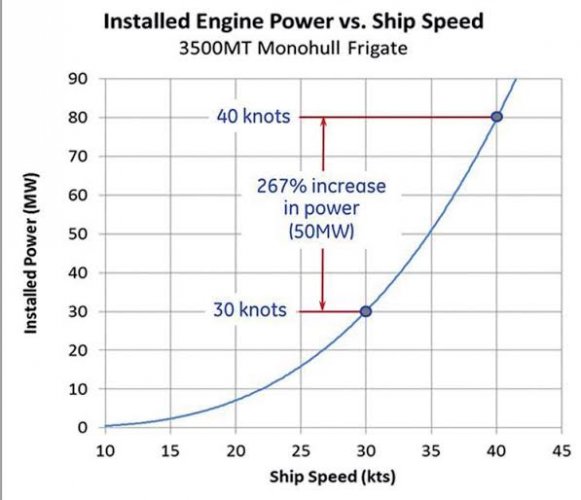
The Zumwalt class at 15,600 ton displacement cruises at 30 knots with 78MW of power generation. You have halved the speed and halved the power. It doesn't work like that. A boat cruising at half the speed requires less than a quarter of the power. Between 15-20MW would be required to cruise around 16 knots.
 
The microreactor in the Navy ship would not be producing variable loads. It is effectively providing the baseload power and the gas turbines provide the variable loads.
This is not considered a viable concept of operations as far as I have been told
Commercial container ships are already going nuclear. Considering the slower development time of military ships the microreactors and nuclear industry will probably be ready.
Yes 4-5 refuelings is too much. It would be best for the microreactor to have 20 years of fuel. The ships then get the systems upgraded and a new reactor core fitted at the 20 year mark. This provides a 40 year service life.

Even 2 refuelings would be acceptable so there are two major overhauls after 13 or so years.
These are diametrically opposed positions. Civvy reactors use low enriched nuclear fuel which naturally necessitate more common refueling but also allow for reactor miniaturization. If you want to extend the period between refueling to 20 years you would need to enrich the fuel to a greater degree than the 19.75% eVinci uses, which would necessitate larger reactors, and now you're inadvertently proving why it doesn't work.
You could maybe pump out better efficiency by transitioning to sCO2 or something but I'm not knowledgeable enough to comment on whether that would provide enough benefit.
The Navy should not lock down the design for a certain reactor type. Build it for but not with.
"Build for but not with" a NUCLEAR REACTOR. You do realize shipboard reactors don't exist in isolation? You only need to look at a Belknap compared to Truxtun to see why that doesn't work.
This would be similar to the removal of the large diesel engines on a ship.
Truly a non trivial exercise
The Zumwalt class at 15,600 ton displacement cruises at 30 knots with 78MW of power generation. You have halved the speed and halved the power. It doesn't work like that. A boat cruising at half the speed requires less than a quarter of the power. Between 15-20MW would be required to cruise around 16 knots.
"surplus"
 
The Navy should not lock down the design for a certain reactor type. Build it for but not with.

This is impossible with a nuclear surface ship. Nuclear surface ships are reactors with warships built around them, not the other way around. There is no way around this without building to commercial standard, which is also not acceptable for a warship. Very bizarre statement.
 
This is impossible with a nuclear surface ship. Nuclear surface ships are reactors with warships built around them, not the other way around. There is no way around this without building to commercial standard, which is also not acceptable for a warship. Very bizarre statement.
This only applies to historical nuclear designs. When the reactor takes up ~20% of the ship volume then the ship must be built around the reactor. The ship needs to be cut in half to remove the resctor. Logistics are huge.

However when a microreactor is only 2-3% of the ships volume the ship does not need to be built around the reactor. The ship no longer needs to be cut in half for refueling. The reactor is now small enough to be removed like a large diesel engine.

This is not considered a viable concept of operations as far as I have been told

These are diametrically opposed positions. Civvy reactors use low enriched nuclear fuel which naturally necessitate more common refueling but also allow for reactor miniaturization. If you want to extend the period between refueling to 20 years you would need to enrich the fuel to a greater degree than the 19.75% eVinci uses, which would necessitate larger reactors, and now you're inadvertently proving why it doesn't work.
Doubling the fuel capacity doesn't double the reactor size. The eVinci is very small. The reactor could be 3-4 times the volume and still be easy to transport.

You could maybe pump out better efficiency by transitioning to sCO2 or something but I'm not knowledgeable enough to comment on whether that would provide enough benefit.
10 MWe over 20 years is achievable while still fitting on a train carriage. Remember they transport complete 737 fuselages by rail. They also transport Falcon 9 rockets by road. These are 10+ times the volume of eVinci.

"Build for but not with" a NUCLEAR REACTOR. You do realize shipboard reactors don't exist in isolation? You only need to look at a Belknap compared to Truxtun to see why that doesn't work.
The sales pitch of microreactors are that they plug in to the existing grid like a battery. Fully stand alone. Amazon plans to use microreactors at their datacentres. With ship integrated electric propulsion the ship has a high voltage backbone. The microreactor can plug in just like the land based versions. Obviously it will need extra safety features for military standards but I doubt will double the size of the reactor.

We do not know what size reactor the commercial ships will use. It would be wise to not lock in the military naval designs to a certain size.
 
This only applies to historical nuclear designs.

No, it applies to all of them. Reactors are dense and cannot be balanced by shifting fluids. You balance the ship by moving the reactors.

The fundamental requirement of balancing the ship and need for stability makes reactors an intimate part of the design. You cannot design a ship unless you know the parameters of the reactor, which means it must exist first, and it cannot be simply changed out without a fundamental redesign of the entire ship. Now you know why U.S. nuclear surface escorts and French nuclear carriers used submarine reactors.

Unless the reactor exists, you cannot design a warship around it. There is nothing to do. It might as well be a Popular Mechanics cover.
 
Stuff in the 10 to 30 MW range is considered a micro reactor and these generally fit in a few standard shipping containers. That also includes cooling and mounting, which would be already integrated on the shop. It should not weigh 600 tons as many use much higher temperature coolant.

The ship jack reactor is not acceptable due to size weight cost manning maintenance decommissioning and refueling requirements.
Oh, the Skipjack reactor vessel does happen to be about the size of a shipping container.

A shipping container packed full of steel (7ton/m3) and uranium (19.5ton/m3), which means very very heavy.

Then you need to include all the shielding in the system weight, too.


The eVinci microreactor provides 5 MW of heat for 8 years. Perhaps they could drive steam. The dirty truth about current SMR technology is that few get down into the under 100 MW range. Most are suited to small cities or industrial zones, not ships.
I mean, I get it. Having a reactor for hotel load and a couple of GTs for sprint power makes a certain kind of sense. (Plus an emergency diesel, I expect)

But yeah, the scale needed is less than 100megawatts.


I can't remember the baseline load figure but DDG(X) has a 40MW target surplus @ 16 knots
Okay, so let's just call it ~50MWe needed to cruise around at 16 knots and power everything.

That's going from S5W to S6G (637-class to 688-class) power levels. The 637 was 4700 tons submerged, the 688 was 7000 tons submerged. And basically the only change was the size of the reactor.
 
Ladies and gentlemen, might I perhaps suggest that perhaps the time of the nuclear outboard motor has come again?
1773307314497-png.805083


Also, the Westinghouse LWNPP may be of interest.
 
Okay, so let's just call it ~50MWe needed to cruise around at 16 knots and power everything.
Hahaha! A Nimitz class carrier can do 16 knots with 50 MW. This is up there with your comment of using plastic straps to hold the fins of the AIM-174B to fit in an internal weapon bay.

A Nimitz carrier can do 30 knots with 190 MW of shaft power. Check this table from the GE website. Travelling at 16 knots only requires 12% of the power compared to 30 knots.
images - 2026-04-10T233930.751.jpeg

A 45,000 ton America class LHD only has 55 MW total power generation onboard and that is travelling 22 knots with all systems running.

We are talking about a destroyer. 10 MW is plenty to cruise at 16 knots with systems running.
 
Oh, the Skipjack reactor vessel does happen to be about the size of a shipping container.

The Westinghouse LWNPP proposed as a drop-in LM2500 replacement was about 300-350 tons with all elements.

The reactor core itself was something like 180-190 and then the remainder for shielding and control systems. Roughly 25 lbs/shp. The LM5000 class was 15 lbs/shp. Would be a tough balancing act without fluids for sure, since you'd have them side-by-side in a single engine room, and with the machinery it came out to be about 100 tons heavier than an LM2500 installation all told. Something between 1,200-1,300 tons versus the 1114 tons of the LM2500.

It could only work well for the Watson-class LMSRs since they use a commercial LM2500 installation. Too concentrated for a warship.
 
This only applies to historical nuclear designs. When the reactor takes up ~20% of the ship volume then the ship must be built around the reactor. The ship needs to be cut in half to remove the resctor. Logistics are huge.

However when a microreactor is only 2-3% of the ships volume the ship does not need to be built around the reactor. The ship no longer needs to be cut in half for refueling. The reactor is now small enough to be removed like a large diesel engine.


Doubling the fuel capacity doesn't double the reactor size. The eVinci is very small. The reactor could be 3-4 times the volume and still be easy to transport.


10 MWe over 20 years is achievable while still fitting on a train carriage. Remember they transport complete 737 fuselages by rail. They also transport Falcon 9 rockets by road. These are 10+ times the volume of eVinci.


The sales pitch of microreactors are that they plug in to the existing grid like a battery. Fully stand alone. Amazon plans to use microreactors at their datacentres. With ship integrated electric propulsion the ship has a high voltage backbone. The microreactor can plug in just like the land based versions. Obviously it will need extra safety features for military standards but I doubt will double the size of the reactor.

We do not know what size reactor the commercial ships will use. It would be wise to not lock in the military naval designs to a certain size.
I don't think you read what I said, or alternatively have no serious response to the actual problems I presented. I'll just zero in on one thing:
Obviously it will need extra safety features for military standards but I doubt will double the size of the reactor.
You don't need extra safety features, you need to make it maintainable while underway (which SMRs are predominantly not) and you need it to have increased redundancy
Hahaha! A Nimitz class carrier can do 16 knots with 50 MW.
That is propulsive power, not propulsion + a surplus for operating systems. It also doesn't account for the hull itself. If you're going to present an argument can you at least not do it in bad faith, and especially not when it is as easily disprovable as this?
A 45,000 ton America class LHD only has 55 MW total power generation onboard and that is travelling 22 knots with all systems running.
Also flawed methodology. You could also say that a Supply class can make the same speed as a Burke on the same powerplant, despite being something like 6 times larger. It's an apples to oranges comparison
The Westinghouse LWNPP proposed as a drop-in LM2500 replacement was about 300-350 tons with all elements.

The reactor core itself was something like 180-190 and then the remainder for shielding and control systems. Roughly 25 lbs/shp. The LM5000 class was 15 lbs/shp. Would be a tough balancing act without fluids for sure, since you'd have them side-by-side in a single engine room. With the machinery it came out to be about 100 tons heavier than an LM2500 installation all told. Something between 1,200-1,300 tons versus the 1114 tons of the LM2500.

It could only work well for the Watson-class LMSRs since they use a commercial LM2500 installation. Too concentrated for a warship.
As someone has just pointed out to me, LWNP would've roughly had 5 year intervals between replacement
 
The Westinghouse LWNPP proposed as a drop-in LM2500 replacement was about 300-350 tons with all elements.

The reactor core itself was something like 180-190 and then the remainder for shielding and control systems. Roughly 25 lbs/shp. The LM5000 class was 15 lbs/shp. Would be a tough balancing act without fluids for sure, since you'd have them side-by-side in a single engine room, and with the machinery it came out to be about 100 tons heavier than an LM2500 installation all told. Something between 1,200-1,300 tons versus the 1114 tons of the LM2500.

It could only work well for the Watson-class LMSRs since they use a commercial LM2500 installation. Too concentrated for a warship.
Very cool, thank you for that!


As someone has just pointed out to me, LWNP would've roughly had 5 year intervals between replacement
Which isn't impossible to deal with. IIRC the early subs (Nautilus etc) had 5 year cores as well. It wasn't till the S5G boats that they really could run for 20 years or more.
 
As someone has just pointed out to me, LWNP would've roughly had 5 year intervals between replacement

Yeah, it leans very heavy towards commercial use, but the point is it would be difficult to balance the ship since you're trying to install a double density LM2500 with less liquid.
 
Why are we talking about 10k and 20k ton ships in this thread?
Why are we talking about nuclear reactors here?
The navy isn’t putting a nuclear reactor into an FF, G or no. That’s just too expensive for manning for it to ever be feasible.

Can we get the thread back on topic?
 
Why are we talking about 10k and 20k ton ships in this thread?
As points of comparison for expected growth from the previous class.

Which gave us an expected size in the ~6500ton size, give or take 500 tons.


Why are we talking about nuclear reactors here?
The navy isn’t putting a nuclear reactor into an FF, G or no. That’s just too expensive for manning for it to ever be feasible.
Because someone keeps insisting that the ideal would be an IEP ship using a "no-maintenance" ~20MW SMR for the ship's baseline load and then turbines for sprint power. Virtually no fuel used for standard operations.
 
As someone has just pointed out to me, LWNP would've roughly had 5 year intervals between replacement
The problem with naval reactors is that they aren't designed to provide full power all the time, so replacement intervals will be much shorter if you're using them at high power to provide baseload.

e.g. The Rubis SSN's 48 MWth / 8 MWe reactor was replaced every ~250,000nm at ~10 knots average speed, which translates to less than 1MW average power (roughly) or ~12% of full power. Given their operational profile they could operate for 6 years before needing replacement... BUT if you were using it at full 8MWe power to provide baseload then the the reactor would probably run out after ~1yr!
 
Fuel is what, ~10% of the operating cost of a Burke? I don't like nuke power for surface combatants, especially small ones that are supposed to be somewhat "expendable" like an FF. We have no idea what damage control looks like on a nuke surface combatant that takes a hit from a USV or something, and I hope we never find out. Leave the nuke plants for subs that are more or less lost with all hands when hit, and giant 100k ton CVNs that are less likely to ever have the radiological spaces compromised.

If we want compact and efficient power/propulsion I would look at IEP powered by a combined cycle gas and supercritical CO2 plant. The combined cycle plant should be sized for cruise and electric loads, and then have another compact turbine generator for max power. Add some battery banks for bursts of power to allow instant use of sprint speed and high power DEWs/sensors without needing to wait for the additional generator(s) to come online. You could also oversize the propulsion motors for an even higher sprint speed over short distances using full generator and battery power.
 
The problem with naval reactors is that they aren't designed to provide full power all the time, so replacement intervals will be much shorter if you're using them at high power to provide baseload.
Sure, but you can design a "Naval" reactor around normal full power operations.
 
Why are we talking about 10k and 20k ton ships in this thread?
Why are we talking about nuclear reactors here?
The navy isn’t putting a nuclear reactor into an FF, G or no. That’s just too expensive for manning for it to ever be feasible.

Can we get the thread back on topic?
I do not recall anyone talking about 10k and 20k ton ships. I would hope FF(X) is at most around 6,000 tons.
 
Also flawed methodology. You could also say that a Supply class can make the same speed as a Burke on the same powerplant, despite being something like 6 times larger. It's an apples to oranges comparison
It is easy to prove you both wrong by working backwards using fuel consumption. A pair of LM2500 producing 50 MW is consuming 10 tons of fuel per hour.

A Type-45 destroyer is the best example to use as it has IEP propulsion and all the values are available to do the calculations. It has around 1,400 ton of fuel (density varies) and has a range of 9,000nm at 16 knots (7,000nm at 18 knots). 9,000nm travelling at 16 knots takes 562 hours. 1400 ton of fuel burned over 562 hours is 2.5 ton of fuel per hour. 2.5 ton of fuel per hour produces around 13 MW of power and that includes all the ships systems.

Scaling up 50% to the larger DDG(X) means the power consumed is around 20MW average at 16 knots cruise with systems running. The estimate of 50 MW is hilarious.

Scaling down to FF(X) will probably require only 10MW for long range cruise.

This is why my proposed 10,000 ton destroyer design includes a 10 MW reactor running constant load and a small 4 MW gas turbine generator for power fluctuations. 10-14 MW is right at the long range cruise sweet spot. I don't mess around and pull numbers out of thin air.

When it comes to boats amateurs always overestimate the power consumed at lower speeds. Don't feel bad for getting it wrong by a factor of 2, most people are off by a factor of 10. When people see an Arleigh Burke top speed of 30 knots using 80 MW of power they would never imagine that cruising at 12 knot can be done on a 1.9MW electric motor. This is 40% the speed with only 2.4% of the power.

The Arleigh Burke USS Truxtun had a single 1.9 MW electric motor fitted that was powered off the existing three AG9140 generators. The combined maximum output of the generators is only 9MW. The ship stayed under that 9MW limit for most of the deployment. The report is online. The general conclusion was the Arleigh-Burke needed slightly more power generation and a second 1.9MW motor on other prop shaftto get a couple more knots of speed. The crew had to constantly balance speed versus essential systems to stay under 9MW.

This is again why my proposed 10MWe reactor with 4MW turbine generator is perfect destroyer combo based on the USS Truxton testing.

The Arleigh Burke running only one engine with just one prop spinning can still hit 21 knots. This is actually how it achieves maximum range. Gas turbines have poor fuel consumption at low throttle settings. It is more efficient to have one gas turbine at full power than two gas turbines at half throttle. The chart shown below is useful for FF(X)

 
Last edited:
When it comes to boats amateurs always overestimate the power consumed at lower speeds.
You've got a lot of gall calling me an "amateur" when you've written a whole essay to try and disprove a point I never made you imbecile, pull out a dictionary quickly and define "surplus". Then get back to me and try not being such a pompous prick
This is again why my proposed 10MWe reactor with 4MW turbine generator is perfect destroyer combo based on the USS Truxton testing.
Ok, but where have you accounted for anything other than propulsive power in this?
combined cycle gas and supercritical CO2 plant.
Interesting you say this
 
Last edited:
You've got a lot of gall calling me an "amateur" when you've written a whole essay to try and disprove a point I never made
Scott Kenny sure did.

Though I'd expect a modern destroyer's baseline hotel load to be close to one LM2500.
Your reply was
I can't remember the baseline load figure but DDG(X) has a 40MW target surplus @ 16 knots
Scott's then assumed you meant 40MW to sustain 16 knots. His reply was then:
Okay, so let's just call it ~50MWe needed to cruise around at 16 knots and power everything..
Scott's post is crystal clear. He thinks 50MW is needed for a large destroyer to sustain 16 knots with all the systems running. This is not even remotely close to reality.

Ok, but where have you accounted for anything other than propulsive power in this?
I have accounted for everything. The Type 45 destroyer calculation of 13 MW average is for the whole ships power consumption over a 9,000nm trip. This includes all the ships systems running during a standard trip, not just propulsive power.

My 10 MWe reactor assumes 8 MW used for 16 knots cruise and 2 MW for essential systems during a peace time transit. The 4 MW gas turbine generator kicks on to allow all defensive and offensive sensors/weapons to be powered while maintaining that 16 knots speed. The big MT30 gas turbine kicks in for high speed.

I will pre-empt the argument that the large AESA radar can consume 10MW. It has a duty cycle of a single digit percentage. So the average consumption will be under 2 MW when running constantly.
 
A gas turbine certainly can be more efficient than a deisel if you operate in a narrow power band as close to its full power rating as possible. The LM2500 one size fits all solution is fine for sprints but operates as a gas guzzler the way they are applied as current power sources on USN ships. Great for startup times and full power. If they were optimized for hotel and cruise power the deisel in comparison would certainly be at a strong disadvantage. They are superior at maximum output. But for general usage and idling, the LM2500 sucks the fuel like nothing else. To add an array of gas turbines to handle multiple power levels is cost prohibitive. There is a place for them for niches, but justifying that niche for .001% of time in use is the hard part..
That seems a bit out of date. You can have GTs sized for both loads and storage, whether batteries and/or flywheels. So the right sized GT starts up when needed to charge your storage. If you are using a lot of power for propulsion or energy weapons then you run a bigger GT or as many smaller ones as needed. The only separation between propulsion, weapons and hotel loads is the conversion hardware, so you can use excess propulsion power for hotel, and you have storage there to smooth it out. Not doing IEP may become a liability in future, but has to be done properly with enough storage to allow the next generator time to start up and run for a while.
 
I do not recall anyone talking about 10k and 20k ton ships. I would hope FF(X) is at most around 6,000 tons.
I did mention big ships, but only in terms of how much displacement growth (%) there was between Sprucans and Burkes and Burkes and Zumwalts.

Which puts us to a ship sized between 5500 and 6500 tons. Then I added another 500 tons in growth margin to make 6-7ktons.


That seems a bit out of date. You can have GTs sized for both loads and storage, whether batteries and/or flywheels. So the right sized GT starts up when needed to charge your storage. If you are using a lot of power for propulsion or energy weapons then you run a bigger GT or as many smaller ones as needed.
Thing is, only having one size of GT makes your training and spares pipelines a lot simpler. So there's good logistics reasons to run IEP with a big diesel for hotel load and a GT for sprint power. Or size your hotel load for whatever power your GT makes. (Note that currently the USN runs on LM2500s and AG9160s/T56s, with the IEP Zumwalts using MT30s and RR4500s)

Middling-big diesels in the 4000-5000hp range take about as long to start as GT of the same power level. If we were talking diesels in the sub-1000hp level, those start faster than a GT.


Not doing IEP may become a liability in future, but has to be done properly with enough storage to allow the next generator time to start up and run for a while.
100% agree here. Need to keep some extra storage capacity over and above whatever the Navy currently thinks is adequate.

Lithium batteries have about 5x the power capacity of lead-acid batteries by weight or by volume (once you add dedicated cooling systems), so it'd be viable to fit a very large capacity battery bank to the ship and try to keep it between 20% and 80% charge in normal conditions. Plus if you really need to run you can draw some battery power for an hour or two.
 
A gas turbine certainly can be more efficient than a deisel if you operate in a narrow power band as close to its full power rating as possible. The LM2500 one size fits all solution is fine for sprints but operates as a gas guzzler the way they are applied as current power sources on USN ships. Great for startup times and full power. If they were optimized for hotel and cruise power the deisel in comparison would certainly be at a strong disadvantage. They are superior at maximum output. But for general usage and idling, the LM2500 sucks the fuel like nothing else. To add an array of gas turbines to handle multiple power levels is cost prohibitive. There is a place for them for niches, but justifying that niche for .001% of time in use is the hard part.

I am a fan of eliminating transmission reduction gears and couplers, too. I would rather see effort put into extra electric motors able to attach with magnetic gears but that may not scale so well to use in a warship. I like to keep an extra prop and a trolling motor on my boat. Never know when either would help in an emergency, and I would hope the USN thinks in similar terms. In a pinch you can always take out extra stuff but cannot add what you don't already have. And I learned this idea for redundancy from a brother in law when his bass boat had the oil mixer fail. Four hours going back with a 36 pound trolling motor wasn't near as bad as swimming.
That's not true, Diesel engines allready exeed the 50 % efficiency mark, not only marine engines but also truck engines with ultra low emissions! The best gas turbines rarly exheed 40 % (note, jet engines operating in cery cold air can operate more efficient).
 
That's not true, Diesel engines allready exeed the 50 % efficiency mark, not only marine engines but also truck engines with ultra low emissions! The best gas turbines rarly exheed 40 % (note, jet engines operating in cery cold air can operate more efficient).
That is thermodynamic efficiency not full effiency. Meaning they get 50% of the theoretical efficiency. Where as turbines are 40% efficient period.
 

Similar threads

Back
Top Bottom