On Elswick Pattern EE 120/50 M1909 guns on Dante Alighieri

GianmarcoBianchi

ACCESS: Restricted
Joined
1 December 2025
Messages
38
Reaction score
43
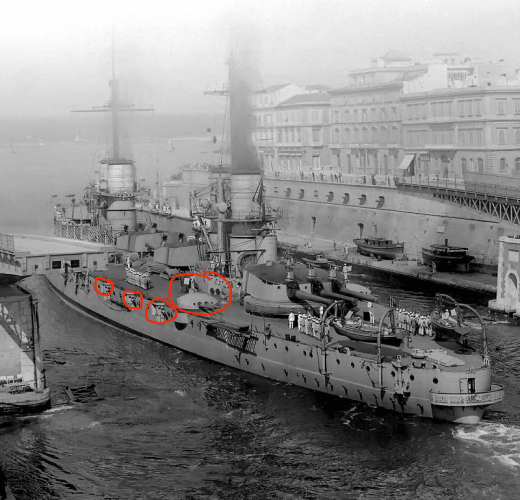
The secondaries of Dante Alighieri are lack of detailed data except muzzle velocity in Navweaps. The twin turrets have weird shape. Dante used both turrets and casements of one same gun, that was rare at that time.
Are you will to offer clear plans and performances of them (twin turrets and single casements)? Hope data reliable.
1774283394864.png
 
I can offer a little bit of information.

These were Armstrong (Elswick) Pattern EE guns, known in Italian service as 120/50 A1909 (Cannone da 120/50 Armstrong 1909). These guns equipped Dante Alighieri and Giulio Cesare, while Vickers-built guns of identical performance equipped Conte di Cavour and Leonardo da Vinci.

Basic Statistics:
Weight (Oscillating Mass): 3.662 tons (3.72 t)
Overall Length: 20.38' (6.212 m)
Bore Length: 50 calibers
Length of Rifling: 204.64" (5.198m)
Chamber Length: 28.64" (727cm)
Rifling Grooves: 36
Rifling Twist: 1 in 30

The guns used a 6.65 kg (14.66 lb) propellant charge, resulting in a muzzle velocity of 850 m/s (2,788 ft/s)

There appears to be some confusion on the ammunition, and I have two, or two and a half, sources offering competing data.

Norman Friedman in Naval Weapons of World War One describes two shells - a fragmentation type and a high explosive type. The high explosive shell is listed at 48.74 lbs with a 2.711 lb burster (22.11 kg shell, 1.23 kg burster), and the fragmentation shell as 55.33 lbs with a 0.65 lb burster (25.10 kg shell, 0.29 kg burster).

Erminio Bagnasco and Augusto de Toro in their 2020 monograph on the the Cavour and Duilio-classes describe an armor piercing or semi-armor piercing (granata perforante) of 22.06 kg, and a high explosive shell (granata dirompente) of 23.15 kg. However, in the English translation of this work (2021), these shells are described as a semi-armor piercing shell and a fragmentation shell.

With that said - the pedestal mounts had an elevation/depression range of +20°/-5°, and a maximum range at +20° of 12,000 meters. I have three competing rate of fire figures. Somewhat confusing, Bagnasco and de Toro list two different rates of fire - both 6 rpm (10 second firing cycle) and 4 rpm (15 second firing cycle). An older source, Giorgerini and Nani's Le Navi di Linesa Italiane, gives a figure of 10 rpm (6 second firing cycle), but I consider this somewhat dubious.

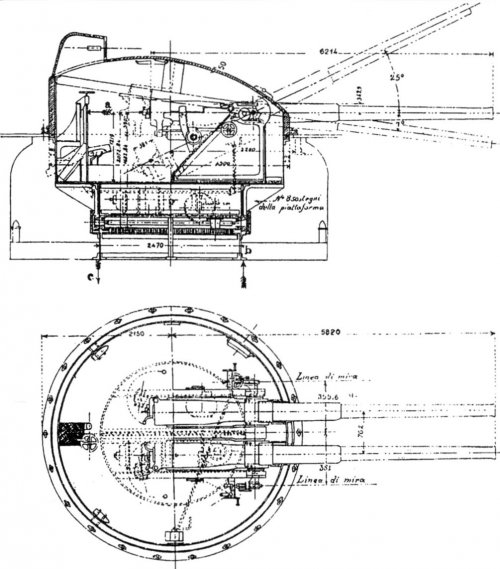
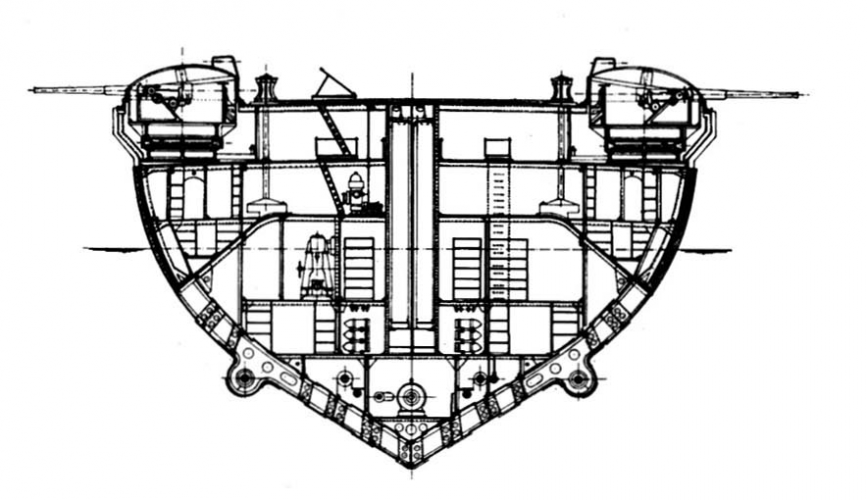
The twin 120mm mounts used on Dante Alighieri were placed within the deck, and had a 50mm thick roof. This proofed them against the muzzle blast of the 12" guns and allowed them to be used simultaneously in gunnery actions, They had a wider range of elevation +25°/-7°, and presumably this also provided slightly greater range.

General Arrangement of the Turrets:

M3mQMZU.jpg

Position at Frame 48:

1774815838821.png
 
I can offer a little bit of information.

These were Armstrong (Elswick) Pattern EE guns, known in Italian service as 120/50 A1909 (Cannone da 120/50 Armstrong 1909). These guns equipped Dante Alighieri and Giulio Cesare, while Vickers-built guns of identical performance equipped Conte di Cavour and Leonardo da Vinci.

Basic Statistics:
Weight (Oscillating Mass): 3.662 tons (3.72 t)
Overall Length: 20.38' (6.212 m)
Bore Length: 50 calibers
Length of Rifling: 204.64" (5.198m)
Chamber Length: 28.64" (727cm)
Rifling Grooves: 36
Rifling Twist: 1 in 30

The guns used a 6.65 kg (14.66 lb) propellant charge, resulting in a muzzle velocity of 850 m/s (2,788 ft/s)

There appears to be some confusion on the ammunition, and I have two, or two and a half, sources offering competing data.

Norman Friedman in Naval Weapons of World War One describes two shells - a fragmentation type and a high explosive type. The high explosive shell is listed at 48.74 lbs with a 2.711 lb burster (22.11 kg shell, 1.23 kg burster), and the fragmentation shell as 55.33 lbs with a 0.65 lb burster (25.10 kg shell, 0.29 kg burster).

Erminio Bagnasco and Augusto de Toro in their 2020 monograph on the the Cavour and Duilio-classes describe an armor piercing or semi-armor piercing (granata perforante) of 22.06 kg, and a high explosive shell (granata dirompente) of 23.15 kg. However, in the English translation of this work (2021), these shells are described as a semi-armor piercing shell and a fragmentation shell.

With that said - the pedestal mounts had an elevation/depression range of +20°/-5°, and a maximum range at +20° of 12,000 meters. I have three competing rate of fire figures. Somewhat confusing, Bagnasco and de Toro list two different rates of fire - both 6 rpm (10 second firing cycle) and 4 rpm (15 second firing cycle). An older source, Giorgerini and Nani's Le Navi di Linesa Italiane, gives a figure of 10 rpm (6 second firing cycle), but I consider this somewhat dubious.

The twin 120mm mounts used on Dante Alighieri were placed within the deck, and had a 50mm thick roof. This proofed them against the muzzle blast of the 12" guns and allowed them to be used simultaneously in gunnery actions, They had a wider range of elevation +25°/-7°, and presumably this also provided slightly greater range.

General Arrangement of the Turrets:

View attachment 807242

Position at Frame 48:

View attachment 807243

about casement, any available clear pics?
 

Similar threads

Back
Top Bottom