I can offer a little bit of information.
These were Armstrong (Elswick) Pattern EE guns, known in Italian service as 120/50 A1909 (Cannone da 120/50 Armstrong 1909). These guns equipped
Dante Alighieri and
Giulio Cesare, while Vickers-built guns of identical performance equipped
Conte di Cavour and
Leonardo da Vinci.
Basic Statistics:
Weight (Oscillating Mass): 3.662 tons (3.72 t)
Overall Length: 20.38' (6.212 m)
Bore Length: 50 calibers
Length of Rifling: 204.64" (5.198m)
Chamber Length: 28.64" (727cm)
Rifling Grooves: 36
Rifling Twist: 1 in 30
The guns used a 6.65 kg (14.66 lb) propellant charge, resulting in a muzzle velocity of 850 m/s (2,788 ft/s)
There appears to be some confusion on the ammunition, and I have two, or two and a half, sources offering competing data.
Norman Friedman in
Naval Weapons of World War One describes two shells - a fragmentation type and a high explosive type. The high explosive shell is listed at 48.74 lbs with a 2.711 lb burster (22.11 kg shell, 1.23 kg burster), and the fragmentation shell as 55.33 lbs with a 0.65 lb burster (25.10 kg shell, 0.29 kg burster).
Erminio Bagnasco and Augusto de Toro in their 2020 monograph on the the
Cavour and
Duilio-classes describe an armor piercing or semi-armor piercing (granata perforante) of 22.06 kg, and a high explosive shell (granata dirompente) of 23.15 kg. However, in the English translation of this work (2021), these shells are described as a semi-armor piercing shell and a fragmentation shell.
With that said - the pedestal mounts had an elevation/depression range of +20°/-5°, and a maximum range at +20° of 12,000 meters. I have three competing rate of fire figures. Somewhat confusing, Bagnasco and de Toro list two different rates of fire - both 6 rpm (10 second firing cycle) and 4 rpm (15 second firing cycle). An older source, Giorgerini and Nani's
Le Navi di Linesa Italiane, gives a figure of 10 rpm (6 second firing cycle), but I consider this somewhat dubious.
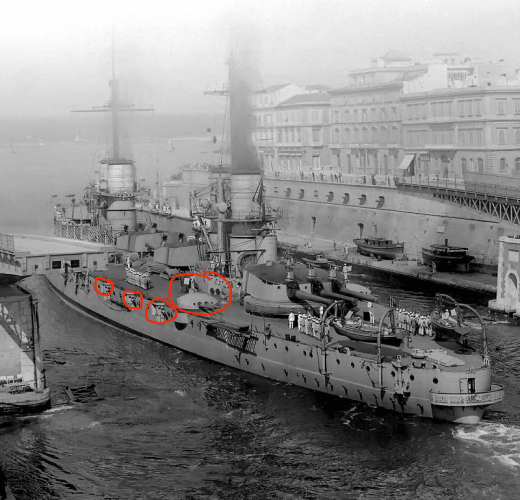
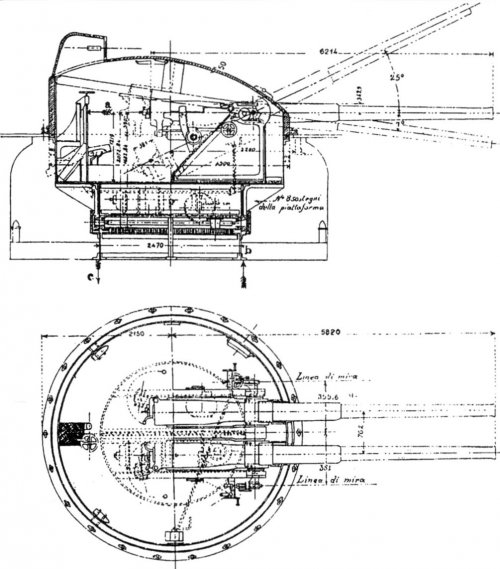
The twin 120mm mounts used on Dante Alighieri were placed within the deck, and had a 50mm thick roof. This proofed them against the muzzle blast of the 12" guns and allowed them to be used simultaneously in gunnery actions, They had a wider range of elevation +25°/-7°, and presumably this also provided slightly greater range.
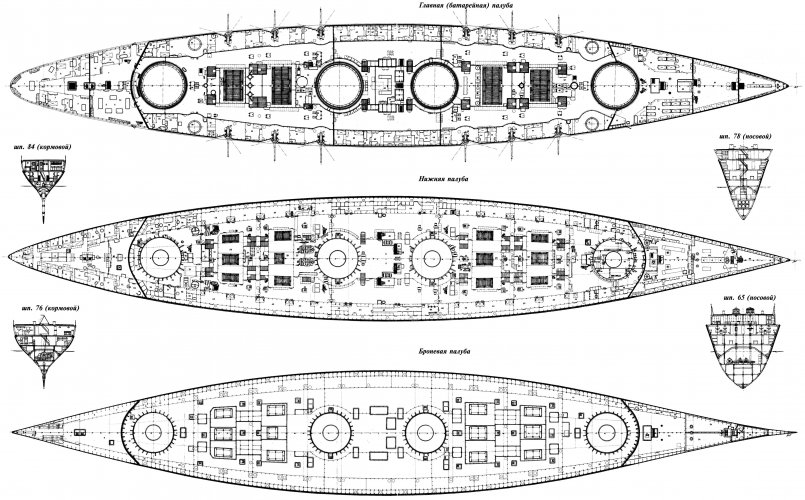
General Arrangement of the Turrets:
View attachment 807242
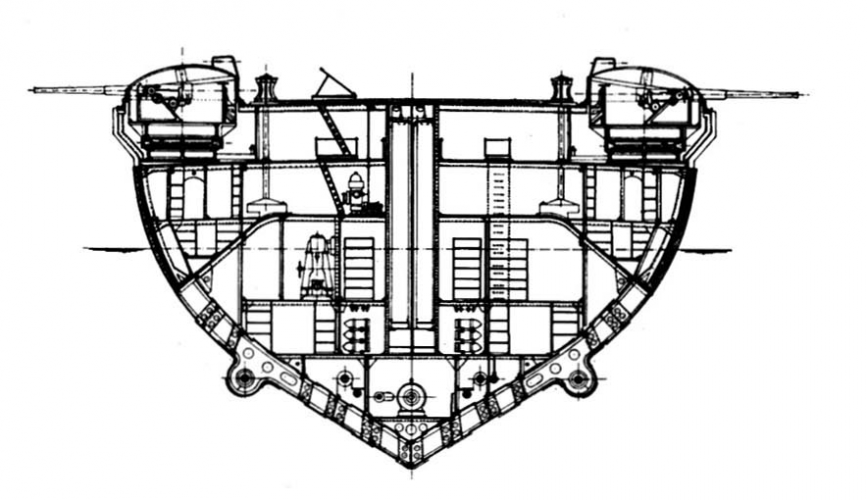
Position at Frame 48:
View attachment 807243