Nuclear War effects

P

pavel

Guest
Friends, you have a strange discussion ... When burning taiga, the temperature does not drop. But the smoke! .. The smoke permeates everywhere. Nightmare is not a nuclear winter. As a result of a nuclear war that we may die of suffocation. This is the first. Second. From forest fires temperature rises. It does not rain!

This is not a nuclear winter. This Nuclear Desert. In the style of Mad Max. After a nuclear war would be everywhere the Sahara desert. End of the biosphere. We will lose the history of mankind. We lose our publications. We will lose the architecture. We will lose the Internet and electronic archives.

We disappear. But what's the point? We have children, we do not schizophrenics. Or schizophrenics? We need amenazin?

This is the most important thing: a nuclear war there would be no tomorrow, or the day after. A nuclear war is impossible. Maybe ... Excuse me ...
 
pavel said:
Friends, you have a strange discussion ... When burning taiga, the temperature does not drop. But the smoke! .. The smoke permeates everywhere. Nightmare is not a nuclear winter. As a result of a nuclear war that we may die of suffocation. This is the first. Second. From forest fires temperature rises. It does not rain!

This is not a nuclear winter. This Nuclear Desert. In the style of Mad Max. After a nuclear war would be everywhere the Sahara desert. End of the biosphere. We will lose the history of mankind. We lose our publications. We will lose the architecture. We will lose the Internet and electronic archives.

We disappear. But what's the point? We have children, we do not schizophrenics. Or schizophrenics? We need amenazin?

This is the most important thing: a nuclear war there would be no tomorrow, or the day after. A nuclear war is impossible. Maybe ... Excuse me ...


No need, IMO to ask to be excused, Pavel. You bring up some rather relevant points.
 
"No need, IMO to ask to be excused, Pavel. You bring up some rather relevant points." Thank you.

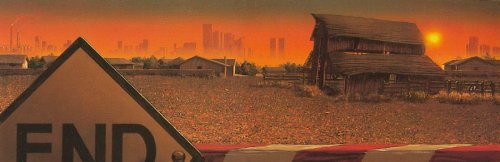
Nightmare picture, right? It drew a woman, an American artist. Pamela Lee. The book "Out of the Cradle" 1984.

Man burns alive in the nuclear fire ...

If you are interested, I have two Soviet magazine. Science and life. 1986. Gaia (GEO, Geya, ГЕЯ). The concept of "forbidden line". Academician Nikita Moiseev. What is nuclear winter ?! He has a real apocalypse. The absolute deluge after a nuclear winter. Tsunami will start from the top of Chomolungma. Complete degradation of the biosphere.
 

Attachments

  • pamela lee nuclear war1.jpg
    pamela lee nuclear war1.jpg
    46.4 KB · Views: 266
  • pamela lee nuclear war2.jpg
    pamela lee nuclear war2.jpg
    72.4 KB · Views: 265
pavel said:
"No need, IMO to ask to be excused, Pavel. You bring up some rather relevant points." Thank you.

Nightmare picture, right? It drew a woman, an American artist. Pamela Lee. The book "Out of the Cradle" 1984.

Man burns alive in the nuclear fire ...

If you are interested, I have two Soviet magazine. Science and life. 1986. Gaia (GEO, Geya, ГЕЯ). The concept of "forbidden line". Academician Nikita Moiseev. What is nuclear winter ?! He has a real apocalypse. The absolute deluge after a nuclear winter. Tsunami will start from the top of Chomolungma. Complete degradation of the biosphere.

Are you aware of "When the Wind Blows"? It was by a British author, Raymond Briggs and was a graphic novel. It is about a couple, who are Old Age Pensioners in the UK who grow alarmed about the reports of the deteriorating world situation and start, on Government advice, preparing a fall out shelter. Nuclear war breaks out and they die from the fall out. Very moving. It was made into a movie. Then, of course there are the classics like "On the Beach", "Doctor Strangelove" and "Fail Safe". Then we have the more modern movies, like "The Day After" and "Threads". I'd recommend all of them, as excellent depictions of what the lead up to and the breaking out of nuclear war are more than likely to be like.
 
--- Are you aware of "When the Wind Blows"? Then, of course there are the classics like "On the Beach", "Doctor Strangelove" and "Fail Safe". Then we have the more modern movies, like "The Day After" and "Threads". ---


Thank you! All of these movies and animations on my dvd eight years. I know them very well. "Threads" - very scary and very truthful film. But there are two errors (nuclear explosion, but the people are living. Woman pees in his pants. no nuclear explosion, but the outbreak kills people. When the boy is feeding the birds.). "When the Wind Blows"? Husband and wife in the house? "On the Beach" - Gregory Peck. Applause. "Doctor Strangelove" - Homeric antifascist anecdote. "Fail Safe" - anti-American film. "The Day After" - I saw him at the school in 1984. The first American film on Soviet television. You forgot one American cartoon. I do not remember him. Two bear with two small nuclear bombs. The animation in the form of children's poems. I also saw him in 1984. What is it called? (Plus Terminator and Testament). Testament - a natural psychological thriller! A nightmare.

Yes. I recommend you the most terrifying film about a nuclear war. Soviet. "Dead Man's Letters".

I want to find an American documentary film.1984-86. The effect of nuclear winter. Not "Nostradamus" with Orson Welles. Other. Very good special effects. The theme of this film - the theory of nuclear winter. No TV bridge! But what?
 
Threads from early 80s Britain... Realistic and horrific, be warned I didn't sleep for 2 days. Read the reviews first, makes the day after look like steamboat Willy.
 
"The Day After" was bad enough but "Threads" was IMHO quite terrifying. I still remember the scene where the kids are watching the British Army convoys heading to Europe with the head lights shining on their faces as they go past...
 
Threads scared the pants out of me. I went through a phase of looking into and researching this sort out thing and frankly you can do yourself damage. I think you have to "learn to stop worrying and love the bomb".
 
What is this film (documentary, fragment )? I saw him in 1988 on Soviet television, but I do not remember the name. It is an American documentary 80s for television. This documentary about nuclear winter. Frozen Ocean. Submarine in the ice, and other horrors. No TV bridge (bridge I looked). An interesting mystery ...

I do not believe a nuclear winter. But in the magazine "National Geographic" 1990-1991 interesting photo. The war in Kuwait. Burning oil wells. Over Kuwait - a giant cloud veil of smoke and ash. It is very thick, black. Absolutely flat. Probably, this is similar to a nuclear winter.
 
pavel said:
What is this film (documentary, fragment )?

It is from the episode "Fate of the Earth" from the PBS documentary series "Planet Earth." This episode aired in March of 1986.

FYI: This one was easy to google. The narrator is instantly recognizable as Richard Kiley (well, if you were an American watching TV from the seventies into the nineties)... throw that in with "effect of nuclear war," and the solution is easy to find.


https://en.wikipedia.org/wiki/Planet_Earth_(1986_series)
 
Orion, thank you very much. I found this series is now on channel You Tube. Planet Earth: Fate of the Earth P4

"By Dawns Early Light"? B 52? The film went on Russian TV in 1999.
 
I still remember the look on my dad's face after this documentary was aired in the1980s in Britain:

https://www.youtube.com/watch?v=9GJttnC8PoA

One of the most memorable points being the effect of one detonation on London, the attempt at following government shelter guidelines and how blast effect would be deadly.
 
Not to be too flippant about this, the basic effects of a nuclear exchange at the highest level would be to ruin everybody's day. When the wind blows was a guide to what to expect and demonstrates that folk basically ignore what they do not like, the 'characters' do just about everything wrong. I suppose a basic premise would be "Who would WANT to survive such an exchange"?

We already face another threat just as bad and that threat is our worldwide infestation of the planet, growing our population without concern as to the ability of the planet to support this population increase. Other species deserve to live in peace without the threat to habitat WE constitute.
 
What about the idea that the Elites are spending their Trillions/Billions on underground shelters and antartic seed vaults because they know an all out nuclear war (even chemical, biological too) is inevitable and necessary to cause planetary depopulation. I don't agree with the premise, but many "globalists" seek a culling of the population no matter how severe because they believe human activity is out of control. How strange is it that they would use the most polluting method imaginable (radioactive isotopes and long half-life by products). At some point even a limited nuclear war is sure to happen somewhere on the globe (Middle East, North Korea, terrorist groups with nukes).
 
I still have "The world's of Herman Kahn". Do a little reading on him and his work in and out of RAND and it will be a wild eye opener.
 
I wonder, has anybody else seen the 1965 British movie, "The War Game"? It was banned by the BBC from broadcast in 1965 and was only eventually seen onscreen in 1985. It was quite horrifying in how it portrayed the events of a nuclear exchange and it's affects on British society. I can remember seeing it back in the late 1980s and it was quite horrifying how it showed the breakdown of law and order and the destruction of society.
 
Phrenzy! "The world's of Herman Kahn"?... The first time I see it. Interesting, interesting... It?

--http://www.sharonghamari.com/excerpt/GhamariExcerpt.pdf--

This anti-nuclear book or not? Why is it a sensation?
 
Nuclear war is highly unlikely to end human civilization and, with a few simple steps, can be survived. Let's discuss each effect

Heat- The thermal radiation is very intense but very brief, it will not last long enough to set fire to kindling sources much thicker than newspapers. And being out of the line of sight of the blast or even wearing light colored clothing will protect you from burns. Nuclear testing proved that painting your windows white and removing combustibles will make your house fireproof. Most fires in Hiroshima weren't caused by the thermal radiation but from the blast severing gas lines and knocking over charcoal stoves, not helped by the fact that homes were made out of wood and that people had drawn dark blackout curtains

Blast- The human body is very durable and even overpressure of 35-45 psi would only be fatal to 1% of people (although it would damage their eardrums and lungs). Most deaths and injuries will be caused by falling debris which can be avoided, except if you are very close to the explosion, by taking cover under heavy furniture, in ditches, or in cars.

Fallout- Experiments have shown sufficient fallout protection can be improvised within a day. Any sufficiently heavy material will protect you. And unless you live downwind of missile silos, you likely will have little fallout to contend with.

More apocalyptic threats can be dismissed

Ozone layer destruction
A study by the National Academy of Sciences in 1975 found that even a 50% decrease in ozone levels (which would require a large number of very high yield explosives) would only increase rates of skin cancer by 10%, 30% at most.

Genetic Damage
The same study found that the rate of birth defects would increase at most from 6% of all births to 6.1%. And this was with a 10,000 megaton exchange, there are a lot fewer nuclear warheads now

Nuclear Winter
Even the authors of the TTAPS study later admitted they overestimated the effects and that "nuclear autumn" was a more apt description, and even that would require an implausibly large amount of fire producing a large amount of smoke implausibly making it into the troposphere.
 
The most frightening thing in recent memory was the 2011 Outbreak of tornadoes…those things rival nukes in power…except they don’t expend their power in one flash.

Ivanova Russia had a strong/violent twister
https://stormtrack.org/threads/ivanovo-tornado-outbreak-6-9-1984.12776/
One recent video I haven’t been able to relocate on the web was Mother’s Earth’s Able-Archer. The footage shows a very frightened woman in Russia who thought she saw a mushroom cloud.

In fact, it was a violent storm that had “anvil-ed out” so to speak. Chasers even called them “H-Bombs.” Here is hoping nuclear war doesn’t start over one of these things being misidentified. A military man is confronted with a lack of power/communications…sees a thunderhead over debris…

Tornadoes are more common in Russia than some think.

View: https://m.youtube.com/watch?v=jclHV2F4kWc
 
Last edited:
How many of the original (total figure) of 12,000 nuclear warheads (of all types realized) do you think are still operational today?
Very few I guess, the natural decay (even of 0,01 of the fissile material would affect its performance) outdated electronic and old microgharges reduce in all the possible way the effective usage of a nuclear device, especially if it was produced 65/55 years ago.

Probably there are still around hundreds of operational worldwide warheads today.
Ok the could do a lot of damage but not, in my humble opinion, to make real a "The Day After" (or worst "Threads") scenario.
A nuclear conflict today would be limited, no the USSR-USA paramount.
Forget the nuclear winter and "billions" of deaths, let alone the "Nuclear Winter" effect.

Still, probably, nuclear bombs are more dangerous today than 40 years ago.
Simply because of what I wrote before, they seems a more "accessible" option right now.
 
Very few I guess, the natural decay (even of 0,01 of the fissile material would affect its performance) outdated electronic and old microgharges reduce in all the possible way the effective usage of a nuclear device, especially if it was produced 65/55 years ago.
Erm... no.

1) Most of modern bombs are of boosted fission design, so the natural decay did not affect their performance. They need just to get "hot" enough to ignite fusion reaction in fusion fuel inside - which could be achieved even at partial assembly - and the neutron flux from the fusion would "afterburn" fission fuel around.

2) Outdated electronics was designed to be durable and stay workable over long time.

3) That's why nuclear bombs are refurbished regularely, replacing their chemical explosive components & neutron boosters.

So no, your arguments aren't valid.
 
Most of modern bombs
What do you mean for "modern" how may old they are?

Outdated electronics was designed to be durable and stay workable over long time.
It depends by several factor, and it also depends who realized such electronics, I cannot accept it as a dogma.

That's why nuclear bombs are refurbished regularely, replacing their chemical explosive components & neutron boosters.
That's the keywords "manintenance".

Apart from USA, China and Israel (maybe France, UK and India/Pakistan) who is expect to mantain a certain number of warheads (not the 60's ones anyway) what we can say about the other ones?
Maintenance of nuclear devices is an expensive affair which involves also very specialized people doing it.

My arguments are based on articles that stil appears (in Italian press for instance) that still talks about 12,000 warheads, billions of deads, Nuclear Winter and so on.
This articles are made to scare out the bejesus and are (at certain limit) pieces of disinformation.
The actual scenario isn't definitely like that.

Is all I have to say about it.
 
The time has come to decriminalize the word “nuclear” and use this technology to restore faith in the future of the Western world and lift humanity out of poverty, hunger, and slavery. There is not going to be a nuclear world war because the guy who starts it knows that he is not going to live to enjoy his victory and if a small-scale terrorist does it, that will be the end of terrorism as a political weapon, bad news for the masterminds.

What does it matter if nuclear weapons are not already operational?

No one is going to know if they can see the warheads on the news.

Nuclear tests are prohibited, no one will know if the warheads are empty and their maintenance is too expensive for their null use.
 
What do you mean for "modern" how may old they are?
Basically every single bomb made from 1970 to nowadays in USA, USSR, Britain and France.
It depends by several factor, and it also depends who realized such electronics, I cannot accept it as a dogma.
Well, kinda everyone. Because it's kinda obvious.

That's the keywords "manintenance".
And?
 
How many of the original (total figure) of 12,000 nuclear warheads (of all types realized) do you think are still operational today?
Very few I guess, the natural decay (even of 0,01 of the fissile material would affect its performance) outdated electronic and old microgharges reduce in all the possible way the effective usage of a nuclear device, especially if it was produced 65/55 years ago.

Probably there are still around hundreds of operational worldwide warheads today.
Ok the could do a lot of damage but not, in my humble opinion, to make real a "The Day After" (or worst "Threads") scenario.
A nuclear conflict today would be limited, no the USSR-USA paramount.
Forget the nuclear winter and "billions" of deaths, let alone the "Nuclear Winter" effect.

Still, probably, nuclear bombs are more dangerous today than 40 years ago.
Simply because of what I wrote before, they seems a more "accessible" option right now.
Even "The Day After" gets things wrong. They show mushroom clouds rising and buildings getting smashed then people getting vaporized. In reality A. The heat comes before the blast B. The heat is unable to vaporize people.

They also make the bizarre assumption that the US wouldn't start evacuating its cities after the Soviet Union evacuates theirs.
 
Nuclear war is highly unlikely to end human civilization and, with a few simple steps, can be survived. Let's discuss each effect

Heat- The thermal radiation is very intense but very brief, it will not last long enough to set fire to kindling sources much thicker than newspapers. And being out of the line of sight of the blast or even wearing light colored clothing will protect you from burns. Nuclear testing proved that painting your windows white and removing combustibles will make your house fireproof. Most fires in Hiroshima weren't caused by the thermal radiation but from the blast severing gas lines and knocking over charcoal stoves, not helped by the fact that homes were made out of wood and that people had drawn dark blackout curtains

Blast- The human body is very durable and even overpressure of 35-45 psi would only be fatal to 1% of people (although it would damage their eardrums and lungs). Most deaths and injuries will be caused by falling debris which can be avoided, except if you are very close to the explosion, by taking cover under heavy furniture, in ditches, or in cars.

Fallout- Experiments have shown sufficient fallout protection can be improvised within a day. Any sufficiently heavy material will protect you. And unless you live downwind of missile silos, you likely will have little fallout to contend with.

More apocalyptic threats can be dismissed

Ozone layer destruction
A study by the National Academy of Sciences in 1975 found that even a 50% decrease in ozone levels (which would require a large number of very high yield explosives) would only increase rates of skin cancer by 10%, 30% at most.

Genetic Damage
The same study found that the rate of birth defects would increase at most from 6% of all births to 6.1%. And this was with a 10,000 megaton exchange, there are a lot fewer nuclear warheads now

Nuclear Winter
Even the authors of the TTAPS study later admitted they overestimated the effects and that "nuclear autumn" was a more apt description, and even that would require an implausibly large amount of fire producing a large amount of smoke implausibly making it into the troposphere.

Well summed up. A nuclear exchange would mean the end for the parties involved as nation states, due to the ensuing collapse and turning large population centers into irradiated no-go zones for at least a couple decades.

Humanity as a whole would move on and especially in the southern hemisphere most people would not be particularly affected with Australia being an exception. The disappearance of goods from North America, Europe, the Levant and East Asia would be noticeable though.
 
The time has come to decriminalize the word “nuclear” and use this technology to restore faith in the future of the Western world and lift humanity out of poverty, hunger, and slavery.

Uhm no? Nuclear fission has been around for over half a century now and widely available to many countries around the world as a source of energy and for a select few as a potent weapon.

If nuclear fission didn't manage to do that since the 1950s it won't happen at all. Nuclear fusion may be another story, but nuclear for now and the next decade or two is still just a pipe dream if we talk about using fusion to meet the energy needs of humanity.

And even then, even if energy needs are met, the exploitation imposed by the political systems in the "west" and "east" will ensure that poverty, hunger and slavery are present somewhere in the world. Gotta sell weapons somewhere or use cheap slave labor to create consumer goods.
 
Well summed up. A nuclear exchange would mean the end for the parties involved as nation states, due to the ensuing collapse and turning large population centers into irradiated no-go zones for at least a couple decades.
No it would not. Hiroshima and Nagasaki aren't irradiated no-go zones. Fallout only occurs in groundbursts, which would likely only be done for missile silos and bunkers, not cities.

And the bonds of human civilization are incredibly robust. They could survive a nuclear war.
 
No it would not. Hiroshima and Nagasaki aren't irradiated no-go zones. Fallout only occurs in groundbursts, which would likely only be done for missile silos and bunkers, not cities.

And the bonds of human civilization are incredibly robust. They could survive a nuclear war.

Hiroshima and Nagasaki produced less fallout and had lower radiation output compared to current day nukes, no?

As for the second point, no I seriously doubt it. If the destroyed states crumble outright or balkanize (and countries with varying, strong regional cultures would), then stronger and/or less impacted neighbors would swoop in and take what's to be taken. Weakened states after an exchange reeling from the aftermath and in disarray would be the golden opportunity for any sort of expansion.
 
Hiroshima and Nagasaki produced less fallout and had lower radiation output compared to current day nukes, no?
Actually, they produced no fallout, because they were airburst, as would pretty much all nuclear warheads aimed at urban areas.
As for the second point, no I seriously doubt it. If the destroyed states crumble outright or balkanize (and countries with varying, strong regional cultures would), then stronger and/or less impacted neighbors would swoop in and take what's to be taken. Weakened states after an exchange reeling from the aftermath and in disarray would be the golden opportunity for any sort of expansion.
I think that can be ruled out pretty easily. Occupying a hostile populace is very costly.
 
No offense, but Russia does not have a good reputation for maintaining their stuff in working order.

Sometimes the US doesn't, either, but Russia's reputation is terrible for that.


Hiroshima and Nagasaki produced less fallout and had lower radiation output compared to current day nukes, no?
Much lower yield than most modern nukes at only ~20 kilotons, but they did spread a whole crapton of "unburned" fissionables and fission products around. Far more leftovers than a modern nuke would produce in the same situation due to only fissioning a few % of the load. The "Fat Man" bomb contained some 6.2kg of plutonium, "Little Boy" had ~64kg of uranium. In the case of Little Boy, only about 2kg actually fissioned, the remaining 60+kg was blasted around as uranium dust. Based on energy yields, Fat Man also fissioned about 2kg.

Modern nukes fission substantially more of the primary to flood the tertiary with enough neutrons to cause the U238 casing to fission. They're not perfectly clean, but the goal of the designers was always maximum fission efficiency. It's the smallest warheads, like the 155 and 203mm nuclear artillery shells, that are least efficient.
 
Blast- The human body is very durable and even overpressure of 35-45 psi would only be fatal to 1% of people (although it would damage their eardrums and lungs). Most deaths and injuries will be caused by falling debris which can be avoided, except if you are very close to the explosion, by taking cover under heavy furniture, in ditches, or in cars.
Where the heck did you get that data?

Hiroshima and Nagasaki established the fatal overpressure level as 5 psi!
 
Humanity as a whole would move on and especially in the southern hemisphere most people would not be particularly affected with Australia being an exception. The disappearance of goods from North America, Europe, the Levant and East Asia would be noticeable though.
This is the key consideration on a species-wide level. North America, Europe, Australia, most of Asia, and possibly also New Zealand are toast. Some key points in Africa and South America might get hit, but overall damage would likely be quite limited.

A couple of decades ago, the Global South was so dependent on imports from the developed world that a nuclear exchange would have been devastating even if it received no direct damage whatsoever. And there were enough warheads around that the major nuclear powers could keep some in reserve in case someone who survived the initial exchange started getting ideas.

Today, there's more local production capability in virtually every country. While it would still be really bad in some places, industrial society would be able to continue. There are also a lot fewer warheads that can be reserved for follow-up strikes or assigned to minor powers on general principle.
Hiroshima and Nagasaki established the fatal overpressure level as 5 psi!
AFAIK the 5 psi overpressure target at Hiroshima and Nagasaki was based on destruction of lightly-constructed buildings. Had the weapons wound up being used against Germany, a lower burst height to achieve an overpressure of 8-10 psi was seen as necessary.
 
I just had an ugly thought---what if the leaders of the superpowers made a pact to kill each other's "troublemakers?"

"Here's how to make neutron bombs--now, you wipe out California, and we'll nuke Dagastanis."
 
Had the weapons wound up being used against Germany, a lower burst height to achieve an overpressure of 8-10 psi was seen as necessary.
And more importantly, they were using these bombs against people completely unprepared. Even if a nuclear attack isn't preceded by days or weeks of some sort of international crisis, people will have at least 10 minutes to find cover.
 
Last edited:
Caiden firestorm or no, it would take time to dig out of masonry

Today's structures would have glass blown out.
Metro Tower in Lubbock was hit by a violent tornado and survived, for whatever that's worth.

Both it and the ALICO building were hit by tornadoes both ranked F-5.

Tornadic winds can have many angles of attack--where nukes are similar to downbursts--but sharper--debris being sucked back into a low. I wonder if nukes can cause runaway roll vortices.

The Long Lines building looks tough.
 
Last edited:
Screenshot 2025-07-01 at 10.49.04 AM.png
Screenshot 2025-07-01 at 10.49.45 AM.png Screenshot 2025-07-01 at 10.49.49 AM.png
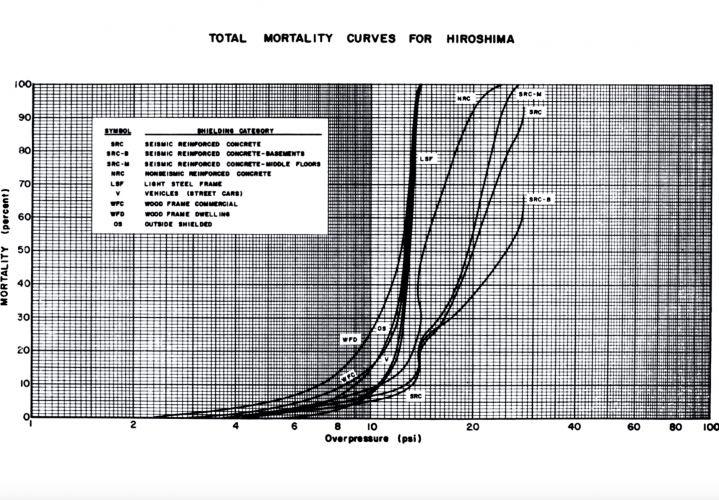
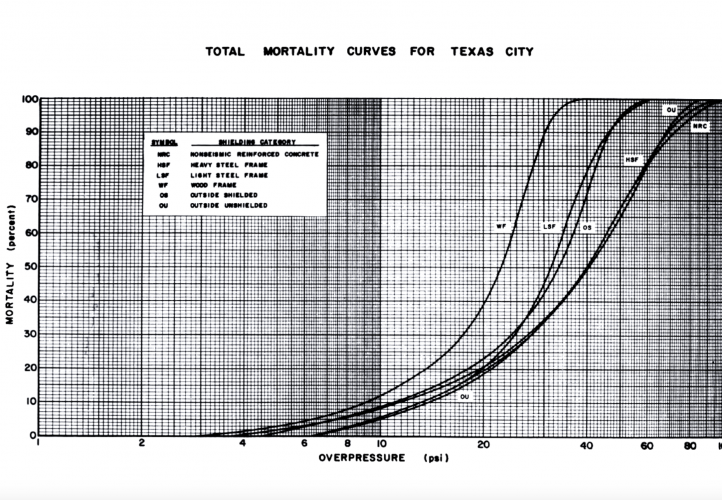
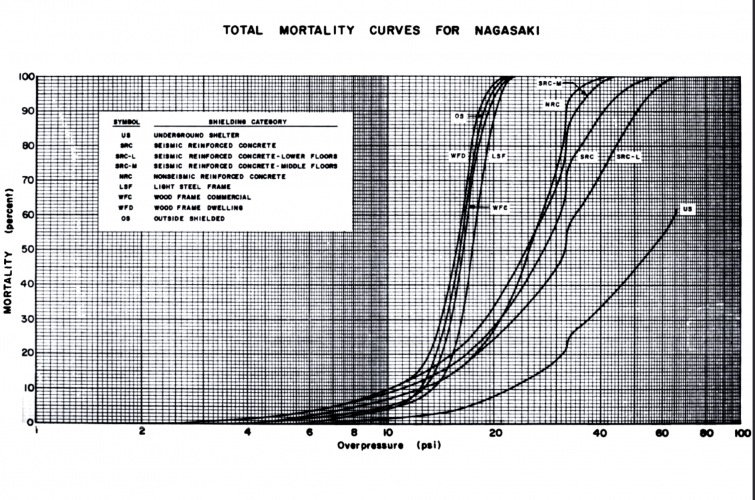
Using data from Hiroshima we see that for most wooden and light steel frame buildings, the median fatal overpressure is about 13 psi. For Nagasaki it was 17 psi. For the non-nuclear explosion in Texas City, it was well over 20 PSI. And this is *total* mortality, meaning it includes deaths from burns and radiation.
https://nige.wordpress.com/wp-content/uploads/2010/10/dirkwood-report-etc.pdf
Let's remember that people in the 1930s thought heavy bombers and poison gas would also mean the next war would be the end of human civilization (see Things to Come).
 
Last edited:
I am surprised Texas City hasn't been done by Hollywood.

Halifax and Beirut just had a single blast.
Texas City was a chain reaction...Grandcamp at the start--then High Flyer.

That lends itself to storytelling
 

Similar threads

Back
Top Bottom