
You are using an out of date browser. It may not display this or other websites correctly.
You should upgrade or use an alternative browser.
You should upgrade or use an alternative browser.
Northrop Grumman B-21 Raider (LRS-B)
- Thread starter TomS
- Start date

- Joined
- 6 August 2007
- Messages
- 4,530
- Reaction score
- 10,230
The current program is strictly A2A
No, it isn’t.
https://insidedefense.com/daily-new...21-production-rate-10-12-air-force-chief-says
Someone is unable to do math…The increase of production rate from 10 to 12 is 20%, not 25…
Someone is unable to do math…The increase of production rate from 10 to 12 is 20%, not 25…

- Joined
- 28 October 2019
- Messages
- 76
- Reaction score
- 325
A couple of things...my recollection is that when the USAF officially announced the deal, they were careful to say capacity rather than rate, and the two are not necessarily the same thing. As for Wilsbach's testimony, I was intrigued enough to actually go listen to it, and what he actually said was they are increasing the rate from "10 aircraft at a time to 12". I find this rather confusing. It's almost as if he's referring to work stations in final assembly rather than annual production.https://insidedefense.com/daily-new...21-production-rate-10-12-air-force-chief-says
Someone is unable to do math…The increase of production rate from 10 to 12 is 20%, not 25…
Scott Kenny
ACCESS: USAP
- Joined
- 15 May 2023
- Messages
- 19,517
- Reaction score
- 27,966
Could be increasing capacity to 12.5-13 planes per year, and then increasing rate to 12.A couple of things...my recollection is that when the USAF officially announced the deal, they were careful to say capacity rather than rate, and the two are not necessarily the same thing. As for Wilsbach's testimony, I was intrigued enough to actually go listen to it, and what he actually said was they are increasing the rate from "10 aircraft at a time to 12". I find this rather confusing. It's almost as if he's referring to work stations in final assembly rather than annual production.

- Joined
- 1 April 2006
- Messages
- 12,276
- Reaction score
- 15,084

Forest Green
ACCESS: USAP
- Joined
- 11 June 2019
- Messages
- 14,512
- Reaction score
- 31,543
Northrop: Faster B-21 Production Allows Air Force to Consider a Bigger Fleet
https://www.airandspaceforces.com/n...-allows-air-force-to-consider-a-bigger-fleet/Northrop Grumman hopes its efforts to make more B-21 Raiders faster will encourage the Air Force to expand the final fleet size of the advanced stealth bomber.
If the Air Force is confident that Northrop will be able to handle increased B-21 orders, Warden said, they may feel more comfortable buying more than 100, the minimum number the service has committed to at this point
Last edited:

FighterJock
ACCESS: Above Top Secret
- Joined
- 29 October 2007
- Messages
- 7,229
- Reaction score
- 8,540
Looks like we are going to be getting 200 B-21s which was what they should have done in the beginning.
That's .... A LOT of money. wow. even assuming economies of scale and hitting 500 million per that's 100B on just b21s.Looks like we are going to be getting 200 B-21s which was what they should have done in the beginning.
FighterJock
ACCESS: Above Top Secret
- Joined
- 29 October 2007
- Messages
- 7,229
- Reaction score
- 8,540
Who knows what the final total of B-21s will be lmaoxd. It all depends on what the USAF wants in terms of total numbers of B-21s.
sure but assuming its at least 100 its still at least 550M USD per ship(in 2010s money mind you so round about 700M now) which means 50b(in 2010 USD) or around 70-80B(in 2026 USD). still mindboggling amounts of money to spend on a single class of bomber but ig this is the USAF, money is not something they lack.Who knows what the final total of B-21s will be lmaoxd. It all depends on what the USAF wants in terms of total numbers of B-21s.

EmoBirb
ACCESS: Top Secret
- Joined
- 18 January 2025
- Messages
- 2,694
- Reaction score
- 6,920
It's the aerial leg of the American nuclear trident for the next several decades, similar to Columbia and Sentinel money is a secondary concern. And compared to B-2 cost went down significantly, now if their cost per flight hour and maintenance is vastly lower as well (which it probably is thanks to advancements in material science regarding RAM and it's presumed two engine nature), then that's an all-round win. B-21 is on track to be one of the most successful military programs of this century, if everything continues to go as smoothly as it did so far.still mindboggling amounts of money to spend on a single class of bomber but ig this is the USAF, money is not something they lack.
Also it’s worth noting 200 would be almost a decade worth of full rate production, which has not occurred yet, so actual purchase costs per year are probably in the tens billion neighborhood.
Last edited:
FighterJock
ACCESS: Above Top Secret
- Joined
- 29 October 2007
- Messages
- 7,229
- Reaction score
- 8,540
And 200 would be at the upper limit of the total that the USAF could eventually get, but consider that the B-2 program ended with only 20 bombers being produced then anything greater than 150 would be a bonus.
- Joined
- 1 April 2006
- Messages
- 12,276
- Reaction score
- 15,084
Decades? This is 21st century. Check B-2 planned production rate - that's in 80s with much step learning curve. LM is assembling hundreds of F-35 per year with NG as subcontractor, so last one know something of scaling up production.Also it’s worth noting 200 would be almost a decades worth of full rate production,

- Joined
- 30 May 2023
- Messages
- 664
- Reaction score
- 1,436
More importantly than the total number are the efforts to left shift the delivery curve.
As I have said, more Raiders *a lot faster* should be the name of the game and I don’t see any other option given USAF Global Strike command is down to B-1B stems and seeds and B-52J surprise surprise is not exactly outperforming either.
B-21 for deep penetrating and F-15EX for stand-off manned attack. If the USAF can get two ARRW on each EX CPFH may favor the math of two EX vs a single BUFF per 4 ARRWs.
As I have said, more Raiders *a lot faster* should be the name of the game and I don’t see any other option given USAF Global Strike command is down to B-1B stems and seeds and B-52J surprise surprise is not exactly outperforming either.
B-21 for deep penetrating and F-15EX for stand-off manned attack. If the USAF can get two ARRW on each EX CPFH may favor the math of two EX vs a single BUFF per 4 ARRWs.
Decades? This is 21st century. Check B-2 planned production rate - that's in 80s with much step learning curve. LM is assembling hundreds of F-35 per year with NG as subcontractor, so last one know something of scaling up production.
Sorry, “almost a decade”, not plural, was what I meant to post. And the program seems geared to deliver 10-12 airframes at full rate, so I stand by that projection. 200 probably would not be achieved until the 2040s.
- Joined
- 30 May 2023
- Messages
- 664
- Reaction score
- 1,436
is your 10-12 pa estimate for a single or two sites?
Ainen
I really should change my personal text
- Joined
- 25 August 2011
- Messages
- 2,823
- Reaction score
- 4,928
To be fair, this isn't technical.Decades? This is 21st century. Check B-2 planned production rate - that's in 80s with much step learning curve. LM is assembling hundreds of F-35 per year with NG as subcontractor, so last one know something of scaling up production.
Peace dividend broke traditional manufacturing front loading (where as much as possible was being produced as fast as possible, to get full capability atvthe earliest date possible) effectively everywhere.
Even when LM assembles ~150 F-35s a year, for CW standards it's kinda...meh. Peak production surges of major fighter types back then were often many times that number.
But for 3 decades we live in a world where defense investment is a political jobs investment first and foremost.
is your 10-12 pa estimate for a single or two sites?
Single. AFAIK there is no firm commitment to a second site.
- Joined
- 30 May 2023
- Messages
- 664
- Reaction score
- 1,436
Single. AFAIK there is no firm commitment to a second site.
Of course not, but we were having a discussion about a second sites impact on rate and volume, hence the question.
12 Pa is one site so 24 per annum for 2 sites brings production down to 8 or so yearsOf course not, but we were having a discussion about a second sites impact on rate and volume, hence the question.
- Joined
- 1 April 2006
- Messages
- 12,276
- Reaction score
- 15,084
You need some time to accomplish new building for assembly line though. Second half of Bld 401 is busy with F-35 center fuselage assembly. Still there are plenty of free space at Site 4.
- Joined
- 30 May 2023
- Messages
- 664
- Reaction score
- 1,436
judging by Boeings F-47 main shed we are looking at a multi year period to bring a second site online.
Yes I’m aware this is making a huge assumption about the production methods of two wildly dissimilar aircraft being made at different primes, but even crude comparables can help parameterize the thought space.
If this is close to accurate, I understand why USAF/NG took a bit of delay to stand up a higher throughput process from Palmdale while going hell bent for leather to set the supply web up to service a much higher cadence as it worked with USAF to figure out how to orchestrate the second line with a bigger airframe buy.
Whatever you think comes next after Raider, it’s not going to come as fast as you think and no one has a crystal ball for predicting the budgetary future of the US armed forces. But right now there is a generational opportunity - however complicated the politics that gave rise to it - to set a much higher capability floor for the USAFs long range strike capability by all stakeholders driving toward an irrevocable commitment to stand up a second site.
Since a production site capable of producing large flying wing type aircraft might be useful to build other flying wing type things that aren’t Raider is just the kind of funny coincidence that tend to matter in the long run.
Yes I’m aware this is making a huge assumption about the production methods of two wildly dissimilar aircraft being made at different primes, but even crude comparables can help parameterize the thought space.
If this is close to accurate, I understand why USAF/NG took a bit of delay to stand up a higher throughput process from Palmdale while going hell bent for leather to set the supply web up to service a much higher cadence as it worked with USAF to figure out how to orchestrate the second line with a bigger airframe buy.
Whatever you think comes next after Raider, it’s not going to come as fast as you think and no one has a crystal ball for predicting the budgetary future of the US armed forces. But right now there is a generational opportunity - however complicated the politics that gave rise to it - to set a much higher capability floor for the USAFs long range strike capability by all stakeholders driving toward an irrevocable commitment to stand up a second site.
Since a production site capable of producing large flying wing type aircraft might be useful to build other flying wing type things that aren’t Raider is just the kind of funny coincidence that tend to matter in the long run.
- Joined
- 1 April 2006
- Messages
- 12,276
- Reaction score
- 15,084
Attachments



- Joined
- 3 June 2006
- Messages
- 3,538
- Reaction score
- 6,212
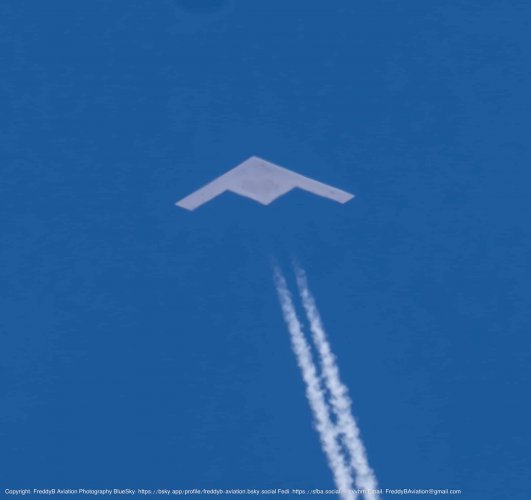
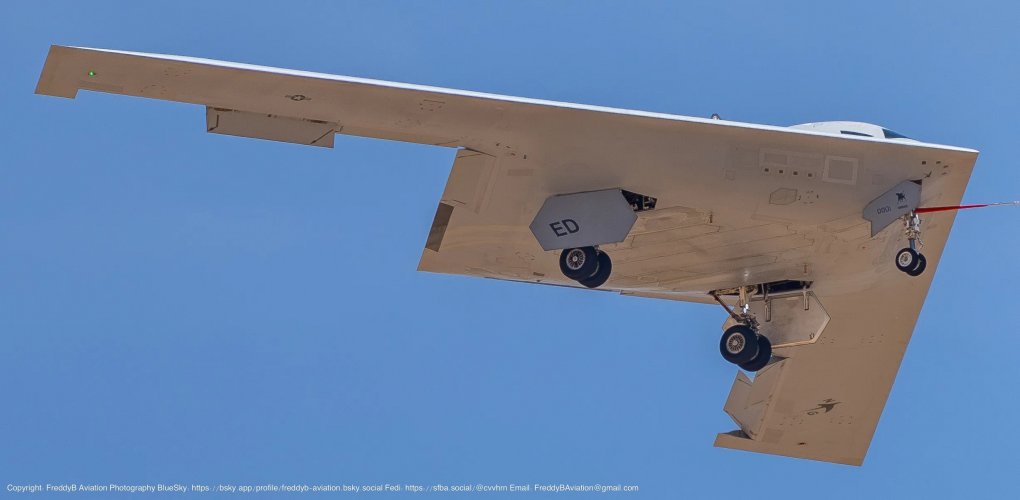
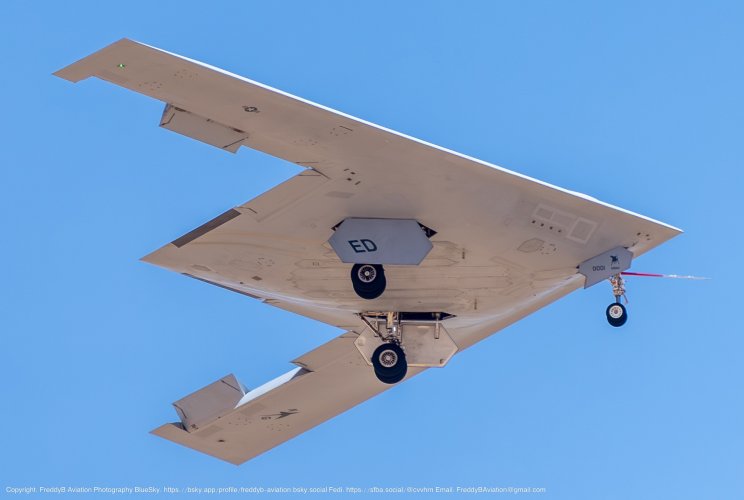
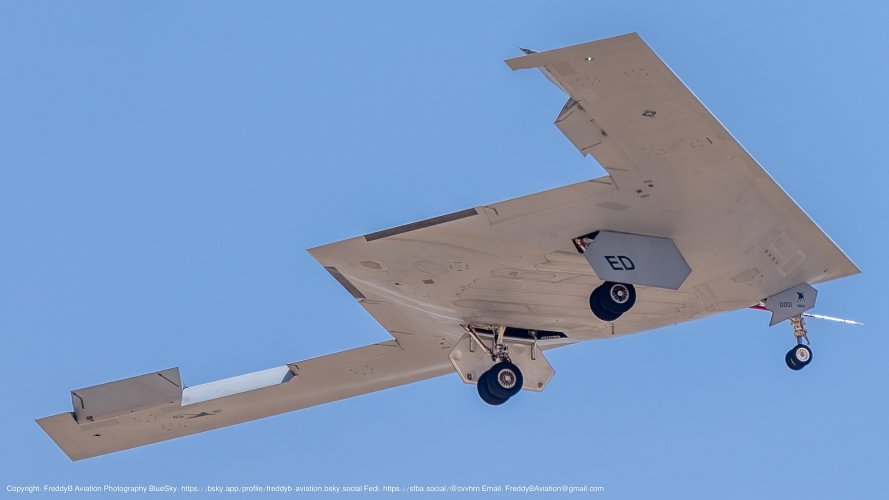
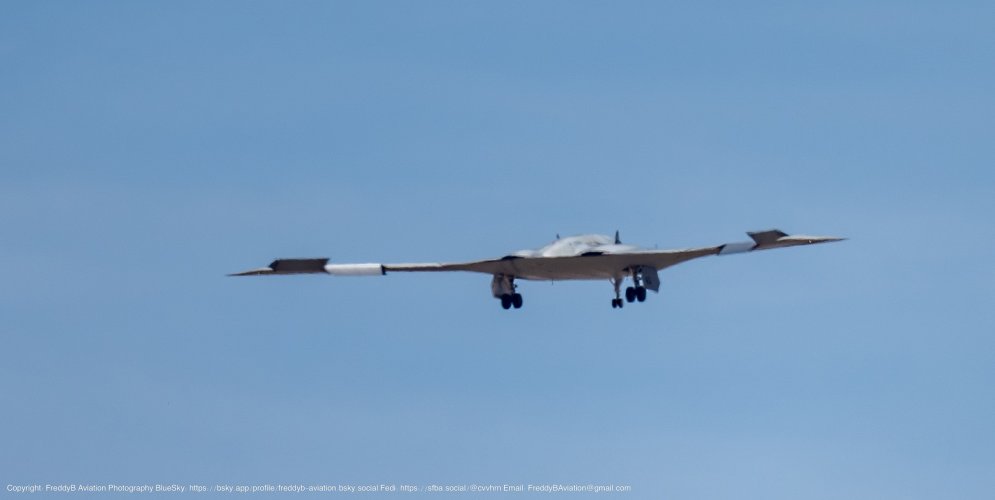
Hello folks, recent photographs seem to indicate that the B-21 Raider’s outboard trailing-edge control surfaces are deflected in opposite directions, suggesting an alternative speed-brake and drag-management configuration compared to the B-2’s conventional split rudders.
Link / Source :
https://theaviationist.com/2026/06/09/b-21-speed-brakes/
Link / Source :
https://theaviationist.com/2026/06/09/b-21-speed-brakes/
Attachments

- Joined
- 2 August 2006
- Messages
- 3,335
- Reaction score
- 1,847
Yes, That's what they're doing. It's a more reliable lower weight solution to the split drag rudders used on the B-2.Hello folks, recent photographs seem to indicate that the B-21 Raider’s outboard trailing-edge control surfaces are deflected in opposite directions, suggesting an alternative speed-brake and drag-management configuration compared to the B-2’s conventional split rudders.
Link / Source :
https://theaviationist.com/2026/06/09/b-21-speed-brakes/
- Joined
- 28 January 2008
- Messages
- 1,645
- Reaction score
- 4,210
The split drag rudders on the B-2 is what we had to use at the time, the B-21 does not need them but the 21 is only down two surfaces, the trailing edge is all elevons. I'm sure most know that the B-2 had flaps on aft, left and right sides of the wing, towards the center. They were not effective and never tested in flight. We only tested them early on in the FCHIL in Pico. AV-1 thru AV-4 (I think, the flaps were permanently secured, all subsequent AVs were built without them. I heard a rumor way back when I started at ASD Pico in 1986 that the USAF brass stated, the YB-49 had flaps then the ATB (B-2) needs flaps.
- Joined
- 1 April 2006
- Messages
- 12,276
- Reaction score
- 15,084
It was known since maiden flight on November 2023. Oh, even earlier, in SeptemberHello folks, recent photographs seem to indicate that the B-21 Raider’s outboard trailing-edge control surfaces are deflected in opposite directions, suggesting an alternative speed-brake and drag-management configuration compared to the B-2’s conventional split rudders.
Link / Source :
https://theaviationist.com/2026/06/09/b-21-speed-brakes/
- Joined
- 1 April 2006
- Messages
- 12,276
- Reaction score
- 15,084
Forest Green
ACCESS: USAP
- Joined
- 11 June 2019
- Messages
- 14,512
- Reaction score
- 31,543
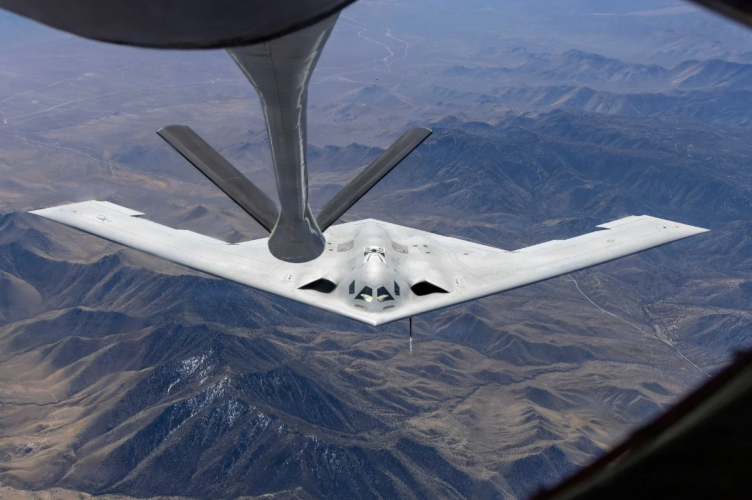
Operational pilot flies B-21 Raider in historic first for U.S. testing
https://defence-blog.com/operational-pilot-flies-b-21-raider-in-historic-first-for-u-s-testing/

https://defence-blog.com/operational-pilot-flies-b-21-raider-in-historic-first-for-u-s-testing/
Key Points
- An operational test pilot flew the B-21 Raider alongside a developmental test pilot at Edwards AFB, the earliest combined DT/OT integration in modern U.S. aircraft testing history.
- Gen. Dale White told the Raider Combined Test Force on June 8, 2026 that the B-21, Sentinel, and F-47 are the three programs the nation's future depends upon.
Operational Pilot Flies B-21 Bomber As Air Force Streamlines Testing
https://www.airandspaceforces.com/o...b-21-bomber-as-air-force-streamlines-testing/
Last edited:

FlyGuy369
Flying is fantastic
- Joined
- 15 June 2023
- Messages
- 576
- Reaction score
- 1,693
I am curious to see how and if Boeing will keep this pace when the 47 rolls out.Operational pilot flies B-21 Raider in historic first for U.S. testing
https://defence-blog.com/operational-pilot-flies-b-21-raider-in-historic-first-for-u-s-testing/
View attachment 815263
Forest Green
ACCESS: USAP
- Joined
- 11 June 2019
- Messages
- 14,512
- Reaction score
- 31,543
Two entirely separate project streams, so it shouldn't make a difference.I am curious to see how and if Boeing will keep this pace when the 47 rolls out.
Forest Green
ACCESS: USAP
- Joined
- 11 June 2019
- Messages
- 14,512
- Reaction score
- 31,543
Seems all wrong, bombers are supposed to start fires.
View: https://x.com/NatSecLedger/status/2069266432857374999?s=20
View: https://x.com/NatSecLedger/status/2069266432857374999?s=20

- Joined
- 3 June 2011
- Messages
- 20,900
- Reaction score
- 19,090
Boeing doesn't build the B-21.I am curious to see how and if Boeing will keep this pace when the 47 rolls out.
FlyGuy369
Flying is fantastic
- Joined
- 15 June 2023
- Messages
- 576
- Reaction score
- 1,693
I know. What I am saying is will Boeing feel pressured to keep pace and timeline like NG is. More like holding the bar.Boeing doesn't build the B-21.

- Joined
- 21 April 2009
- Messages
- 14,351
- Reaction score
- 9,436
- Joined
- 1 April 2006
- Messages
- 12,276
- Reaction score
- 15,084
Like why… There were at least six raiders assembling before LRIP started. Two of them were ground test assets, two of them are currently flying, so there are at least two that can be sent to Ellsworth without disrupting the current test fleet. And that is not counting the LRIP aircrafts that would have been in production for more than three years in 2027…
Forest Green
ACCESS: USAP
- Joined
- 11 June 2019
- Messages
- 14,512
- Reaction score
- 31,543

