Emmmm…I don’t have a lot of concrete information about Russian ICBMs, but RS-24 Yars, R-36M2 “Satan”, and RSM-56 Bulava seems to all use MIRVs with much less than 1Mt warhead. I think it’s pretty much only China operating very high yield singular ICBM warheads…Problem is, they're only "falling out of fashion" in the US. Russia and China are still balls to the wall.

You are using an out of date browser. It may not display this or other websites correctly.
You should upgrade or use an alternative browser.
You should upgrade or use an alternative browser.
Northrop Grumman B-21 Raider (LRS-B)
- Thread starter TomS
- Start date

- Joined
- 3 June 2011
- Messages
- 20,899
- Reaction score
- 19,090
Do we know if the high yield warheads of the R-36 have been dismantled? (To say nothing of Russian bombs.)Emmmm…I don’t have a lot of concrete information about Russian ICBMs, but RS-24 Yars, R-36M2 “Satan”, and RSM-56 Bulava seems to all use MIRVs with much less than 1Mt warhead. I think it’s pretty much only China operating very high yield singular ICBM warheads…
I suggest not reading too much into it… It would mean the B-21 is not compatible with MOP, cannot employ 8*LRSOs or 8*JASSM-XRs at once (both presumed to be 4000-5000lbs if ALCM is a good comparison), which seems kind of absurd…From the link, "The size and weight limits are aligned with integration requirements for the B-21 Raider stealth bomber, which is expected to carry one NGP per mission under current planning assumptions."
Not saying that it cannot be the case, but it seems an extraordinary claim to me…
Last edited:
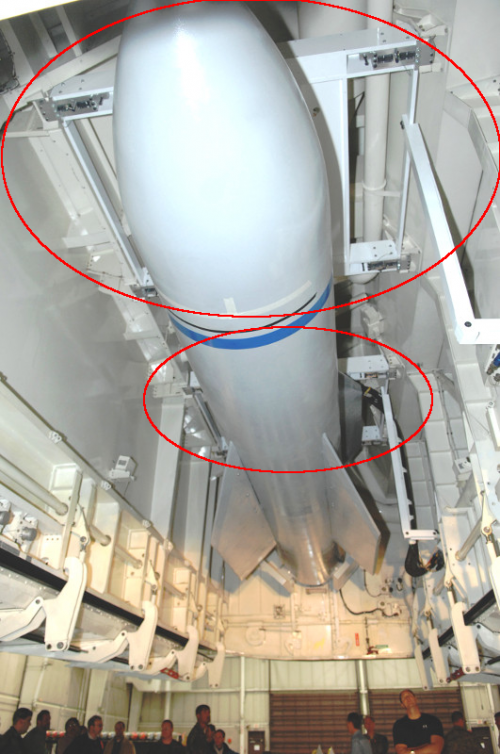
Are you sure?GBU-57 mounts to the same points as the rotary.
Looks like it attached to the same mounting for the 2 SBRA.
Attachments
Last edited by a moderator:
- Joined
- 28 January 2008
- Messages
- 1,645
- Reaction score
- 4,210
They definitely designed a special carriage for the weapon and used various mounting points in the bay. Normally, the B-2's fly with either SBRAs or RLAs or a combination of the two. The structure in the bays is pretty beefy could adapt just about anything, this image is just a bay mock-up.

- Joined
- 1 April 2006
- Messages
- 12,276
- Reaction score
- 15,084
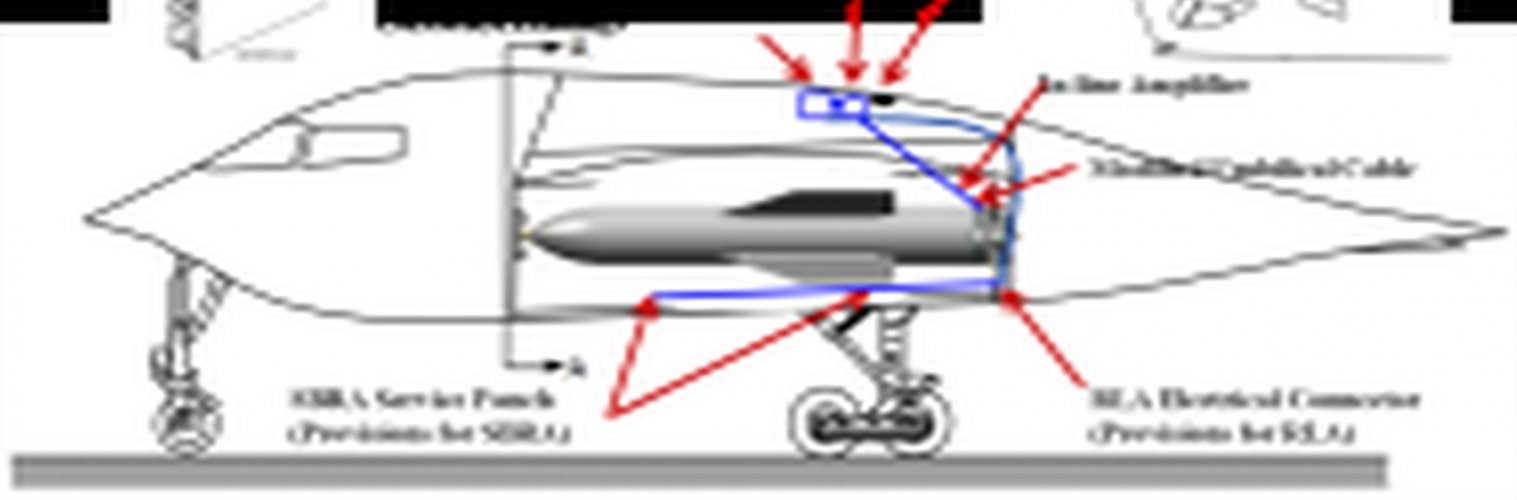
...Are you sure?
Looks like it attached to the same mounting for the 2 SBRA.
Attachments
It is hard for me to imagine that AGM-181 is less than 3,000 lbs, as the missile it replaces is 3,200. Any weight reduction from new construction methods I assume would be used to add fuel weight not reduce volume/mass. Similarly it is hard for me to imagine a rotary launcher of less than 8 weapons, since that is the case for all three other rotary systems in service. That would seem to put a floor of around 24,000 lbs plus launcher weight (B-2s is 2000#?). It is possible that the nominal payload is lower than this and that this would be an overloaded state that requires reducing fuel, as two GBU-57 simply must, but that seems a little unlikely. Equally unlikely is that the whole MOP inventory was to be retired with the B-2, so I assume B-21 carriage is possible, at least with reduced fuel.
I suspect we never learn B-21s actual rack arrangement or nominal war load in the current security environment.
I suspect we never learn B-21s actual rack arrangement or nominal war load in the current security environment.
Scott Kenny
ACCESS: USAP
- Joined
- 15 May 2023
- Messages
- 19,517
- Reaction score
- 27,966
That really depends on just how little unused volume there is in the designs. IIRC there are some big die-cast aluminum chunks in the AGM-86 to hold the nuclear warhead, it's not a simple stressed-skin body with ribs and stringers.It is hard for me to imagine that AGM-181 is less than 3,000 lbs, as the missile it replaces is 3,200. Any weight reduction from new construction methods I assume would be used to add fuel weight not reduce volume/mass.
So if you replace those solid chunks with thinner composites you get much less weight, but may not gain any usable volume for fuel at all. Plus, even if a theoretically-hollow structure is available for use as a fuel tank, the fuel is significantly less dense than aluminum.
That said, I'm expecting the AGM-181 to be in the same ballpark weight as the AGM-158C, even if it is the same length as the JASSM-XR. ~2800lbs.
I mean, not counting LRSO or AGM-158B/Cs we're talking about a rotary rack load of about 16k (8x 2000lb). And if the load is all B61s we're down way less than that, about 6.5k for Mod12s and ~10k for a full load of Mod11s.Similarly it is hard for me to imagine a rotary launcher of less than 8 weapons, since that is the case for all three other rotary systems in service. That would seem to put a floor of around 24,000 lbs plus launcher weight (B-2s is 2000#?). It is possible that the nominal payload is lower than this and that this would be an overloaded state that requires reducing fuel, as two GBU-57 simply must, but that seems a little unlikely. Equally unlikely is that the whole MOP inventory was to be retired with the B-2, so I assume B-21 carriage is possible, at least with reduced fuel.
It's when we get to the plain BRAs that the payload gets huge. A single B-2 sized bay can hold 20k (2x 20x 500lb), and I'm pretty sure we are all assuming the B-21 bay is long enough to add a third BRA to make that 30k (60x 500lb).
I wouldn't say "never" but I would say "not for a couple of decades".I suspect we never learn B-21s actual rack arrangement or nominal war load in the current security environment.





- Joined
- 21 January 2015
- Messages
- 14,992
- Reaction score
- 24,206
Opinion: Do F-47s And B-21s Have A Place In Drone-Filled Skies?
https://aviationweek.com/defense/bu...-do-f-47s-b-21s-have-place-drone-filled-skiesThe F-47 and B-21 are the crown jewels of next-generation air dominance and strike capability, but they will also be components in a larger family of systems. Sixth-generation aircraft will be needed to gain air supremacy in contested airspace, but maybe the high-volume, lower-cost components of next-generation systems could also borrow stealth and sensors from these crown jewels.
What if another future mission of the B-21 is to launch swarms of attack drones that could loiter behind enemy defenses? These drones could then rely on sensors and jammers in the F-47 or their CCA. With the battlefield printing technology Reim described, this could check all the boxes of an ideal weapon system.
As technology continues to advance, sixth-generation aircraft will have an essential role in any future war. If we look at the historical pattern of warfare technology and tactics, it is clear we will need billion-dollar aircraft even in a sky full of drones.

- Joined
- 21 April 2009
- Messages
- 14,351
- Reaction score
- 9,436
At the very least we can say they’re for planetary defense. They just happen to fit on other platforms.Do we know if the high yield warheads of the R-36 have been dismantled? (To say nothing of Russian bombs.)
https://www.airandspaceforces.com/pentagon-considering-second-b-21-production-line/
Adm. Richard Correll, head of U.S. Strategic Command, told lawmakers March 17 that his command still believes the Air Force needs to increase its planned B-21 fleet to 145 airplanes—a figure his predecessor Air Force Gen. Anthony J. Cotton endorsed last March. A second production line could be a way to reach that goal.
“There are, of course, investments that have been made to increase the production rate and to potentially open a second production line,” Correll told the House Armed Services Committee’s subcommittee on strategic forces. “That decision has yet to be made, but clearly the B-21 represents a really significant capability both from a conventional and a nuclear perspective.”
Scott Kenny
ACCESS: USAP
- Joined
- 15 May 2023
- Messages
- 19,517
- Reaction score
- 27,966
The only reason you'd need a second production line is to increase delivery rate.
SlothmanAllen
ACCESS: Confidential
- Joined
- 3 January 2025
- Messages
- 80
- Reaction score
- 192
I suspect any sort of second production line is conditional to the $1.5 trillion topline that the budget request will be. The real question is if Congress will pass anything even remotely approaching that. For example, Rep. Adam Smith said this recently, "the Pentagon has to start making choices between the more affordable — and potentially expendable — systems like drones and exquisite platforms like fighter jets, submarines and warships."The only reason you'd need a second production line is to increase delivery rate.
Doesn't sound like Democrats are onboard with a ~50% defense budget increase, especially if no one is willing to raise taxes to offset the cost.

Halcyon66
ACCESS: Top Secret
- Joined
- 9 July 2022
- Messages
- 1,519
- Reaction score
- 3,257
Chinese Scientists Think They Found a B-21 Raider Stealth Bomber ‘Wing Stability Problem"
https://nationalsecurityjournal.org...raider-stealth-bomber-wing-stability-problem/
https://interestingengineering.com/military/issues-in-us-b21-design
Interesting points, guess time will tell.
Regards,
https://nationalsecurityjournal.org...raider-stealth-bomber-wing-stability-problem/
https://interestingengineering.com/military/issues-in-us-b21-design
Interesting points, guess time will tell.
Regards,
Halcyon66
ACCESS: Top Secret
- Joined
- 9 July 2022
- Messages
- 1,519
- Reaction score
- 3,257
The DoD is already short 50 billion with current operations. And you are dreaming if you think that any extra money is coming from Congress this term or next.
https://www.cnbctv18.com/world/pent...r-congress-likely-to-oppose-ws-l-19871312.htm
Get in line.......................

Regards,
Chinese Scientists Think They Found a B-21 Raider Stealth Bomber ‘Wing Stability Problem"
seems a little silly tbh the B2 has a pretty similar shape and even the original B2 concept looks identical to the b21 and no real wing issues seemed to be present
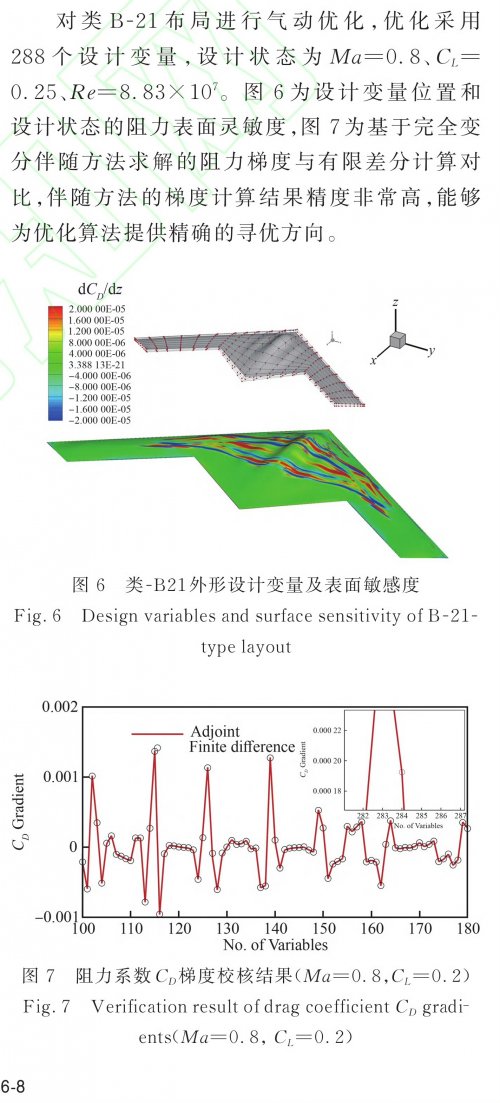
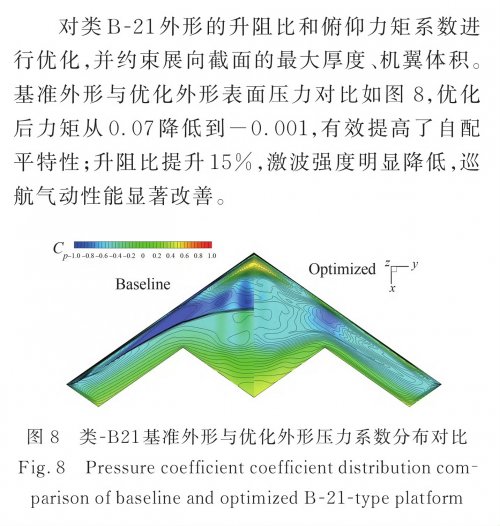
Couldn't find the actual paper, here are some excerpts on Chinese social media:Chinese Scientists Think They Found a B-21 Raider Stealth Bomber ‘Wing Stability Problem"
I think the news reporters completely missed the point... This is a paper describing an optimization software package that can optimize aerodynamics and RCS together. They do not know the actual 3D geometries of the B-21, so they casually drew a "B-21-type layout" and tried to optimize it. Since the starting point is not a real design but something they drew up for comparison, of course the software-optimized version got better aerodynamic performance and RCS characteristics...
Attachments
Last edited by a moderator:

FighterJock
ACCESS: Above Top Secret
- Joined
- 29 October 2007
- Messages
- 7,229
- Reaction score
- 8,540
My thought's too Josh_TN, I thought that all the necessary details of the B-21 were burried deep in the black world.


In_A_Dream
ACCESS: Top Secret
- Joined
- 3 June 2019
- Messages
- 786
- Reaction score
- 926
The only reason you'd need a second production line is to increase delivery rate.
That's the kind of news I was waiting for, interesting times ahead!
- Joined
- 3 June 2011
- Messages
- 20,899
- Reaction score
- 19,090
Of course the next question is are there enough skilled workers to operate it.That's the kind of news I was waiting for, interesting times ahead!
The reason its max payload is 40,000 lbs is really quite simple.The B-2 was tested with 2 30k lb bombs, and did two MOP per bomber strikes, but in reality it was designed around, ideally, a total load of 40k lb for long range missions in high threat areas. Like real world missions against Russia or China. Even that likely doesn't allow for a full fuel load. 60 k lb of bombs would eat into its fuel allowance even further. As per USAF, B2 empty weight is 160 000 lb, meaning a 60k lb bomb load would lead to 220 k lb without fuel. Given that the MTOW, per USAF is 336 k lb, that means 116 k lb of fuel, instead of 167 k lb. A 30% reduction. Sure, that can be rectified to an extent with in air refueling, but you'd still need more tanker top ups, as max weight in air would still be less than if such a heavy load wasn't carried around.
Basically, i think USAF never really indented to regularly use B2 with two MOPs anyway, operationally. That's why officially it's max loadout is 40 000 lb. Sure, in 2025, when they hit iran, 7 bombers dropped 14 MOPs. But Iran is a much, much more permissible target area than either Russia or China would be and B2s had to fly just 300 miles inside hostile territory. In Russia/China, B2s would often have to fly several times as much inside enemy territory, so fuel loads carried would be much more critical.
The B2 was designed around the idea of carrying two bomb bays, each containing a rotary launcher with eight B61 or B83 bombs loaded onto it.
The weight of the B83 bomb is 2465 lbs, and it is commonly referred to in government papers as a 2500 lb class bomb, or even simply has its weight rounded up to 2500 lbs entirely.
2500 * 8 * 2 = 40,000 lbs
Obviously the airframe is capable of carrying more weight if the bomb bays are configured differently and different munitions are used. But it was originally designed for a nuclear strike mission first and foremost, which is why the nuclear strike mission payload weight is the one which is commonly cited as its nominal max payload capacity, even though it can technically carry more weight with certain conventional munition payloads.
Emmmm…I don’t have a lot of concrete information about Russian ICBMs, but RS-24 Yars, R-36M2 “Satan”, and RSM-56 Bulava seems to all use MIRVs with much less than 1Mt warhead. I think it’s pretty much only China operating very high yield singular ICBM warheads…
It's unclear how many (if any) of the ultra high yield R-36 warheads were ever deployed (we know they were designed and tested and considered ready for deployment in the 1990s, but it's less clear if any of them were actually deployed at all (different sources have conflicting accounts on this), and if they actually were deployed, in what number (another area where different sources have wildly conflicting accounts)), or if any have survived to the present day.Do we know if the high yield warheads of the R-36 have been dismantled? (To say nothing of Russian bombs.)
It is somewhat unlikely for Russia to have bothered retaining any of them into the modern era (especially post-New-START), as their strategy for nuclear war has always involved riding out a first strike before retaliating with the surviving land based ICBMs, and therefore it is absolutely critical to be able to pack as many MIRV warheads as possible onto each missile (within the constraints of treaty limits) in order to maximize the number of warheads that survive.
They are also somewhat limited on the total number of remaining operational R-36 silos following the collapse of the Soviet Union and various arms control treaties that required verified destruction of numerous silos, and as it is preferable to spread the warheads they are permitted across as wide a pool of R-36 missiles as possible, logic suggests that the ultra high yield warhead variants would be more of a liability than anything else.
Lastly, there has been no indication from reputable sources that the Sarmat is planned to carry such a large warhead (some large single warhead options have been proposed, but none with anything close to the yield level attributed to the ultra high yield R-36 warheads), which just further suggests that Russia likely does not currently field any ultra high yield R-36 warheads.
The B-21 is basically just a scaled-down B-2 with a single bomb bay instead of two bomb bays. It'll carry 8x B61/B83 bombs (with normal range), or 1x MOP (with reduced range). There is virtually no chance of it being incapable of carrying the MOP.It is hard for me to imagine that AGM-181 is less than 3,000 lbs, as the missile it replaces is 3,200. Any weight reduction from new construction methods I assume would be used to add fuel weight not reduce volume/mass. Similarly it is hard for me to imagine a rotary launcher of less than 8 weapons, since that is the case for all three other rotary systems in service. That would seem to put a floor of around 24,000 lbs plus launcher weight (B-2s is 2000#?). It is possible that the nominal payload is lower than this and that this would be an overloaded state that requires reducing fuel, as two GBU-57 simply must, but that seems a little unlikely. Equally unlikely is that the whole MOP inventory was to be retired with the B-2, so I assume B-21 carriage is possible, at least with reduced fuel.
I suspect we never learn B-21s actual rack arrangement or nominal war load in the current security environment.
I'm hesitant to comment on the rotary cruise missile launcher issue because it greatly depends on the exact design, diameter, length, and weight of the AGM-181 LRSO, and it also depends on if the rotary launcher is being optimized for maximum capacity at nominal range or maximum capacity with reduced range. However I think as long as the weight of the LRSO is kept sufficiently under control, and assuming the diameter and length are not constraints, then using an 8-missile launcher should be feasible as long as reduced range at full load is acceptable. I am very doubtful that it would be able to carry eight LRSOs at nominal range though, as I expect the missile to be too heavy to allow for that.
Rotary rack load capacity is presumably at least 19,720 lbs at bare minimum (8 * 2465 lbs), as I find it hard to believe that they would design the B-21 without the capacity to carry the B83 (which weighs 2465 lbs).I mean, not counting LRSO or AGM-158B/Cs we're talking about a rotary rack load of about 16k (8x 2000lb). And if the load is all B61s we're down way less than that, about 6.5k for Mod12s and ~10k for a full load of Mod11s.
It's when we get to the plain BRAs that the payload gets huge. A single B-2 sized bay can hold 20k (2x 20x 500lb), and I'm pretty sure we are all assuming the B-21 bay is long enough to add a third BRA to make that 30k (60x 500lb).
For the B61, weights are as follows (for a loadout of 8 bombs):
- B61-3/4: 6008 ± 120 lbs
- B61-7: 6104 ± 120 lbs
- B61-10: unknown (no exact weight data is available for the B61-10, but as this weapon is in the inactive reserve stockpile, it probably doesn't matter anyways)
- B61-11: 9680 ± 120 lbs
- B61-12: 6600 lbs
- B61-13: 6696 lbs (no exact weight data is available for the B61-13, but we can use the relative weights of the B61-4, B61-12, and B61-7 to make an educated guess as to the B61-13's likely weight, which works out to an estimated 837 lbs)
We already have that covered by the enormous USAt the very least we can say they’re for planetary defense. They just happen to fit on other platforms.
Supposedly the B53 physics packages were identified as being of particular interest for planetary defense use cases, and at one point dismantlement of their CSAs was intentionally put on hold pending evaluation of their possible future use for planetary defense purposes.

- Joined
- 6 August 2007
- Messages
- 4,530
- Reaction score
- 10,230
There is virtually no chance of it being incapable of carrying the MOP.
Other than they are not planning to carry it. It’s not on the list of conventional weapons they plan to certify.
MOP is being replaced by other weapons smaller, lighter weapons.
A smaller and lighter conventional earth penetrating warhead is going to be significantly less effective than the MOP, and will cost a fortune to design and build. Why mess with what works? Unless you go nuclear, the MOP is the best option out there for bunker busting. Its design costs are already paid for, and incremental build costs for orders of additional MOPs are much lower than the cost to buy brand new bombs of a novel design from a yet-to-be-constructed production line.Other than they are not planning to carry it. It’s not on the list of conventional weapons they plan to certify.
MOP is being replaced by other weapons smaller, lighter weapons.
- Joined
- 6 August 2007
- Messages
- 4,530
- Reaction score
- 10,230
A smaller and lighter conventional earth penetrating warhead is going to be significantly less effective than the MOP, and will cost a fortune to design and build. Why mess with what works? Unless you go nuclear, the MOP is the best option out there for bunker busting. Its design costs are already paid for, and incremental build costs for orders of additional MOPs are much lower than the cost to buy brand new bombs of a novel design from a yet-to-be-constructed production line.
No, it won’t be less effective. That’s the point.
The MOP is like taking down a building with a truck boom.
The new weapons are like doing the same work with 5 pounds of HE. They put the force where it needs to go.
I thought this was a forum for serious fact-based discussions, not/r/NonCredibleDefense...No, it won’t be less effective. That’s the point.
The MOP is like taking down a building with a truck boom.
The new weapons are like doing the same work with 5 pounds of HE. They put the force where it needs to go.
...because this is straight out of that subreddit.
Doing the same work as a 30,000 lb precision guided earth penetrating bomb filled with 5342 lbs of high explosives using only 5 lbs of HE inside a presumably proportionally scaled down "smaller, lighter weapon"?
You have to be either joking or trolling.
It's either that, or you truly are legitimately that scarily ignorant about the mechanics of earth penetrating warheads, in which case I think I am probably wasting my time by posting here if this is the kind of reaction to expect when I venture outside my usual domain of nuclear weapons-related topic areas.
I mean, have you ever taken a university-level physics course? Hell, even high school physics alone is probably more than enough to understand why this obviously isn't going to work. This is almost on the same level as UFO conspiracies and ancient aliens.
Ye gods, I think I need to take a break from this place or something, because I can't even begin to reply to this. Where do you even start? How do you even begin to arrive at the belief that it's possible to do the same work with less than 1/1000th the amount of explosive and god knows how much less an amount of weight? This is like flat earth conspiracies, where the fundamental premise is so far off from reality that you just don't know how to engage with them.
Edit: I think I have a even better refutation for you:
The weight of the next generation penetrator (which is intended to eventually replace the MOP) is 22,000 lbs (vs 30,000 lbs for the existing MOP). If your assertion that they can do the same work with 5 lbs of HE was true, then it wouldn't weigh anywhere near 22,000 lbs.
See this article for details: https://www.airandspaceforces.com/p...ordinance-penetrator-bombs-dropped-b-2s-iran/
Now it's possible that they will optimize the casing design to squeeze out a tiny bit more performance, and maybe further upgrade the INS unit to get slightly better accuracy out of it, and use a more integrated and optimized case design in order to minimize structural weight and maximize the amount of explosive filling in it.
But the reduced amount of explosive filling in an 8000 lb lighter bomb is going to make it less effective (although depending on how much they can lighten the structure, it's possible that it could have only a slightly smaller amount of explosives in it).
Overall, best possible case scenario is that it performs similarly or slightly better than the MOP (mainly through greater optimization of the penetrator design and higher accuracy/precision).
Worst possible case scenario is that it performs significantly poorer than the MOP (mainly through the likely substantially smaller quantity of explosive filling unless they manage to massively lighten the structure).
IMO it'll probably be slightly superior in some aspects, and slightly inferior in other aspects, and on balance, will probably somewhat be less effective at raw destruction and capability to damage deeply buried facilities, but probably still a decent enough replacement for the MOP.
I don't think it's a great use of money to build new penetrators, but perhaps the B-21 is more limited on max payload than we had believed, in which case I guess that'd force their hand on needing to replace the MOP. Or perhaps it is simply intended to allow the smaller B-21 the option of dropping a conventional EPW in deep penetration scenarios. That's one of the downsides of having the B-21 be so much smaller than the B-2 in terms of payload capacity. You can outfit a B-2 with a single MOP to gain a substantial amount of extra range. You cannot exactly do the same thing with the B-21.
Last edited:
yeetmahboi
ACCESS: Top Secret
- Joined
- 6 April 2022
- Messages
- 1,025
- Reaction score
- 1,434
A5K definitely has more than 5lbs of kaboom inside the nose.
Make Sarcasm Great Again.
Make Sarcasm Great Again.
djfawcett
With Enough Power, Anything Will Fly
- Joined
- 16 December 2012
- Messages
- 322
- Reaction score
- 567
JTR, lighten up. Sarcasm doe not get you very far on this forum. Moreover, you totally misread what quellish wrote. He was doing a comparative analysis. He was not saying that a new penetrator was being built with 5lb of He. You obviously have a reasonable knowledge base. Use it to grow the overall knowledge base of the forum, not to degrade a participant. Best Regards
- Joined
- 6 August 2007
- Messages
- 4,530
- Reaction score
- 10,230
Doing the same work as a 30,000 lb precision guided earth penetrating bomb filled with 5342 lbs of high explosives using only 5 lbs of HE inside a presumably proportionally scaled down "smaller, lighter weapon"?
You have to be either joking or trolling.
This was both a comparison and a metaphor, but it was not comparing "MOP" to using 5 lbs of HE, nor was it saying that a next generation weapon uses 5 lbs of HE.
It was a comparison between a (large) truck bomb taking down a building, and 5 lbs of HE doing the same work. This particular comparison is very commonly used by people working with HE or demolitions.
In the case of the truck bomb very little of the energy is making it into the target.
In the case of 5 lbs of HE, it is being placed exactly where it needs to be.
"MOP" is a blunt instrument. For some reason people seem to be in love with it and it's bigness. Compensating much?
The problem of holding hard and deeply buried targets at risk has been worked heavily for the last 30+ years. In the last 15 there have been a number of advancements in measuring and modeling how explosive forces couple to the ground and other materials. Explosives, fuses and penetrators are much more refined than they were when the "MOP" requirements (or SILVER Books) were drafted. These are things I have deep personal experience with - and I still have all 8 fingers!
And then...
It's either that, or you truly are legitimately that scarily ignorant about the mechanics of earth penetrating warheads, in which case I think I am probably wasting my time by posting here if this is the kind of reaction to expect when I venture outside my usual domain of nuclear weapons-related topic areas.
I mean, have you ever taken a university-level physics course? Hell, even high school physics alone is probably more than enough to understand why this obviously isn't going to work. This is almost on the same level as UFO conspiracies and ancient aliens.
Ye gods, I think I need to take a break from this place or something, because I can't even begin to reply to this. Where do you even start? How do you even begin to arrive at the belief that it's possible to do the same work with less than 1/1000th the amount of explosive and god knows how much less an amount of weight? This is like flat earth conspiracies, where the fundamental premise is so far off from reality that you just don't know how to engage with them.
Whenever taking a break from the forum it's a great time to catch up on the forum rules and guidelines. Personal attacks such as you wrote above are specifically prohibited.
Scott Kenny
ACCESS: USAP
- Joined
- 15 May 2023
- Messages
- 19,517
- Reaction score
- 27,966
I'd suggest Wichita, though I'm sure there's other places with a population of loose aerospace workers available.Of course the next question is are there enough skilled workers to operate it.
Scott Kenny
ACCESS: USAP
- Joined
- 15 May 2023
- Messages
- 19,517
- Reaction score
- 27,966
While I haven't seen any weight data for the JASSM-XR, I'm expecting it to be about the same weight as the LRASM or maybe 3000lbs at maximum. And I expect the LRSO to be roughly the same weight as the JASSM-XR: ~2800llbsI'm hesitant to comment on the rotary cruise missile launcher issue because it greatly depends on the exact design, diameter, length, and weight of the AGM-181 LRSO, and it also depends on if the rotary launcher is being optimized for maximum capacity at nominal range or maximum capacity with reduced range. However I think as long as the weight of the LRSO is kept sufficiently under control, and assuming the diameter and length are not constraints, then using an 8-missile launcher should be feasible as long as reduced range at full load is acceptable. I am very doubtful that it would be able to carry eight LRSOs at nominal range though, as I expect the missile to be too heavy to allow for that.
And in all honesty, I expect it to be lighter. The nuclear warhead is not the 1000lb titanium semi-armor-piercing monster, it's going to be a lot lighter. On the order of 400lbs, I think. Now, it's a really dense chunk of metals but because it is so dense you can use basically all the length of that 1000lb conventional warhead as a fuel tank. But jet fuel is less dense than the thick titanium casing or the fuel, so a nuclear-tipped cruise missile would be longer ranged or significantly lighter.
I agree that they should have designed the B-21 to carry B83s.Rotary rack load capacity is presumably at least 19,720 lbs at bare minimum (8 * 2465 lbs), as I find it hard to believe that they would design the B-21 without the capacity to carry the B83 (which weighs 2465 lbs).
For the B61, weights are as follows (for a loadout of 8 bombs):
You can see why the B83 is the bounding condition for normal nuclear loadouts on these bombers. 2465 lbs is well over twice the weight of the heaviest B61 variant.
- B61-3/4: 6008 ± 120 lbs
- B61-7: 6104 ± 120 lbs
- B61-10: unknown (no exact weight data is available for the B61-10, but as this weapon is in the inactive reserve stockpile, it probably doesn't matter anyways)
- B61-11: 9680 ± 120 lbs
- B61-12: 6600 lbs
- B61-13: 6696 lbs (no exact weight data is available for the B61-13, but we can use the relative weights of the B61-4, B61-12, and B61-7 to make an educated guess as to the B61-13's likely weight, which works out to an estimated 837 lbs)
Are B83s still in service? I thought they all got retired and disassembled years ago, except for ~50 Canned Sub-Assemblies for asteroid defense? Which would make it unlikely for the B-21 rotary rack to be designed for B83s.
Are B83s still in service? I thought they all got retired and disassembled years ago, except for ~50 Canned Sub-Assemblies for asteroid defense? Which would make it unlikely for the B-21 rotary rack to be designed for B83s.
I think you might be confusing the B83s, Scott, with B53s.
- Joined
- 1 April 2006
- Messages
- 12,276
- Reaction score
- 15,084
It's interesting that original January SCMP article says that CARDC paper by Huang Jiangtao was published in 'previous month' Acta Aeronautica et Astronautica Sinica but search returns zero.Couldn't find the actual paper, here are some excerpts on Chinese social media:
Attachments

I think you might be confusing the B83s, Scott, with B53s.
B53 is retired.
But the Biden Admin announced the retirement of the B83 in 2022, to be replaced by the B61-13.

