- Joined
- 3 June 2011
- Messages
- 20,899
- Reaction score
- 19,090
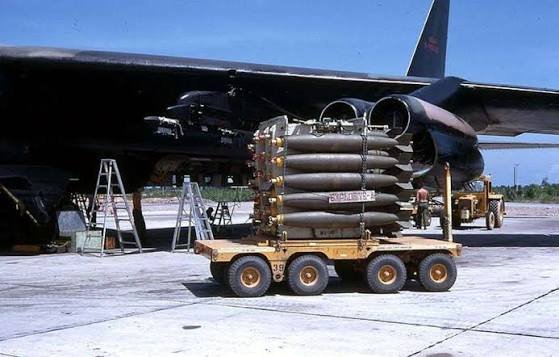
Not for "carpet bombing" For more efficient use of space.No, I highly doubt we will see a WWII style bomb rack developed for carpet bombing using Mk82.

Not for "carpet bombing" For more efficient use of space.No, I highly doubt we will see a WWII style bomb rack developed for carpet bombing using Mk82.

We do know ARRW dimensions and weight for ages, and can measure IWB lenght with 5% accuracy from photos.Unknown at this stage, we don't know the IWB length accurately, or ARRW dimensions for that matter.

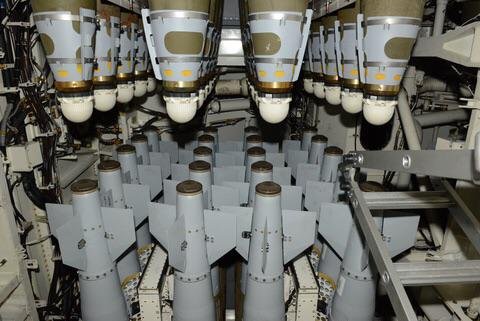
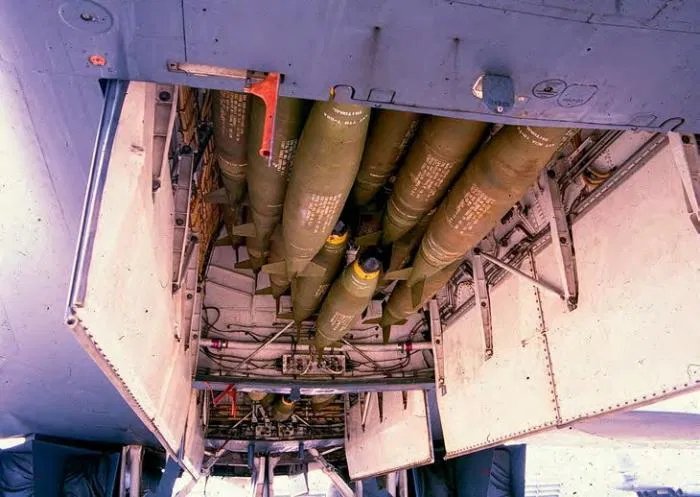
2,000lb JDAM is just under 13 feet long. So two of these bombs would fit perfectly in tandem on a rotary launder.
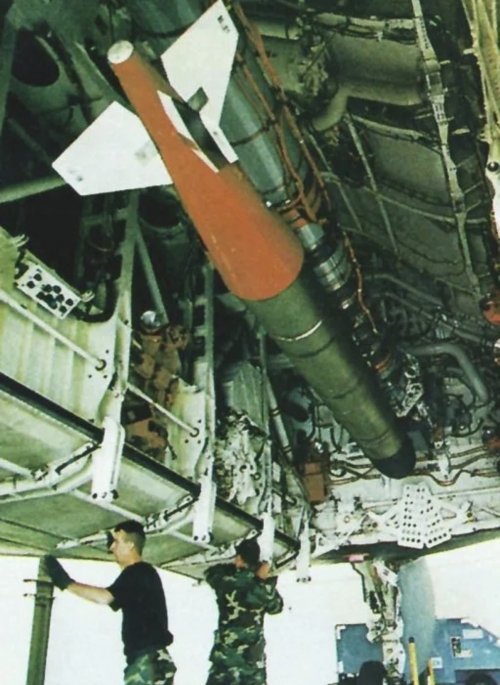
It seems that four of them can be carried around the rotating launcher, similar to the 5000 lbs JDAMs…Pretty sure that won't fit into a B-21. We're looking at something closer to a stretched ASALM for the hypersonic cruise missile.

I see the $700M number in most of the articles about the B-21, but I have no idea where it comes from. The only official number has always been the original $550M APUC in 2010 dollars. That number will inflate to a LOT more than $700M by the time production aircraft roll off the line. I asked Grok to do the inflation arithmetic and come up with a unit price list assuming 100 production aircraft are delivered from 2028 to 2039 using a learning curve of 80%. Here's the result:I sincerely doubt a $700 million aircraft would be used to fire medium range AAMs.

I see the $700M number in most of the articles about the B-21, but I have no idea where it comes from.
I think you misunderstood the discussion. No one suggested installing the racks while they are loaded with bombs. The discussion is swapping out the empty rotary launcher with empty bomb racks between missions. The bombs would still be loaded one by one into the aircraft. Swapping out the empty rotary launcher for the empty bomb racks would take significant time. Just to carry extra Mk82 bombs or use the space more efficiently is a bit ridiculous.I find it really hard to imagine swapping in a new rotary launcher or two new racks with all the bombs on them is more time consuming than putting in the bombs one by one...
I have already mentioned using racks on the rotary launcher to allow four 6 foot long weapons in the place of a single 2000lb bomb. Even with custom racks the 500lb bombs will never fit nicely or efficiently on the rotary launcher.The rotary launchers use adapters and other racks that offer both 14" and 30" as well as other optional locations. You mount your specific rack to these if needed.
Amusingly, the USAF kept complaining in their report to congress about the B1 needing 24 hours to reload compared to 4-5 or so hours for the B52 as one of the reason they needed the more numerous LRS-B/B21.
We have solid ARRW dimensions, have known them for years.Unknown at this stage, we don't know the IWB length accurately, or ARRW dimensions for that matter.
Where was that discussed? I don't remember reading it. IIRC you can't quite fit 24" diameter cylinders around a rotary launcher.It seems that four of them can be carried around the rotating launcher, similar to the 5000 lbs JDAMs…
But that is exactly what people do in real life…?No one suggested installing the racks while they are loaded with bombs
Sorry about the confusion, but I said it because the number checks out, not because it was discussed before… Just using your estimation, the width of the bomb bay being six feet or 72 inches, and each of the missiles taking 24 inches, that leaves 24 inches for the rotary spindle and release mechanisms, and the missiles won’t collide with each other.Where was that discussed? I don't remember reading it. IIRC you can't quite fit 24" diameter cylinders around a rotary launcher.
You need a bit of clearance around the ordnance to drop safely (and to load the rotary into the aircraft). If you look at all the cruise missiles designed around the rotary launcher, they're only about 18" tall.Sorry about the confusion, but I said it because the number checks out, not because it was discussed before… Just using your estimation, the width of the bomb bay being six feet or 72 inches, and each of the missiles taking 24 inches, that leaves 24 inches for the rotary spindle and release mechanisms, and the missiles won’t collide with each other.
“It won’t need to be based in theatre. It won’t need logistical support to hold any target at risk.” —Lloyd J. Austin, at the B-21 rollout ceremony Dec. 2022The history of the B-21 comes from the Next-Generation Bomber program. NGB was a stealthy, subsonic, medium-range and medium payload bomber.
Two JDAM nose-to-tail are under 26 feet. A perfect fit.You need clearances around the launcher. If the doors are actually 26 feet long, I doubt you can fit two 2000-lb JDAMs nose-to-tail. If they are 27 feet, it gets a lot more feasible.
Please read more carefully.“It won’t need to be based in theatre. It won’t need logistical support to hold any target at risk.” —Lloyd J. Austin, at the B-21 rollout ceremony Dec. 2022
The medium range aspect of the NGB is probably already thrown out somewhere down the line…
NGB mentioned all the advantages of having the bombers located closer to the theatre with rapid loading. These advantages still apply to the B-21.
My dearest, beloved, oh so close to my very own heart, freely sharing fountain of knowledge of relevant US military related information Quellish, please pray tell, what is a "product ion", how can you tell it apart from naturally born/occurring ions in the wild, but most importantly, what is the exact relevance of them in this discussion??? Thank you for your attention to this matter! MJBI believe that is total program cost (dev, production, lifetime sustainment) divided by number of aircraft. Which in the 90s was a popular way to do it, but it’s very problematic . You cut product ion and the apparent unit cost goes up a lot
Sure, B-2 currently operates out of at least two of these three locations (UK and Diego Garcia), and frequently visit the other (Australia). So the SBRA currently on the B-2 fleet is probably not a problem…If we draw a 3,000 mile ring around bases in Australia, the UK and Diego Garcia it covers nearly all of the potential targets.

So we do. I'd say they probably will fit then, definitely on length, diameter could be a squeeze for RLA.We do know ARRW dimensions and weight for ages, and can measure IWB lenght with 5% accuracy from photos.
I need to amend my comment on loading the RLA into the bird, you're almost certainly doing that with the ARRWs in an X setup to maximize ordnance-to-wall clearance as you're stuffing things into the bay.So we do. I'd say they probably will fit then, definitely on length, diameter could be a squeeze for RLA.
Even the AGM-129?I need to amend my comment on loading the RLA into the bird, you're almost certainly doing that with the ARRWs in an X setup to maximize ordnance-to-wall clearance as you're stuffing things into the bay.
But you still need enough space for the RLA to physically rotate to ARRWs in the + setup to drop and I'm questioning how exactly a 26"/66cm cylinder fits onto the RLA when all the weapons designed for the RLA are 18" tall.
Fact sheet for those describes them as external carry only on B-52s.Even the AGM-129?
Ah okay, designation systems had it wrong.Fact sheet for those describes them as external carry only on B-52s.
https://www.af.mil/About-Us/Fact-Sheets/Display/Article/104543/agm-129a-advanced-cruise-missile/

Sadly, true. (For now. There is talk of getting rid of those too. There is no shortage of idiots in Congress.)That would be the B-83 nuclear bombs then Scott Kenny as they are currently the only large nuclear bombs left in the US inventory if I am right.
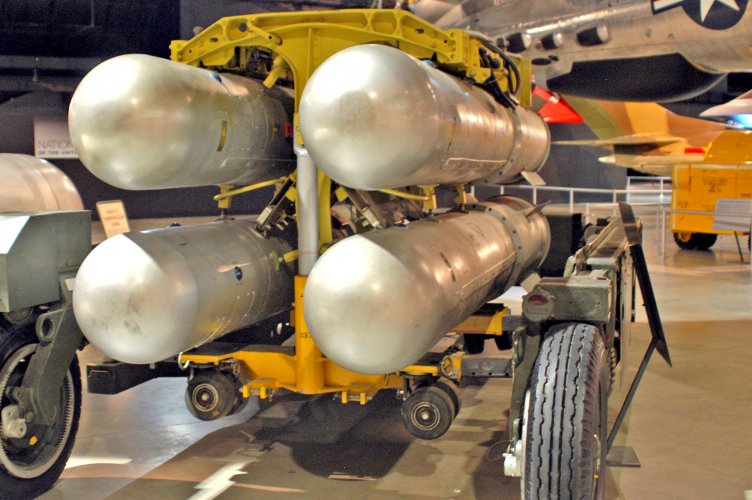
I'm saying that it would be better to hang GBU-72s on a clip like the one in the picture (which happens to be for B28s).That would be the B-83 nuclear bombs then Scott Kenny as they are currently the only large nuclear bombs left in the US inventory if I am right.
The whole point of creating all of these 6 foot long glide bombs and small cruise missiles is that four of them can fit where a single 2,000lb JDAM is located. The added benefit is everything fits the F-35 and probably the F-47.
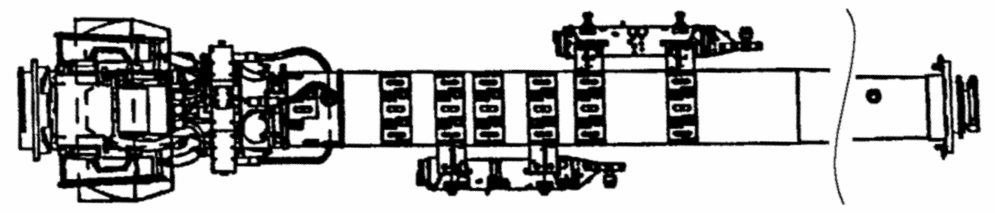
This means the rotary launcher will be built for two 2,000lb JDAM in tandem with 30inch spacing between the mounting provisions. The BRU-61 rack has the same 30inch spacing allowing four 6 foot weapons. The rotary launcher would only be removed when the big bunker buster weapon is carried.
On that note, the B-2 can hold GBU-37 5klbs GAMs onto its RLA. GBU-37s are probably about the same size as GBU-72s (But probably still much thinner than ARRWs! Steel has a much higher density than carbon fiber shell and HTPB rocket fuel)I mean, it's certainly possible that the B-21's weapons bay is bigger than I'm guessing, wide enough to hold 4x GBU-72s on an RLA.
I think this image was taken at the CTF around my time there. The B-2s bays are large, don't know if the ARRW would fit?On that note, the B-2 can hold GBU-37 5klbs GAMs onto its RLA. GBU-37s are probably about the same size as GBU-72s (But probably still much thinner than ARRWs! Steel has a much higher density than carbon fiber shell and HTPB rocket fuel) View attachment 805689
SBRA accomodates 20x 500lb and 3x SBRA empty weight almost 5050 lb max.I was thinking 4x4x3 =48, or 27,600
Is the 5000 the weight of three SBRA?
GBU-57 mounts to the same points as the rotary.Comparing loading capacity it's 8x5000 lb + 2200= 42.2kllb on the rotary; and GBU-57 30+klb on ceiling/deck afaik.
So just loadwise either could work. We are back to square one about size.
From the link, "The size and weight limits are aligned with integration requirements for the B-21 Raider stealth bomber, which is expected to carry one NGP per mission under current planning assumptions."Also let's not forget the Next Generation Penetrator for which the request was for it to remain within 22klb.
I've alway assumed it was meant to increase magazine load to two. So the actual deck load rating is likely 45klb.
https://www.thedefensenews.com/news...-to-Succeed-30000-Pound-GBU-57-Bunker-Buster/
Idk man, i dont think it's so sad megaton weapons are falling out of fashion, i would rather have my post apocalypse with some of humanity left rather than non...It will be a sad day when the B-83 get's retired Sferrin.

I always thought with more precision and survivability of modern delivery methods, yield needed would go down. Would mt warheads be needed for deep bunker networks of China?I rather suspect that megaton range weapons are actually going to be in great demand in the near future.
Yes, among other targets.I always thought with more precision and survivability of modern delivery methods, yield needed would go down. Would mt warheads be needed for deep bunker networks of China?
Problem is, they're only "falling out of fashion" in the US. Russia and China are still balls to the wall.Idk man, i dont think it's so sad megaton weapons are falling out of fashion, i would rather have my post apocalypse with some of humanity left rather than non...
Weight Reduction and Platform Integration
Procurement documentation specifies that the NGP warhead must weigh 22,000 pounds or less, representing a reduction of roughly one-third compared to the GBU-57. The size and weight limits are aligned with integration requirements for the B-21 Raider stealth bomber, which is expected to carry one NGP per mission under current planning assumptions.
The reduced form factor is also intended to allow potential integration with additional platforms as future force structure evolves. While the GBU-57 is exclusive to the B-2 fleet, the NGP is being designed with broader compatibility considerations, subject to certification and testing.