Once more, it was discussed thousand times here in this topic since first flight. Small bays sit right below APU exhausts on top. They may also hold EDG and ECS stuff. They are not missile bays.
 
Last edited:
The B-21 getting a stand-in-attack weapon? I wonder if that is going to be Hypersonic? I would think that it would be good to have such a missile as part of the armament for the Raider.
Due to how the rocket equation works (you have to accelerate all your fuel as well as payload), the amount of fuel required to reach a given velocity grows exponentially. So, an ideal platform to carry a hypersonic weapon would be one that flies fast in the first place and/or can carry a lot of mass. Imo something like the B-52 or B-1 would be more suited for it. That said, I'm not saying the B-21 won't have them, it's just that the B-21 doesn't really have any unique advantages in their use, other than that the B-21 has a long service life ahead of it.
 
Due to how the rocket equation works (you have to accelerate all your fuel as well as payload), the amount of fuel required to reach a given velocity grows exponentially. So, an ideal platform to carry a hypersonic weapon would be one that flies fast in the first place and/or can carry a lot of mass. Imo something like the B-52 or B-1 would be more suited for it. That said, I'm not saying the B-21 won't have them, it's just that the B-21 doesn't really have any unique advantages in their use, other than that the B-21 has a long service life ahead of it.
The initial speed advantage of the B-1B is not that much though… B-21 gives out ~240m/s at M0.8 at high altitude, B-1B gives out ~370m/s. Assuming a solid fuel specific impulse of 265s, and an engine shut-off velocity of Mach 5 or 1500m/s at altitude. The missile sized for reaching Mach 5 from the B-21 would have to have 38% of its mass as fuel, while the missile sized for the same max velocity launching from a B-1B would only need to have 35% of its mass as fuel, which is not a large difference…

The point being, planes are just slow compared with rockets. And B-1B is not a very fast plane either (SR-71 or XB-70 would do much, much better, even the F-22 reaches faster speed at cruise).
 
The initial speed advantage of the B-1B is not that much though… B-21 gives out ~240m/s at M0.8 at high altitude, B-1B gives out ~370m/s. Assuming a solid fuel specific impulse of 265s, and an engine shut-off velocity of Mach 5 or 1500m/s at altitude. The missile sized for reaching Mach 5 from the B-21 would have to have 38% of its mass as fuel, while the missile sized for the same max velocity launching from a B-1B would only need to have 35% of its mass as fuel, which is not a large difference…
The small difference for the boost phase does matter a lot more for the sustainment time. I'm estimating ~16s for airbreathing missile or about 15 nm range, the whole range of former short range A2A missiles.
 
So unless that slant in the panel is enough to make up for 2 ft (I highly doubt it can), or you are willing to argue that the front section of the panel is 2 ft longer than the aft section, or missiles are tucked diagonally into the panel, then I'm not sure how that's going to fit AMRAAMs - as much as I would like it to.
The front section does appear to be slightly longer than the rear section. Maybe 55/45 split. This combined with the slant of the panel makes up the 2 feet.

So it seems the bomb bay is on the order of 26-27 feet?
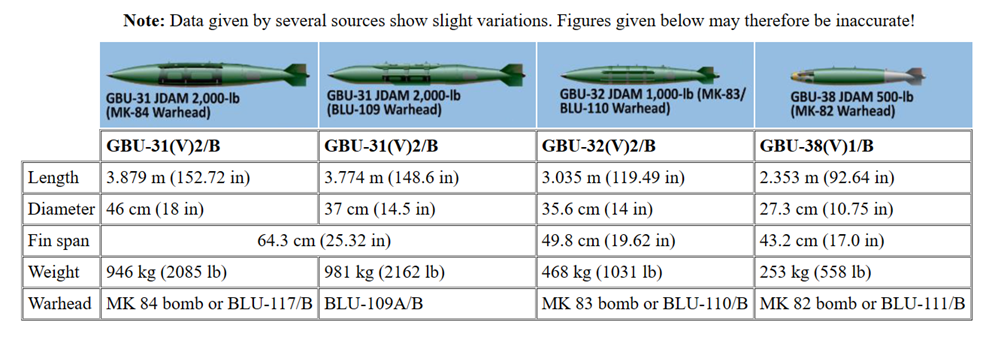
2,000lb JDAM is just under 13 feet long. So two of these bombs would fit perfectly in tandem on a rotary launder.

Two SiAW or AARGM-ER will not fit in tandem once clearances are added. This is why the USAF just put out an RFI to developing a new high speed strike weapon. The RFI clearly states to fit F-47 and B-21.

Most of the new weapons are standardising on 12 foot length and 6 foot length. This has been communicated to all of the manufacturers. Four 6 foot long small diameter bombs on a BRU-61 quad rack take up exactly the same space as a 2,000lb JDAM.
 
I suspect B-21 mostly spends its time dropping glide bomb or deep penetration weapons.
 
The front section does appear to be slightly longer than the rear section. Maybe 55/45 split. This combined with the slant of the panel makes up the 2 feet.


2,000lb JDAM is just under 13 feet long. So two of these bombs would fit perfectly in tandem on a rotary launder.

Two SiAW or AARGM-ER will not fit in tandem once clearances are added. This is why the USAF just put out an RFI to developing a new high speed strike weapon. The RFI clearly states to fit F-47 and B-21.

Most of the new weapons are standardising on 12 foot length and 6 foot length. This has been communicated to all of the manufacturers. Four 6 foot long small diameter bombs on a BRU-61 quad rack take up exactly the same space as a 2,000lb JDAM.

I was under the impression that mk82 JDAM is 8 feet and mk 84 is 12 feet, as is all US nuclear bombs. So a bomb bay of a bit over 24 feet would allow 2x or 3x weapons to be carried in a suitable rack system.
 
I was under the impression that mk82 JDAM is 8 feet and mk 84 is 12 feet, as is all US nuclear bombs. So a bomb bay of a bit over 24 feet would allow 2x or 3x weapons to be carried in a suitable rack system.
https://www.af.mil/About-Us/Fact-Sh...4572/joint-direct-attack-munition-gbu-313238/
GBU-31v1/B (Mk84) is 153" long. Just short of 13ft long. The BLU-109 version is a little shorter. So you're not sticking 2x 2000lb JDAMs in tandem in a bay shorter than 27ft long.

More to the point, 8x2000 is 16klbs. 16x2000 is 32.
 
https://www.af.mil/About-Us/Fact-Sh...4572/joint-direct-attack-munition-gbu-313238/
GBU-31v1/B (Mk84) is 153" long. Just short of 13ft long. The BLU-109 version is a little shorter. So you're not sticking 2x 2000lb JDAMs in tandem in a bay shorter than 27ft long.

More to the point, 8x2000 is 16klbs. 16x2000 is 32.
Well worth clicking that link, impressive they produce the tail kit for $22k. Admittedly they make in (some) volume but still not a complete "rip-off". Here's the table someone (possibly Scott) shared previously.
 

Attachments

  • 1773480329848.png
    1773480329848.png
    209.5 KB · Views: 79
I doubt the B-21 uses any chaff or flares, the B-2 is not equipped with them, doesn't need them.
Really? The B-2 has neither chaff nor flares? While relying on the reduction of it's radar signature and thermal signature is all nice and dandy paired with proper mission planning, isn't that a bit...risky?
 
I was under the impression that mk82 JDAM is 8 feet and mk 84 is 12 feet, as is all US nuclear bombs. So a bomb bay of a bit over 24 feet would allow 2x or 3x weapons to be carried in a suitable rack system.
I doubt they will put three mk82 bombs in tandem on the rotary launcher. This would require too many attachment points. It makes sense to have 8 mounts on the rear and 8 mounts on the front of the rotary launcher.

I then expect 16 2,000lb JDAM as the maximum bomb load on a rotary launcher. 8 at the front and 8 at the rear. Each 2,000lb JDAM can be replaced with a rack with four Small diameter bombs. This gives a maximum of 64 SDB. Also the 1,000lb JDAM-ER with the wing kit fits nicely in the space of a 2,000lb JDAM.

This would means JASSM and LRASM would be a poor fit as two can't fit in tandem.
 
The initial speed advantage of the B-1B is not that much though… B-21 gives out ~240m/s at M0.8 at high altitude, B-1B gives out ~370m/s. Assuming a solid fuel specific impulse of 265s, and an engine shut-off velocity of Mach 5 or 1500m/s at altitude. The missile sized for reaching Mach 5 from the B-21 would have to have 38% of its mass as fuel, while the missile sized for the same max velocity launching from a B-1B would only need to have 35% of its mass as fuel, which is not a large difference…

The point being, planes are just slow compared with rockets. And B-1B is not a very fast plane either (SR-71 or XB-70 would do much, much better, even the F-22 reaches faster speed at cruise).
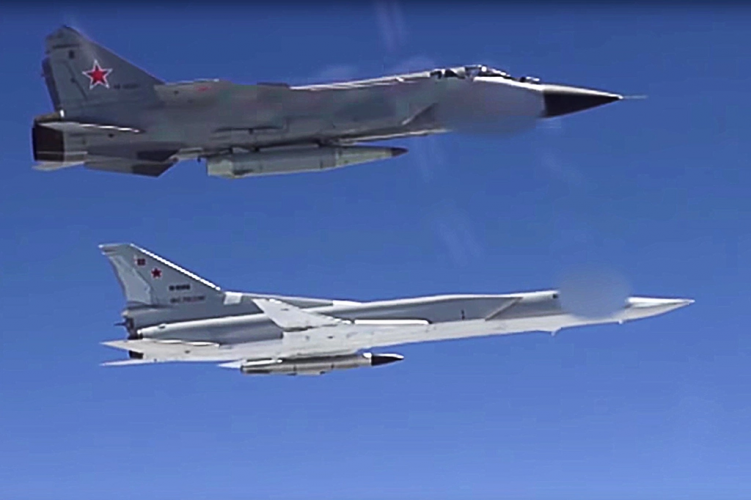
Huh, I never knew the B-1's top speed was Mach 1.2 (according to wikipedia), based on that, it's not that much of an upgrade. Beside that I don't think you need to get a hypothethical hypersonic missile up to Mach 5 - I think it has its own built in booster, so Mach ~3 might suffice. Anyway, most of it is conjecture, but I did find this pic of a Kinzhal (lets not argue about it being really hypersonic, I think we can agree it flies at M5+) mounted on both a MIG-31 and a Tu-22M:
1773496379102.png
As you can see, the booster's more than twice the size on the Tu-22M (whose top speed is M1.8) and the MIG31 (M2.8). So if you're to air-launch a hypersonic weapon, that 1 Mach difference matters a lot. Which kind of supports the conclusion that a hypersonic carrier either has to be able to carry a lot of mass around.

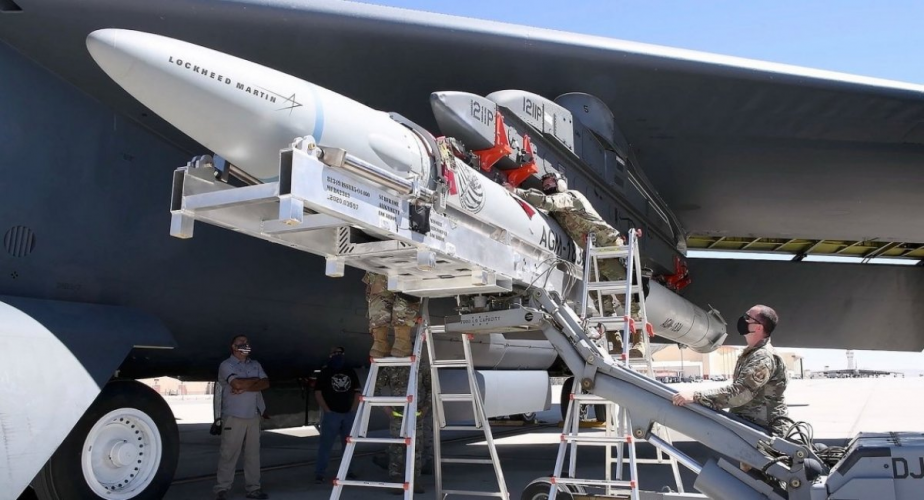
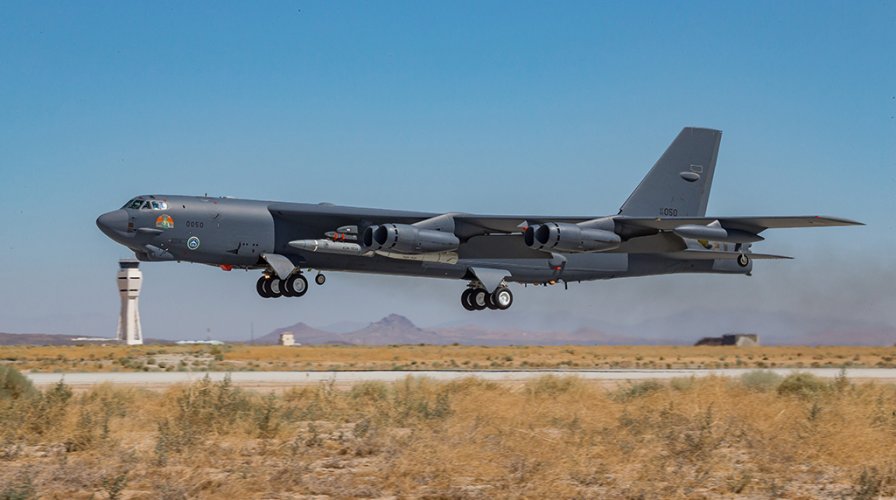
But enough about off topic stuff - lets return to the question - can the B-21 carry hypersonic weapons? The B-21s bomb bay is around ~7m in length, designed to fit stuff like the LRSO and the MOP like the B-2. The US equivalent to the Kinzhal is the AGM-183, which is also around 7m without a booster fitted. There are pics of it both with a booster and without (on the B-52), so I'd guess both are options, and the missile can only reach its max performance with a booster. Other advanced types of hypersonics, such as scramjets, need even longer boost sections (that I've seen pics of), and would likely not be usable in their current iteration on the B-21.
 
I don't think there is a problem with launching Kinzhal at subsonic speeds.
As far as we know, there are at least 50 Kinzhal carriers, and that's all we need.
MiG-31I
Launch conditions: altitude 15,000 m, speed 650 m/s, 2,340 km/h, M=2.2, pitch 44 degrees.
Active section 0 – 52 s, speed at the end of the active section 2,785 m/s, 10,026 km/h, M=9.44
Flight time 483 sec/8.05 min, speed at the time of arrival 1815 m/s, 6534 km/h, M=5.34
Trajectory length 1121 km, flight range 980 km, maximum flight altitude 229 km for 249 seconds
Carrier range without external tanks 1178 km, complex 1178 km + 980 km = 2158 km (no more)
Range of the carrier with external tanks 1568 km, of the complex 1568 km + 980 km = 2548 km (no more)

Su-34M
Launch conditions: altitude 10000 m, speed 265.5 m/s, 956 km/h, M=0.9, pitch 48 degrees.
Active section 0 – 52 seconds, speed at the end of the active section 2332 m/s, 8395 km/h, M=7.9
Flight time 423 seconds/7.05 minutes, speed at the time of arrival 1579 m/s, 5684 km/h, M=4.64
Path length 793 km, flight range 683 km, maximum flight altitude 175 km in 222 seconds.
The carrier's flight range without external tanks is 1178 km, and the complex's flight range is 1354 km + 683 km = 2037 km (maximum).
The carrier's flight range with external tanks is 1615 km, and the complex's flight range is 1615 km + 683 km = 2298 km (maximum).

 
Last edited:
There are pics of it both with a booster and without (on the B-52)
Wait… Can you provide an image with AGM-183 having a booster fitted…? I have never seen that before…

Also, the missile under the Tu-22M is not a Kinzhal, but a KH-22/32 as Forest Green said. Completely different missile.

I am also not sure why you are considering the size of the booster only… The rocket equation holds for the fraction of total fuel mass over total missile mass (of course having more stages is going to reduce the weight of the motor casing once you drop them off). If a booster is only providing a small amount of delta-V, it does not occupy that much space and mass relative to the entire missile in and of itself…
 
Last edited:
Really? The B-2 has neither chaff nor flares? While relying on the reduction of it's radar signature and thermal signature is all nice and dandy paired with proper mission planning, isn't that a bit...risky?
No chaff , no flares. Imagine even a single piece of chaff getting hung up in a door after deployment flapping around, there goes your RCS.
 
Some of you here need to get to know the basics (specs of aircrafts) first rather than start baseless speculation.
I doubt they will put three mk82 bombs in tandem on the rotary launcher. This would require too many attachment points. It makes sense to have 8 mounts on the rear and 8 mounts on the front of the rotary launcher.
By default 500 lb are not mounted to rotary launchers first. They are mounted to WWII esque arrangement & rack structures. This is true for B52, B2. The B1 got some weird half rotary for this but with same arrangement. A decade ago they upgraded its rotary to also accomodate 500 lb for a maximum of 32. I expect the B21 to return to the WWII like tradition as well as a better mor universal rotary system.
Huh, I never knew the B-1's top speed was Mach 1.2 (according to wikipedia), based on that, it's not that much of an upgrade. Beside that I don't think you need to get a hypothethical hypersonic missile up to Mach 5 - I think it has its own built in booster, so Mach ~3 might suffice. Anyway, most of it is conjecture, but I did find this pic of a Kinzhal (lets not argue about it being really hypersonic, I think we can agree it flies at M5+) mounted on both a MIG-31 and a Tu-22M:
Hypersonic is defined as 5+ Mach so no fying at lower speeds. For ramjet to work they need to boost to their operational speed and that costs a lot of fuel for the missile which reduces fuel availabe for sustaining phase. So launching speed is limited to higher speeds.
 
That's a Kh-22/32 on the Tu-22M.

Why the russian Project on Adapting Kinzhal Missiles for Tu-22M3 Bomber Failed​

https://en.defence-ua.com/weapon_an..._missiles_for_tu_22m3_bomber_failed-6490.html
Sorry, just did a bit of searching on Google, and some posts like this were implying this was a Kinzhal and looked similar enough:

https://en.defence-ua.com/weapon_an..._missiles_for_tu_22m3_bomber_failed-6490.html

Wait… Can you provide an image with AGM-183 having a booster fitted…? I have never seen that before…

Also, the missile under the Tu-22M is not a Kinzhal, but a KH-22/32 as Forest Green said. Completely different missile.

I am also not sure why you are considering the size of the booster only… The rocket equation holds for the fraction of total fuel mass over total missile dry mass (of course having more stages is going to reduce the weight of the motor casing once you drop them off). If a booster is only providing a small amount of delta-V, it does not occupy that much space and mass relative to the entire missile in and of itself…

Again I might be wrong but it seems to me that you can add booster 'sections' between the warhead and the exhaust:
https://en.defence-ua.com/industrie..._drown_from_three_previous_failures-2961.html

On the first pic. the missile seems quite long, much longer than the pylon on the B-52. It seems like it had multiple sections fitted.

I don't think there is a problem with launching Kinzhal at subsonic speeds.
As far as we know, there are at least 50 Kinzhal carriers, and that's all we need.
Thanks for pointing it out, but even your reference shows that the finaly velocity differs when the launch platform has a different speed, moreover the difference in the final speed is more or less the same as the difference between the launch speeds, with the MIG 31 doing a bit better because of higher launch altitude, probably because the missile doesn't have to climb as much and enjoys less drag, but the final difference is like 3% (1.3% of which is explained by the difference in speed of sound).

I'm not sure if it's a 'thing' but the Kinzhal could be concievably fitted with a booster and achieve higher speeds when launched from slower aircraft.
 
On the first pic. the missile seems quite long, much longer than the pylon on the B-52. It seems like it had multiple sections fitted
I believe the latter “section” in the image you mentioned is just another AGM-183 missile…
 
Hypersonic is defined as 5+ Mach so no fying at lower speeds. For ramjet to work they need to boost to their operational speed and that costs a lot of fuel for the missile which reduces fuel availabe for sustaining phase. So launching speed is limited to higher speeds.
Forgive me, I meant that the missile's last stage needs a minimum of Mach 3 to work - for traditional rockets, this is meaningless, since rockets mostly only care about delta-V. However I think most people agree, that the 'true' hypersonic weapons are scramjets, and those have a minimum speed to work, but they also come with their own boosters (afaik the Zircon has its intake duct filled with solid propellant, to accelerate the missile from launch to speeds where its scramjet works)
 
I believe the latter “section” in the image you mentioned is just another AGM-183 missile…
Maybe, you are right, however it looks like 1 piece to me.
 

Attachments

  • 1773511566771.png
    1773511566771.png
    1.3 MB · Views: 329
Last edited by a moderator:
I doubt they will put three mk82 bombs in tandem on the rotary launcher. This would require too many attachment points. It makes sense to have 8 mounts on the rear and 8 mounts on the front of the rotary launcher.

I was thinking three SBRA.
 
With regards to hypersonics…I would not be surprised if HACM was ultimately integrated with B-21. AGM-183 is not publicly funded, so if it is in any state of adoption, it has become a black project.
 
By default 500 lb are not mounted to rotary launchers first. They are mounted to WWII esque arrangement & rack structures. This is true for B52, B2. The B1 got some weird half rotary for this but with same arrangement. A decade ago they upgraded its rotary to also accomodate 500 lb for a maximum of 32. I expect the B21 to return to the WWII like tradition as well as a better mor universal rotary system.
No, I highly doubt we will see a WWII style bomb rack developed for carpet bombing using Mk82.

The whole point of creating all of these 6 foot long glide bombs and small cruise missiles is that four of them can fit where a single 2,000lb JDAM is located. The added benefit is everything fits the F-35 and probably the F-47.

This means the rotary launcher will be built for two 2,000lb JDAM in tandem with 30inch spacing between the mounting provisions. The BRU-61 rack has the same 30inch spacing allowing four 6 foot weapons. The rotary launcher would only be removed when the big bunker buster weapon is carried.

6 foot weapons include:
Boeing GBU-39 Small diameter bomb
Raytheon GBU-53 StormBreaker
MBDA SPEAR 3
Leidos AGM-190
Anduril Barracuda

The Mk82 becomes an awkward size. While three bombs can fit in tandem it will require 14 inch mounting spacing at 3 unique locations on the rotary launcher. 3x500lb then takes the place of 2x2000lb or 8x250lb. Very inefficient. I can't see the high end B-21 being used to take advantage of the large stockpile of cheap low end Mk82.

The B-1b could stagger two 500lb bombs per 2,000lb bomb location on the rotary launcher. However this could only be done because each position on the rotary launcher was sized for a 2 foot wide cruise missile. A rotary launcher optimised for 16x 2,000lb JDAM then becomes very unoptimied to fit Mk82 and also JASSM/LRASM.

If the US insisted on having a high end glide bomb halfway between a 2,000lb JDAM and the GBU-39/53 then they would just request a new weapon. Boeing and Raytheon could make the GBU-39/53 with double the width and keep the same height/length. The F-35 could then carry two per bay.
 
The whole point of creating all of these 6 foot long glide bombs and small cruise missiles is that four of them can fit where a single 2,000lb JDAM is located.
The plan for fitting SDBs onto the B-2s called for a maximum of 192 SDBs per aircraft. If four were installed on each station of each rotary launcher, the maximum would be 4*8*2 = 64.
 

Attachments

  • 718290.pdf
    863.5 KB · Views: 17
Search for Smart Bomb Rack Assembly (SBRA) used in the B-2 fleet. You will be surprised.

Indeed. 4 stacks of 5 bombs, with two SBRA per bay in the B-2. I suspect B-21 was designed with a bay that could accommodate three similar racks.

I do not know if the current SBRA can accept JDAM-ER, but I suspect whatever is used in B-21 will. That probably would limit the number carried, perhaps stacks of 4 instead of 5. There is a huge advantage in having the extra stand off distance, not just in avoiding defenses but also in limiting the release events - ideally you would only want to open the bomb bay once and dispense all of the ordnance in one go. The high cruise altitude of B-21 should allow for a big range extension. The other big advantage of mk 82 over SDB is flexibility - things like quickstrike and quicksink become options. I am sure there will be a rack system for SDB as well, or else a system that is adjustable to either weapon. Their is no reason ~100 SDB could not be carried.
 
The plan for fitting SDBs onto the B-2s called for a maximum of 192 SDBs per aircraft. If four were installed on each station of each rotary launcher, the maximum would be 4*8*2 = 64.
The B-2 bomb bay is one of the reasons we see the US standardising weapon sizes. Each B-2 weapon bay is not long enough to fit two 2,000lb JDAM in tandem. This means it can only fit 8 2,000lb JDAM per bay on a rotary launcher giving a maximum of 16 2,000lb bombs. The single B-21 bay is longer and would allow the same 16 bombs in a much smaller bomber.

Swapping between racks and rotary is too time consuming. The rotary launcher allows the most flexibility in missions and rapid reloading time. Sharing racks and loading equipment with the F-35 is a huge advantage. The B-21 bay maximises bomb capacity while allowing a convenient rotary launcher.

Hypothetically if you really want to fit 500lb bombs on a rotary launcher then they could develop custom racks for the rotary launcher to fit 40+ bombs.
 
Really? The B-2 has neither chaff nor flares? While relying on the reduction of it's radar signature and thermal signature is all nice and dandy paired with proper mission planning, isn't that a bit...risky?

Could be a space reserved for a NEMESIS, HEL, or some other form of active missile defense.
 
Swapping between racks and rotary is too time consuming. The rotary launcher allows the most flexibility in missions and rapid reloading time.
I find it really hard to imagine swapping in a new rotary launcher or two new racks with all the bombs on them is more time consuming than putting in the bombs one by one...
 
This means the rotary launcher will be built for two 2,000lb JDAM in tandem with 30inch spacing between the mounting provisions. The BRU-61 rack has the same 30inch spacing allowing four 6 foot weapons. The rotary launcher would only be removed when the big bunker buster weapon is carried.
The rotary launchers use adapters and other racks that offer both 14" and 30" as well as other optional locations. You mount your specific rack to these if needed.
The B-2 bomb bay is one of the reasons we see the US standardising weapon sizes.
What about NATO members happen to design similar "sizes" since the 70's?
Swapping between racks and rotary is too time consuming. The rotary launcher allows the most flexibility in missions and rapid reloading time. Sharing racks and loading equipment with the F-35 is a huge advantage. The B-21 bay maximises bomb capacity while allowing a convenient rotary launcher.

Hypothetically if you really want to fit 500lb bombs on a rotary launcher then they could develop custom racks for the rotary launcher to fit 40+ bombs.
Amusingly, the USAF kept complaining in their report to congress about the B1 needing 24 hours to reload compared to 4-5 or so hours for the B52 as one of the reason they needed the more numerous LRS-B/B21.
Indeed. 4 stacks of 5 bombs, with two SBRA per bay in the B-2. I suspect B-21 was designed with a bay that could accommodate three similar racks.
The SBRA may fit (the bombs need a bit more than 7m) and 60x 575 lb + 5000= 39500 lb would be a bit more than official admitted.

There's another good reason to use WWII style bomb assemblies instead of the rotary structural integrity.
The rotary launcher has to connection to two bulkheads while the bomb assemblies connect and distribute their weight over many airframe bulkheads. This could increase airframe flight hours and perhaps permit higher maneuvering g-loads.
 
Last edited:
The SBRA may fit (the bombs need a bit more than 7m) and 60x 575 lb + 5000= 39500 lb would be a bit more than official admitted.

I was thinking 4x4x3 =48, or 27,600
Is the 5000 the weight of three SBRA?
 
I am sure it would fit with the proper rack system, but giving a stealth bomber a thousand mile range missile seems to be putting a hat on top of a hat. HACM is a lot smaller and lighter; I could see as many as 8 being carried. Probably not an integration priority though; the big advantage of B-21 is the ability to deploy numerous smaller weapons.
 

Similar threads

Back
Top Bottom