North American B-25 development (NA-40, P442, etc.)

Apophenia

ACCESS: Top Secret
Senior Member
Joined
25 July 2007
Messages
4,916
Reaction score
5,537
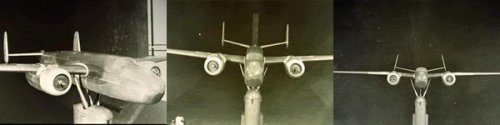
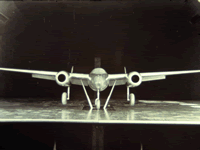
From the University of Washington's Aeronautical Laboratory in Seattle.
http://www.uwal.org/multimedia/historical.htm

Obviously not an unbuilt project exactly but perhaps the final development stages between North American's NA-40B and the NA-62.

The first (1939) shows a NA-62 model with undercarriage down.

The model looks much like the first production B-25s except for the vertical tails. These surfaces have the outline and higher position of the NA-40 tails. Rudder shape is generally like that of the NA-40 but lacks the aerodynamic balance (à la the NA-62).

I include shots of the vertical tails of both the NA-62 (L) and NA-40B (R).

The second series show different approaches to the horizontal tail surfaces (the vertical tails appear to have the same proportions as those on the u/c down model).

On the left (1939), the horizontal surfaces are flat (and the wings are of constant dihedral). In the centre (1940), the horizontal surfaces have dihedral applied. On the right (1940), the horizontal surfaces are dihedraled and the vertical tails are also canted.

On the right, note also that dihedral has been eliminated from the outer wing panels (as per the tenth production B-25).

BTW: all these wind tunnel models models are identified as "Boeing B-25"

Finally comes the "North American Aviation XB-2B [sic] Pressurized Medium Bomber (1940)". Is it me or does this NA-63 have twin tails?
 

Attachments

  • UW-NA62-tail.jpg
    UW-NA62-tail.jpg
    19.1 KB · Views: 867
  • UW-NA62-dihedral.jpg
    UW-NA62-dihedral.jpg
    19.5 KB · Views: 747
  • UW-XB28.gif
    UW-XB28.gif
    12.2 KB · Views: 1,039
"North American Aviation XB-2B [sic] Pressurized Medium Bomber (1940)" should probably read as the XB-28 which fit the decription and photo - IIRC both single and twin tails were considered before settling on a single fin.

Please see:

http://www.nationalmuseum.af.mil/factsheets/factsheet.asp?id=2526
 
Thanks Hoo-2b-2day.

I didn't know that twin-fins were considered for the NA-63/XB-28.
 
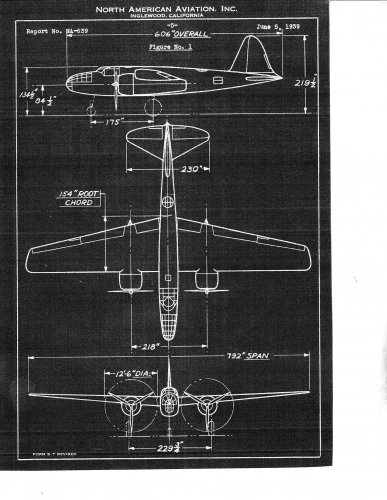
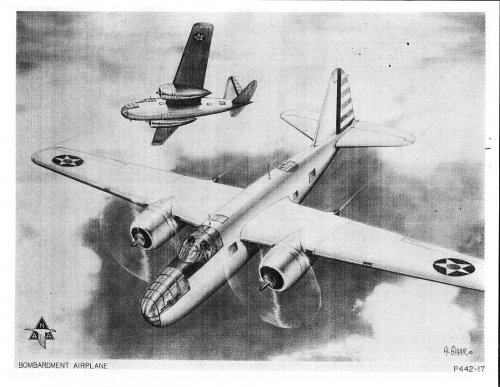
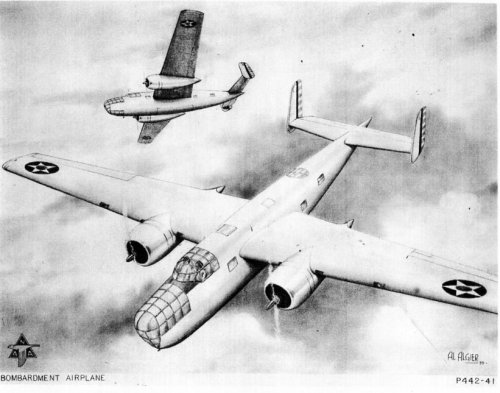
I was cruising through some material in the Kuter papers at AFHRA today and came across North American's response to Air Corps Circular Proposal 39-640 (11 March 1939 w/3 amendments) dated 5 June 1939. The cognoscenti will recognize that proposal as the genesis of the B-25 Mitchell bomber, but NAA's response, Report NA-639, includes some surprises. North American examined multiple variations of what it called P442 (P for Project?) prior to the contract award. The familiar twin-tailed B-25 only first appeared as model P442-41. Wanna see what came earlier? Here's P442-17:
 

Attachments

  • B-25 Pic 1.jpg
    B-25 Pic 1.jpg
    779.1 KB · Views: 931
Odd that NAA went from a single tail to twin-tail in their design, while Martin apparently did the opposite.
 
Smashing, Clioman! But where does the strange "Av'n Project" describer come from? A bit of franglais here?
 
Clioman said:
Ahh...Av'n is a contraction of Aviation. Sorry about that. ;)


Oh... silly me. :-[ I should have thought about that! (instead I got side-tracked by the French "avant-projet" which means "preliminary design"! :-\ ).
Anyway, I've modified your title to make it perfectly clear. ;)
 
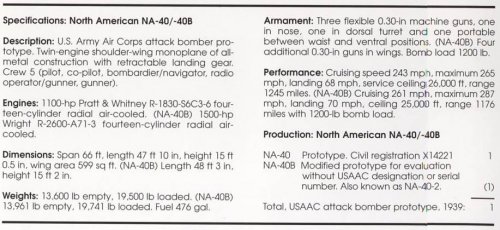
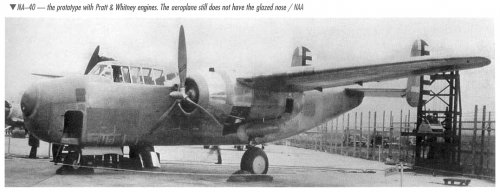
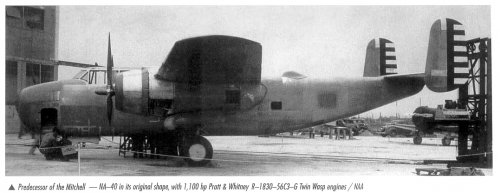
I am unsure how the P442 is related to the NA-40 I found in two books: 'North American Aircraft 1934-1998 - Volume 1' by Norm Avery, Narkiewicz//Thompson 1998, 'B-25 Mitchell' by Jerry Scutts', Crowood 2001. As they present it, it is the ultimate B-25 predecessor that reached hardware status.

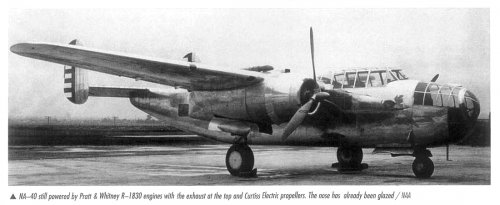
The NA-40 as first flown was powered by two Pratt & Whitney R-1830-S6C3-6 air-cooled radials.
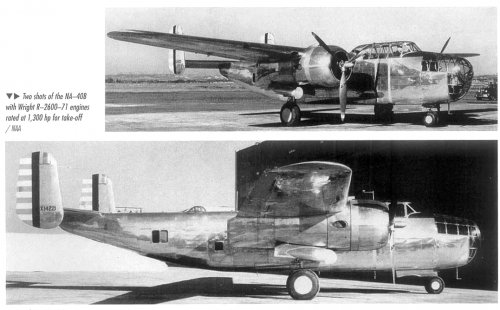
When re-engined with two Wright R-2600-A71-3 air-cooled radials it became the NA-40B.

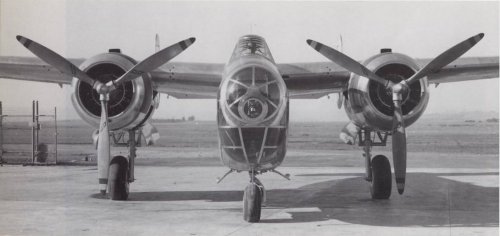
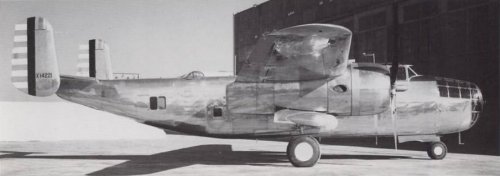
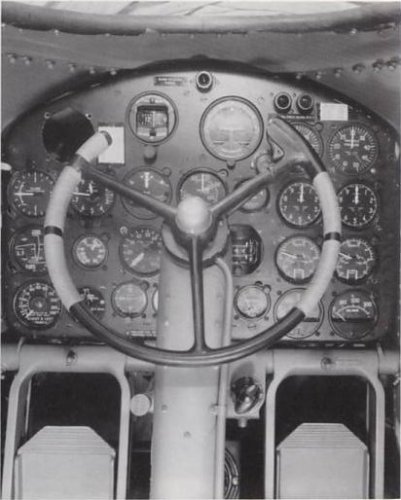
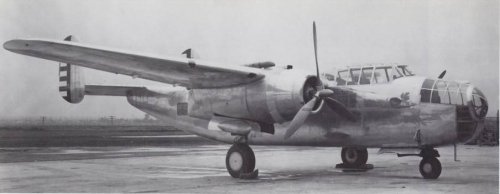
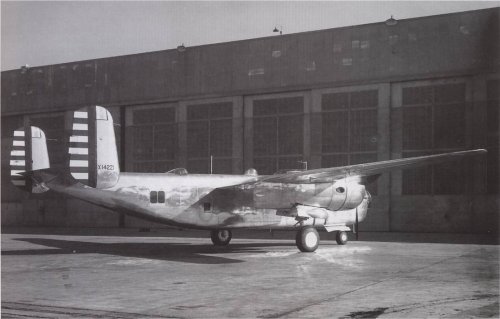
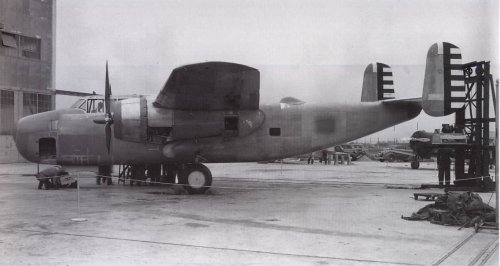
Images NA-40-01 and NA-40-02 are from the book by Jerry Scutts, all the other images and specifications are from Norm Avery's book.
 

Attachments

  • NA-40-specs.jpg
    NA-40-specs.jpg
    107.4 KB · Views: 255
  • NA-40B-02.jpg
    NA-40B-02.jpg
    75.5 KB · Views: 200
  • NA-40B-01.jpg
    NA-40B-01.jpg
    40.6 KB · Views: 194
  • NA-40-04.jpg
    NA-40-04.jpg
    43.3 KB · Views: 198
  • NA-40-03.jpg
    NA-40-03.jpg
    41.1 KB · Views: 202
  • NA-40-02.jpg
    NA-40-02.jpg
    104.4 KB · Views: 200
  • NA-40-01.jpg
    NA-40-01.jpg
    94.8 KB · Views: 523
Topics merged.

Apart from the first image, the other pics you shared are of the modified NA-40B, with the glazed nose. This lone prototype was never actually purchased by the USAAC and retained its civilian registration X14221 until it crashed.

There were several stages in this prototype's development:
  • NA-40: full nose, Pratt & Whitney R-1830 engines
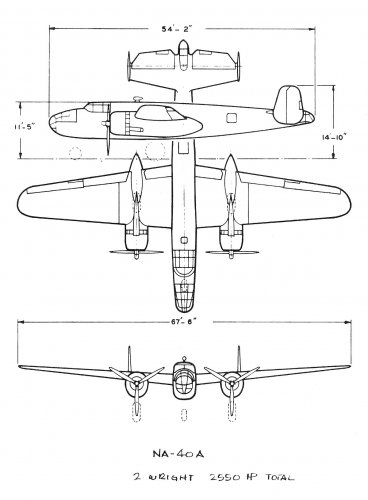
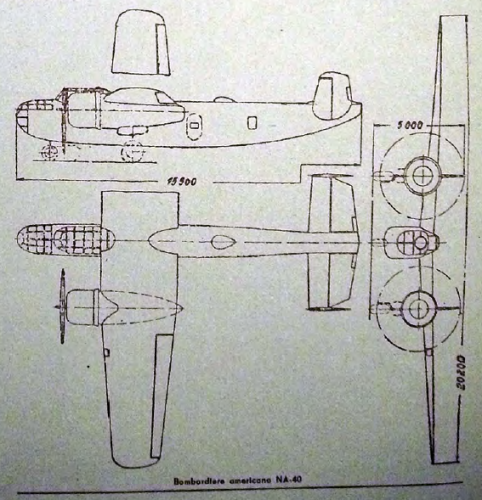
  • NA-40A: glazed nose, Wright R-2600 engines, glazed tail (project, not built)
  • NA-40B: glazed nose, Pratt & Whitney R-1830 engines (modified from NA-40)
  • NA-40B: glazed nose, 1,300 hp Wright R-2600-71 engines (same aircraft, also called NA-40-2)
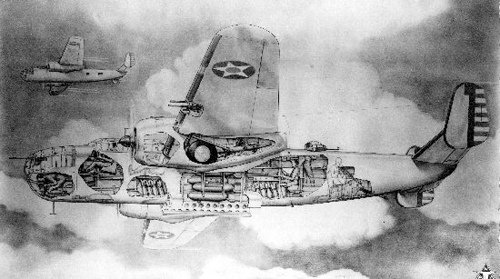
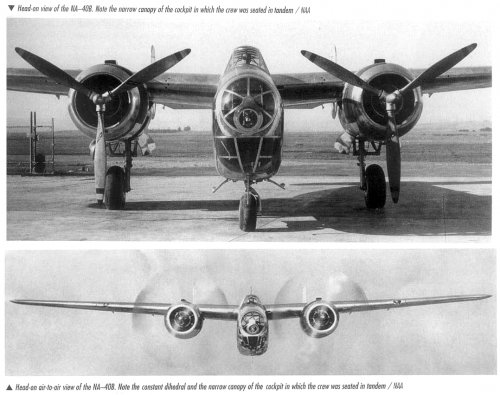
Here are pictures of the prototype in its original NA-40 configuration and in successive NA-40B forms, all from Monografie Lotnicze No. 78, a painting of the NA-40B and a three-view arrangement of the unbuilt NA-40A (source unknown).
 

Attachments

  • NA-40A three-view.jpg
    NA-40A three-view.jpg
    157.6 KB · Views: 303
  • NA-40B artwork.jpg
    NA-40B artwork.jpg
    72.2 KB · Views: 251
  • NA-40B (ML 78) 3.jpg
    NA-40B (ML 78) 3.jpg
    510.4 KB · Views: 189
  • NA-40B (ML 78) 2.jpg
    NA-40B (ML 78) 2.jpg
    213.8 KB · Views: 170
  • NA-40B (ML 78) 1.jpg
    NA-40B (ML 78) 1.jpg
    384.1 KB · Views: 174
  • NA-40 (ML 78) 2.jpg
    NA-40 (ML 78) 2.jpg
    251.9 KB · Views: 173
  • NA-40 (ML 78) 1.jpg
    NA-40 (ML 78) 1.jpg
    254.3 KB · Views: 186
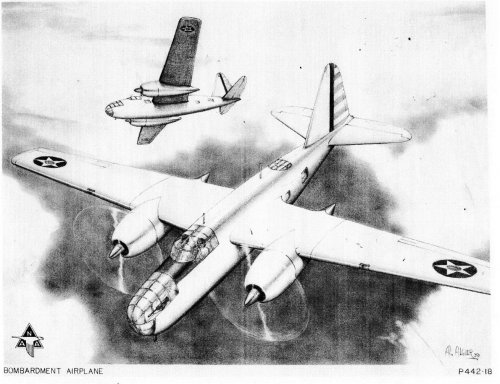
Here are two more images from that proposal. The first one is P442-18...it's followed by something more familiar (P442-41)...
 

Attachments

  • P442-18001.jpg
    P442-18001.jpg
    362.7 KB · Views: 233
  • P442-41004.jpg
    P442-41004.jpg
    138.4 KB · Views: 256
Has nobpdy else noticed that the P442 is a considerably larger aircraft than NA-40/B-25 with wings that scream Northrop-Douglas in layout?
 
Hi,

http://www.avia-it.com/act/biblioteca/periodici/PDF%20Riviste/Ala%20d'Italia/L'ALA%20D'ITALIA%201941%2003.pdf
 

Attachments

  • 2.png
    2.png
    712.2 KB · Views: 573
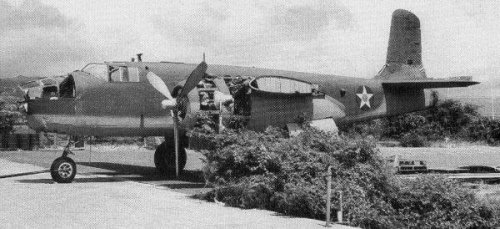
Has someone seen this very strange single-tail modification of the Mitchell, and was this real of a photomontage? (it would be such a poor job of the latter that I'm inclined to think it could be real) I know the planned Super Strafer variant was to have a single-tail, but the markings seem to indicate this is earlier.

Sorry in advance if the question has already been asked and/or answered elsewhere.
 

Attachments

  • 37615314_2031170357100788_2582264364195119104_n.jpg
    37615314_2031170357100788_2582264364195119104_n.jpg
    45.5 KB · Views: 447
Just an educated guess, but I posit that this B-25 was a test mule for a single tail configuration, whether for the Super Strafer or as a mod for the B-25 production line. It is possible that as a test aircraft they wouldn't have bothered to over-paint the "meatball" in the center of the cocarde as the aircraft would never leave the U.S.

AlanG
 
This B-25J "Mitchell" (44-30478) was converted to cosmetically appear as a A-20 Havoc.
Sources:
http://www.warbirdregistry.org/b25registry/b25-4430478.html
http://www.goodall.com.au/warbirds-directory-v6/north-american.pdf
 
fightingirish said:
This B-25J "Mitchell" (44-30478) was converted to cosmetically appear as a A-20 Havoc.
Sources:
http://www.warbirdregistry.org/b25registry/b25-4430478.html
http://www.goodall.com.au/warbirds-directory-v6/north-american.pdf

Thanks a lot, fightingirish!
 
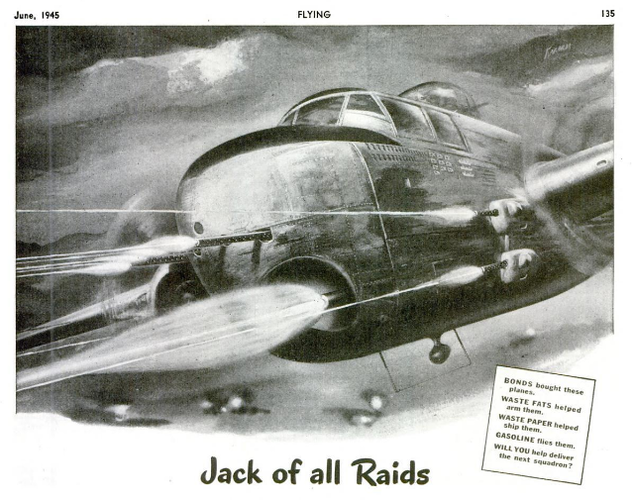
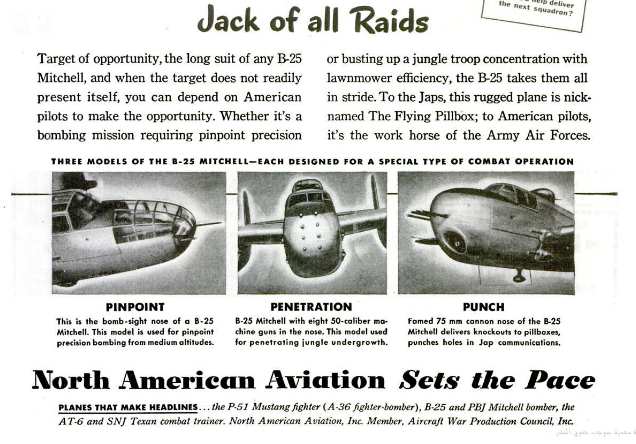
From Flying magazine 1945-6.
 

Attachments

  • 6-1945-6.png
    6-1945-6.png
    547 KB · Views: 208
  • 7-1945-6.png
    7-1945-6.png
    365.8 KB · Views: 180
  • 1.png
    1.png
    351.9 KB · Views: 224
By 1944, NAA had made so many B-25s that the USAAF used them as advanced trainers for bomber crews. B-25s had largely replaced Beechcraft C-45 (civilian D18) as multi-engined trainers.
The RCAF continued using B-25s as pilot-trainers, bombardier-trainers, navigator-trainers and VIP transports until 1962.
Post-war, the USAF used them as trainers, VIP transports, and officers hacks as well.
 
From old site on the Net,

as early as 1937, the US Army Air Corps Materiel Division began preliminary conceptual work on a light, twin-engine Category A bomber—the Attack Bomber—that could eventually replace the single-engine Northrop A-17, then entering service. The new aircraft was expected to deliver higher performance and more powerful armament. In March 1938, the USAAC specified its requirements for the new bomber, issuing Circular Proposal No. 38-385. These specifications called for the aircraft to have a payload of 544 kg (1,110 lb) of bombs, a range of 1,931 km (1,900 mi), and a speed of no less than 322 km/h (200 mph).

Initially, four aircraft manufacturers—Bell, Douglas, Martin, and Stearman—were involved in developing such aircraft designs, submitting their proposals by July 1938. Bell designed the Model 9 with two Allison V-1710 inline engines, two 37 mm cannons in the forward fuselage, and a calculated speed of 410 km/h. Douglas submitted the Model 7B with two Pratt & Whitney R-1830 radial engines. The same engines were also used in Martin's Model 167. Stearman designed the X-100, powered by two Pratt & Whitney XR-2180 radial engines. All bombers were to be twin-engined, of all-metal construction, armed with at least four machine guns in the wings, and equipped with a bomb bay in the fuselage.

The USAAC required the competing companies to build prototypes for testing at their own expense by March 17, 1939. Bell soon withdrew from the competition, and North American Aviation entered in its place. Designed by a team of engineers led by John L. "Lee" Atwood and R.H. Rice, the aircraft, designated NA-40 , was an all-metal, high-wing, cantilever monoplane with twin vertical tails and enclosed cockpits for a crew of up to five (at the time, Category A light bombers typically had a crew of two to four). The aircraft had a trapezoidal, three-piece wing with ailerons and two-piece trailing-edge flaps. It was equipped with retractable tricycle nosewheel landing gear, the nosewheel retracting into a recess under the cockpit, and the mainwheels retracting into recesses in the rear of the engine nacelles. The aircraft featured a heavily glazed front fuselage (the so-called "greenhouse" – initially designed as a sheet metal enclosure), housing a single navigator and bombardier. Both pilots sat in tandem (one behind the other) in a cockpit enclosed by a long glass canopy. This arrangement of seats – instead of side by side – allowed the bomber's fuselage to be significantly narrower and more aerodynamic. The radio operator and gunner were stationed in the rear fuselage. The bomb bay was located in the center of the fuselage.

The aircraft was powered by two 14-cylinder Pratt & Whitney R-1830-S6C3-G "Twin Wasp" radial engines, each developing 1,115 hp, housed in nacelles under the wings. The bomber was to be armed with three movable 7.62 mm machine guns – one in the forward gunner's cabin, one in a rotating gun turret on the rear fuselage dorsal (operated by the gunner), and one inside the rear fuselage, capable of being deployed through sliding windows and firing at the sides or under the fuselage (operated by the radio operator). Additionally, each wing was designed to accommodate two fixed machine guns of the same caliber, but the prototype flew unarmed.

The NA-40 prototype, designated civilian registration NX14221, first flew on January 29, 1939, from Mines Field, a factory airfield, by NAA test pilots Paul Balfour and Frank Lyons. Initial test flights, however, revealed numerous shortcomings with the new aircraft. Specifically, severe vibrations in the tail and engine cylinder overheating were observed. During test flights, a speed of 431 km/h (276 mph) was achieved at an altitude of 1,524 m (5,000 ft) at a takeoff weight of 8,845 kg (18,800 lbs). However, the aircraft was not fully equipped at the time and clearly required more powerful engines. In total, the prototype, in this configuration, flew for 5 hours and 20 minutes over 14 flights. At the end of February 1939, the R-1830 engines were replaced with more powerful 14-cylinder Wright R-2600-A71-3 "Double Cyclone" engines, each developing 1,521 hp (according to [1] and [5] 1,318 hp, according to [6] 1,600 hp), while their cowlings, engine nacelle fairing, carburetor air intakes, and exhaust system were also modified. The modified aircraft was designated NA-40-2 or NA-40B and first flew on 1 March 1939. Paul Balfour was again at the controls. Despite an increased takeoff weight of 9,526 kg, the NA-40B reached a speed of 462 km/h at an altitude of 1,524 m during tests.

On March 12, 1939, the NA-40B prototype flew to the USAAC test facility at Wright Field, Ohio, for military trials. The trials were relatively successful, with only the Curtiss Electric propellers exhibiting some problems (their characteristics didn't quite match those of the engines), and they were scheduled to be replaced with new Hamilton Standard Hydromatics. Unfortunately, on April 11, the aircraft suffered a complete crash when, during takeoff for a test flight, one of the engines suddenly failed, causing the pilot, Major Younger Pitts, to lose control of the aircraft. The crew managed to escape the crashed and burning wreckage before it was completely consumed.

As a result of this incident, the NA-40B lost its chance in the competition, and the first stage of the competition was ultimately passed to Stearman's X-100 and Martin's Model 167. These aircraft later received the military designations XA-21 and XA-22 , respectively. This first competition, however, was inconclusive, and in April 1939, the USAAC issued slightly modified requirements, Circular Proposal No. 39-640. However, on June 30, 1939, the Air Force selected a modified Douglas Model 7B (or DB-7), known by the military designation A-20, as its standard light attack bomber.

Because the NA-40 was not officially ordered by the Army Air Corps, it received neither a military type designation nor a serial number. The project was not further developed in its original form, but North American designers later used the experience gained from its implementation to design the NA-62 bomber. This aircraft was introduced into production and service with the Air Force under the designation B-25 "Mitchell ," becoming the most widely built American twin-engine bomber.

 
From the University of Washington's Aeronautical Laboratory in Seattle.
http://www.uwal.org/multimedia/historical.htm

Obviously not an unbuilt project exactly but perhaps the final development stages between North American's NA-40B and the NA-62.

The first (1939) shows a NA-62 model with undercarriage down.

The model looks much like the first production B-25s except for the vertical tails. These surfaces have the outline and higher position of the NA-40 tails. Rudder shape is generally like that of the NA-40 but lacks the aerodynamic balance (à la the NA-62).

I include shots of the vertical tails of both the NA-62 (L) and NA-40B (R).

The second series show different approaches to the horizontal tail surfaces (the vertical tails appear to have the same proportions as those on the u/c down model).

On the left (1939), the horizontal surfaces are flat (and the wings are of constant dihedral). In the centre (1940), the horizontal surfaces have dihedral applied. On the right (1940), the horizontal surfaces are dihedraled and the vertical tails are also canted.

On the right, note also that dihedral has been eliminated from the outer wing panels (as per the tenth production B-25).

BTW: all these wind tunnel models models are identified as "Boeing B-25"

Finally comes the "North American Aviation XB-2B [sic] Pressurized Medium Bomber (1940)". Is it me or does this NA-63 have twin tails?
All -

Howdy !

I want to ask a few questions, of anyone here that might have knowledge of the answer:

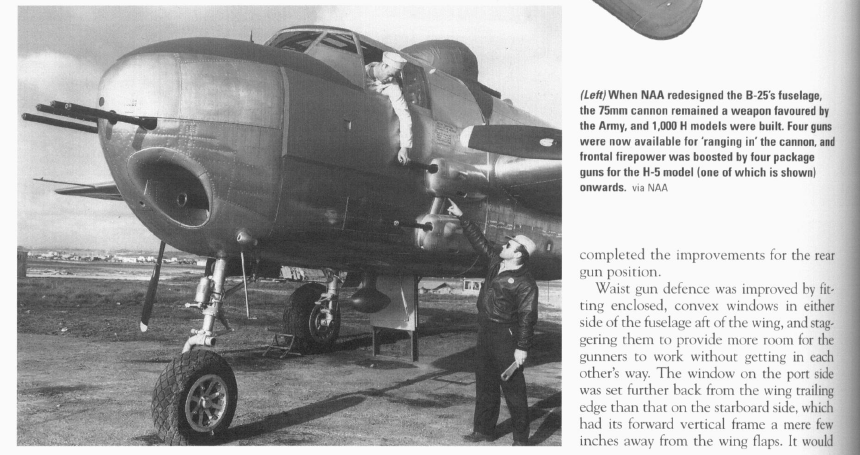
On the B-25 “ J “ model, a 8 .50 caliber “ solid nose “ was a factory-installed optional configuration in-lieu of the standard “ J “ model “ glass nose “. While many of these were installed on a dedicated sub-line @ the factory, the “ 8 gun nose “ configuration was also made available as a “ kit “.

The 8 gun nose “ kit “ was also offered as a “ depot level “ mod, yet could be ordered by B-25 operators; for installation “ in the field “. B-25 maintenance squadrons were replete with mechanics capable of sheet metal work, work on aircraft electrics and hydraulics, and aircraft armorers were also assigned, to name just a few specialities. Therefore, field-level aircraft modification to the factory engineered/supplied solid gun nose configuration certainly was doable.

From what I have read, it appears that factory-produced solid nose “ J “ models principally went to Marine Corps operators in the Pacific theatre; and were included as part of the total PBJ- 1 and -2s operated. It does appear that some Pacific Theatre B-25 operators converted incidental aircraft to the solid gun nose, by installing the “ kit “ in the field themselves; example…. after a glass nosed aircraft had received battle-related damage and a replacement nose was required.

My questions:
Does anyone have knowledge of B-25Js being delivered outright from the factory to
US Army Air Corps operators in the Mediterranean Theatre of Operations ?

Does anyone have knowledge of USAAC METO B-25s having been given a “ solid gun nose “ via field-level installation ?

I have read the histories of the various USAAC B-25 operators, especially those that operated from Corsica and Italy in the 1944-45 time frame ( new B-25Js appearing in the METO from Summer 1944 on ). I have also looked over many pics of B-25s from the various squadrons, to see if any “ 8 gun nose “ B-25s were in evidence.. and saw none.

With all of the interdiction missions B-25s performed in that theatre, it just seems as though an enterprising outfit could have upped their strafing capabilities; if so desired.


With regards,
357Mag
 

Similar threads

Back
Top Bottom