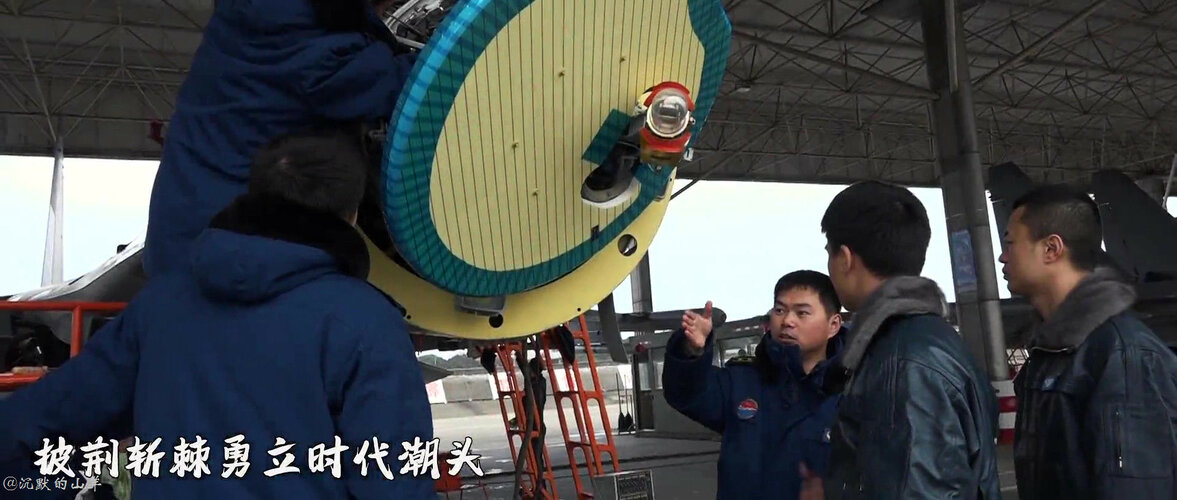
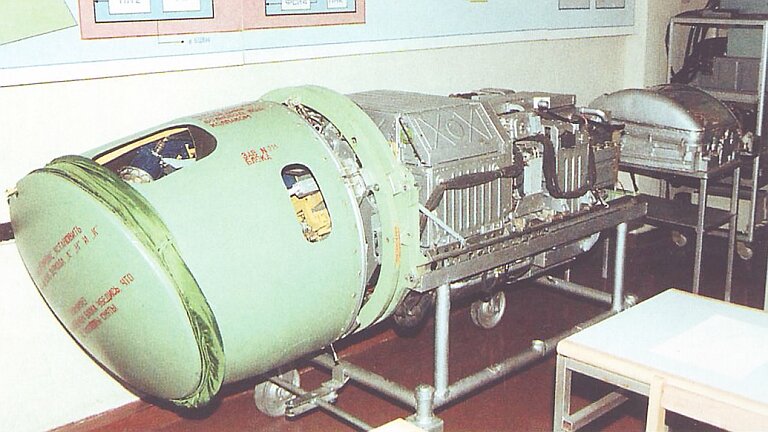
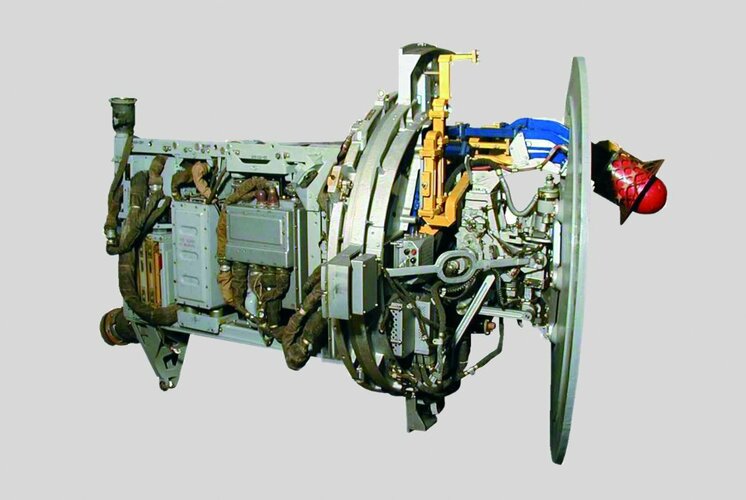
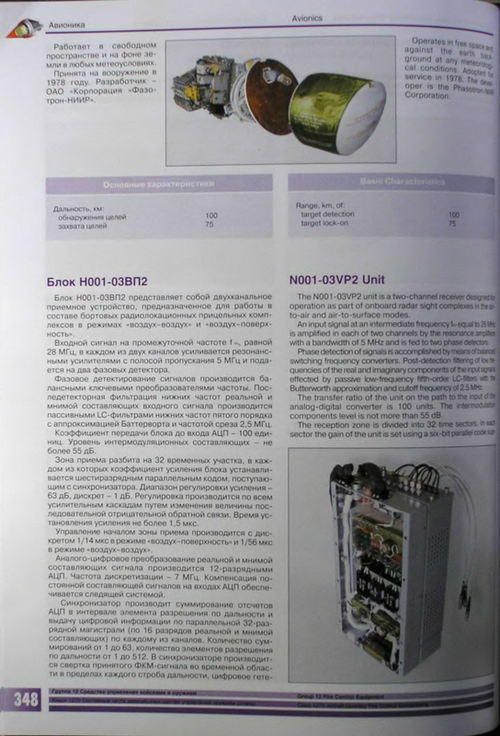
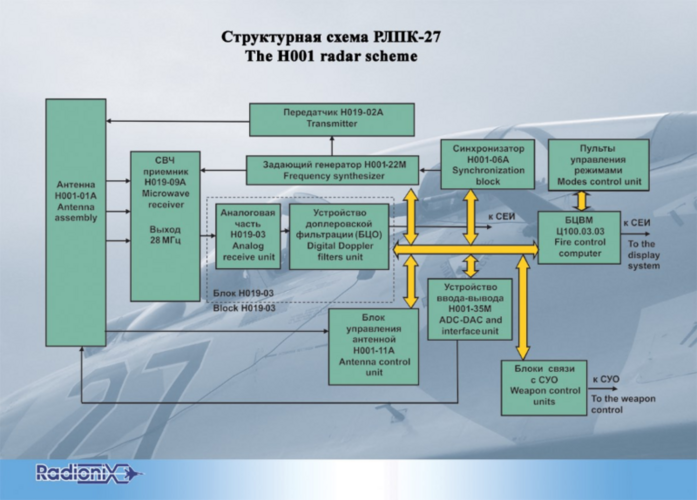
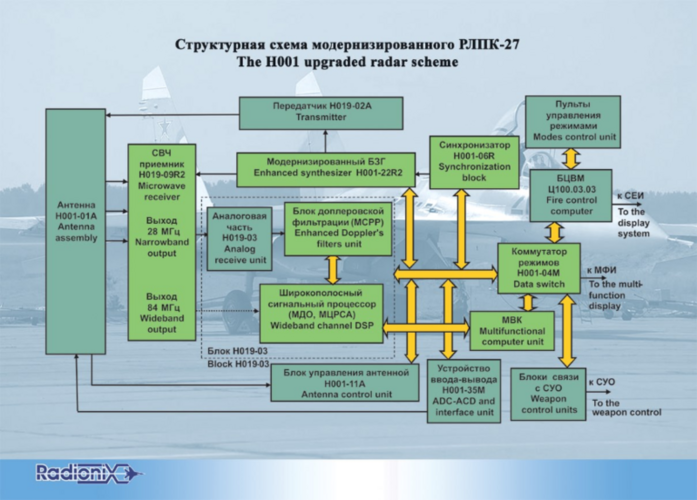
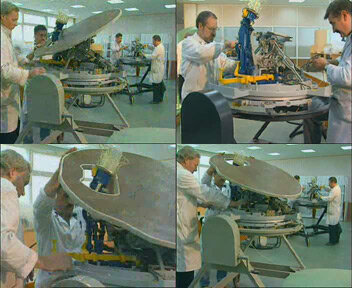
Not sure if it fits here but since it is - at least IMO - the first time I've seen an open PLAAF Su-30 radar, can anyone explain, what we see here?
Is it a protective cover since I thought its radar is still a cassegrain-type or something else?
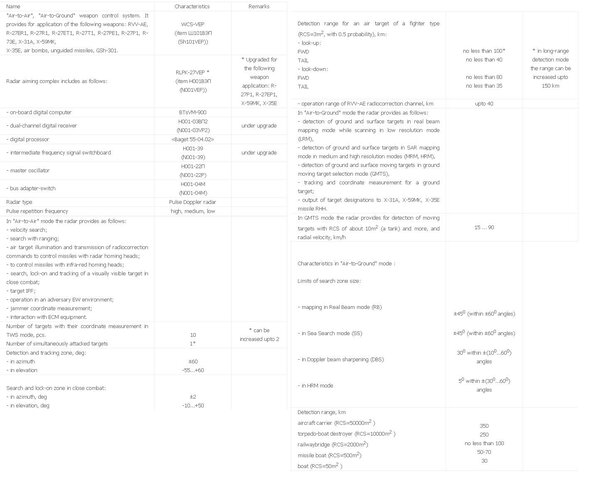
And by the way, I need some help concerning the original N001 Myech radar used by the Chinese original Flankers. Can anyone give an estimate on how reliable and correct these summarised reports are?
And by the way, I need some help concerning the original N001 Myech radar used by the Chinese original Flankers. Can anyone give an estimate on how reliable and correct these summarised reports are?
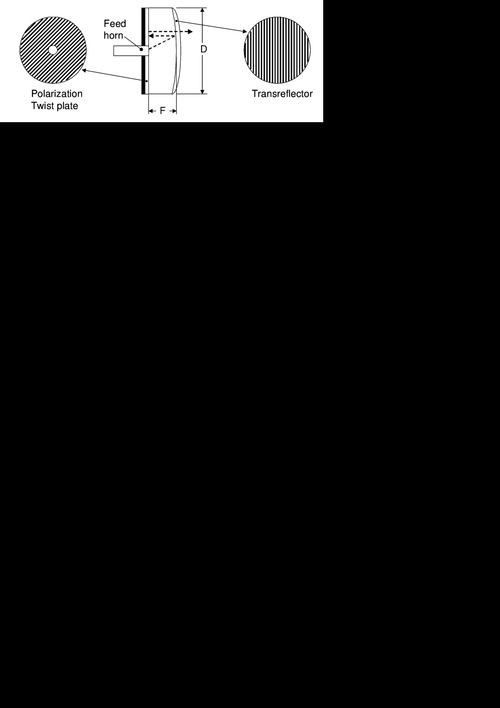
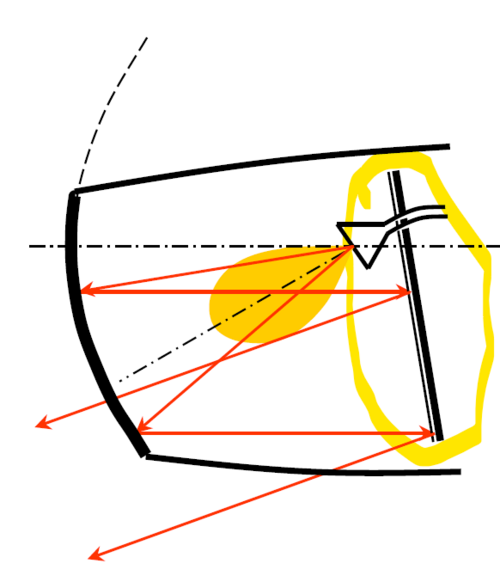
Its missing the "dustbin" part and just has the cassegrain twist reflector (circled in yellow) and feed horn.
The Carlo Kopp articles say almost nothing interesting or useful about the N001 radar, but as a very high level summary its OK I guess?
What exactly do you want to know? I can't believe we don't have a topic for it (though the MiG-29 Avionics topic has some complex technical disussions with some N001 information)
There were contemporary Western reports of Su-27 airframes in storage awaiting radars but I don't think I've read a Russian source to that effect yet. Note that it wasn't unusual for state acceptance trials to complete many years after production commenced - so is it more like IOC or FOC?
So the SU-27 had N001 radar from first deliveries (in 1985). Early models were quite unreliable with a low mean-time-between-faliures, but they were essentially feature complete. The same was true of the AL-31F engine.
i think the limiting factor would be the processor and not the antenna design, from what i can remember the Tornado Fox hunter and some Saab twist-cassegrain designs did have ground attack/mapping modes.
I’m looking for pictures of the radar in production for the Su-27 with a cassegrain antenna. There is a real chaos in hundreds of web sites, publishing wrong photographs of the Phazotron N001 developed for MIG as if they were the Sukhoi 27.
The arrangements and adaptations of electronic radar equipment are completely different, the fuselage adapter, the equipment rack... Other times the Su-30’s radars are being shown as if it were the radar in the nose of the Su-27. A disaster...
But is very dificult only with this, to determine the details of forms for the other side, or for the support and handler of the antenna. Are there other technical drawings, plans or photographs of the certain model? Thank you !!
This probably would worth having another look at the N-001 variants and their performance evolution? This is a confusing subject for the modernized variants, at least for me. I tried having a look on www but nowadays google is absolute trash and you can't find anything. Am i tripping or there is a variant called N-001VP1 possibly used on VKS Su-30M2? I could swear i've read about it somewhere.
Also, i've found a N-001VM variant in connection with Su-27SM3, this from some keypub articles, described as having further enhanced performance. If the V/VE/VEP(?) could do 150km vs fighter size targets, how much does the VM do?
This probably would worth having another look at the N-001 variants and their performance evolution? This is a confusing subject for the modernized variants, at least for me. I tried having a look on www but nowadays google is absolute trash and you can't find anything. Am i tripping or there is a variant called N-001VP1 possibly used on VKS Su-30M2? I could swear i've read about it somewhere.
Also, i've found a N-001VM variant in connection with Su-27SM3, this from some keypub articles, described as having further enhanced performance. If the V/VE/VEP(?) could do 150km vs fighter size targets, how much does the VM do?
24 Su-27SM3 have N001VM ( RLPK-27VM) which can support arming with the new R-77-1. I once found on the site ''library.voenmeh.ru'' that TWT has average power on the HPRF mode of 1.5kW( N001/E/V/VE have 1kW) and that max output pulse power on that working mode is 10kW ( N001/E/V/VE have 8kW). Like N001V/VE ,VM also have PPS-DO combat mode with narrower FoV ( MiG-21 with 3sqm of frontal RCS can be detected from 150km away).
Some sources have info that combat mode AVT ( automatic) with combo of MPRF and HPRF got increased range to 300km but in that mode ,radar can track only one aircraft,with bigger RCS. It's something similar to mode LRS with 160nmi range in US radars AN/APG-63/70 and AN/APG-68.
The N001 radar for the Su-27 was designed by Viktor Grishin. Pushing the state of the art for the USSR, the original design, known as Myech, was supposed to draw heavily on technologies developed for the experimental Soyuz radar program led by NPO Istok. It was intended to have a great deal of commonality with the MiG-29's N019 Rubin radar.
Development was difficult. Originally intended to significantly outperform the AN/APG-63 of the F-15, with a 200km detection range, in reality this goal proved impossible for NIIP to achieve. It was intended to use an all new design antenna, featuring electronic scanning in elevation and mechanical scanning in azimuth. This would give excellent multitarget engagement capability, and use of the MiG-31's R-33 was envisaged. This design proved overly ambitious, and was simply unachievable for a mass production radar given the state of the Soviet electronics industry in the early eighties. In May 1982, it was decided that the NIIP designed digital computer and antenna were simply not up to scratch, nor likely to become so in the near future.
Phazotron's N019 had already reverted back to an improved version of the Sapfir-23ML's twist-cassegrain antenna to replace its problematic flat-plate antenna. It was decided therefore to use major components from the N019 radar, including a scaled-up copy of its twist-cassegrain antenna and the TS100 processor. By March 1983, the redesign was complete, though the resulting radar was nowhere near as good was intended. Instead of 200km, detection range barely reached 140km even against a large bomber.
In 1985 NIIP were ordered to improve its performance. Attention and work had switched to the new N011 radar to equip the Su-27M, and problems with N001 persisted. According to NIIP, initial units had a MTBF of only 5 hours. Though the Su-27 entered service in 1986, its radar was not finally accepted into service until 1991. Eventually MTBF was brought up to 200 hours.
N001 has a 1.075m antenna diameter twist-cassegrain antenna. A pulse-doppler design operating in the 3-cm band utilising medium and high PRFs for optimum lookdown capability, the N001 has a search range of 80-100km against a 3 sq m RCS target in a headon engagement, 140km against a large bomber. It can track a 3 sq m target at 65km. In a pursuit engagement, search range for a 3 sq m target falls to just 40km. Azimuth limits are ±60° . It can also track ECM sources, and feed target data to the Su-27's IRST system.
The average power transmitted is 1kW (same as N019).
MTBF is 100 hours.
A radar datalink is used for updating inertially guided missiles such as the R-27.
The Su-27K used an updated SUV-33 control system, the N001 radar was largely unchanged but with sea optimised lookdown capability and support for the carrier-based GCI system.
A modernised N001 radar developed for retrofitting to in-service Su-27 (analogous to the Phazotron N019M Topaz) can track and engage 2 targets at once using the R-77 missile.
NIIP N001 modernisation package
Stage 1: Provision of ground mapping modes. Existing radar is modified with a bypass channel that allows incoming radar data to be switched to a new all-digital processing system. When a new mode is selected, radar data is sent to the new subsystems, but if an old mode is selected the data is processed as before by the existing radar hardware. Thus all old modes remain unchanged. New air to ground modes added are very similar to those of the Zhuk radar. Only 1 additional air-to-air mode, which gives RVV-AE compatibility. Stage 2: NIIP propose a new lightweight, optically-fed Pero phased array antenna as a drop-in replacement for the existing cassegrain antenna. This will substantially improve air-to-air performance, and increase air-to-ground resolution. New modes will be added at the same time for target identification, velocity search, and to detect hovering helicopters. Suggested that range might reach 300km against a large target.
Upgrade to Stage 2 is expected to cost 35% of the cost of a new radar.
Data from the Su-27SK Flight Manual for the RLPK-27E with the N001E Myech radar.
Дальность действия РЛПК в свободном пространстве и на фоне земли практически одинакова и зависит от высоты полета самолета, полусферы атаки и составляет по истребителям (σ = 3 м2):
а) при полете самолета на больших высотах:
в ЗПС:
при атаке сверху вниз: Добн = 30 – 40 км;
Дзахв = 30 – 35 км;
при атаке снизу вверх: Добн = 50 – 55 км;
Дзахв = 45 – 50 км;
в ППС: Добн = 80 – 100 км, Дзахв = 65 – 80 км;
б) при полете самолета на средних высотах (более 1000 м):
в ППС: Добн = 80 – 100 км, Дзахв = 65 – 80 км;
в ЗПС: Добн = 25 – 35 км, Дзахв = 25 – 30 км;
в) при полете самолета на малых высотах (200 м):
в ППС: Добн = 35 – 40 км, Дзахв = 28 – 32 км;
в ЗПС: Добн = 20 – 25 км, Дзахв = 18 – 20 км;
В режиме ОБЗОР в ППС может наблюдаться пропадание цели в диапазоне дальностей 100 – 70 км на время до пяти циклов обзора (провалы по Д).
РЛПК обеспечивает обнаружение воздушной цели, летящей со скоростью более 210 км/ч в ППС и ЗПС. Цели, летящие с меньшей скоростью (например, вертолет), не обнаруживаются. РЛПК обеспечивает обнаружение и захват движущегося с малой скоростью вертолета при атаке в ППС. Обнаружение и захват висящего вертолета и при атаке в ЗПС не обеспечивается.
Trasl :
The (detection) range of the radar in free space and against the background of the earth is practically the same and depends on the altitude of the aircraft, the hemisphere of attack and is for fighters (σ = 3 m2):
a) when flying at high altitudes:
in the rear hemisphere , when attacking from top to bottom : detection range is 30-40km ,lock-on range is 30-35km.
when attacking from the bottom up: detection range is 50-55km,lock-on range is 45-50km.
in the front hemipshere ,detection range is 80-100km,lock-on range is 65-80km.
b) when flying an aircraft at medium altitudes (more than 1000 m):
in the front hemisphere , detection range is 80-100km,lock-on range is 65-80km.
in the rear hemisphere, detection range is 25-35km, lock-on range is 18-20km.
c) when the aircraft is flying at low altitudes (200 m):
in the front hemisphere,detection range is 35-40km,lock-on range is 28-32 km.
in the rear hemisphere ,detection range is 20-25km,lock-on range is 18-20km.
In the search mode in the front hemisphere , the target may disappear in the range of 100-70 km for up to five search/scan cycles (D gaps).
The radar-based control system (RLPK) detects aerial targets flying at speeds exceeding 210 km/h in the PPS and ZPS. Targets flying at lower speeds (e.g., a helicopter) are not detected. The radar-based control system detects and locks on a slow-moving helicopter during an attack in the PPS. Detection and lock-on of a hovering helicopter is not provided during an attack in the ZPS.
24 Su-27SM3 have N001VM ( RLPK-27VM) which can support arming with the new R-77-1. I once found on the site ''library.voenmeh.ru'' that TWT has average power on the HPRF mode of 1.5kW( N001/E/V/VE have 1kW) and that max output pulse power on that working mode is 10kW ( N001/E/V/VE have 8kW). Like N001V/VE ,VM also have PPS-DO combat mode with narrower FoV ( MiG-21 with 3sqm of frontal RCS can be detected from 150km away).
Some sources have info that combat mode AVT ( automatic) with combo of MPRF and HPRF got increased range to 300km but in that mode ,radar can track only one aircraft,with bigger RCS. It's something similar to mode LRS with 160nmi range in US radars AN/APG-63/70 and AN/APG-68.
That is interesting if so, wonder if that 10kw TWT is of the same type as the one on Irbis, which has 2 x 10kw TWTs, and on the modernized Bars for Su-30SM2 which also has 1x 10kw TWT from Irbis.
In another topic some time back we were discussing soviet russian radar processors, this is from japanese wiki. I'm a bit puzzled by the old Ts101M used of N-001V on presumably the russian Su-27SM, i though there is a much more modern Baget series on the N-001V on VKS Su-27SM?
N001V (RPLK-27V)Improved type. Additional radar operation modes, including air-to-ground and air-to-ship modes, and increased capacity by replacing the signal processor with TS100 to TS101M.
N001VE (PLLK-27VE)Improved for the Su-30MKK. The BCVM-486-6 processor enhances signal processing power to track 10 targets simultaneously, enabling simultaneous combat with two targets and extending the tracking distance to 70km. Other improvements include the addition of navigation modes, expanded the air-to-ground mode, including mapping, and support for R-77.
N001 VEP (RPLK-27VEP)The processor is replaced with a baguette 55-04.02 and the central computer is replaced with the VTsBM-900, respectively, improving the processing power. In addition to extending the detection distance to 150km for fighter jets and 300km for bombers, there are additional radar modes such as , ground mapping, velocity search, and other radar modes, and enhancement of detection capabilities for low-flying targets.
That is interesting if so, wonder if that 10kw TWT is of the same type as the one on Irbis, which has 2 x 10kw TWTs, and on the modernized Bars for Su-30SM2 which also has 1x 10kw TWT from Irbis.
In another topic some time back we were discussing soviet russian radar processors, this is from japanese wiki. I'm a bit puzzled by the old Ts101M used of N-001V on presumably the russian Su-27SM, i though there is a much more modern Baget series on the N-001V on VKS Su-27SM?
N001V (RPLK-27V)Improved type. Additional radar operation modes, including air-to-ground and air-to-ship modes, and increased capacity by replacing the signal processor with TS100 to TS101M.
N001VE (PLLK-27VE)Improved for the Su-30MKK. The BCVM-486-6 processor enhances signal processing power to track 10 targets simultaneously, enabling simultaneous combat with two targets and extending the tracking distance to 70km. Other improvements include the addition of navigation modes, expanded the air-to-ground mode, including mapping, and support for R-77.
N001 VEP (RPLK-27VEP)The processor is replaced with a baguette 55-04.02 and the central computer is replaced with the VTsBM-900, respectively, improving the processing power. In addition to extending the detection distance to 150km for fighter jets and 300km for bombers, there are additional radar modes such as , ground mapping, velocity search, and other radar modes, and enhancement of detection capabilities for low-flying targets.
Not 10kW TWT but 1.5kW TWT ( as average power on the HPRF working mode ) friend. Value of 10kW is the max output pulse power on the HPRF mode . Btw, N035 Irbis has two TWT's, as wrote before ,one the main with 5kW of average power on the HPRF mode and the second one with 2kW. Main TWT has max output pulse power on the HPRF mode of 20kW.
OK but as far as I know ,there is ''average power'' and the ''Peak power'' as max output pulse power. If we write 1kW or 1.5kW or 5kW -TWT , that means the average power of the TWT is 1kW or 1.5kW or even 5kW ( often measured in the HPRF working mode).
''Peak power'' is the maximum pulsed power the radar can emit. We can write that value of 8kW for the old N001/V/VE or 10kW for the modernised N001VM or even 20kW for the N035 Irbis ( of course for the main TWT).
That is interesting if so, wonder if that 10kw TWT is of the same type as the one on Irbis, which has 2 x 10kw TWTs, and on the modernized Bars for Su-30SM2 which also has 1x 10kw TWT from Irbis.
In another topic some time back we were discussing soviet russian radar processors, this is from japanese wiki. I'm a bit puzzled by the old Ts101M used of N-001V on presumably the russian Su-27SM, i though there is a much more modern Baget series on the N-001V on VKS Su-27SM?
N001V (RPLK-27V)Improved type. Additional radar operation modes, including air-to-ground and air-to-ship modes, and increased capacity by replacing the signal processor with TS100 to TS101M.
N001VE (PLLK-27VE)Improved for the Su-30MKK. The BCVM-486-6 processor enhances signal processing power to track 10 targets simultaneously, enabling simultaneous combat with two targets and extending the tracking distance to 70km. Other improvements include the addition of navigation modes, expanded the air-to-ground mode, including mapping, and support for R-77.
N001 VEP (RPLK-27VEP)The processor is replaced with a baguette 55-04.02 and the central computer is replaced with the VTsBM-900, respectively, improving the processing power. In addition to extending the detection distance to 150km for fighter jets and 300km for bombers, there are additional radar modes such as , ground mapping, velocity search, and other radar modes, and enhancement of detection capabilities for low-flying targets.
I suspect with the processors it’s a mistake and they roughly correspond with the Fulcrum equivalent.
N019m and N001VE use TS100M and have the same exact upgrade (R77 TWS)
n019M1 and N001VEP use baguette and gain air to ground modes but are otherwise the same unless LRS is wanted. If the SM is for air defense it might not be needed.
I suspect with the processors it’s a mistake and they roughly correspond with the Fulcrum equivalent.
N019m and N001VE use TS100M and have the same exact upgrade (R77 TWS)
n019M1 and N001VEP use baguette and gain air to ground modes but are otherwise the same unless LRS is wanted. If the SM is for air defense it might not be needed.
Yes ,old N019M 'Topaz' in the MiG-29S ( from 1992) and N001V 'Myech' in the Su-27SM ( after 2000) have the same BTsVM ,Ts101M. Those radars and WCS enabled use of the old R-77 ,not newer R-77-1.
N019M1 Topaz in the MiG-29SM has in fact Ts400 from the N010 Zhuk .
This is the appropriate topic. For the 'overscan' , mentioned Ukr. source for the max output pulse power of N001: 7,8kW in fact in the HPRF/MPRF working mode.
This site uses cookies to help personalise content, tailor your experience and to keep you logged in if you register.
By continuing to use this site, you are consenting to our use of cookies.