Next-gen turboprop (ATR-72/Q400/C295M/C-27J replacement): Feasible? Good idea?

H_K

ACCESS: Top Secret
Joined
21 February 2010
Messages
1,949
Reaction score
5,878
There has been very little innovation in the turboprop market in decades, despite over 2,000+ turboprops built by the 3 market leaders (Airbus/Leonardo/DeHavilland) over the last 40 years... in the 20-to-30 tonne class alone. This number doesn't even include some of the smaller niches, under 20 tonnes (e.g. ATR-42, Saab 340) or the small production runs in China, Russia etc.

Aircraft / First flight / Maximum take-off weight / # Built / Backlog
ATR-72
1988 / 23 tonnes / 1,240+ built / 100+ in backlog
Q400 1998 / 30.5 tonnes / 630+ built / 0 in backlog (awaiting production restart)
C295M 1997 / 23 tonnes / 238 built / 70+ in backlog
C-27J 1999 / 32.5 tonnes / 117 built / 4 in backlog

--> So what kind of new turboprop could Airbus/Leonardo build if they finally decided to replace their aging ATR-72 / C295 / C-27Js?

Would they build only a civilian turboprop? Only a military tactical transport (EU FMTC project)? Or could they build a single common platform to serve both military and civilian needs? (similar to Antonov's AN148/158/178 family?) We know Embraer's own project is on hold, and China's MA700 is dead in the water due to the lack of a suitable domestic engine.
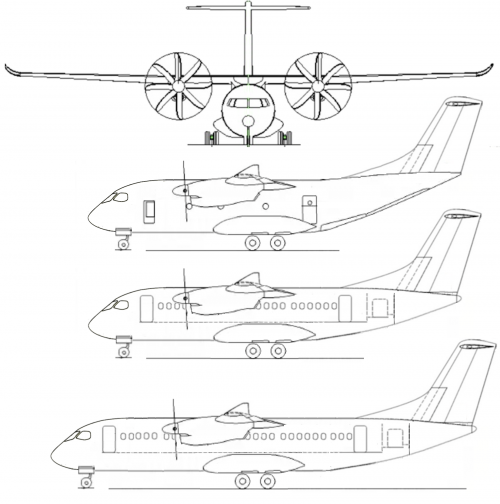
 
I've been noodling with a ~30 tonne Airbus/Leonardo/ATR turboprop family that would come in multiple variants in order to meet both civilian and military needs. Think of it as a stretched C-27J with new wing, cleaned up aerodynamics, and major weight savings from composites.

This is inspired by Leonardo's own TP90 studies and the military FMTC requirement:
https://www.secretprojects.co.uk/threads/atr-92.21374/
https://www.secretprojects.co.uk/threads/future-mid-size-tactical-cargo-fmtc.39696/

The key would be to ensure maximum commonality across at least 3 variants:

1) Military variant (30-32t MTOW): 12-14t payload, e.g. 50 troops, 5 pallets, or 1 light vehicle (~10t)​
2) Short Civil variant (~26t MTOW): 70-78 passengers​
3) Long Civil variant (~30t): 90-103 passengers​

For example, common elements could include the nose section, wing, engines (4,000-5,000 shp), avionics, tail and ancillary equipment. The cross section could be similar to the C-27J, allowing 5 abreast seating in civilian configuration. There would be 2 fuselage lengths, the military and short civil variant both being ~2m longer than a C-27J, while the long civil variant would include a 3.5m stretch to add 20-25 pax (4-5 extra rows). Both civilian variants would otherwise share the same fuselage. The military variant would obviously have a different fuselage, a reinforced landing gear and probably some other structural reinforcements. Finally, the short civil variant's wing would probably be shortened (as on the ATR 42) to save weight.

Here's a sketch of what this would look like.

Top: Military variant / Middle: 70-78 pax civil variant / Bottom: 90-103 pax civil variant
FCTM TP70 TP90 50px=1m.png
 
Last edited:
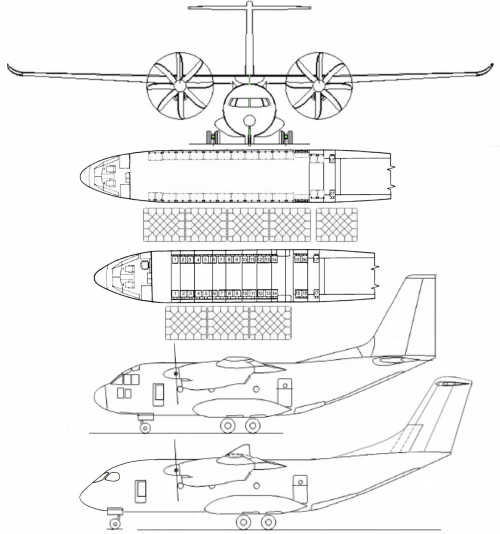
To illustrate the military version's capabilities, here's a more direct comparison to the C-27J, which I used as a starting point. Note the cleaned up aerodynamics (nose, landing gear sponson, tail), new wing, and slightly lengthened fuselage (+2m) to allow for 1 extra pallet. The ramp has also been modified to carry a 5th pallet.

Next Gen Tactical Transport vs C-27J
+30% increase in volumetric capacity (8.6m -> 11m cabin length)​
+47% increase in passenger capacity (34 -> 50 troops)​
+66% increase in logistics capacity (3 -> 5 pallets, including 1 on the ramp)​

I'm assuming take-off weights would be similar, but the new aircraft would benefit from lower fuel consumption and structural weight savings (~10-15% i.e. ~2 tonnes lighter), which would increase max payload from 11.5t to 12-14t (overload for vehicle transport), with 9-10t being a more typical logistics load when carrying 50 troops or 5 pallets (or a mix).

FCTM vs C-27J 50px=1m v4.png
 
Last edited:
Very interesting design considerations. A couple of considerations of areas that you might find differences. Your military version will need very robust landing gear that allow the aircraft to operate away from runways in austere environments. This might also call for more robust structure to handle the landing velocities and shocks from less improved landing surfaces. Flap system for the aircraft ought be no less than what is available now on the C-27J. It appears you are already considering aerodynamics as a part of the effort. Improved range is always a plus for both civil and military transport aircraft.

Curious why turboprop vs turbofan? Efficiency?

Looking forward to watching this thread.
 
Your military version will need very robust landing gear that allow the aircraft to operate away from runways in austere environments. This might also call for more robust structure to handle the landing velocities and shocks from less improved landing surfaces.

Curious why turboprop vs turbofan? Efficiency?
Turboprops are always better than turbofans for rough/short field operations. They produce more thrust at low speeds, so shorter takeoff runs, there are fewer concerns about foreign object damage etc. Plus props are more fuel efficient, especially outside of optimal high altitude cruise parameters (e.g. flying low & slow or loitering).

That said I don't necessarily envision this aircraft being designed for totally unprepared surfaces. I was picturing the same runway capability as a Casa C295, i.e. the ability to use typical civilian dirt or grass strips. Not necessarily making hard tactical landings plonking the nose gear down first for example.
 

Similar threads

Back
Top Bottom