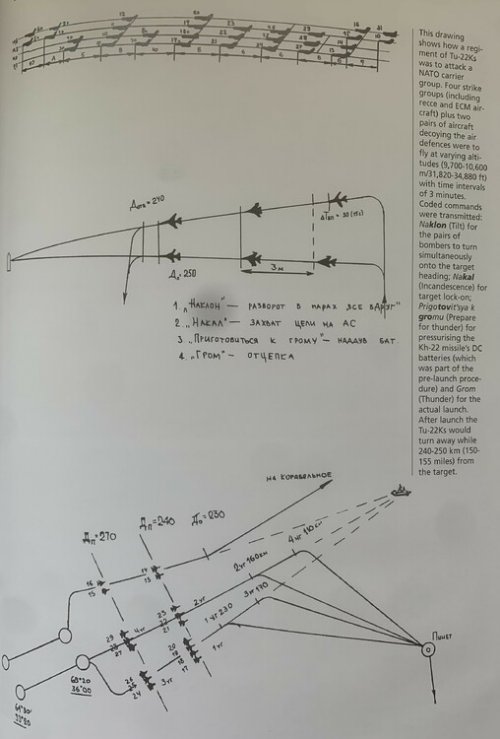
I fear I've been misunderstood. The speculation is that if the Soviet surface fleet had been in a position to come out and play in 1953, NATO would have to face up to the threat 20 years earlier.

I've always thought the MA-1 rocket powered pod was screaming out to be made into a big anti-ship missile.
"One of the prime considerations in the development
of Weapon System 138A was that of operational
flexibility. The configuration, as proposed, can be
used either as a two-stage or as a single stage missile
system, depending upon the momentary operational
requirement. The propulsion stages have been sized
in such a manner that the first stage can be used
alone to provide excellent performance. The nose
cone is interchangeable and can be assembled either
to the second stage or directly to the first stage.
Through use of this modular concept, a range of 861
n. miles can be obtained with one stage from the B-58
with a Mach 2.2 launch at 60,000 feet.

...

The missile system, as proposed by Convair, will
meet the performance requirements specified for the
design launch conditions in the GSR. For this condition
(Mach .73 launch at 40,000 feet) the missile in the
two-stage configuration has a range of 1,068 n. miles,
and for supersonic launch from the B-58 (Mach 2.2
launch at 60,000 feet), it has a range of 1,365 n. miles."
 
"One of the prime considerations in the development
of Weapon System 138A was that of operational
flexibility. The configuration, as proposed, can be
used either as a two-stage or as a single stage missile
system, depending upon the momentary operational
requirement. The propulsion stages have been sized
in such a manner that the first stage can be used
alone to provide excellent performance. The nose
cone is interchangeable and can be assembled either
to the second stage or directly to the first stage.
Through use of this modular concept, a range of 861
n. miles can be obtained with one stage from the B-58
with a Mach 2.2 launch at 60,000 feet.

...

The missile system, as proposed by Convair, will
meet the performance requirements specified for the
design launch conditions in the GSR. For this condition
(Mach .73 launch at 40,000 feet) the missile in the
two-stage configuration has a range of 1,068 n. miles,
and for supersonic launch from the B-58 (Mach 2.2
launch at 60,000 feet), it has a range of 1,365 n. miles."
Not sure what that has to do with my post, but OK... yes, you could in principle put a manoeuvring warhead on a Skybolt, R-27K style. I'd be surprised if it was available for service before the mid-1970s, though.
 
Just a word on the effects of shaped charges/EFPs in sophisticated AShM warheads; presumably the making of a small hole through the steel plate the ship is made out of isn't the aim, it wouldn't make much of a leak. IIUC the EFP generates immense heat, so that any compartment it enters will generate immense overpressure (like when you see a tank with its turret blown off) and blow out watertight doors as well has create a flash-over fire. By the sounds of it the blast-frag opens a big hole and the EFPs create all sorts of damage and fires in a much larger area of the ship than the blast-frag could reach.
 
Not sure what that has to do with my post, but OK... yes, you could in principle put a manoeuvring warhead on a Skybolt, R-27K style. I'd be surprised if it was available for service before the mid-1970s, though.
Flew successfully in 1963 and back then they didn't take 20 years to enter service. As for your MA-1 though. . .

1749510363882.png

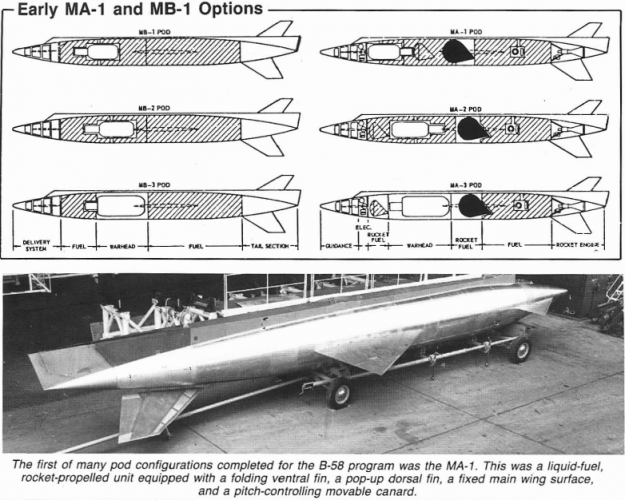
MA-1 C-This was one of the 4 original pod configurations
studied for the B-58 and it was known initially as
the controlled bomb pod. It was to be a rocket-propelled
version of the MB-1, permitting the B-58 standoff launch
capability. Expected range of the 27,108 lb. unit was
approximately 160 miles. For the three warheads studied
for the pod, maximum altitude during the flight to target
was expected to be up to 108,000: at a speed of Mach
4. A Sperry guidance system was to control the pod during
its flight to target. Before launching, the guidance
system determined the pod's present position and
computed the desired heading. After launching, it controlled
the operation of the pod's 15,000 lb. tho JP-4 and RFNA
(red fuming nitric acid) fueled Bell Aerospace LR81-BA-l
rocket engine. It also ordered the pitch angle for the climb
and glide and dive angles to the target.
Total powered flight time was 65 seconds. The pod was
designed to climb at a 20° angle, glide at 7°, and dive
to the target at 70°. Throughout the flight the guidance
system corrected the heading to keep the pod on course.
The control system commanded the pod's maneuvers
and provided stability.
 
Good. How about salvaging all the dollars and work done on Vought Regulus I and II, turning them into monster antiship missiles ? they would pack some colossal punch. As a bonus, Regulus I submarines are already in service, while the II was coming soon when they canned it.
Those take ~20-30 minutes to set up for launch, and it's so big it's a single shot.


Going a step further: remember when B-52G got Harpoons in the 1980's ? how about getting a (broadly) similar capability in the 1960's with a Hound Dog ? once again, the missile is enormous - and blistering fast.

Going another step further: in the 1950's the US military developed a ton of guided cruise missiles : a whole exotic zoo of them. I have the list somewhere: Rascal, Matador, Mace, Snark, Navaho, Regulus I & II, Hound Dog... all of them ended squeezed between Minuteman and Polaris. Would be nice to "recycle" all those babies into the antiship role.
Hound Dog would make a decent AShM. Mach 2+, 1700lb warhead (whether nuclear or conventional)

Problem is that it's so big even a B-52 can only haul 2 of them. Means you need an entire Bomber squadron to get a good volley to swamp the defenses.

My vote would be an Air-launched Talos, or an enlarged version like Vandal. Something Talos-sized, B-52s could carry 12, maybe 16-20 if they could fit into the bomb bay.
 
I suspect that the USSR also thought of the cunning strategy of 'use better explosives', to be fair!
I'm never sure if reported warhead weights are TNT equivalent or in actual explosive weights.


Though that gets into action-reaction fallacy. The response to your opponent having big warheads on their AShMs isn't to put bigger warheads on yours. It's having better ways of stopping them.
Exactly.


You put big warheads on because you want to sink big ships.
And until the Soviet Fleet comes out to play, there's no major push for heavy AShMs.

Instead, the US is looking at small AShMs to blast all those missile-armed FACs.


The supersonic anti-ship missile studied as part of the Perseus Advanced Cruise Missile program makes an interesting comparison to P-700. Comparable range, comparable speed, warhead less than half the size (316 kg vs. 750 kg), rather more than half the weight. It's pretty obvious from the numbers that the US didn't have any tricks that the USSR didn't.
Exactly. An American P-700 is going to be as big as the Soviet P-700. Big warhead is big, fuel for long supersonic range is big.

The only size advantage would be the electronics, which at AShM scales is a rather trivial part of the overall missile size.
 
How bout proliferating Polaris with anti ship mode...
USSR actually tried this, with R-27 submarine-launched ballistic missile. The modified R-27K was equipped with a specially-designed upper stage, capable of active exoatmospheric maneuvering. It received targeting data from "Legenda" sattelite system, and was equipped with passive radar system for terminal homing (well, actually pre-terminal; it could not maneuver in atmosphere. The atmospheric guidance stage was proposed, but dropped due to extreme complexity). The idea was, that it would be able to attack carrier groups from about 1000 km range, hitting them with 650-kt warhead.

The system was installed on K-102 submarine (Project 629, used as test vessel for weapon development), 10 out of 11 test launches were deemed sucsessfull - including one, when the target raft was actually hit by incoming warhead. But it was not accepted into service, since long-range supersonic cruise missiles were viewed as more efficient solution. A major problem was, that R-29K could be used only with nuclear warheads, and by mid-1970s no one thought it would be a good idea anymore.

A new anti-ship ballistic - the R-33, based on R-29 - was developed by 1980s. It have a range of about 1800 km. It was, again, not accepted, since nuclear arm limitation treaties limited the number of ballistic missiles, deployed on submarines; the anti-ship ballistics, therefore, could be deployed only in place of some strategic missiles, and Soviet leadership considered this unacceptable.
 
Wait, so that is why Soviet doctrine prioritized supersonic AShMs over subsonics?

Not exactly. Initially, push for supersonic speed was viewed as efficient method to penetrate air defenses. Most long-range and medium-range SAM's of 1960s were relatively slow-firing, and most dedk fighters could not reliably engage something as small as cruise missile in anything but tail-chase. So salvo of supersonic missiles could evade the fighters (they simply would not have time to swing around, accelerate, chase the missile and shoot it down) and break through SAM defense perimeter before SAM's would be able to shoot them all down.

Speaking generally, supersonic speed left defenders with much less time to act, allowed far less defense measures to be undertaken and complicated defense targeting - since any mistake led to greater miss. The great penetrating capability was only an icing on cake.
Speed also simplifies targeting issues - the faster the missile, the less certain your target track needs to be for the missile to get in seeker range before the target simply moves out of the way. And the Soviets were never able to consistently lick the targeting issue.
 
Speed also simplifies targeting issues - the faster the missile, the less certain your target track needs to be for the missile to get in seeker range before the target simply moves out of the way. And the Soviets were never able to consistently lick the targeting issue.

The Soviets big problem was the power of their targets, so much so that they really couldn't approach to within 300 so miles without being obliterated. They had to generally stay out of CAG range (~500miles), then hopefully sneak in at speed, launch and then get away. It's a tough ask.
 
The Soviets big problem was the power of their targets, so much so that they really couldn't approach to within 300 so miles without being obliterated. They had to generally stay out of CAG range (~500miles), then hopefully sneak in at speed, launch and then get away. It's a tough ask.
Well, the late 1950- early 1960s Soviet naval strategy was mainly defensive, based on the idea of "keeping USN carriers out of strike range against Soviet homeland". So the whole idea was, essentially, that USN carrier groups would be trying to break through Soviet defense perimeter, making themselves vulnerable for combined naval-air operations. The general idea always was to disable the carrier through either Maritime Missile-Carrying Aviation attack, or missile-armed submarine strike. Then the missile-armed warships (project 56E and Project 57 destroyers, Project 58 cruisers) were supposed to dealt with remaining heavy ships with over-the-horizin missile strikes. And then the gun & torpedo armed old cruisers and destroyers would close in for mopping the surviving escorts.

P.S. The ships were supposed to be provided with fighter cover from coastal airbases. All main Soviet fleets have fighters regiments, with pilots trained for oversea operations. Large ships, like cruisers, were all equipped with command posts & communication equipment to direct interceptors and avoid "friendly fire" situations. So normally, the airspace over Soviet flotilias would be covered by at least some fighters. In 1960s, the naval fighter regiments were subordinated to PVO Strany (territory air defense), but still were supposed to provide Navy with air cover, when required.
 
Last edited:
USSR actually tried this, with R-27 submarine-launched ballistic missile. The modified R-27K was equipped with a specially-designed upper stage, capable of active exoatmospheric maneuvering. It received targeting data from "Legenda" sattelite system, and was equipped with passive radar system for terminal homing (well, actually pre-terminal; it could not maneuver in atmosphere. The atmospheric guidance stage was proposed, but dropped due to extreme complexity). The idea was, that it would be able to attack carrier groups from about 1000 km range, hitting them with 650-kt warhead.

The system was installed on K-102 submarine (Project 629, used as test vessel for weapon development), 10 out of 11 test launches were deemed sucsessfull - including one, when the target raft was actually hit by incoming warhead. But it was not accepted into service, since long-range supersonic cruise missiles were viewed as more efficient solution. A major problem was, that R-29K could be used only with nuclear warheads, and by mid-1970s no one thought it would be a good idea anymore.

A new anti-ship ballistic - the R-33, based on R-29 - was developed by 1980s. It have a range of about 1800 km. It was, again, not accepted, since nuclear arm limitation treaties limited the number of ballistic missiles, deployed on submarines; the anti-ship ballistics, therefore, could be deployed only in place of some strategic missiles, and Soviet leadership considered this unacceptable.
That's amazing !
And now the chinese have pulled out that trick, with the DF-21D ...
https://en.wikipedia.org/wiki/DF-21#DF-21Dhttps://en.wikipedia.org/wiki/Anti-ship_ballistic_missile#Operators
 
USSR actually tried this, with R-27 submarine-launched ballistic missile. The modified R-27K was equipped with a specially-designed upper stage, capable of active exoatmospheric maneuvering. It received targeting data from "Legenda" sattelite system, and was equipped with passive radar system for terminal homing (well, actually pre-terminal; it could not maneuver in atmosphere. The atmospheric guidance stage was proposed, but dropped due to extreme complexity). The idea was, that it would be able to attack carrier groups from about 1000 km range, hitting them with 650-kt warhead.
https://en.wikipedia.org/wiki/Legenda_(satellite_system)
Ah, ok I see. The nuclear radarsats (one of them the infamous Kosmos 954, but that's another story).
 
IIUC at least in the 70s and 80s Tu142s would fly from Murmansk to Angola, and back the next day or so, in order to survey the Atlantic Ocean for NATO ships. Add this to their satellites, spy trawlers and activities of their Navy and this is how they figured out where the USN carriers were so the AVMF and Subs could attack them in wartime.
 
Flew successfully in 1963 and back then they didn't take 20 years to enter service.
It didn't have the active terminal homing needed to actually hit a ship. Even with megaton-class warheads, aiming at the point where the ship was won't sink it.
As for your MA-1 though. . .
Interestingly enough, going back to the details in this post, the MA-1 pod with a W27 warhead is very similar in weight, range, and warhead size to a Kh-22. Physically a lot larger, as it has the empty tankage for the B-58 outward leg, but once again showing that the US and USSR tended to come up with similar sized missiles for similar requirements.
I'm never sure if reported warhead weights are TNT equivalent or in actual explosive weights.
I suspect it's the full warhead, including the fragmentation case and any other cunning tricks that the designers have built in.
A new anti-ship ballistic - the R-33, based on R-29 - was developed by 1980s. It have a range of about 1800 km. It was, again, not accepted, since nuclear arm limitation treaties limited the number of ballistic missiles, deployed on submarines; the anti-ship ballistics, therefore, could be deployed only in place of some strategic missiles, and Soviet leadership considered this unacceptable.
I didn't know there'd been a follow-on to the R-27K, that's very interesting information! Presumably it would have been carried in Project 667B-based submarines?
 
Well... actually it would be "Medium Soviet Missile" territory. Our heavy stuff usually have warheads about 1500-2000 lb, HE/shaped charge ones.

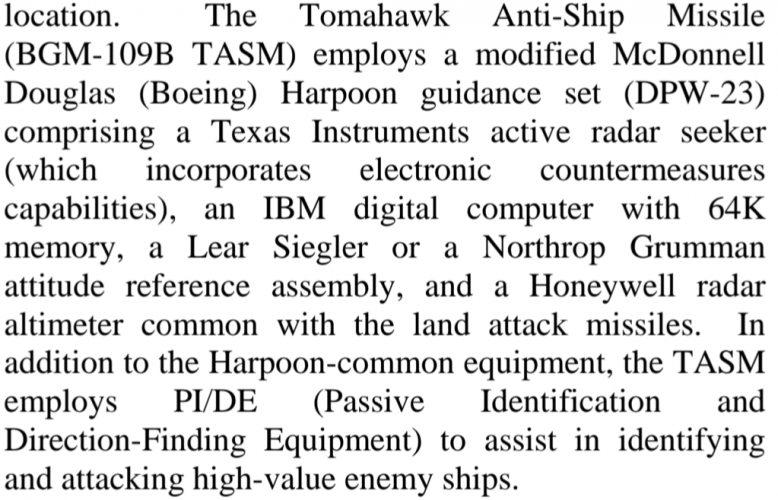
But I agree, the TASM was an elegant idea. Its main problem was, that it was... well, it was dumb. It could not perform any complex attack pattern, it have no datalink capability, not even friend-or-foe indentifier, and its only way of penetrating air defense was to fly really low. It can't perform any terminal evasion maneuvers, and did not have any self-defense measures (even simple chaffs weren't installed). Basically, it was "Harpoon on steroids".
According to Forecast International, it possibly had a defensive jammer (could be a typo for electronic counter countermeasures), plus a passive seeker capable of identifying individual Soviet surface combatants by their radar emissions (the latter claim is also repeated by Friedman, although hardwired for a specific radar set, either in Network Centric Warfare, or Seapower and Space, I can't remember which one).

1000011084.png

It should be pointed that TASM had one additional way of penetrating air defences, it was meant to be launched on the basis of information gathered entirely by ELINT, mostly White Cloud satellites, so Soviet naval formations would not necessarily know that they were being tracked and targeted, and that the first warning of a TASM attack would be the emissions from the seekers for the TASMs in their terminal phase.

Conversely, US formations would be aware of Soviet attempts to find them with Bear-Ds and US-A satellites with active radars.
 
Last edited:
According to Forecast International, it possibly had a defensive jammer (could be a typo for electronic counter countermeasures), plus a passive seeker capable of identifying individual Soviet surface combatants by their radar emissions (the latter claim is also repeated by Friedman, although hardwired for a specific radar set, either in Network Centric Warfare, or Seapower and Space, I can't remember which one).
It probably meant counter-countermeasure capabilities of the seeker; i.e. the ability to discriminate decoys and jamming. The passive identification capability looks perfectly realistic, though. Must admit, I never head about such TASM capability before, but it make total sence.

so Soviet naval formations would not necessarily know that they were being tracked and targeted, and that the first warning of a TASM attack would be the emissions from the seekers for the TASMs in their terminal phase.
Problem is, that TASM did not have midcourse guidance. Since it was subsonic, and long-distance flight would took a lot of time, it could not rely on target being at predicted point. That's why it have pre-programmed search pattern. So the first warning would likely be the emission of TASM seeker searching for target - sufficient warning to warm-up Osa-M and AK-630.

The PI/DE capability, of course, change things to TASM favor - but only if high-value target isn't under EMCON.
 
Problem is, that TASM did not have midcourse guidance. Since it was subsonic, and long-distance flight would took a lot of time, it could not rely on target being at predicted point. That's why it have pre-programmed search pattern.
The entire reason why the US invested so much in White Cloud, hull-to-emitter correlation and BRIGAND (can't remember the full meaning of the acronym, but it involved the identification of non-emitting ships in a formation by using bistatic reflections of surface search radars and SATCOM sidelobes IIRC) was to avoid having to use the TASMs search pattern in the first place. The USN knew that a TASM used in such a manner would reveal it's position, and warns the Soviets and likely leas to it being shot down, hence why they tried to extrapolate tracks and gather as much intelligence passively. It was highly risky, placing civilian shipping at risk, didn't guarantee that the right Soviet ships would be hit, or even that any Soviet ships would be hit at all, but it was what the US intended to do in the 1980s.
 
The entire reason why the US invested so much in White Cloud, hull-to-emitter correlation and BRIGAND (can't remember the full meaning of the acronym, but it involved the identification of non-emitting ships in a formation by using bistatic reflections of surface search radars and SATCOM sidelobes IIRC) was to avoid having to use the TASMs search pattern in the first place. The USN knew that a TASM used in such a manner would reveal it's position, and warns the Soviets and likely leas to it being shot down, hence why they tried to extrapolate tracks and gather as much intelligence passively. It was highly risky, placing civilian shipping at risk, didn't guarantee that the right Soviet ships would be hit, or even that any Soviet ships would be hit at all, but it was what the US intended to do in the 1980s.
Frankly, just installing the mid-course command guidance on TASM would be simpler solution. IMHO.
 
It didn't have the active terminal homing needed to actually hit a ship. Even with megaton-class warheads, aiming at the point where the ship was won't sink it.
Of course. The question is if such a seeker could have been developed at the time. Passive radar (ARM / HOJ) should have been relatively simple. (Relatively.) As for an active seeker, BOMARC had a seeker small enough. The YF-12A was performing look-down/shoot down shots in the early 60s. Maybe they could have got something working.
 
Frankly, just installing the mid-course command guidance on TASM would be simpler solution. IMHO.
I don't believe that you could make a satcom system small enough at the time.

Else you'd need to have a plane within LOS of the missile strike to relay.


I suspect it's the full warhead, including the fragmentation case and any other cunning tricks that the designers have built in.
Probably. Which at least for Talos meant almost twice the weight of the explosives inside.

Then again, one of the old 16" HE shells only had like 150lbs of boom inside, despite weighing 1900lbs overall.
 
Yep, it was designed to fit into R-29 launch tubes without modernization.
Combat system update to allow targeting, and you're off to the races. Pop up from under the ice somewhere within 1,800km of the Norwegian Sea and make a US Admiral's day a whole lot worse.
Frankly, just installing the mid-course command guidance on TASM would be simpler solution. IMHO.
The US (and NATO in general) seems to have been heavily bought into the idea that weapon systems should have the minimum of dependence on offboard input. There were certainly plenty of Western authors talking about how midcourse guidance was terrible because if you destroyed the platform providing guidance the whole strike would fall apart.
Then again, one of the old 16" HE shells only had like 150lbs of boom inside, despite weighing 1900lbs overall.
Yeah, charge/weight ratios on artillery shells of any persuasion are pretty poor, and for AP shells even more so. On the other hand, when you can't do trickery with shaped charges, that means you get big fragments which penetrate well.
 
The US (and NATO in general) seems to have been heavily bought into the idea that weapon systems should have the minimum of dependence on offboard input. There were certainly plenty of Western authors talking about how midcourse guidance was terrible because if you destroyed the platform providing guidance the whole strike would fall apart.

I have recollections that offboard input opened a vulnerability to ECM as well.
 
The US (and NATO in general) seems to have been heavily bought into the idea that weapon systems should have the minimum of dependence on offboard input. There were certainly plenty of Western authors talking about how midcourse guidance was terrible because if you destroyed the platform providing guidance the whole strike would fall apart.

The Exocet strikes in the Falklands had the Super Etendards a) flying very low b) popping up to lock their Anemone radars on a ship target c) pass the data to the Exocet d) fire and e) get back to low level and run away like a bat outta hell.

Bottom line: once fed with target data and fired, the Exocet would be on its own: inertial guidance for cruise before terminal active radar homing.
 
The Exocet strikes in the Falklands had the Super Etendards a) flying very low b) popping up to lock their Anemone radars on a ship target c) pass the data to the Exocet d) fire and e) get back to low level and run away like a bat outta hell.

Bottom line: once fed with target data and fired, the Exocet would be on its own: inertial guidance for cruise before terminal active radar homing.

True, but that takes advantage of an aircraft's ability to increase it's radar horizon to much more than a ship by gaining altitude, and has a man in the loop until the point of firing.
 
Last edited:
Hound Dog would make a decent AShM. Mach 2+, 1700lb warhead (whether nuclear or conventional)
Had a couple of realisations.

First, just as the MA-1 with a W27 warhead is a pretty good match for the Kh-22, the Hound Dog is actually pretty comparable to a K-10S. I've no idea how you persuade one into the belly of a B-47, but if you could then you've got something interesting that compares with the Tu-16K-10 / K-10S system.

Second, B-58s flying unrefuelled from Newfoundland can reach the GIUK gap. From Iceland, they can cover the entire Barents Sea. Which would make things rather interesting if one were a Soviet admiral trying to get a carrier group to sea.

Thirdly, the headline figures for the P-5 and Regulus I are actually pretty similar. If some submarine veteran had shown up in the right meetings and repeatedly asked 'and how quickly can I dive again?' until everyone else got the message, a more practical weapon system could be imagined. And that opens the door to anti-ship versions. Interestingly, Regulus I actually could receive mid-course guidance, albeit in a pretty primitive form.

Getting something to shoot them at is a bit more of a problem. But not insoluble. Firstly, the Soviet Navy had plans in 1944-1946 for a blue water fleet including 6 to 9 fleet carriers. Get the politics right, and those go ahead. Then you have the prospect of having to fight for air superiority, therefore more fighters on the carriers at the expense of attack aircraft. In that case, SSMs start to look appealing as a primary strike weapon.
 
Had a couple of realisations.

First, just as the MA-1 with a W27 warhead is a pretty good match for the Kh-22, the Hound Dog is actually pretty comparable to a K-10S. I've no idea how you persuade one into the belly of a B-47, but if you could then you've got something interesting that compares with the Tu-16K-10 / K-10S system.
Needed a better version of this:

Data for GAM-63A:

Length9.74 m (31 ft 11.5 in)
Wingspan5.09 m (16 ft 8.3 in)
Diameter1.22 m (4 ft)
Weight6120 kg (13500 lb)
SpeedMach 1.6
Range160 km (100 miles)
PropulsionBell XLR67-BA-1 liquid-fueled rocket; 53.3 kN (12000 lb)
WarheadW-27 thermonuclear (2 MT)

151106-F-DW547-005.jpg
 
First, just as the MA-1 with a W27 warhead is a pretty good match for the Kh-22, the Hound Dog is actually pretty comparable to a K-10S. I've no idea how you persuade one into the belly of a B-47, but if you could then you've got something interesting that compares with the Tu-16K-10 / K-10S system.
I think you'd need to do something equivalent to the Lancaster "Tall Boy" modification to stuff a Hound Dog into a B-47.

Or, make two inner wing pylons between the engines and fuselage and carry 2 of the beasts. They're technically within a B-47's bombload, Hound Dogs area little over 10,000lbs each and the B-47 could carry 25,000lbs of bombs.


Second, B-58s flying unrefuelled from Newfoundland can reach the GIUK gap. From Iceland, they can cover the entire Barents Sea. Which would make things rather interesting if one were a Soviet admiral trying to get a carrier group to sea.
Oh, eww, that would suck for a Soviet admiral!

Just gotta convince the Chair Force flyboys that planting nukes on ships is just as vital as nukes on cities.


Thirdly, the headline figures for the P-5 and Regulus I are actually pretty similar. If some submarine veteran had shown up in the right meetings and repeatedly asked 'and how quickly can I dive again?' until everyone else got the message, a more practical weapon system could be imagined. And that opens the door to anti-ship versions. Interestingly, Regulus I actually could receive mid-course guidance, albeit in a pretty primitive form.
The problem with Regulus was setup time.

If it was more like the Talos, in that it got assembled and checked out to be ready for launch inside the ship and then rolled onto the launcher to go within seconds of going on the launcher, Regulus would have been a viable surface ship weapon.

It still would not be a viable submarine-launched weapon, because any submarine big enough to carry Regulus would be a pig and slow to submerge. The development of SUBROC and Polaris would have fixed the launched from submerged problem.

Frankly, if SUBROC had a better range it would have made a passable nuclear-only AShM. As-is, it was 55km and pure ballistic flight path with no seeking. But 25kt says "We don't need no steenking seeking".
 
I think you'd need to do something equivalent to the Lancaster "Tall Boy" modification to stuff a Hound Dog into a B-47.
Either that or a shorter, fatter Hound Dog, but I think ground clearance might be an issue.
Just gotta convince the Chair Force flyboys that planting nukes on ships is just as vital as nukes on cities.
Nah, give them to the Navy. A B-58 would look really good in Navy white over blue. Get in quick enough and you can call them PB5Ys.
The problem with Regulus was setup time.
Yup, which is why you need a submariner in the room insisting that they need to be on the surface for less than five minutes if they're firing one. That's short enough that you can stick up a mast, satisfy yourself there's no MPAs about, and be confident you'll be gone before one shows up to ruin the game.

That means it's got to be a sealed round in a zero-length launcher, no setup required – not a miniature aircraft that requires assembly and checkout before launch. Launching submerged would be even better of course. But don't let the perfect be the enemy of the good enough. That can come in the second generation weapon.
 
Ha ! I told you all those big cruise missiles of the 1950's could reddem themselves as anti-ship missiles. As for B-47s, I think RASCAL more or less max out that bomber.
https://en.wikipedia.org/wiki/GAM-63_RASCAL
SpecificationsRascal
Mass18,200 lb (8,255 kg)
Length31 ft 11.5 in (9.74 m)
Diameter4 ft (1.22 m)
Wingspan16 ft 8.3 in (5.09 m)

Neat thing with B-47s : B-47B and B-47E were produced in much larger numbers than the entire Tu-16 family. Retiring the B-47 fleet from SAC service in 1965 was a colossal operation: by July 1966 Davis Monthan AFB boneyard had a thousand of them - that were almost immediately melted into aluminum bricks.

SpecificationsHound Dog
Mass10,147 pounds (4,603 kg)
Length42 feet 6 inches (12.95 m)
Height9 feet 4 inches (2.84 m)
Diameter28 inches (710 mm)
Wingspan12 feet 2 inches (3.71 m)

Hey, how about this : Rascal was bigger and heavier than Hound Dog. How about Regulus I ?

SpecificationsRegulus I
Mass13,685 pounds (6,207 kg)
Length32 feet 2 inches (9.80 m)
Diameter4 feet 8.5 inches (1.435 m)
Wingspan21 feet (6.4 m) extended
9 feet 10.5 inches (3.010 m) folded
 
Last edited:
Hello,
I'm a little late, but so glad folks are talking about this. My own interest in naval history sort of started with a "why does Russia have scarier-looking ship" question.


Worth bearing in mind that Harpoon wasn't even an anti-ship missile at first - it was intended to be used against surfaced submarines. One can get away with quite an unsophisticated weapon for that role.
Came across a relevant footnote from this paper. Would be interested if anyone can explain this seeker business further. The whole article seems fascinating but a little factually dubious.
Harpoon is subsonic and has a very complex
and effective active radar seeker, an ideal
combination against surfaced submarines. a
french contemporary missile, the aero-
spatiale AM-39 exocet, intended to hit the
surface combatants, has opposite, and deadly,
features—supersonic speed and a relatively
simple seeker.


But it was not accepted into service, since long-range supersonic cruise missiles were viewed as more efficient solution. A major problem was, that R-29K could be used only with nuclear warheads, and by mid-1970s no one thought it would be a good idea anymore.
I suppose then that there was an assumption that in case of nukes, enough would always make it through the defenses regardless of delivery method? Still, reading about Soviet antiship saturation tactics gives a sense that they were at the edge of feasibility. An astonishing feat!
IMG_3976.thumb.jpeg.4b590646b88e51d815e726dba089ede5.jpeg
 
I suppose then that there was an assumption that in case of nukes, enough would always make it through the defenses regardless of delivery method? Still, reading about Soviet antiship saturation tactics gives a sense that they were at the edge of feasibility. An astonishing feat!
Partially; on practice, nuclear-tipped missiles represented only a part of Soviet submarines/cruisers armament.
 
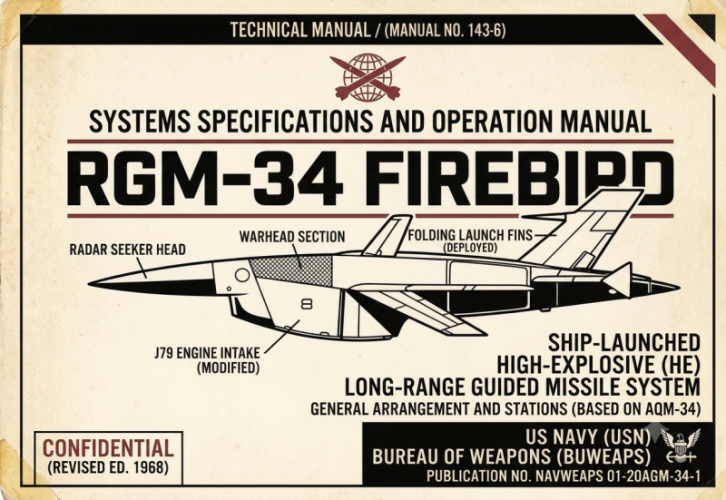
Oh, by the way, recently I made an arcticle about AU RGM-34 Firebird missile in my blog. On Russian, so use auto-transalate, please.

* RGM-34 Firebird missile - the derivative of Ryan Firebee BQM-34A target drone, equipped with active radar seeker and 500-pdr HE warhead. It was developed as ship-launched weapon, mainly to arm destroyers and frigates, and basically serve as counter to Soviet P-15 Termit missile.


1943475_800.png
 
Partially; on practice, nuclear-tipped missiles represented only a part of Soviet submarines/cruisers armament.
Plus they were more of suppression/disabling weapons rather than another warhead type.
I.e. thrown somewhere around there (+- several km) without a seeker, INS only.

This is not to say that several hundred kt will is not a killer... but overall normal killers were still heavy theater ASCMs. The baseline target for Soviet ASCM is a US supercarrier (with full understanding that something like an Iowa-class battleship can be in the scope), and they were intended to sink, not disable.
Finally, US defensive screens by default had CAPs, giving massive advantage to supersonic solutions (harder to ensure midcourse correction for the Soviet side, much harder to engage with aircraft weapons - for the American side).

All in all, Soviet theater ASCMs played the same conceptual role that the long lances did in WW2. Just the "night battle" section replaced with coordinated theater-level fires.

NATO/US didn't really have to contend with many heavy Soviet targets, and had enough airpower to brute-force/overpower a few (half a dozen) units, which did require heavier weapons.
 
Last edited:
Plus they were more of suppression/disabling weapons rather than another warhead type.
I.e. thrown somewhere around there (+- several km), often without a seeker, INS only.
Most of Soviet nuclear-tipped ASM have seekers. The inertial guidance was simply too inaccurate against fast moving target even with nuclear warhead.
 
Most of Soviet nuclear-tipped ASM have seekers. The inertial guidance was simply too inaccurate against fast moving target even with nuclear warhead.
Kh-22 certainly didn't. I am not sure about others...

My understanding is that their speed and really heavy(500...1000kt) warheads were to ensure blast will achieve necessary effects regardless. Not necessarily sinking, but certainly disabling all radars for good.
 
The Kh-22 Burya have specific model - Kh-22PSI - with opinertial guidance only, but it was intended for attacks against stationary land targets, not against ships.
It's exactly an anti-ship variant. What land target can you hit with a CEP of 10km? Cities of course, but this isn't primary target of concern for this weapon.
On the other hand, you certainly can do disabling damage to a ship formation. A missile with a flight time of a few min doesn't really need a seeker with an MT-class warhead. And whatever survives will likely be absolutely defenseless, and can be picked up by following conventional missiles.
 
It's exactly an anti-ship variant. What land target can you hit with a CEP of 10km? Cities of course, but this isn't primary target of concern for this weapon.
On the other hand, you certainly can do disabling damage to a ship formation. A missile with a flight time of a few min doesn't really need a seeker with an MT-class warhead.
Do you reallt think that missile with several km CEP (by the way, the most common data is that max CEPwas about 5 km) could be used against ship formation?

The X-22 flight time at max range is about 10 minutes. In ten minutes, the 30-knot warship could move up to 9 km, thus going out of disabling range even for megaton warhead. In general, Cold War era warships required abou 20 psi of shockwave overpressure to be disabled. Which means that even megaton warhead must hit within 3 km of the ship.
 
Back
Top Bottom