
I must admit I believed this too when I first read it. However, considering Mogami was planned, constructed, and started entering service years before the Moskva was sunk in 2022, hints at post fact justification; or maybe they really did make these calculations ahead of time?

The Germans build their ships to have two fighting islands for a reason. For whatever reason though, Japan has decided on this configuration though. The 32 cell version starts to make more sense, because you really want to intercept everything you can.
Pretty sure they did their homework. The Moskva is just a convenient irl example for the public without having to reveal their work and leaking insights.

The German design were 8-12kt ships, though. It's a good design. The Mogami on the other hand is meant to be a cheap and fast to procure hull. I suppose they figured losses are inevitable but stealth gives it reasonable survival endurance for the cost.

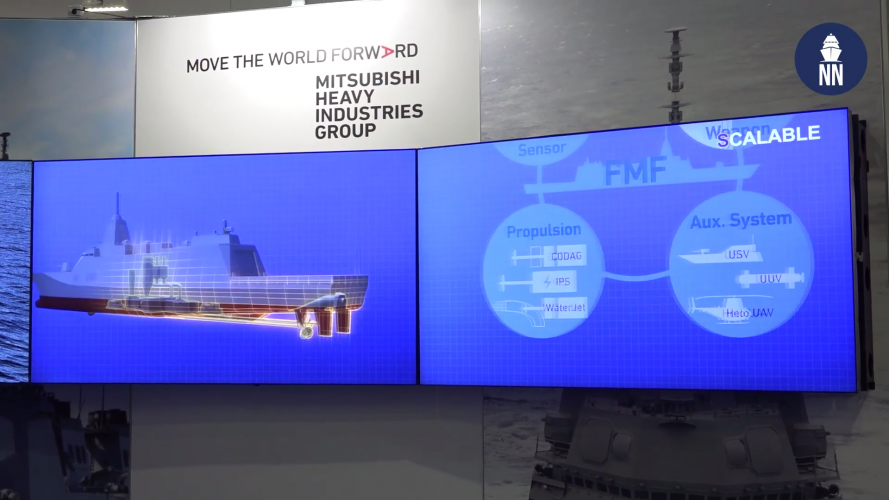
Anyhow, I noticed the Mogami has an option for a water jet!
It's too bad it's taking up too much space in the stern such that no boats can be used.
But I still wonder how much flankspeed it would give in a tight situation.
 

Attachments

  • JS Kumano (FFM-2)「くまの」 Mogami-class Frigate of the JMSDF_snapshot_05.46.png
    JS Kumano (FFM-2)「くまの」 Mogami-class Frigate of the JMSDF_snapshot_05.46.png
    1.1 MB · Views: 19
I must admit I believed this too when I first read it. However, considering Mogami was planned, constructed, and started entering service years before the Moskva was sunk in 2022, hints at post fact justification; or maybe they really did make these calculations ahead of time?

The Germans build their ships to have two fighting islands for a reason. For whatever reason though, Japan has decided on this configuration though. The 32 cell version starts to make more sense, because you really want to intercept everything you can.
As of 2020—back when the Mogami class was still referred to as the "30DD"—the crew consisted of only 90 personnel.
To begin with, the construction of the lead ship started in 2019.
https://trafficnews.jp/post/102022
 
Even the current ships use that design ethos though. F123, F124, F125.
Yes, but they are using engineering as the 2nd control center which afaik doesn't have much of sensor displays or anywhere near CIC level of awareness nor combat command ability.
Naturally, Mogami does have engineering, too. So it's not like they could'nt exercise similar control. It's just not sufficient.
 
https://news.usni.org/2026/09/01/ja...consideration-for-new-u-s-frigate-competition
Welp here we go again. I don't see a situation where the USN would ever adopt a Turkish design and there are all sorts of issue with integration into USN systems.

Chungnam could at least get off the starting line, but still runs into issues with stuff like KVLS, and Korean software. Also it only carries 16 cells vs the competition. Hard capped at 30kts, 4,500nm range

Mogami seems like the most obvious pick.
  • 10,000nm range (probably the most important factor)
  • Mk41 VLS with ESSM
  • CEC and heavily integrated into US software
  • MROU facilities in both Japan and Australia
  • Existing variant being built for Australia is already available for most USN needs
This could be a turn around for USN frigates as long as they can handle ditching their massively overkill DC standards. Still this is the USN we are talking about so this is still a long ways away.
Does this mean the ffx and ffgx is dead?

Also seems like a standard pacific frigate class, Taiwan, Japan, US, and Aus all sharing the same design will simplify logistics
 
Yes, but they are using engineering as the 2nd control center which afaik doesn't have much of sensor displays or anywhere near CIC level of awareness nor combat command ability.
Naturally, Mogami does have engineering, too. So it's not like they could'nt exercise similar control. It's just not sufficient.
Oh dear.

No, the Germans have dedicated damage control rooms with multifunction terminals. They don't operate from engineering... This isn't star trek. And you can't "naturally" apply one standard to another simply because they both have engineering spaces. Mogami's DC ethos is built on the idea that if the CIC gets blown to pieces, then it's game over, the ship is lost.
 
Oh dear.

No, the Germans have dedicated damage control rooms with multifunction terminals. They don't operate from engineering... This isn't star trek. And you can't "naturally" apply one standard to another simply because they both have engineering spaces. Mogami's DC ethos is built on the idea that if the CIC gets blown to pieces, then it's game over, the ship is lost.
Couldnt the ANZACs be operated from engineering if CIC was down? They are old MEKO200s. But if that happened engineering would already be overloaded with one crisis after another. For a new ship i would say double down on the layered defences...
 
Couldnt the ANZACs be operated from engineering if CIC was down? They are old MEKO200s. But if that happened engineering would already be overloaded with one crisis after another. For a new ship i would say double down on the layered defences...
Ask the RNZN. Pretty sure the design incorporates a secondary damage control room. Necessary functions can continue from there.

Layered defences are fine, but you still need to prepare for the worst.
 
It's safe to say that they saw whatever NAVSEA was cooking up in terms of demands and decided to just nope out of there before things got stupid. It's a shame, but MHI is Japan's biggest contractor. They don't want them to get bogged down with 5-10 years of design work and completely overhauling a US shipyard just for 2 domestically built hulls. That is the absolute best case scenario with the likely scenario being that after MHI invests in a US shipyard, the contract gets cancelled and now the US has a fancy new shipyard with no orders going to Japan. There was also the US Steel fiasco that really burned Japan on trying to do large investments in US industry.

The more robust logistics chain would have definitely been an advantage, but putting a large number of resources into a foreign program would bog down domestic design efforts. I think even just focusing on the NZ frigate program would confer similar levels of benefits with a much smaller headache. The best route is probably to maintain efforts on multiple smaller scale purchases like that where off the shelf products can be offered.
 
https://www.australiandefence.com.au/news/news/first-mogami-for-australia-in-production

Production of the long-lead items for the first of Australia’s Mogami-class frigates has begun in Japan, Minister for Defence Industry Pat Conroy has revealed.​


The news follows a meeting between Minister Conroy and the Japanese Prime Minister’s Special Envoy OUE Sadamasa in Canberra on 9 September.


“Production has already begun on long lead items for our first Mogami, so the construction of our first frigate is already underway,” Conroy told ADM.


“And at the same time, we’re working on the industrial transfer so that production of the Mogami-class will transfer over to Australia.”


Australia is acquiring 11 under Defence’s Project Sea 3000 (General Purpose Frigate) program, with the first three vessels being constructed at Mitsubishi Heavy Industries’ historic naval dockyard in Nagasaki.


The first vessel is expected to be delivered to the Royal Australian Navy in 2029 and will enter service in 2030. The third and final Japanese-built ship will enter service in 2034.


Following the successful completion of the Henderson Maritime Precinct in Western Australia and satisfactory progress on the delivery of Landing Craft Medium (LCM) and Landing Craft Heavy (LCH) vessels for the Australian Army, Austal will commence construction of the remaining seven Mogami-class frigates early next decade.
 

Similar threads

Back
Top Bottom