
You are using an out of date browser. It may not display this or other websites correctly.
You should upgrade or use an alternative browser.
You should upgrade or use an alternative browser.
MiG Lightweight Fighter Projects of the 70s/80s
- Thread starter hs1216
- Start date


- Joined
- 27 December 2005
- Messages
- 19,229
- Reaction score
- 35,676
You are wrong, this was a genuine project.thank you, Hesham,
And for Paralay, I don’t think, that your drawing is project of real aircraft fighter, maybe i'm wrong?

- Joined
- 3 June 2006
- Messages
- 3,539
- Reaction score
- 6,220
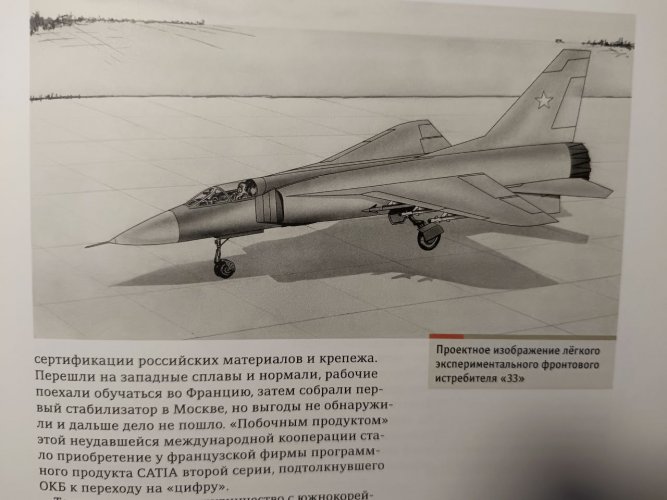
... and reminds me also a lot of the Dassault Mirage F2.Thanks - that is very much a fixed wing MiG-23.Project image of a light experimental front-line fighter "33"
View attachment 642123
Thanks and I presume, that the source of this picture is the new Russian book MiG: Flying Through Time.

- Joined
- 6 September 2006
- Messages
- 5,316
- Reaction score
- 11,545
Presumably then the izdeliye 33' had origins going further back into the early 1970s then?
The wing looks very similar to that of the izdeliye 7-31 with that narrow LERX (the 7-23 is also similar but has a much larger LERX). I presume there is some cross-over here between the Mig-21 and 23 family developments?
The wing looks very similar to that of the izdeliye 7-31 with that narrow LERX (the 7-23 is also similar but has a much larger LERX). I presume there is some cross-over here between the Mig-21 and 23 family developments?

- Joined
- 26 May 2006
- Messages
- 38,264
- Reaction score
- 20,404
Presumably then the izdeliye 33' had origins going further back into the early 1970s then?
No my dear Hood,
it was begun to study by MiG in early 1980s.
famvburg
I really should change my personal text
- Joined
- 24 July 2011
- Messages
- 386
- Reaction score
- 58
It looks very similar to one of the artist concepts of the PRC’s Shenyang(?) J-13 designs.
- Joined
- 27 December 2005
- Messages
- 19,229
- Reaction score
- 35,676
Incorrect. This "Project 33" is from the mid 1970s and was based on the MiG-23 with a new fixed wing with LERX. It was planned to use an R-100D engine (further developed R-35) and a "Коrall" (Coral) weapons system and the weapons of the later model MiG-23s (GSh-23, K-23/K-24/K-60/K-13M1) with the addition of K-14 and K-73.Presumably then the izdeliye 33' had origins going further back into the early 1970s then?
No my dear Hood,
it was begun to study by MiG in early 1980s.
Incidentally this is exactly what most people expected the MiG-29 to be.
- Joined
- 6 September 2006
- Messages
- 5,316
- Reaction score
- 11,545
Incorrect. This "Project 33" is from the mid 1970s and was based on the MiG-23 with a new fixed wing with LERX. It was planned to use an R-100D engine (further developed R-35) and a "Коrall" (Coral) weapons system and the weapons of the later model MiG-23s (GSh-23, K-23/K-24/K-60/K-13M1) with the addition of K-14 and K-73.
Incidentally this is exactly what most people expected the MiG-29 to be.
Thanks for confirming that information Paul.
MiG certainly seem to have tinkering with LERX throughout the 1970s on their legacy delta and swept wing designs.

Hank58
ACCESS: Restricted
- Joined
- 9 June 2020
- Messages
- 41
- Reaction score
- 179
Skimming through some of these old threads. I stumbled onto this one. I vaguely recall a story that the "MiG-33" model was an idea MiG kicked around to propose to General Dynamics for joint development just after the collapse of the Soviet Union. That was a strange time when for a brief moment such Russian-American cooperation seemed possible. The story was that this model was placed prominently in the MiG design bureau museum, as a conversation starter for a visiting delegation of high-level General Dynamics officials. The story goes that instead of sparking a thoughtful conversation about working together with MiG to develop this little export fighter, the General Dynamics visitors made an off-hand derisive comment in passing about the MiG design being an F-16 knock-off. That flip attitude infuriated the still proud MiG OKB leadership, squashing all thoughts of their working with these stuffed-shirt and pompous Americans. I can't remember the exact source of that story, but to me it rings true of the time.Sure ;D
Just a small ask, i wonder if anyone has saved the picture of the Izdeliye 33 that looks like a fixed wing MiG-23 that Paralay posted earlier, it seems it dissapeared from here and for the life of me i can't find it on my computer, i know i must have saved it!
Thank you
Thank you
- Joined
- 27 December 2005
- Messages
- 19,229
- Reaction score
- 35,676
It was intentionally deleted by a moderator.Just a small ask, i wonder if anyone has saved the picture of the Izdeliye 33 that looks like a fixed wing MiG-23 that Paralay posted earlier, it seems it dissapeared from here and for the life of me i can't find it on my computer, i know i must have saved it!
Thank you
Thanks for clarifying that, would you or anyone else have perhaps the picture's file name (i tried the attachment number as seen in Paralay's post but that didn't return any results), perhaps i can try to find it like that on my computer?

,
Last edited:
- Joined
- 27 December 2005
- Messages
- 19,229
- Reaction score
- 35,676
I've resaved this image at a smaller resolution in paralay's post. The original file was called "33.jpg".Design image of the light experimental front-line fighter "33"
I believe its taken from this book:
https://www.secretprojects.co.uk/threads/mig-flying-through-time.33250/

- Joined
- 3 September 2006
- Messages
- 1,548
- Reaction score
- 1,698
How does this configuration relate to the ventral-inlet one in your post #67?Design image of the light experimental front-line fighter "33"
Previous design, subsequent?
,
Last edited:
- Joined
- 26 May 2006
- Messages
- 38,264
- Reaction score
- 20,404
MiG-33-further development of the MiG-29, probably the MiG-29M3 with RD-43 engines

MiG-35 - 1.44 / 1.42
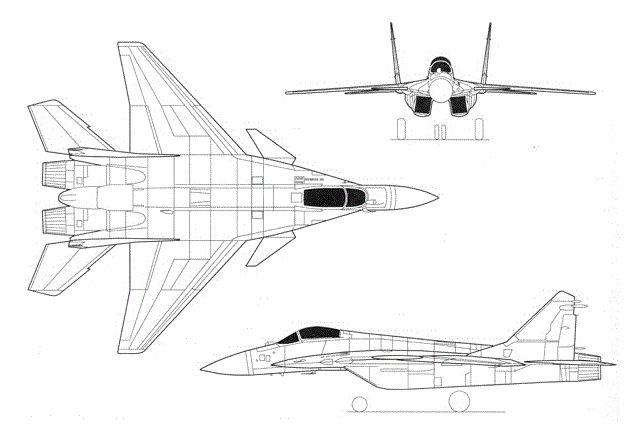
Was it built ?.
Scott Kenny
ACCESS: USAP
- Joined
- 15 May 2023
- Messages
- 19,583
- Reaction score
- 28,055
Odd to see a twin inlet for a single engine like that. Was that so they had space for movable ramps, etc, without too much weight and space?More
The engine was never created. This is one of the many reasons for the rejection of the MiG-29M3Was it built ?.

Keyboard Commando
Haunebu Pilot
- Joined
- 16 August 2015
- Messages
- 59
- Reaction score
- 79
Do you have any more information or sources for this version? Been on a bit of a MiG-29 kick lately and want to include this in an alternate history timeline I'm writing.MiG-33-further development of the MiG-29, probably the MiG-29M3 with RD-43 engines
MiG-35 - 1.44 / 1.42
..Back in the mid-80s at the OKB. Mikoyan's research was carried out by order of the military, which showed the possibility of creating attack aircraft and fighters with a mass of almost two, and the cost is at least one and a half times less than that of modern aircraft with similar combat characteristics. At the same time, special attention was paid to reducing the cost not only of production, but also of aircraft operation.
...Both projects of the OKB named after The Mikoyan attack aircraft and fighter were created as aircraft of a "special period", i.e. optimized for wartime production. This period was characterized by a shortage of raw materials and components, a decrease in the qualifications of production, flight and technical personnel, a breakdown in production cooperation, a shortage of fuel, etc. It is easy to note that all these characteristics reflect the current state of Russian aviation and industry.
...The creation of a "special period fighter" turned out to be a difficult task due to the stricter (compared to the attack aircraft) requirements. Nevertheless, it was possible to create a design for an aircraft with a normal take-off weight of about ten tons, which, in terms of its basic tactical and technical characteristics, was practically not inferior to the MiG-29. Before providing the materials to the Customer, the Aerodynamics Design Bureau recalculated the characteristics three times, ensuring that the project data did not exceed (!) according to its performance, the MiG-29, which the Design Bureau at that time advertised as "the best fighter for gaining air superiority."
The RD-33 single-engine fighter was designed, in general, according to a fairly traditional "tailless with TGO" scheme, but had some original layout solutions. Due to this, it was possible to provide excellent stability / handling at high angles of attack (which, in turn, gave a gain in maneuverability). At the same time, it was possible to achieve a reduction in the weight of the structure and an improvement in operational characteristics (in particular, for removing / installing the engine and access to avionics units).
Slightly inferior to the MiG-29 in steady turn (due to lower thrust-to-weight ratio), the new fighter had an advantage in unsteady maneuver, rate of climb and subsonic range.
...For a fighter, the "economic effect" was not so impressive, but its estimated cost was 2.2 million rubles, while the MiG-29 cost 3.7 million rubles, and the Su-27 cost about 5 million rubles.
1970 - light front-line fighter with a single AL-31F engine with a thrust of 12300 kgf. The aircraft had a normal aerodynamic design with a fixed wing with a curved leading edge and side air intakes. It was supposed to create the most lightweight design possible to obtain a starting thrust-to-weight ratio of 1.4. The estimated maximum speed at altitude was 2350 km / h (M = 2.2), at the ground - 1450 km / h, the practical ceiling was 21500 m. The estimated flight range with combat load reached 2,800 km when flying at altitude and 1,000 km near the ground, and the transfer range was 5,000 km. The possibility of landing on an unpaved airfield was envisaged. The armament, suspended from six points of the wing floor, included K-27 medium-range missiles and the entire existing arsenal of short-range missiles, as well as a limited-range 30 mm cannon. The aircraft could carry up to 3 tons of bombs. In terms of equipment, the fighter was close to the MiG-29 designed at that time and even had a rear-view radar in the fairing on the keel. The project turned out to be extremely stressful in terms of weight, in addition, doubts arose about the possibility of ensuring a high value for aerodynamic quality. The twin-engine MiG-29 seemed to be a more promising project, therefore, no further detailed study of the light front-line fighter with a single AL—31F engine was carried out.
The Design Bureau was almost constantly working on projects for single-engine light fighters. Only such aircraft could have a minimum cost of manufacture and operation. The following projects have been completed prior to the engineering notes stage.
1981 (according to other sources, 1984-85) — single-engine light fighter, designated by the code "41". It was assumed that at the first stage the aircraft would be equipped with an R-33 engine with a thrust of 8,300 kgf, and at the second stage - a modified engine with a thrust of 10,000 kgf. The fighter was originally designed according to a normal aerodynamic design, it had a flush wing and side air intakes. The take-off weight with two R-73 missiles was 9.5 tons. At the first stage, a radar of the Komar type with a conventional parabolic antenna was to be installed, at the second stage, a station with a phased array antenna. The speed was limited to the number M = 1.7, take-off and landing from the ground were provided. The estimated flight range reached 2,000 km, with a PTB of 3,000 km. The fighter could carry R-60 or R-73E melee missiles, small arms consisted of a GSH-301 cannon, and the bomb load was up to 3.5 tons.
In the second version of the aerodynamic layout, the fighter did not have a horizontal tail, and a small wing was located in front of the wing. This variant practically did not differ from the first one in terms of flight characteristics and take-off weight. A more thorough study of the air intake showed the possibility of increasing the number of M to 1.84.
...the normal take-off weight is 9,800 kg, the fuel weight is 2,900 -3,000 kg, the RD-33K engine is similar to the MiG-29M (reduced in air-to-surface mode), the MiG-29 lost in terms of steady maneuver (since thrust-to-weight ratio is lower), won in terms of unsteady maneuver (wing load), He confidently reached high angles of attack, high altitude and subsonic range. There he managed to "slightly" move away from the scheme in which the Gripen was made, which gave a number of advantages, and in areas that were not obviously related. For example, in terms of stability at high angles + a decrease in airframe weight + a serious reduction in the complexity of operation.
At the same time, the "classic" configuration was drawn, but it seriously lost - in such a small dimension, it is difficult to pull the "classic" to a good level.
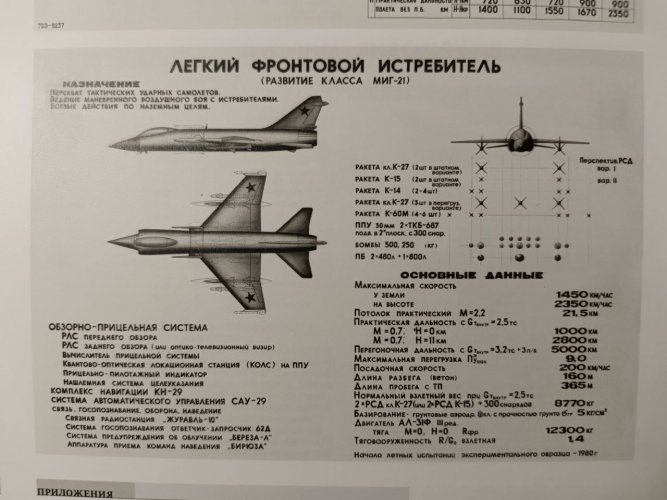

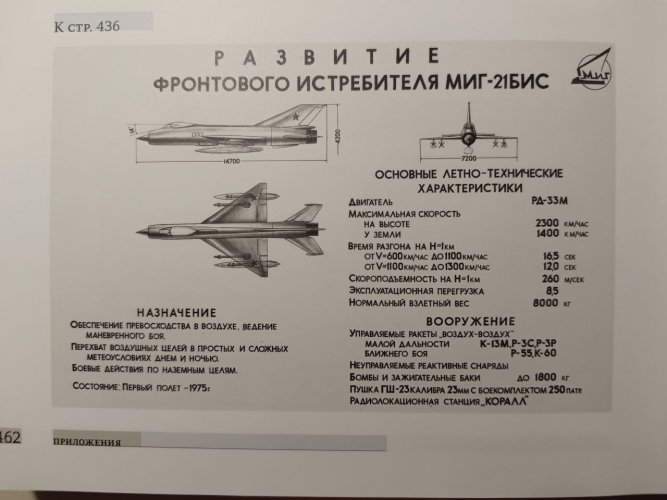
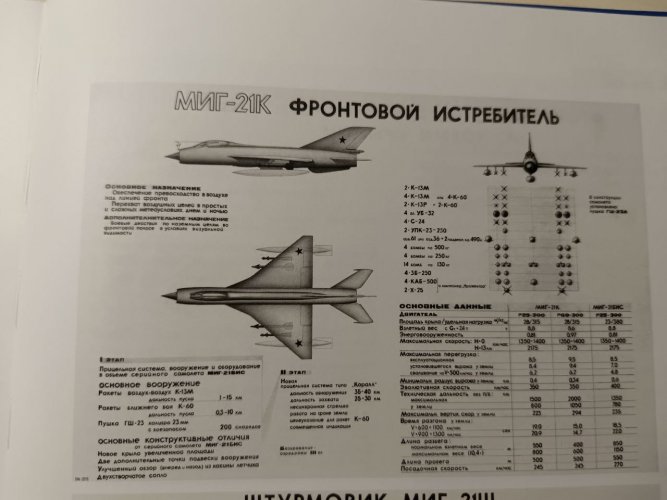
Thank you, Dmitry.Several more light fighter projects (development of the MiG-21)
Similar threads
-
 Anti-F-15: The Soviet PFI Program
- Started by overscan (PaulMM)
- Replies: 56
-
Article Related to Some of Russian Air Launched Missile Programme
- Started by ocay
- Replies: 4
-
Lockheed CL-1200 / X-27 Lancer
- Started by overscan (PaulMM)
- Replies: 88
-
 John K. Northrop - The Development of All-Wing Aircraft
- Started by VTOLicious
- Replies: 8
-